
lightfieldstudios@123rf.comCategoriespersonal training Program Design Strength Training

The Art of the Indicator Set

The 21st century has graced us with a bevy of technological advances:

  • High-speed internet.
  • Telescopes that now treat us to images of Black Holes
  • Nanotechnology to help improve manufacturing, healthcare, climate change, and agriculture.
  • Pizza crust made out of cauliflower.

The health/fitness sector has also benefitted. Trainers have the ability to work with clients from all over the world in real-time. We also have the capability to measure things like bar speed and heart rate variability via applications on our phone; all of which provide data to help us gauge our “readiness” to train on any given day.

But seriously, cauliflower is now used to make pizza crust! Even more miraculous is that it doesn’t taste like sawdust.

Technology surely is great.

However, when it comes to ascertaining one’s readiness to train I tend to lean more toward the anti-app route, and instead rely on what I call “INDICTOR SETS.”

What the Heck Is An Indicator Set?

The easiest way to explain is via some anecdotal observances.

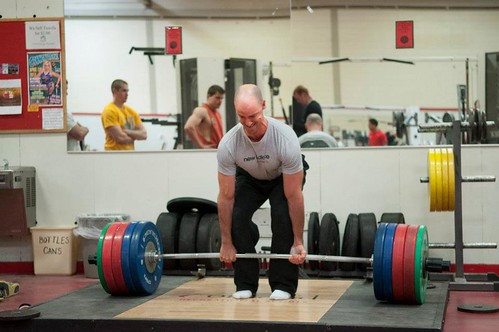
I was walking to my gym to train the other day where the plan was to show up, warm-up, crank a little Mobb Deep over the stereo, get angry enough to want to fight a tornado, and work up to a heavy(ish) triple on my deadlift (535 lb).

On paper it looked like a done deal.

But once I started warming up, things didn’t go quite as planned:

135 x 5

225 x 5

315 x 3

405 x 1 (didn’t feel horrible, but didn’t feel great)

455 x 1 (INDICATOR SET)

An indicator set basically lets me know whether or not I have “it” that day.

For instance, in the previous two weeks, 455 lbs (which is ~70% of my 1RM) literally flew up. Based on “feel” of my bar speed, and how effortless the set felt, I knew I could make a run for a high 500’s pull.

Put another way, I gave myself the green light to go for it, and I did.

Conversely, 455 felt like absolute garbage the other day.

It felt slow off the ground. And it felt even slower at lockout, which I normally never have any issues with.  The indication was: “Tony, if you attempt to go any higher you’ll run the risk of shitting your spine.”

So, I did the smart thing and called it.

I re-racked the plates, turned the page, and did my accessory work:  DB reverse lunges, a little pouting in the corner, and some pull-throughs.

via GIPHY

Listen, it’s not a perfect system, nor is it anything remotely scientific. To be as transparent as possible: I am not anti-technology. But I am anti-technology to the point that many (not all) people tend to miss the forest for the trees when it comes to their readiness to workout.

If their Apple watch indicates a modicum of fatigue they’ll shut that shit down faster than you can say, well, apple.

Just because your watch says you should avoid training on any given day doesn’t necessarily mean you have to. Besides, I’m not entirely sold on the reliability of those apps anyway. I’ve had clients walk into a session feeling like a million bucks only to have their watch tell them danger, danger, DANGER, and to not even look at a barbell.

On the flip side, I’ve also had clients show up feeling like they made out with a petri dish, only to warm-up, move around a little, and then feel like Leonidas leading the Spartans to battle.

via GIPHY

Indicator sets help you learn to FEEL whether or not you’ve got the juice on any given day. In short: It’s a form of auto-regulation that helps you to not have to rely on some algorithm.

Plus, it’ll save you a few hundred dollars…😙

At least in this scenario you’ll have some tangible, performance-based evidence to help you gauge things. Muscle fatigue is one thing and tends to be easier for many people to use as a metric.

If you’re overly sore you can feel that and tweak your programming accordingly. CNS (or nervous system) fatigue is a bit more nebulous and harder to pinpoint, or even feel for that matter.

Indicator sets help you with the latter.

To that end, I encourage you to start utilizing indicator sets as part of your warm-up on the days you know you’re going to be pushing the envelop. 

Pick a weight during your warm-up that you can use to “gauge” where you’re at that particular day. This number should be heavy enough to be challenging, but one you KNOW you can perform fast and with immaculate technique.

(this will likely be around 80% of your 1 rep-max)

Trust me.  The whole mindset of lift heavy or go home – while admirable – isn’t always the best approach.

khoamartin@123rf.comCategoriescoaching Program Design Strength Training

3 Ways to Improve Your Deadlift Without Deadlifting

For the sake of brevity, this post assumes you can perform a deadlift – trap bar, straight bar, a bag of groceries of the ground, a person, whatever – without shitting your spine.

If you can’t, go seek out a reputable fitness professional to show you how. Or, you can always check out THIS Cliff Notes version I helped author not too long ago.

Much like if someone wants to get better at writing they should, you know, write; or if they want to get better at cooking souffles they should practice cooking souffles; or if they want to master the art of not getting laid, they should attend Star Trek conventions….

…if you want to get better at deadlifitng, you should deadlift.

The more you (purposely) practice something the better you’ll get at it. I understand it’s stating the obvious, but it can’t be repeated enough.

There are many moving parts to executing a pristine deadlift, and oftentimes it bodes in our favor to include exercises, drills, and/or movements that compliment the lift or, more germane to the conversation, address a technique flaw or general weakness.

Below are a handful of quick-n-dirty suggestions that may (or may not) apply to you and help increase your deadlift badassery.

1) Deadstart Squats


This is one of my favorite deadlift accessory movements for a few reasons:

  • When set up to match your hip position for the deadlift it offers a ton of carryover in terms of both mechanics and musculature targeted.
  • The deadlift is (mostly) a concentric movement. The Deadstart Squat, too, is (mostly) a concentric movement.
  • For people who struggle with keeping their chest up (preventing their upper back from rounding) during the deadlift, this will be a challenge. NOTE: I’d likely revert to a FRONT squat hold for those who really struggle with back position here. Front squat position is also a better option for those who lack the requisite shoulder mobility (external rotation) to perform well. Another great option is using the Safety-squat or Yoke bar.
  • Great option for training power/explosiveness.
  • Because I said so.

As far as sets/reps there are two approaches I like, both of which gravitate more towards the low(er) end of the spectrum.

One (3-5)

Here, reps will stay in the 3-5 (25ish total reps) range using 60-75% of 1RM. A 4-week macro-cycle may look something like this:

Week 1: 5×5 @ 65% 1RM, 90s rest

Week 2: 6×4 @ 70% 1RM, 90s rest

Week 3: 8×3 @ 75% 1RM, 90s rest

Week 4: 3×5 @ 60% 1RM, 90s rest

Idea is to stay tight throughout duration of set. You should always come to a complete stop on the pins, however you shouldn’t relax

Two (Singles)

I love this option as I feel it offers the most carryover to my deadlift.

Because I’m only performing one-rep, I can place a premium on getting as tight as humanly possible and being as explosive AF. In addition I can go a little heavier in weight here (70-85% of 1RM)

A 4-week macrocycle may look something like this:

Week 1: 12×1 @ 70% 1RM, 30s rest

Week 2: 10×1 @ 75% 1RM, 30s rest

Week 3: 8×1 @ 80% 1RM, 60s rest

Week 4: 6×1 @ 85% 1RM, 60s rest

2) RKC Plank

I don’t know about you, but this is what I look like whenever someone brags to me about how (s)he can hold a two-minute plank:

via GIPHY

You might as well be bragging to me about how you can point out the color red or, I don’t know, walk in a straight line.

Besides, you know and I know if you’re holding a plank that long it (probably) looks like garbage.

NOTE: This is not to insinuate I’m against the plank or find zero value in it.

Au contraire.

Without going too far down the rabbit hole of spinal mechanics, prone (and side) planks (and how long someone can perform them) are a legitimate assessment tool and are staples in terms of low back rehab and performance.

Teaching the RKC Plank offers a quick primer on how to 1) perform the plank right and 2) allow people a window to appreciate what it really feels like to get and maintain full-body tension.


The RKC Plank is all about building context.

More specifically it’s about appreciating full-body tension. If someone can’t understand (or feel) what this means while lying on the floor…how in the hell are they going to understand it standing up while attempting to pick up a heavy object off the floor?

Trust me, when done right, 10s will feel like torture.

3) Straight-Arm Band Pulldowns


The idea is pretty simple (and effective).

Prior to each set of deadlifts you perform a set of 5-10 repetitions of band pulldowns (holding each rep for a 3-5s count).

This serves a few functions:

  • It allows the trainee to prime or feel his or her’s lats firing. Setting your lats (and subsequently posteriorly tilting your scapulae) as part of your DL set-up will help with leverages and moment arms getting you closer to the barbell. Greg Nuckols does a fantastic job at explaining things more thoroughly and nerdely HERE.
  • Offhandedly, it also helps with anterior core engagement, which in turn aids with rib position. Less rib flare = less lumbar extension = more stable position to lift a metric shit-ton of weight.

Closing Thoughts

None of the above are revolutionary ideas or are going to win be any fitness writing Pulitzers. However, they are exercises/drills I use myself (and with my own clients/athletes) and have found they provide a lot of benefit.

Give them a try yourself and let me know your thoughts/experiences.

microgen@123rf.comCategoriesExercise Technique Program Design Strength Training

Are Compound Movements Actually Making You Stronger?

NOTE FROM TG: It’s Christmas. So, I’m out. But, I figured this would be an opportune time to repurpose some old content.

1) If you didn’t read this the first time I posted it all I have to say is “pfffffft, whatever.”

2) If you did, you’re cool. And, share it……;o)

Understandably, the title of this post suggests some nefarious agenda where my goal is to spend the next few minutes explaining why we’ve had it all wrong the entire time.

“You mean to tell us, Tony, there’s a chance compound movements don’t make people stronger?”

“What’s next: telling us water isn’t wet, the Earth isn’t round, you’ve been busting our balls the entire time and kipping pull-ups are, in fact, one of your favorite exercises?”

Relax. Deep breaths.

Just so people don’t think I’ve lost my marbles or are already tapping away on their keyboard drafting their hate mail before actually reading what I have to say below….the short answer to the title of this post is:

“Yes, I do feel compound (multi-joint) movements – think: deadlift, squat, bench press, rows, overhead pressing – make people into beasts, and should lay the foundation for any well-rounded strength training program.”

However, I fear many trainees (and coaches) often fall into the same trap where we’re programmed into thinking compound movements, and only compound movements, should be utilized 100% of the time…no exceptions.

A thousand years of no gainz and incessant internet trolling to the person caught using the leg curl machine or, the horror, performs a few sets of tricep kickbacks.

Shut Up

No, really…shut up.

Of COURSE compound movements make you strong(er). If you want to get strong, it only makes sense to perform those movements which will allow you to use the most weight and force the body into a state of adaptation to get strong.

Granted a lot of other things need to fall into place in order for “strong” to happen. Just because you place a barbell on your back and meander up and down doesn’t mean you’re the second coming of Ed Coan.

Technique, frequency of training, addressing weaknesses, technique, and technique consistent progressive overload all need to be taken into consideration.

What’s more, if strength is the goal – particularly with the big 3 – compound/multi-joint movements performed in low(er) rep ranges (1-5) is kind of important.

Why?

Cliff Notes Version:  Lifting maximal weight has a number of effects:

1. Maximal number of motor units are recruited.

2. Fastest MU’s are activated (high-threshold motor units).

3. The discharge frequency (rate coding) is increased.

4. Activity is synchronous – both inter and intra-muscularly.

5. Potential for future hypertrophy gains (especially when you revert back to a “hypertrophy” specific training phase).

6.  While some argue whether or not the research is efficacious – it goes both ways – lifting heavy things helps to increase serum Testosterone levels.

7.  Girls will want to hang out with you (<=== it’s science).

But It’s Not All PRs and Butterfly Kisses

While all the above is true, focusing solely on compound movements (and lifting maximal weight all the time) does have its pitfalls.

1). There’s an inherent likelihood of increased wear and tear on the joints over time (Yes, even with “good” technique).

2). Compound movements = produce/accumulate more fatigue (particularly neural fatigue). And if it’s not managed appropriately, one may see a decrease in strength/performance over time.

And finally, something not many people consider:

3). We’re Really Good at Compensating.

You may have noticed that I drilled the idea of “technique” earlier. It’s that important.

As a coach I find many people are unable to express their true fitness/strength level due to faulty joint positions (misalignment, such as excessive lumbar extension/APT), and, honestly, not “earning the right” to increase load.

I.e., they haven’t performed enough reps at “x” weight in order to go up.

To that end, drilling technique – and respecting each individual’s anthropometry – is always going to be of paramount importance.


Due to our ability to compensate well, the likelihood you’re leaving poundages in the tank are very high.

As well, when we start talking accessory movements, I’m always in the camp which takes the approach they should generally be used to address some form of technique flaw or weakness with the main lift in question.

For Example

If someone is struggling with their deadlifts off the floor – meaning, they’re super slow – some viable accessory movements to address this would be:

1). Limiting tap-n-go reps (bouncing off the floor).

2). Deficit pulls (2-3″ elevated) to generate more quadricep recruitment.

3). More squat variations such as Safety Squat Bar squats and front squats (again, to generate more quadricep recruitment).

4). Anderson Squat – performed from a deadstart, emulating one’s deadlift stance.


Note: Notice my hip placement above. When I was pulling conventional style (the video is four years old) this variation of Anderson squat very much mirrored my deadlift stance, which carried over well.

Back To My Point

Oh yeah, my point.

Listen, it’s okay to perform isolation work or more bodybuilding-specific exercises. A more “hybrid” approach – strength and hypertrophy – is going to bode well for most people anyways.

Case in point: my bench press sucks. There are days where I’d rather wash my face with broken glass than bench press.

One of the things my coach has been implementing into my programs of late is more isolation work to address muscular issues.

Think about it: expressing strength is (mostly) about generating force. Hoisting big weights helps in this regard. However, a bigger muscle – almost always – is going to produce more force than a smaller one.

Indeed, I’ve been hammering away at my bench press technique – even implementing accessory movements like paused bench presses and Spoto Presses to address my weaknesses.


But guess what? Lately – for the past two blocks of training – I’ve been performing a TON of dumbbell chest flyes. You know, those “wimpy” things guys use to train their chest cleavage.

I feel so dirty admitting it.1

Funnily enough my bench press has seen it’s best jump in a while since incorporating more isolation type work for the pecs and triceps.

Too, my DL has gone up since tossing in some leg extensions; and I have to assume the chest flyes play a role too…;o)

Read: It’s not only about compound movements. Don’t be so dogmatic.

True, they serve as the staple for any strength-based program…but try not to neglect the importance of choosing the correct accessory work – even if it’s isolation exercises – to compliment your goals.

The internet will forgive you.

Categoriescoaching Program Design

5 Ways To Get Better At Writing Training Programs

I received a message from a young coach the other day asking if I knew of (or used) any tricks to help make writing training programs easier or less time intensive.

Outside of suggesting he build his own time traveling DeLorean, skip a head 50 or so years to clone himself 17 times (and to see if someone possibly cured male pattern baldness…asking for someone I know), and then travel back to 2025 with his small army of “hims” to help with the workload, I offered the following suggestions and advice.

I figured this was a good topic to expound on and decided to make it into a blog post.

Hope it helps.

1. Practice Makes Perfect (Kinda)

  • If you want to get better at playing the violin…play the violin.
  • If you want to get better at long division…do long division.
  • If you want to get better at free throws….practice more free throws.
  • If you want to get better at not getting laid…go to Star Trek conventions.

I keed, I keed.

There’s no way to sugar coat this:

“If you want to get better at writing programs…write more programs.”

I have a folder on my desktop labeled Lisa, Don’t Open This Folder Client Programs, and if I opened it right now and actually took the time to count the number of programs in it – which is an amalgamation of my eight years at Cressey Sports Performance in addition to the ten years I’ve been training people out of CORE and Core Collective – I’d garner a guess there’s at least, I don’t know, a kazillion, billion programs in it.

Okay, lets just say it’s a lot.

I am by no means insinuating I’m some program writing maverick and that I’ve got things dialed down to a well-tuned science, but it stands to reason in the 20+ years I’ve been writing training programs, I’ve gotten pretty okay at not sucking at it.

That being said, the sooner you acquiesce to the idea it’s going to take time, practice, and lots of experience on your part in order to get “adequate” yourself, the better off you’ll be.

To answer the question, though: Is there a way to expedite the program writing process?

Well, it depends.

Many factors come into play – one’s training age, injury history, goals, availability of equipment, total training frequency, favorite He-Man character (<– very important), to name a few.

I’d say on average it takes me anywhere from 10 to 45 minutes to write a program.

Moreover:

1. I rarely start from scratch.

I’ve written enough programs and have worked with enough people that I can Spidey-sense similarities and correlations between one client and another. If someone has the same background and/or goals as a previous client of mine I don’t need to re-invent the wheel. I can take someone else’s program, do a little bada-binging and bada-booing (tweaking), and cater it to someone else.

I take pride in writing individual programs for all my clients, but I’m also a realist. Most of the time most people need to be doing the same stuff anyways; at least in the beginning:

  • Less bench pressing.
  • More rows.
  • Better scapular rotation and reaching (general shoulder health).
  • More single leg work and carries.
  • More butt stuff (posterior chain in general).
  • Deadlifts DO NOT always mean using a barbell or that one is pulling from the floor.
  • No, deep squats aren’t dangerous.
  • Yes, your knees can go past your toes.
  • Give your clients a little of what THEY want to do. Key words to consider: “a little.”
  • If you ask me one more time whether or not you should go keto I’m going to throw my face into a wall.

2. Understand there’s NO SUCH THING AS A PERFECT PROGRAM.

It’s inevitable you’re going to be overzealous with some people or underestimate others, especially with regards to exercise selection.

I don’t think a day goes by where I’m not crossing out things on a program or making minor adjustments, or hell, even overhauling the entire program.

No one is perfect (except Ryan Gosling).

via GIPHY

2. Remember: It’s THEIR Program, Not Yours

No quote is more appropriate here than one of Dan John’s classics:

“The goal is to keep the goal, the goal.”

Ranked #16 in my list of “man crushes”

If someone’s goal is to get strong or maybe compete in powerlifting, then, yeah, they should likely focus on the classic barbell lifts.

Write a program that reflects that.

Kipping pull-ups likely aren’t going to get the job done. In fact, kipping pull-ups are never going to get the job done.

Stop it.

Just, stop.

If someone’s goal is to lose a bunch of fat, again, I could make the case strength is still important and that the barbell lifts (which utilize multiple joints and make burning a bunch of calories in a short amount of time a thing. Plus, the goal of any fat loss plan should be to KEEP the muscle you have. What makes muscle, keeps muscle. Lifting heavy things is paramount.) may be of benefit.

But understand there are many methods to get any job done.

Maybe someone would rather jump into a shark’s mouth than touch a barbell.

Blasphemous, I know. But it happens.

If so, don’t be an insufferable dick about it and force feed YOUR preferences over your client’s.2

A glaring example here is when you see bodybuilders training 55 year old female clients like bodybuilders. Yeah dude, I doubt she’s interested in her bicep peak. I mean, maybe. But I doubt it.

Stick to the goals and consider your client’s preferences.

This can make writing programs much, much, MUCH more “freeing” and palatable. If someone likes using dumbbells, incorporate more dumbbells. If someone seems to be down with landmine exercises, use more landmine exercises.

Often, the #1 factor for a program’s success is ADHERENCE.

A client/athlete is much more apt to stick to a program when it’s one they enjoy and want to do.

3. Write Programs In Bulk

You’re bound to be more efficient and “in the zone” when it comes to writing program when you write them in bulk.

Instead of writing one program here and another one there, sit down, grab a cup of coffee (or tea), put on some of your favorite program writing music (for me it’s Deep House or Norah Jones, don’t judge), and get to work.

I think you’ll find it’ll increase your program writing prowess.

4. Have Someone Audit Your Programs

Asking a colleague to take a peek at some of your programs and to provide some honest feedback is a splendid way to hone and sharpen your skills.

via GIPHY

Of course it helps to be someone who can take constructive criticism well. If your default reaction is to get defensive, stomp your feet, and yell “YOU’RE RUINING MY LIFE” when a friend suggests it might not a good idea to program back squats for someone with limited shoulder external rotation and to maybe consider front squats instead, you may want to hold off on this idea.

Conversely, grow up, it’s only going to make you better and to allow you an opportunity to see things from a different lens.

5. When In Doubt, Simplify

The next time you find yourself sitting in front of your computer screen contemplating putting in Close Grip Bench Press cluster sets for your 16 year old high-school athlete with weight releasers utilizing a 5-0-7 tempo while also repeating the alphabet backwards, in Elvish:

  1. Stop
  2. Punch yourself in the pancreas.
  3. Hard.
  4. And remember to just keep things simple.

Believe me, I know how easy it is to be seduced into adding novelty to your client’s programs for the sake of adding novelty…but I assure you most of them do not care and more importantly most do better without it.

The “boring” stuff is almost always going to be the better fit and is likely all most of your clients will need for quite some time.

Seriously, when in doubt….simplify.

And then just coach the shit out of everything.

6. Miscellaneous Pontification

– It would also bode in your favor to actually lift weights. Practice what you preach.

– Refrain from adding things to your programs that you yourself have not tried first.

– Network. Make nicey nice with local coaches and physical therapists. You’ll learn a ton.

– I cannot WAIT for the 5th season of Ted Lasso to come out.

– Also, not for nothing, but did you not notice I used both words “amalgamation” and
“acquiesce” in this blog post? You didn’t, did you?3

ksuksa@123rf.comCategoriescoaching Program Design

4 Coaching and Program Design Digressions

4 Coaching & Program Design Digressions

1. Fillers Instead of Warming Up?

You know it, I know it, your mom’s second cousin’s Little League baseball coach’s sister knows it, everyone knows it…

…people always skip their warm-up prior to training.

Hell, [industry secret revealed] I skip my warm-up more than 50% of the time.4

Now, to back track a bit, I am not anti-warming up and I do advocate my clients and athletes do follow one.

I do write them in.

However, what I am not a fan of is the laundry list approach to warming-up.

You know what I mean: the warm-up that consists of a never-ending list – 10, 15, sometimes 20 exercises deep – of positional breathing, t-spine mobility, glute activation, and stretching drills.

I take a gander at something like that and am like…

via GIPHY

I can only imagine what some of my clients in the past were like…

via GIPHY

This is not an attempt to discount or demerit the importance of doing any of those drills mentioned above. I just know humans, and I know the vast majority of them would rather jump in front of a mack truck than do their warm-up.

Which is where the idea of “fillers” comes in.

These are nothing more than low-grade, low-intensity mobility or activation drills that are performed DURING the workout, typically during rest periods.

In short: It’s a sneaky way to put the shit that people need to work on in the program in a way that they’ll actually do it.

I’ve written about fillers in the past and how to best incorporate them depending on the main lift of the day:

2. Underwhelm Them Early

This is a phrase I stole from my good friend Mike Robertson, but it mirrors much of what I do with all of my new clients. In the beginning all I am really concerned with is letting my clients marinate in the basics.

I want them to hinge, squat, push, pull, carry, and perform some single leg work. Now what variation of all those things will depend on a multitude of factors: health & injury history, goals, ability level, not to mention their anatomy (anthropometry and leverages). When all is said and done, though, from a programming standpoint, my clients should be underwhelmed. I want their programs to be mind-numbingly boring.

People need reps out of the gate, a lot of reps…of the same thing(s). That is the only way they’re going to learn and begin to “own” their movement.

What they don’t need is a bunch of novelty and a coach who’s only goal is to entertain them. I can appreciate (and understand) that training should be fun and stimulating and fill everyone’s love tank to the ‘enth degree. However, in my eyes, that needs to be earned via lots and lots and lots of repetition of the same shit.

No one ever got strong or mastered any exercise by constantly changing things up.

Wow your clients with customer service; underwhelm them with exercise selection.

3. Easy Training is Good Training

Keeping in tune with the whole “underwhelming them early” vibe, I’m a firm believer in the anecdote – astutely stolen from Dan John – that “easy training is good training.”

Put into other words: I’m less of a “holy shit I can’t feel the left side of my face, that workout was awesome” kinda guy and more of a “huh, I could totally do more, but [insert anything from going to see a movie and hanging out with your spouse to reading a book and drowning in kitty cuddles]” kinda guy.

See, I’d rather my clients/athletes leave a session feeling as if they could do more, maybe even wanting to do more, but don’t.

This is not to say “easy” training doesn’t involve some amount of effort or uncomfortableness; far from it. It is to say that pounding your clients into the ground every…single…session isn’t necessarily making them better or more resilient or whatever other cute adjective you want to toss in here.

There’s a common saying I’ve seen many other coaches use and it bears repeating:

“Your progress in the weight-room is directly correlated with how well you’re able to RECOVER from said workouts.”

This entails training with sub-maximal loads (65-80% of 1RM) more often in addition to other things such as encouraging more GGP/Zone 2 work (think: heart rate hovers in the 120 BPM range), sleep, calories to support one’s goals, and hydration to name a few.

4. Is It Necessary to De-Load Often?

It’s common practice for many gyms and trainers to use every fourth week as a rudimentary “deload week” (or a structured tempering of training volume, load, or both) for their clients and athletes.

It makes sense…especially when you consider billing cycles.

For example, to a large degree I still use this approach because every month my clients “re-up” their packages and I get to ding their credit cards in exchange for a freshly curated program.

But even then I have to take into consideration a few things.

  • Training Frequency: someone who only trains 2x per week won’t necessarily do enough work to warrant a de-load as compared to someone who trains 4x per week.
    .
  • Training Experience/Goals: someone who is working out for basic health or is a complete newbie will have a stark difference in approach to de-loading compared to someone training for a powerlifting meet or has more experience and is just stronger as a general observation. The former may go weeks without the need for any type of deload while the latter may be best suited for one every 3-4 weeks.
    .
  • Life: Work, vacations, the beach, your slow-pitch softball schedule, your kid’s explosive diarrhea…all have a tendency of tossing us organic de-loads as it is. Oftentimes there’s no need to go out of my way to plan de-loads for some clients because “life” takes care of that anyway.

All of this doesn’t even get into the weeds on all the different types or ways to implement a de-load. I already touched on the idea of lowering one’s overall training volume or even intensity (personally I’m a fan of lowering volume but keeping intensity on the high(er) side of the spectrum, if not the same), but there are a bevy of other options too:

  • Omitting compound movements in lieu of more isolation type movements (I.e., less axial loading).
  • Going into full-on body-part-split-per day bodybuilder mode for a week or longer (<— this is fun).
  • Reducing training frequency (instead of 5x per week, go with two).
  • Get out of the gym entirely and partake in more outdoor activities.

For the Record: I’m very much a fan of people taking a full-week off from training – particularly if they’re consistent – 1x per year just to give themselves a break.

That said, I will sometimes push the boundaries with some of my clients and won’t implement an actual de-load until 1) I see a drastic decrease in their progress or performance on the gym floor 2) they’re eyes start bleeding or, you know, 3) they simply ask.

Often, especially if a client shows up to a session and they look like death, I’ll implement a de-load session, affectionately referred to as a Bloop, Bloop, Bloop workout.

HERE the idea is to listen to them, understand that, yes, life gets in the way sometimes, but to also not let them off the hook so easily.

They’re still going to workout and move – it just won’t involve working up to a heavy triple on their front squat.


CategoriesProgram Design Rehab/Prehab Strength Training

Find Your Entry Point: How to Train Around an Injury

If you make a habit of lifting heavy things it’s inevitable you’ll likely experience a few setbacks along the way.

These can range anywhere from the “no big deals” (bloody shins from deadlifting, shoulder niggle) to the dire (disc herniation, explosive diarrhea).

…or worse case, forgetting your squat shoes on squat day.

Suffice to say: Getting hurt is frustrating. Attempting to work around an injury can be even more so.

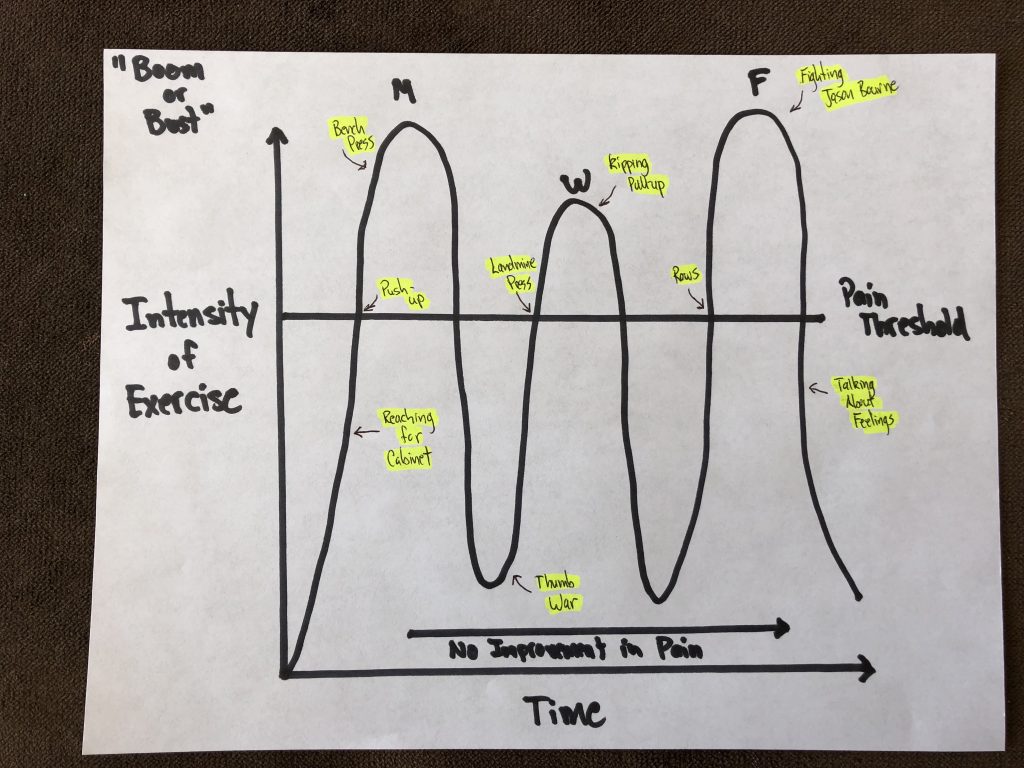
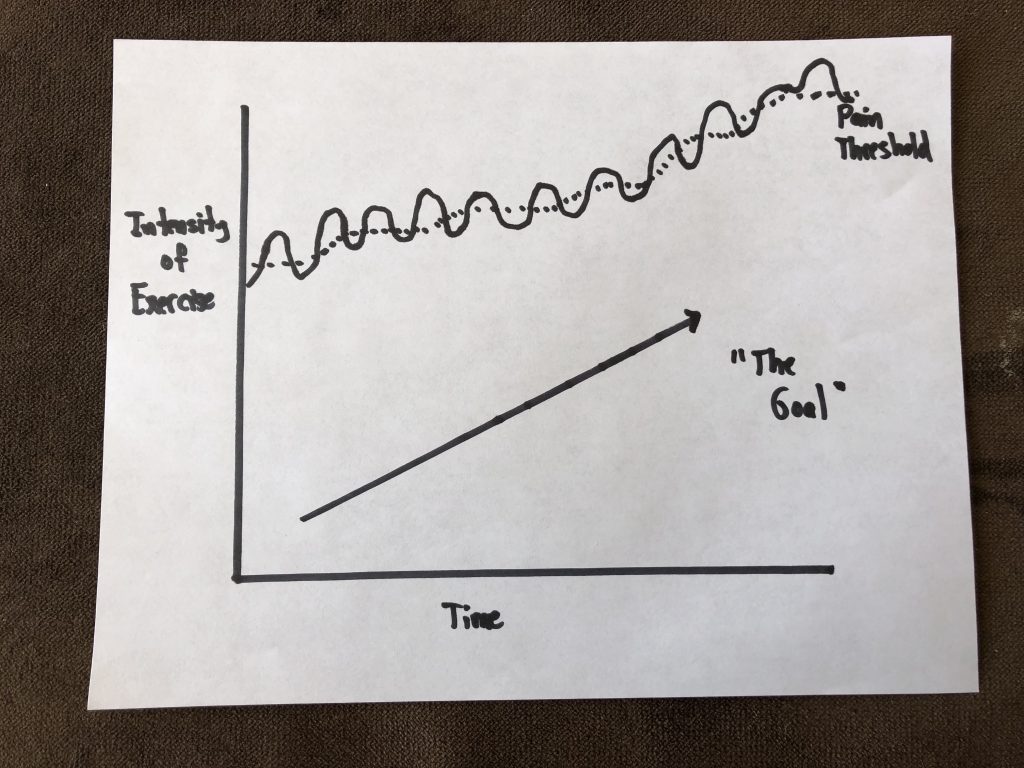
It bothers me when people default to tossing their hands in the air and surrendering themselves to a two-to-four week window of “rest” and rolling the dice. There’s a lot of good that can be done, even underneath the umbrella of injury. Instead, I’ve long championed the idea of trainees finding their Trainable Menu and focusing more on what they CAN do rather than what they can’t.

Another way to re-frame things is to find your entry point.

In fact…here’s your entry point making an entrance to your next training cycle while you’re working around an injury.

via GIPHY

Find Your Entry Point

Speaking of entry points: I remember a few years ago when I sat down with Julian to watch the original Jurassic Park. He was four at the time. Now, most coherent parents would start with something a little less scary.

You know, say, Dino Dana or, I don’t know, Care Bears.

Nope, I went with the ginormous, scary T-Rex.

In hindsight, it probably wasn’t the best “entry point” for someone who, at that point, had no idea dinosaurs weren’t real. Again, maybe Toy Story or, hell, Mighty Morphin Power Rangers would have been a more germane choice?

I gotta say, though…

…Julian handled the T-Rex like a champ.

He didn’t blink once. He giggled when the guy sitting on the porto-potty met his demise.

I didn’t know whether to be proud or scared shitless.

Kid’s the next John Wick in the making.

Okay, Cute Story Tony. But WTF Are We Talking About Here?

Yeah, yeah, yeah…

Lifting heavy things.

Entry Points.

I’ve recently been making my way through Dr. Michael Mash’s excellent resource, Barbell Rehab, and giving credit where it’s due…he spends quite a bit if time throughout the course discussing the idea of entry points and how to use the concept to guide anyone’s return back to a specific lift after injury.

Let’s use the bench press as an example.

If someone has pain when he or she bench presses with a straight bar, finding their entry point is nothing more than altering the lift the minimal amount possible in order to gain the minimum desired training effect.

For the visual learners out there it may look something like this:


Adapted from Barbell Rehab

TO BE CLEAR: If pain exists in the shoulder the idea is NOT to automatically regress all the way back to a push-up.

I know some people who’d rather swallow a live grenade than do that. Instead, the goal is to be as specific as possible in order to elicit a (relatively pain-free) training effect.

If someone has pain with a straight bar FLAT bench press, however it alleviates significantly when you switch them to a decline bench press.

Sha-ZAM.

You just found their entry point.

Maybe it’s DB Floor Presses for one person, and yes, maybe it’s a push-up (albeit loaded) for another. The idea is to TRAIN. Moreover, it also could just come down to tweaking their grip slightly or adjusting some component of their technique.

Rehab doesn’t always have to result in sending someone to corrective exercise purgatory.

Likewise, using the squat as an example, sometimes the entry point is using a different bar (Duffalo or Safety-Squat Bar) if the shoulder is the issue, or maybe it’s having someone squat ABOVE parallel if it’s their knee(s) or hip(s) bothering them.

Sometimes, and hear me out, we may have to combine the two: Not a straight bar AND above parallel.

I know what some of you might be saying…”Tha fuck outta here, Tony.”

Yes, it’s true. (please play video below and hopefully get a few LOLs. Or not)


And everything’s going to be fine.

In fact, more than fine.

maridav@123rf.comCategoriesAssessment Corrective Exercise Program Design

Which Is More Fictional: Unicorns or Tight Hamstrings?

A few weekends ago I was in London teaching a workshop with my friend Luke Worthington.

We had a group of 35 trainers from across the UK (and Europe) eager to learn more about assessment, program design, coaching up common strength movements, and how I rank the Bourne movies.6

One of the main umbrella themes we kept hammering home was that, contrary to popular belief, “tight” hamstrings isn’t really a thing.

Labelling the hamstrings as “tight” is often the default scapegoat and blamed for everything from butt wink to low back pain to male pattern baldness. So it wasn’t surprising to see the flabbergasted reactions from the majority of attendees when Luke and I kept repeating our message.

You would have thought Gandalf rode in on a Unicorn yelling “You shall not stretch the hamstrings!” based on people’s facial expressions.

via GIPHY

Did Tony Just Say Tight Hamstrings Don’t Exist?

What’s next: Water isn’t wet? Grass isn’t green? Ryan Gosling’s gaze doesn’t penetrate my soul?

Listen, I’m as skeptical as they come whenever anyone in the health/fitness industry uses the words “everyone,” “always,” or “never.”

Those are three words, when used ad nauseam, immediately scream “shady motherfucker with an agenda,” whenever I hear them.

  • It’s never the hamstrings. OR You should never eat past 7 pm.
  • Always avoid gluten. OR If you’re serious about fat loss, always avoid carbs.
  • Everyone must deadlift from the floor. OR Everyone who reads this site is clearly off the charts intelligent and attractive. (<— 100% true).

There are nevertheless exceptions to every rule and circumstance. I’d be remiss not to tip my hat at the notion there are, indeed, people out there who have legitimately tight (or, more to the point, anatomically short) hamstrings.

That being said, I doubt you’re one of them.

I’m not going to sit here and say it’s never the case, but it’s such a rare occurrence that you’re more likely to win an arm wrestling match vs. a grizzly bear than actually having tight/short hamstrings.

Take butt wink for example.

The common culprit is tight hamstrings (photo on the right).

Image via Girls Gone Strong

But if we were to discuss (and respect) basic anatomy we’d note the following:

  • My pecs can cut diamonds.
  • The hamstrings are a bi-articular muscle group that cross both the hip and knee joints.
  • As we descend into deep(er) hip flexion – I.e., squat – the hamstrings lengthen on one end (hips) and shorten on the other (knee), for a net change of nada.

#itsnotthehamstrings.

But How Can We Tell?

It’s uncanny how many people I’ve interacted with in my career who describe having tight hamstrings, and after telling me they’ve been stretching them for 43 years (<— only a slight exaggeration), are still looking for that one magical stretch to cure them.

My first step is to plop him or her on an assessment table and ask them to perform a simple screen to ascertain whether or not they do, in fact, have tight hamstrings.

It’s called the Active Straight Leg Raise.

Image: FMS.com

You lie the individual supine and ask them to slowly, while keeping one leg cemented to the table or floor, elevate the other off the table while keeping it as straight as possible. They keep going until they feel the first smidgeon of resistance (or you start to see compensations like the pelvis rotating, the foot rotating, and/or either knee start to flex).

An acceptable ROM is anywhere from 70-90 degrees of hip flexion.

A funny thing almost always happens.

Most people pass the screen with flying colors.

Me: “You don’t have tight hamstrings.”

Them: “The fuck outta here! You mean, there aren’t any other stretches I should be doing?”

Me: “Zero.”

Them: “Zero?”

Me: “Yep, zero.”

[Cue crickets chirping]

This finding doesn’t, however, dismiss the fact said person’s hamstrings still FEEL tight.

So, W……..T……….F?

Something is awry.

To peel back the onion a bit more I’ll then implement a brilliant trick I was reminded of by Ottawa based personal trainer, Elsbeth Vaino.

The Bridge Test


I’ll have the same individual perform a standard glute or hip bridge. They’ll get into position and then I’ll ask “where do you feel that?”

Many will immediately say “hamstrings.”

I’ll then have them perform a 1-Leg Glute Bridge and ask them to hold that position for 10-15 seconds.

Most don’t last five.

“YOWSA…..my hamstrings cramped up.”

Why?

The body’s #1 hip extensor is the glute max, and if it’s not doing it’s job well the body’s #2 hip extensor, the hamstrings, will pick up the slack.

In all likelihood, for most people most of the time, the hamstrings feel tight because 1) they’re overactive and doing double the work and/or 2) pelvic alignment needs to be addressed (more glutes and anterior core = more posterior pelvic tilt = hamstrings are put on slack).

NOTE: the latter point – hamstrings lengthened due to (excessive) anterior pelvic tilt – is why stretching them only feeds the issue. The tightness many feel is neural in nature, not because of true shortness. Stretching an already lengthened muscle only exacerbates things.

Something Else to Consider: Active End-Range Hip Flexion

To add another nail into the “it’s not the hamstrings” coffin I’ll also take a gander at one’s ability to move their hip into (active) end-range flexion.

This “trick” digs into some of Dr. Andreo Spina‘s work on Functional Range Conditioning (FRC) and is another splendid way to gently tell someone to stop stretching their hamstrings.


No diggidy, no doubt.

Final Word

The sensation of tight hamstrings is less about an anatomically short muscle which requires endless hours of static stretching, and more about improving:

  1. Position/alignment of the pelvis via nudging people into a little more posterior pelvic tilt by hammering glutes and anterior core.
  2. Active end-range hip flexion. Allow people to experience this position more often and good things will happen.

Stop…..stretching…..the…..hamstrings.

shakzu@123rf.comCategoriesProgram Design Strength Training

The Rule of 90%: 2.0

The rule of 90% can be applied to almost anything.

One of the best examples, with special emphasis to health and wellness, stems from Dr. John Berardi and the crew over at Precision Nutrition.

Simply stated, if you eat “clean” or follow the rules 90% of the time, good things tend to happen.

By focusing the bulk of your diet or nutrition plan on things like lean meats, vegetables, fruits, “healthy” fat, whole, minimally processed foods, going “off the grid” 10% of the time, and eating foods you enjoy – hello mint cookies-n-cream ice cream! – won’t really make that big of a difference in the grand scheme of things.

Life will go on, you’ll stay more consistent with your plan (and you’ll keep your sanity).

The Rule of 90% can also be applied to co-habitation (put the toilet seat down 90% of the time, and your spouse or significant other won’t want to stab you in the throat) strength and conditioning, albeit in a different context.

I wrote an article on T-Nation.com what seems like eons ago (2006!) titled, coincidentally enough, The Rule of 90%.  Catchy, right?

via GIPHY


In it I discuss how, if your goal is to improve maximal strength, it’s important to incorporate lifts at or above 90% of your 1-rep max.

Cliff Notes Version:  lifting maximal weight (90%+) has a number of effects:

1. Maximal number of motor units are recruited.

2. Fastest MU’s are activated (high-threshold motor units).

3. The discharge frequency (rate coding) is increased.

4. Activity is synchronous.

5. Potential for future hypertrophy gains (especially when you revert back to a “hypertrophy” specific training phase).

6.  While some argue whether or not the research is efficacious – it goes both ways – lifting heavy things helps to increase serum Testosterone levels.

7.  Lastly, girls (or boys!) will want to hang out with you (<=== it’s science)

How It’s Applied (Watered Down Version, Like A Lot)

Lets say someone’s bench press max is 275 lbs, and the goal for a particular training session is to hit four singles at or above 90%.  It may look something like this:

Bar x whatever

135 x 5

185 x 5

225 x 3

250 x 1

265 x 1 (feel good! Eff it, lets go for a PR).

280 x 1 (it was a grinder, but you got it).

From here, it’s important to note that ANY lift at 90% or above (275 lbs), counts.  Doing the math, that means any lift which was heavier than 247.5 lbs.

So now we have ONE more single left.  I’d opt for a clean rep with good bar speed.

260 x 1 (Nailed it! Lets go pound a protein shake).

via GIPHY

The Rule of 90%: 2.0

Hitting lifts that are 90% or above one’s 1RM isn’t something I’d recommend for beginner or even most intermediate lifters.  It takes a lot of experience and “time under the bar” to get to the point where handling that much weight is safe.

To that end, this approach IS NOT something I advocate for those with little training experience (lets say less than a year of consistent training).

However, that doesn’t mean we can’t still apply the principles to great affect.

Something I implement often (because I don’t go out of my way to test 1RM right off the bat) is the idea of ramping up to a 3 RM (rep max) – for that day – and then using the same approach as above, hitting a certain number of sets at or around 90%.

There’s a fair bit of autoregulation and “feel” involved, and results will vary depending on how someone feels any given day (A) like Randy Macho Man Savage after consuming 9000 mg of caffeine or B) a bag of dicks), but it gets the job done.

I’ll simply have someone work up to a challenging triple (set of 3) for that day, and then once they hit it, aim for “x” number of sets at or slightly above 90% of THAT number.

Lets stick with the bench press. Goal is to hit four sets at or above 90% of 3RM.

Bar x whatever

135 x 5

185 x 3

225 x 3 (bar speed is still good)

245 x 3 (starting to slow up, but still passable)

265 x 3 (last rep was a bit of a grinder. We’ll use this as our marker or “top set” for the day).

Doing the math, 90% of 265 is 238.5.  So, any lift above that counts (245 and 265, respectively).

As always, I’d opt for clean, fast reps from here and would encourage someone to stick in the 245-255 range for their last two sets.

And That’s, That

Hopefully that makes some sense, and, of course, this is a strategy that could be applied to all the “big lifts” (squat, deadlift, bench press, chin-up, rows).  Sorry, Tricep Kickbacks are off the list.

Too, I’d be conservative with how often it’s applied.  1-2 sessions per week would suffice (maybe use it for one lower body movement, and one upper body movement), but once a week would be a nice option for most.

Week 1: ramp up to a 3RM deadlift, hit 3-5 sets at 90%+
Week 2: ramp up to a 3RM bench press, hit 3-5 sets at 90%+
Week 3: ramp up to a 3RM squat, hit 3-5 sets at 90%+
Week 4: ramp up to a 3RM deadlift (try to beat your previous number), hit 3-5 sets at 90%+

So on and so forth.

All in all, I find this is a much more “user friendly” way to implement the Rule of 90% and something that most trainees could easily implement into their training.

Give it a try and let me know how it goes!

cherezoff@123rf.comCategoriescoaching Program Design

The Lost Art of Simple


What’s our obsession with making things hard or complex?

The Lost Art of Simple

I remember when I was a kid all I needed to entertain myself was my bike. I’d ride around pretending I was Knight Rider talking to my bike as if it were KITT.7

“Turbo boost KITT.”

And then I’d pedal faster.

“Oh snap, we’re under heavy fire and need to perform counter measures.”

And then I’d swerve back and forth between trees avoiding every heat seeking missile sent in my direction.

“KITT, eject, eject.”

This is when I’d point my bike in the direction of some sweet jump I’d have constructed, and, well, this would happen:


Nowadays you ask a kid to go outside and play and they’re looking at you as if you have three heads and wondering how that’s even possible without an iPhone in hand. It’s almost as if there has to be some form of technology or gadgetry involved.

A frisbee? No way.

A wiffle ball and bat? Pfffft, whatever.

A tree? Hahahahahaha.

The simple days of simple games are long gone. I mean, I know they exist, and I know there are kids out there still playing hide-n-seek, kickball, and pick-up basketball.

But it’s few and far between. Pokemon Go, seemingly, has replaced the playground.

I can’t help but notice the same parallel in the fitness industry. People (on both sides of the fence: fitness pros and non-fitness pros alike) seem to be under the impression that fancy or complex is somehow better than simple. And maybe even more tragic: many believe that better results are always a result of adopting complex methodologies over the simple ones.

Sometimes this is true. Oftentimes it’s BS.

I’ve had my fair share of other coaches coming in to shadow and observe for a few hours at a time. It’s always an honor and I am more than willing to accommodate. Sure they could spend their time reading Mike Boyle or watching any litany of fitness people on Instagram, but no, some choose to come in on a Saturday to watch people deadlift and listen 90’s hip hop.

One theme I am becoming more cognizant of is how surprised some coaches are about how “simple” my programming is.

There’s very little glitz and glam or shiny bright objects to pivot from the fact that all I really want is for my clients/athletes to become unapologetically brilliant at the basics.

People squat, people hip hinge, and people perform these things called rows, push-ups, and Farmer carries.

You may have heard of them.

Antiques to some, I know.

Furthermore, is my assessment process.

The idea of simple starts there. Unless someone is coming in with a lengthy injury history or is training for something super specific like, say, I don’t know, the Mime Bombsniffing Olympics, what advantage is there in making the assessment more complicated than it has to be?

Taking a more global approach is a fantastic starting point for most people. There’s no need to put them under a microscope. If anything, for most people most of the time, their “assessment” is nothing more than an opportunity to weed out “red flags” by taking a quick peek at hip IR/ER, hip flexion/extension, and other things like overhead shoulder mobility.

In a sense I’m trying to see what their passive ROM is, are there any limitations, and if so, 1) does it match their active ROM and 2) are there any test/re-test strategies I can implement to see an improvement?

To a larger degree (and stealing a quote from my friend, Luke Worthington):

“Can you do the thing that you want to do? Yes. Good. No. Let’s fix that.”

Here’s the Thing: 80% of my assessments are done on the gym floor. There’s only so much poking and prodding I can do on table before A) shit starts getting weird and B) the client starts feeling like a patient.

In reality the assessment should be a watered down training session.

  • I want to see them squat.
  • I want to see them hip hinge.
  • I want to see them get up off the floor.
  • I want to see them Sparta kick the wall.

I can glean way more information watching people move. And too, they get a taste of what a typical training session will be like with me.

It’s a very simple procedure that, when some coaches observe, comes across as super-duper minimal, and it throws them off, as if to say, “Really? That’s it?”

Yep, that’s it.

People want to train.

They could give two flying shits about their big toe dorsiflexion. Trust me.

Funny Side Story: I was once given a “bad” review at a conference I spoke at because in my topic, “Shoulder Assessment,” I didn’t demonstrate anything “new and innovative.” To which I was like, “Well, since when does shoulder assessment need to be new and innovative?” Why not take the mindset of doing the “boring” screens well?

Note to Self: Bring a flame thrower to next speaking engagement. That will add some innovation.

Going Back to Programming.

This is another component where I feel simplicity has its benefits.

The never-ending game of  oneupmanship on social media many fitness pros play is exhausting. This is a conversation for another day, but the LOOK-AT-ME, performative vibe many take is absurd. I watch some of the videos people put up and all I want to do is say “Riiiiiigggghhhhttt.”

I also want to throw an ax into my face, but that’s besides the point.

Comparatively speaking my Instagram feed is probably batshit boring to some people.

I can hear the cacophony of “BFD” comments now. “Wow, cool Tony. You have your clients squat. What’s next: A set of chin-ups?

No, wait, Pallof Presses!?!?!”

Actually, yeah. Probably.

Call me crazy, but I’d rather educate and provide a rationale for putting up certain videos/pictures (cute cat pictures aside) than worry about whether or not I’m earning some fleeting social media credibility.

What’s more, you wanna talk about boring and vanilla? Grab two back-to-back programs of any client of mine and it’s a safe bet you’ll see more of a linear periodization approach, which is about as vanilla as things gets. Take my client Sara for example (the woman in the video above).

On the days she trains with me at CORE we tend to focus more on the coaching-intensive exercises like squats and deadlifts. We’ll first hit one of the two hard (generally, lower reps/mid to higher intensity loads) and follow suit with “everything else.”

Here’s how we approached her squats and deadlifts the past two months.

October

Sumo Deadlift (Weeks 1,3), Back Squat (Weeks 2,4) 
      
 WeekSetsReps Load
 152 85%
 2Hit 135×1then3×5115 lbs
 33×1 @90%then3×5 75%
 4Hit 140×1then3×5120 lbs

November

Sumo Deadlift (Weeks 1,3), Back Squat (Weeks 2,4)
      
 WeekSetsReps Load
 145 75%
 2135 x (2×1)then3×3 @125 lbs
 355 75%
 4145×1then3×2 @130 lbs

If you pay particular attention to her squat progression, it’s more or less me ensuring she was doing more work each week.

Nothing magical or advanced at all.

And it worked.

She smoked a PR of 145 lbs this past Monday. While listening to Lil Kim. Because that’s how we roll.

Program design doesn’t have to be complex.

All it really comes down to is ensuring you’re coaching your clients well (<– a lost art in of itself) utilizing stances and grips and bar placements that suit their goals and anatomy…

…and that they’re placing a premium on doing more work over the course of several weeks/months.

Simple and Boring. It Works

I’m willing to bet your clients will prefer a simpler approach (if not thrive on it) once you give it a fair shot.

  • People tend to not need as much novelty as they think. Muscle confusion is a stupid concept. People need consistency in order to master movement.
  • You don’t always need to increase load. People need to earn the right to increase weight on the bar. Staying within a certain range for several weeks and accumulating volume is often a undervalued way to progress.
  • Try not to make assessment to much of a thing. Granted, if someone has a lengthly injury history you may need to go down some sort of rabbit hole to figure out what exacerbates their symptoms. And then attempt to address it. But more often than not people will appreciate you not putting them under a microscope. If you treat the assessment as more of a training session and not some sick game to point out every miniscule dysfunction and how much of a walking fail someone is, they’ll be less likely to think you’re a douche.
Categoriespersonal training Program Design Strength Training

Maybe Your Shoulder Hurts Because Your Technique Sucks

Full Disclosure: I am not a fantastic presser. I’m not going to sit here and attempt to regal you with stories from high-school where I used to drive a Camaro, hookup with the Prom Queen, and bench 405 for reps (you know, before that nasty football injury in the State Championship ruined everything).

Nope, this is not that kind of story. I recognize the bench press often serves as a litmus test for general level of badassery, but I’ve always considered myself an average presser (personal best of 315 lbs at a bodyweight of sexy).

Or, in Dave Tate’s words “I suck.”

Not gonna argue with Dave…;o)

I know how to coach it, and have worked with many people in my years as coach to help them improve and increase their bench press. More commonly, though, is helping people work around a nagging shoulder injury that prevents them from “attacking” the lift in the first place.

NEWSFLASH: Many people complain that the bench press bothers their shoulder.

And while the first inclination is to nix the bench press altogether and jump into corrective exercise mode and start having people blow into balloons or perform any number of thoracic mobility or scapular stability drills to get at the (possible) root of the problem, I feel we sometimes need to pump the brakes.

I mean, I agree that for many people their upper back mobility is atrocious and that it’s likely a very good use of their time to address it. And yes, some people may have gunky tissue quality or less than exemplary scapular stability or kinematics which likely is playing a significant role in their ouchie shoulder.

A thorough assessment or appointment with a manual therapist can hopefully help.

But maybe, just maybe, the reason why someone’s shoulder(s) hurt during bench pressing is because their technique makes my eyes bleed?

*shrugs*

Maybe all they need is a little more coaching. As I always say:

“Correct movement can be corrective.”

This is why, when someone’s shoulder hurts during the bench press, my first “tier” to attack is technique. The fitness industry has become too corrective at the expense of coaching our athletes/clients. Taking the 5-10 minutes to address someone’s set-up can make a huge difference in how the movement feels.

  • Are they driving their upper traps into the bench?
  • Are they getting their scapulae retracted and depressed?
  • Do they press the bar up and out of the j-hooks, or do they “guide” the bar out?
  • Do they “let the bar settle” before they lower it?
  • Do they “meet the bar with their chest? Or do they allow their shoulders to roll forward?

All of these can be easy-to-fix snafus that may eliminate any shoulder discomfort during the bench press.

Bench Press Set-Up

What happens if you address technique, it’s sound, and the bench press still hurts? You can still implement other pressing variations that can work in the interim while you address the root cause(s).

Decline Bench Press

Think about what’s not happening during a decline bench press as opposed to a flat or incline bench variation?

In a decline there’s less shoulder flexion involved which helps keep many trainees out of the “danger zone” of shoulder pain. So if flat bench pressing hurts you may be able to get away with a decline.

Spoto Press (Invisible Board Press)

A common flaw I see is some people have a hard time “meeting the bar with their chest” and end up having their shoulders roll forward as they lower the barbell.

Popularized by Bench Press Captain America, Eric Spoto (722 lbs, unequipped), the Spoto Press is a variation to combat this where you stop the bar a few inches above the chest, pause, and then press back up.

When In Doubt, Use Dumbbells

When you grab a barbell with a pronated (overhand) grip, you “lock” the humerus in an internally rotated position which can be problematic since it narrows the acromion space.

Using dumbbells alleviates this issue because you can nudge a little more external rotation by adopting a neutral grip. This is a major reason why I prefer DB pressing variations for overhead athletes as opposed to straight bar.

Corrective Pressing Variations That Don’t Feel Corrective

While not always the case, a common thread I see when it comes to shoulder pain is the INability of the shoulder scapulae to be able to move. In order to move big weight you need to respect tension and stability. In some cases, however, the shoulder blades are kinda “stuck” (usually downward rotation) and lack the ability to move through a full ROM.

It’s still vital to be able to access scapular movement for overall shoulder health.

When this happens I prefer to use pressing variations that allow for a little more wiggle room. As in: we allow the shoulder blades a little breathing room. Push-ups will always be my first choice here. But relax, I recognize most would rather swallow a live grenade than read more about push-ups.

For those interested you can READ this brief article.

Off-Bench DB Press

Scooting a smidge to the side of a bench will allow more scapular movement. What’s nice about this exercise is that it’s also a great core exercise (you have to fire like crazy in order to not fall off the bench) in addition to an awesome way to further engage the glutes. You can’t quite see it with the angle of this video, but I’m also situated further down on the bench so my lower half isn’t resting on it.

Bottoms-Up Press – Off Foam Roller

I snaked this one off Dr. Joel Seedman. Using a KB and holding it in the bottoms-up position is a fantastic way to ramp up rotator cuff activation…you really have to fight to stabilize and keep the joint centrated.

Moreover, by lying on the foam roller the shoulder blades are now able to move to a higher degree. And, much like the off-bench variation above, there’s also a high degree of glute engagement as well as foot and ankle engagement.

And That’s That

Don’t be so quick to bust out the band external rotations and t-spine drills. Addressing technique on the bench press can be every bit as corrective in terms of addressing shoulder pain. Likewise, don’t be so quick to omit all pressing variations. All aren’t equal and it oftentimes is a matter of choosing the right variation for the individual and nice vice versa.

Press on.