nnudoo@123rf.comCategoriesFemale Training Program Design Strength Training

You Need to Lift Shit to Fix Shit: Some Postpartum Considerations

I know, I know…

I’m a dude.

What could I possibly have to say when it comes to the delicate intricacies of postpartum anything?

Well, as it happens, I’ve worked with many women during and after their pregnancies throughout the years, and have had pretty good success with mansplaining the inner workings of a uterus helping them understand that, whether they’ve given birth seven months ago or seven years ago, strength training can help with myriad of postpartum issues.1

*cue the trumpets*

You Need to Lift Shit to Fix Shit

Just so we’re on the same page…

…when I say “lift shit” this DOES NOT insinuate anything close to maximal effort.

For starters: I’m not an asshole.

Secondly: All strength training is not powerlifting. It’s still feasible to have someone lift appreciable loads – even postpartum – and not assume I’m attempting to turn them into Sheila McDeadliftMyFaceOff.

via GIPHY

But more to the point: I’m not an asshole.

I understand, to the best of my Y chromosome having abilities, the intricacies and delicateness that coincide with the months postpartum. It’s not a time to rush back into things and to race oneself back to pre-pregnancy gym numbers.

The first few months are all about rebuilding the base (specifically to address the pelvic floor and diaphragm, to get the “core” connected again, and to progress from there).

After that, a person’s capabilities and foundation matter more than whatever time frame it takes to get them deadlifting appreciable weight again.

As far as the BIG no-no’s to avoid immediately postpartum:

  • Plyometrics – burpees (please, stop), jumping, stairs, and running.
  • Anything coming close to max-effort loading.
  • Front abdominal exercises (planks, sit-ups, push-ups, leg lifts, or anything that makes the abdominals bulge anteriorly or uses the core to support a lot of bodyweight).
  • FWIW: Any sort of Fight Club is out of the question during this time as well.

via GIPHY

It’s Not Just About Kegels

Kegel exercises are amazing, but as Dr. Sarah Duvall notes in her spectacular Pregnancy & Postpartum Corrective Exercise Specialist 2.0 course they’re often OVER used.

Or, more often that not…the ONLY thing used.

For many women their postpartum approach = kegels (and that’s it).

Alternatively, a more germane (and, not coincidentally, successful) approach to postpartum training is:

  • Kegels
  • Teaching a GOOD breath – focusing on the canister position.
  • Cementing all of the above with “strength.”

Kegels are a fantastic (and proven) tool to use to help with pelvic floor dysfunction. Teaching them the right way (and when appropriate) helps to connect and educate the pelvic floor. As it stands, women who did dedicated pelvic floor training = 17% less likely to report incontinence.

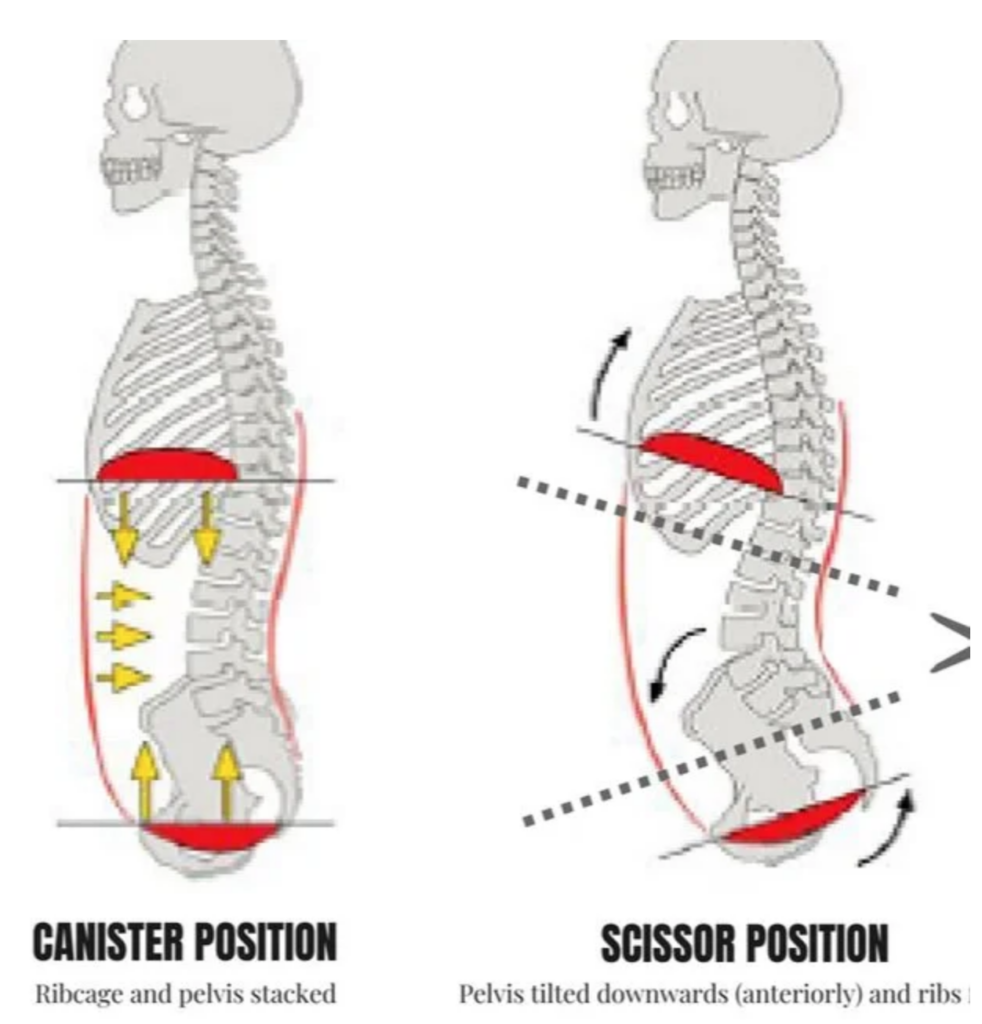
However, when OVER used kegels can lead to an overactive pelvic floor. Compound that with the all too common scenario of very little attention being made toward the efficacy of positional breathing drills – I.e., emphasizing the canister position (pelvis stacked underneath the ribcage; or reduced rib flare)  – and you have a recipe for disaster.

Photo on Left = Canister position.
Photo on Right = not that.

Positional breathing begins with teaching a GOOD inhale. This entails 3D (360 degree) expansion of the ribcage. With a good inhale the diaphragm contracts down and it able to “let go” and relax. Moreover, as Sarah notes in her course, every (good) inhale can push down on the pelvic floor which is okay.

Bearing down is one thing. This is not ideal.

However, with a proper inhale, the idea is to push the “ground floor of the house to the basement.” In other words: the inhale EXPANDS pelvic floor. Then, a full, accentuated exhale brings everything back to the ground floor.

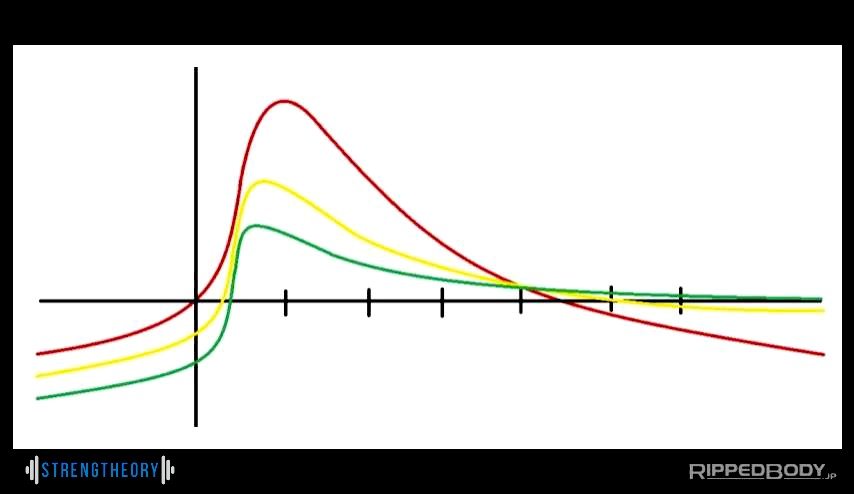
For the visual learners out there this may help (graph taken from Sarah’s course):

Again to reiterate:

“Inhale = pushes down onto pelvic floor (get it to the basement)….exhale = RELAXES.”

Taking the time to really build context and to hammer home the importance of the canister position will be a home run for many (if not most) postpartum women.

A simple example would be something like a deadbug, performed with a full 360 degree inhale followed by a drawn out, full exhale (without aggressive bearing down of the abdominals):


Tony, Did You Forget About Lifting Things?

Puh.

Not at all.

Strength training is the part where we “cement” all of the above into place. It’s crucial to build pelvic floor awareness (kegels) as well as function (positional breathing drills). If someone is unable to do this right, I am NOT going to load them.

However, assuming the work has been done I see no reason not to.

First we start with TIMING of the breath with the bodyweight squat. Inhale on the way down (pelvic floor expands and relaxes).

Exhale on the way down (pelvic floor comes back up and contracts).


Once that is mastered, then we can begin to THIS IS SPARTA. BACK SQUAT MAX EFFORT, BABY.

Just kidding.

I just use common sense and progress accordingly with something like Goblet Squats and always remain cognizant that I DO NOT want any aggressive bearing down of the abdominals and to keep IAP in check. The pelvic floor is just like any other muscle and needs progressive overload too.

Being postpartum is not a disease and I find it increasingly frustrating that many women are programmed into thinking that the only approach is with kegels and kegels only.

It’s a far more multi-faceted approach that requires attention to detail and dare I say…

…lifting shit.

dragonimages@123rf.comCategoriescoaching Motivational psychology Strength Training

The Fitness Zeitgeist

danielt1994@123rf.comCategoriesExercise Technique Program Design Strength Training

60 Second Deadlift Tip: What’s the Best Grip To Use?

Which Is the Best Grip To Use?

This is a tricky question and one I’m asked often when discussing how I coach up the deadlift.

We have to be cognizant of balancing what will likely help prevent injury (namely a bicep tendon tear), but also allow for optimal performance and turn you into a deadlifting Warlock.

My approach is pretty simple:

  1. Use a double overhand grip during your warm-up sets until it becomes a limiting factor or you’re unable to maintain your grip during your work sets.
  2. Switch to an alternate (under/over) grip to help keep the bar from rolling out of your hands.

👇👇👇👇👇👇 THIS NEXT ONE IS IMPORTANT 👇👇👇👇👇👇

       3. Alternate your alternate grip (left and right facing you or facing away) with every subsequent set.

I’ve personally had zero issues – with regards to injury or developing any “grip imbalances” – utilizing this approach with myself or with my clients.

SIDE NOTE: Yes, person who will inevitably bring up the hook grip. That’s an option too. We get it: You’re better than us.

SIDE NOTE (Part 2): Speaking of the hook grip, check out THIS article on the topic. It contains everything you’ll need to know.

CategoriesFat Loss Strength Training

What’s Better For Weight Loss: Cardio or Lifting Weights?

I’m a member of a local neighborhood bank here in Boston. I joined a year ago when I finally grew tired of all the shady hidden fees my previous bank was hammering me with – maintenance fees, minimal balance fees, checking fees, etc.

It’s been a lovely experience and I appreciate the more personalized approach my current bank provides. In particular I appreciate Nelson, the gentleman responsible for helping to set up all my business accounts.

Every time I walk in he greets me by name, asks how business is going, and it’s not uncommon for us to detour into some movie small talk.4

Also, since he’s the one who manages my business accounts, Nelson also knows what I do for a living and he’ll often ask me for some fitness advice…like he did today when he asked my opinion on what’s better for weight loss: cardio or lifting weights?

via GIPHY

Cue Jaws Theme Music

Now, normally when I’m out in public and stranger or even casual acquaintance asks me that question one of two things happens:

  1. I immediately fall to the ground and feign an epileptic seizure.
  2. The theme music from Jaws reverberates in my inner dialogue.

It’s such a murky and convoluted question with so many variables to consider that there’s no one definitive way to answer. What’s more, my answer is usually not what most people want to hear and all I get in return are a bunch of “mmm’hmms” and “uh-huhs” peppered with a few “so, that’s great and all , but what I read on the internet was…….

I’d rather swallow live bees.

However, in Nelson’s case it’s the least I can do. He’s helped me out a ton in the last year, and, you know, I’m not a dick.

So, of course I’m going to answer to the best of my ability and hopefully point him (and you, dear reader) in the right direction.

Losing Weight 101

At the most basic level, losing weight comes down to one umbrella theme: eliciting a caloric deficit via taking in less calories than you burn5. I often tell clients of mine that this can be as simple as not inhaling that bowl of Fruity Pebbles on a nightly basis…….

……one’s nutrition and being dialed-in with calories in vs. calories out always has been and always will be the main obstacle to consider/tackle with regards to weight loss.

But too, eliciting a caloric deficit can also be achieved via consistent exercise whether it’s by taking a spin class or by lifting heavy things.

Which is more effective or optimal, however?

Well, that depends.

BOTH work and I often reiterate to people that the answer is not to perform one in lieu of the other. In fact, I encourage everyone to implement both strategies if they have the time and means to do so.

I understand why the bulk of people tend to gravitate towards the cardio end of the spectrum.

  • Hopping on a spin bike or lacing up a pair of sneakers for a jog tends to be more “user friendly.”6
  • Cardiovascular’centric endeavors tend not to require a gym membership.
  • They can also be performed anywhere.

What’s more, one main reason why I feel a lot of people shun lifting weights – outside of not knowing really where to start – is that they see is something like this…..

via GIPHY

Or this…..

via GIPHY

And proceed to destroy the back of their pants.

They see images of advanced, highly-trained individuals performing seemingly unfathomable feats of strength and think to themselves “that’s a whole lotta nope right there.”

[I’m not going to get into the “will lifting weights make me bulky” argument right now. For starters, “no, it won’t.” But mostly doing so will just make me want to throw my face into a brick wall repeatedly.

FYI: Read THIS.]

The other, more germane reason (I think) why many shun weight-training is, hate to break it to you, sheer ignorance.

I’m Biased – But Here’s Why I Think Weight Training Works Well And Should Often Take Priority

I try to limit the number of blank stares I receive when trying to explain why weight training is important for weight (fat) loss.

Here’s my go-to elevator pitch:

NOTE: Yes, I understand there are many nuances to consider when breaking down the topic. This is a blog post, not a dissertation.

“Comparing minute-to-minute…accounting for intensity, cardio will almost always burn more calories compared to lifting weights – I’d say somewhere in the range of 2-3x more. However, it’s what your body is doing afterwards, when you’re sitting at home binging Stranger Things on Netflix or playing Magic the Gathering (<— can we hang out?), that’s the difference maker. When you hop off the elliptical machine you’re pretty much done burning calories. However, when you lift weights, in the hours after7, you’re not done. It goes by several names – Thermal Effect of Exercise, Afterburn Effect, being a brick fucking shit-house – but when you lift weights, you’re burning calories looooong after you’re done.” 

You can also think of it this way:

  1. Again accounting for intensity, lifting weights, for all intents and purposes, breaks down muscle to a (much) larger degree compared to cardio. It takes energy to build that muscle back up. This requires more energy from the body. This is what’s often used to best explain the AfterBurn Effect mentioned above.
  2. Muscle is more metabolically “active” tissue compared to fat. The more muscle you have, the more calories you burn at rest.
  3. Cardio doesn’t build (that much) muscle. You lose weight, but then you just end up looking like a smaller, weaker version of your original self. Sad face.

At the end of the day, though, it does come down to personal preference and what people are actually going to do.

If someone really hates lifting weights or just really likes doing cardio…I’m going to encourage them to stick with whatever modality allows them to remain the most consistent.

But Here’s My Final Say

#1. Don’t eat like an asshole

After that….do both (cardio & lifting weights).

I’ll tell people they should prioritize 2-4x per week of weight training and use their cardio to either compliment those days or serve as ancillary “bonus” days to get some exercise in.

I just feel the benefits of adding strength and muscle to the mix far out-weighs any misconceptions that may exist (and will only help to expedite the process).

As far as how to lift weights or where to start? A great option would be to read The New Rules of Lifting by Lou Schuler and Alwyn Cosgrove (HERE’s the version for men, and HERE’s the version for women) or maybe check out my Beginner to Badass program via TrainHeroic.

poppypix@123rf.comCategoriesProgram Design Strength Training

Factors to Consider When Training Around Pain

Getting hurt is a drag.

It’s even more of a drag when you’re someone who’s used to being active and an injury prevents you from training consistently or prevents you from training as hard as you’d like.

There’s generally two approaches many people take:

1. Complete rest.
2. Conjure up their inner Jason Bourne and grit their teeth through it.

Neither is ideal in my opinion.

I take the stand that injury (or training with a degree of pain <— sometimes) is inevitable. As I’ve jokingly (but not really) stated in the past…

…”Lifting weights isn’t supposed to tickle.”

Pain, pain science, and how to train around pain is a very complex and nuanced topic. This is a blog post, not a dissertation.

To that end, today I want to take some time to discuss a few strategies on how to train around pain that don’t revolve around the extremes: Sitting on the couch watching Netflix or plotting to take down Treadstone.

Full Disclosure: Much of what I’ll cover below is in Dr. Michael Mash’s online resource, Barbell Rehab, which is currently my new spirit animal of favorite continuing education courses.

Also: Just as a heads up, much of what I discuss below will be covered in more detail in mine and Dean Somerset’s latest IN-PERSON continuing education workshop – The Complete Fit Pro Blueprint – coming to both Boston (June 6-7th) and Dublin (Oct 3rd-4th) later this year. More dates coming soon…;o)

Factors to Consider When Training Around Pain

Let’s begin with the definition of “pain.”

Pain

/pān/

noun

1. A localized or generalized unpleasant bodily sensation or complex of sensations that causes mild to severe physical discomfort and emotional distress and typically results from bodily disorder (such as injury or disease).8

2. That feeling you get when your significant other wants to talk about feelings or what your eyes see when you watch someone perform kipping pull-ups.9

More precisely we often associate pain with actual damage. However, pain doesn’t always have to gravitate around that denominator.

Pain can also be equated to a smoke alarm alerting the body that something is awry:

  • “Hey, bicep tendon here: I think I’m close to snapping, can you tone it down on the bench dips?”
  • “Hey, knee cap here: I’m about to end up on the other side of the room if you don’t fix your squat.”
  • “Look out – a ninja!”

More to the point, pain is multi-faceted and can manifest a plethora of ways, which is why it’s imperative to educate people that it isn’t always centered around a physical injury.

Take for instance this cup analogy highlighted in a 2016 study from the medical journal Physiotherapy: Theory & Practice titled “The clinical application of teaching people about pain” by Louw, et al.

Pain is like a cup, and there are many factors that can fill it up.

Moreover, you can address people’s pain in one of two ways:

1. Reduce the contents of the cup.

2. Make the cup bigger (via appropriately progressed strength training)

As Michael addresses in Barbell Rehab, there are several ways to build a framework to train around pain that don’t involve being passive, subjecting yourself to corrective exercise purgatory, or in a worse case scenario…surgery.

1. Technique Audit

When someone comes to Core Collective for an assessment with me and they go into great detail on how bench pressing bothers their shoulder(s), rather than spending 30 minutes assessing how much shoulder range of motion they have, waxing poetic on the myriad of drills they can perform to improve thoracic extension, and/or going into the weeds on diaphragmatic positional breathing mechanics I’ll instead do this really out-of-the-box thing where I’ll ask them to…

…wait for it.

…wait for it.

…here it comes.

…show me their bench press.


More times than not, all that’s needed is a subtle technique fix on their set-up and execution of the lift itself and their shoulder hates them less almost instantly.

This isn’t to say we’d ignore other factors like thoracic mobility and breathing mechanics altogether; especially of deficits exists. However, I’ve found that most people are less inclined to want to light their face on fire from corrective exercise boredom if I just cut to the crux of the issue at hand.

Their shitty technique.

2. Programming Audit

This is a point I remember Dr. Quinn Henoch hammering home when I listened to him present a few years ago.

How often do you audit your programs?

Has it ever occurred to you that maybe, just maybe, the reason why you (or your clients) are hurt is because you were a bit overzealous with an exercise variation – or, more commonly, you were too aggressive with loading – and that that was the culprit of your’s (or their) low back pain…?

…and not because your left ankle lacked two degrees of dorsiflexion, or, I don’t know it was windy yesterday?

Load management (or lack of it) is the lowest hanging fruit we often overlook.

via GIPHY

Here’s an example of what I mean.

Using the same person above who’s shoulder bothers them when he/she benches: Let’s say they like to bench press 1x per week, on a Monday of course.

Like clockwork, the day after they bench, their shoulder feels like Johnny Lawrence used it for target practice with his fists. It feels like that for a few days, dissipates, and then by the time the following bench day arrives it feels better and the same cycle continues.

A more cogent approach may be to spread out the same volume over TWO workouts rather than one.

Here’s what they normally do:

Monday: Bench Press: 6×5 @ 185 lb

(Total Tonnage = 5,550 lb)

Here’s what they should do:

Monday/Thursday: Bench Press: 3×5 @ 185

(Total Tonnage = 2,775 lb) x 2

Sweep the leg.

via GIPHY

3. Change Modifiable Factors

Pigging back on the above, when something hurts or is painful always, always, always look at volume/load first.

From there you can ascertain at what load does something hurt – what’s the symptom threshold? Find that and when you do, train just below it to build tolerance and resiliency. The result will be twofold:

1. You’ll be encouraging an actual training effect.

2. Eventually, you’ll surpass the original symptom threshold because you forced an adaptation.

An easy example here would be squats. If someone experiences knee pain at a certain depth – maybe at parallel or just below it – have him or her perform a box (or free) squat ABOVE that spot.

Likewise, maybe all that’s needed to make the squat less painful is to change the stance width, or degree of toeing out? You can also tinker with bar position or even the tempo. The point is: Assuming we’ve ruled out anything nefarious, I’d rather someone keep squatting with a variation/tweak that reduces their symptoms dramatically than omit them altogether,

4. An Exorcism

But only as a last resort.

jackf@123rf.comCategoriesProgram Design Strength Training

Landmine Training and Why I Like It

I’ve been a fan of the Landmine going all the way back to the early years of Cressey Sports Performance when we  started to implement it into our clients’ and athletes’ programs.

Now, I’m not going to sit here and say the Landmine is the end-all-be-all panacea of fitness and performance. I like it and use it (often). But it’s not like it’s going to cut your 40 time by 0.7 seconds, add 50 lbs to your deadlift in a week, make it so that your pecs can cut diamonds, or give you the power of invisibility.10

Having said that, there are many reasons why I dig it.

Here’s a few…

Landmine Training and Why I Think It’s the Shit (Sorry, Non-PG Title Goes Here)

1. User Friendliness

I remember having a conversation with my friend Ben Bruno a few months after he left Boston to start training people out west in LA.

I often say that people in Boston, and in the east coast in general, tend to be a bit grittier. We live in miserable weather 50% of the year, we tend to swear like sailors more often, the weather sucks balls, and too, from a training standpoint, east coast peeps tend to be a bit more “strength” oriented. 

Did I mention the weather is abysmal? Just in case I wasn’t crystal clear…it’s crap.

Now, this isn’t to say that people on the west coast aren’t strong or are adverse to getting strong. Rather, it’s just to  say that when you live in 75-80 degree weather year round you tend to be more concerned with sustaining a six-pack than a 2-3x bodyweight deadlift.

via GIPHY

Ben, to his credit, after having coached at Mike Boyle Strength & Conditioning for several years, wanted to take his strength oriented mindset to LA, but he soon learned that that wasn’t going to fly and that he’d need to re-frame or pivot his approach in order to succeed his new environment.

He’d ask clients to deadlift, lunge, or squat a (regular) barbell and they’d look at him as he’d just said The Godfather III was the best of the Godfathers.

The fuck outta here.

However, Ben soon realized that all he had to do was take the barbell and slide it into a Landmine apparatus and his clients would be like “weeeeeeeeeeeeeee, this is fun.”

Set up a barbell in a squat rack for someone to squat? = Nope.

Set up a barbell in a Landmine for someone to squat? = SHUT UP AND TAKE MY MONEY.

And that’s totally fine.

If the Landmine makes something a little less intimidating and more accessible to the user and it gets him or her more excited to train, then I see no reason why we wouldn’t want to lean into that.

As my friend Kevin Mullins stated recently, “exercises are expressions of movement patterns.” In the grand scheme of things who cares how someone squats, deadlifts, lunges, rows, (or whatever). so long as they move and challenge the body to adapt and change?


2. Joint Friendliness

I’ve championed this point of view for a number of years now so I don’t feel I need to belabor it more here. In short, and to paraphrase myself..

“…a lot of people have really shitty overhead mobility.”

As such, oftentimes, overhead pressing may not be the best fit for some people (at least at present time) because they likely don’t have access to the requisite shoulder flexion in order to do so “safely” and without some significant compensations (namely, excessive lumbar extension and forward head posture).


As such, the Landmine Press is a perfect solution because it keeps trainees out of the “danger zone” yet still allows ample opportunity to train the shoulders, albeit in a more joint friendly fashion.

https://www.youtube.com/watch?v=r6Bmle–DUw


3. It Takes Up Minimal Space

My old training studio (before I moved to the current Core Collective) in Boston was 500 sq. feet (so just barely the size of a Jetta).

I’d have to be very judicious with the equipment I purchased so as not to take up too much space. I don’t know how everyone else feels, but for me open space was GOLD (and it still is, even with 10x more space)

The more I have of it the more activities I can do.

via GIPHY

I bought two Landmine attachments for my Rogue squat rack because 1) I knew I’d put them to good use and 2) I knew they wouldn’t take up too much space.

Rogue Landmine Attachment = $95

Selectorized Shoulder Press Machine = waaaaay more than that (and takes up way too much space).

Now, admittedly, I understand you can still McGyver a Landmine set-up without a Landmine using the corner of a wall (which is free), but that can still get a little suspect at times

One option is the Barbell Bomb sold by Ab Mat.11 Every one of my racks at Core Collective (six in total) have one of these as part of the “pod.” This makes it so you can set up a “Landmine” anywhere in your gym – in the corner someone, in the middle of the gym floor, on the roof, wherever! This can open the gateway to pressing, rowing, squatting, and hoisting things anywhere you please.

WU-TANG!

4. John Wick Likes It

True story.

5. Versatility

The Landmine can be used to train every part of the body.

Upper Body (Meadows’ Row)

Lower Body (Offset Shouldering Squat)


Upper & Lower Together (Deep Squat 1-Arm Landmine Press)


Everything


And Whateverthefuck


Moreover, the Landmine can be utilized by newbies, gym rats, athletes, Doug from Accounting, and even wizards. It truly is one of the more versatile pieces of equipment out there.

What’s more, exercises can be performed in a litany of positions:

Lying Down (Hollow Position Landmine)


Half Kneeling (Half Kneeling Sideways Landmine Press)


Single Leg (Angled Landmine Reverse Lunge)


Just to name a few

6. Versatility Part  II

Actually I lied, there’s more.

I’ve used the Landmine to help groove a hip hinge.

Because the barbell is “locked” in place it makes it that much easier for someone – especially those new to training – to intuitively feel the hinge.


Likewise, we can also easily add rotation and multi-planar motion into the mix:

And, lastly, who says you HAVE to do traditional Olympic style training in order to train and improve power?


That’s That

I am not doing the Landmine justice with this simple 1100-1200 word blog post. That said, I do think I’ve been able to get the point across that it’s a very versatile piece of equipment with an even more versatile range of applications. For an extra layer of badassery, I’d HIGHLY recommend Landmine University’s page HERE. There you’ll take landmine training to the next level and possibly take on a second career fighting crime.


lightfieldstudios@123rf.comCategoriespersonal training Program Design Strength Training

The Art of the Indicator Set

The 21st century has graced us with a bevy of technological advances:

  • High-speed internet.
  • Telescopes that now treat us to images of Black Holes
  • Nanotechnology to help improve manufacturing, healthcare, climate change, and agriculture.
  • Pizza crust made out of cauliflower.

The health/fitness sector has also benefitted. Trainers have the ability to work with clients from all over the world in real-time. We also have the capability to measure things like bar speed and heart rate variability via applications on our phone; all of which provide data to help us gauge our “readiness” to train on any given day.

But seriously, cauliflower is now used to make pizza crust! Even more miraculous is that it doesn’t taste like sawdust.

Technology surely is great.

However, when it comes to ascertaining one’s readiness to train I tend to lean more toward the anti-app route, and instead rely on what I call “INDICTOR SETS.”

What the Heck Is An Indicator Set?

The easiest way to explain is via some anecdotal observances.

I was walking to my gym to train the other day where the plan was to show up, warm-up, crank a little Mobb Deep over the stereo, get angry enough to want to fight a tornado, and work up to a heavy(ish) triple on my deadlift (535 lb).

On paper it looked like a done deal.

But once I started warming up, things didn’t go quite as planned:

135 x 5

225 x 5

315 x 3

405 x 1 (didn’t feel horrible, but didn’t feel great)

455 x 1 (INDICATOR SET)

An indicator set basically lets me know whether or not I have “it” that day.

For instance, in the previous two weeks, 455 lbs (which is ~70% of my 1RM) literally flew up. Based on “feel” of my bar speed, and how effortless the set felt, I knew I could make a run for a high 500’s pull.

Put another way, I gave myself the green light to go for it, and I did.

Conversely, 455 felt like absolute garbage the other day.

It felt slow off the ground. And it felt even slower at lockout, which I normally never have any issues with.  The indication was: “Tony, if you attempt to go any higher you’ll run the risk of shitting your spine.”

So, I did the smart thing and called it.

I re-racked the plates, turned the page, and did my accessory work:  DB reverse lunges, a little pouting in the corner, and some pull-throughs.

via GIPHY

Listen, it’s not a perfect system, nor is it anything remotely scientific. To be as transparent as possible: I am not anti-technology. But I am anti-technology to the point that many (not all) people tend to miss the forest for the trees when it comes to their readiness to workout.

If their Apple watch indicates a modicum of fatigue they’ll shut that shit down faster than you can say, well, apple.

Just because your watch says you should avoid training on any given day doesn’t necessarily mean you have to. Besides, I’m not entirely sold on the reliability of those apps anyway. I’ve had clients walk into a session feeling like a million bucks only to have their watch tell them danger, danger, DANGER, and to not even look at a barbell.

On the flip side, I’ve also had clients show up feeling like they made out with a petri dish, only to warm-up, move around a little, and then feel like Leonidas leading the Spartans to battle.

via GIPHY

Indicator sets help you learn to FEEL whether or not you’ve got the juice on any given day. In short: It’s a form of auto-regulation that helps you to not have to rely on some algorithm.

Plus, it’ll save you a few hundred dollars…😙

At least in this scenario you’ll have some tangible, performance-based evidence to help you gauge things. Muscle fatigue is one thing and tends to be easier for many people to use as a metric.

If you’re overly sore you can feel that and tweak your programming accordingly. CNS (or nervous system) fatigue is a bit more nebulous and harder to pinpoint, or even feel for that matter.

Indicator sets help you with the latter.

To that end, I encourage you to start utilizing indicator sets as part of your warm-up on the days you know you’re going to be pushing the envelop. 

Pick a weight during your warm-up that you can use to “gauge” where you’re at that particular day. This number should be heavy enough to be challenging, but one you KNOW you can perform fast and with immaculate technique.

(this will likely be around 80% of your 1 rep-max)

Trust me.  The whole mindset of lift heavy or go home – while admirable – isn’t always the best approach.

khoamartin@123rf.comCategoriescoaching Program Design Strength Training

3 Ways to Improve Your Deadlift Without Deadlifting

For the sake of brevity, this post assumes you can perform a deadlift – trap bar, straight bar, a bag of groceries of the ground, a person, whatever – without shitting your spine.

If you can’t, go seek out a reputable fitness professional to show you how. Or, you can always check out THIS Cliff Notes version I helped author not too long ago.

Much like if someone wants to get better at writing they should, you know, write; or if they want to get better at cooking souffles they should practice cooking souffles; or if they want to master the art of not getting laid, they should attend Star Trek conventions….

…if you want to get better at deadlifitng, you should deadlift.

The more you (purposely) practice something the better you’ll get at it. I understand it’s stating the obvious, but it can’t be repeated enough.

There are many moving parts to executing a pristine deadlift, and oftentimes it bodes in our favor to include exercises, drills, and/or movements that compliment the lift or, more germane to the conversation, address a technique flaw or general weakness.

Below are a handful of quick-n-dirty suggestions that may (or may not) apply to you and help increase your deadlift badassery.

1) Deadstart Squats


This is one of my favorite deadlift accessory movements for a few reasons:

  • When set up to match your hip position for the deadlift it offers a ton of carryover in terms of both mechanics and musculature targeted.
  • The deadlift is (mostly) a concentric movement. The Deadstart Squat, too, is (mostly) a concentric movement.
  • For people who struggle with keeping their chest up (preventing their upper back from rounding) during the deadlift, this will be a challenge. NOTE: I’d likely revert to a FRONT squat hold for those who really struggle with back position here. Front squat position is also a better option for those who lack the requisite shoulder mobility (external rotation) to perform well. Another great option is using the Safety-squat or Yoke bar.
  • Great option for training power/explosiveness.
  • Because I said so.

As far as sets/reps there are two approaches I like, both of which gravitate more towards the low(er) end of the spectrum.

One (3-5)

Here, reps will stay in the 3-5 (25ish total reps) range using 60-75% of 1RM. A 4-week macro-cycle may look something like this:

Week 1: 5×5 @ 65% 1RM, 90s rest

Week 2: 6×4 @ 70% 1RM, 90s rest

Week 3: 8×3 @ 75% 1RM, 90s rest

Week 4: 3×5 @ 60% 1RM, 90s rest

Idea is to stay tight throughout duration of set. You should always come to a complete stop on the pins, however you shouldn’t relax

Two (Singles)

I love this option as I feel it offers the most carryover to my deadlift.

Because I’m only performing one-rep, I can place a premium on getting as tight as humanly possible and being as explosive AF. In addition I can go a little heavier in weight here (70-85% of 1RM)

A 4-week macrocycle may look something like this:

Week 1: 12×1 @ 70% 1RM, 30s rest

Week 2: 10×1 @ 75% 1RM, 30s rest

Week 3: 8×1 @ 80% 1RM, 60s rest

Week 4: 6×1 @ 85% 1RM, 60s rest

2) RKC Plank

I don’t know about you, but this is what I look like whenever someone brags to me about how (s)he can hold a two-minute plank:

via GIPHY

You might as well be bragging to me about how you can point out the color red or, I don’t know, walk in a straight line.

Besides, you know and I know if you’re holding a plank that long it (probably) looks like garbage.

NOTE: This is not to insinuate I’m against the plank or find zero value in it.

Au contraire.

Without going too far down the rabbit hole of spinal mechanics, prone (and side) planks (and how long someone can perform them) are a legitimate assessment tool and are staples in terms of low back rehab and performance.

Teaching the RKC Plank offers a quick primer on how to 1) perform the plank right and 2) allow people a window to appreciate what it really feels like to get and maintain full-body tension.


The RKC Plank is all about building context.

More specifically it’s about appreciating full-body tension. If someone can’t understand (or feel) what this means while lying on the floor…how in the hell are they going to understand it standing up while attempting to pick up a heavy object off the floor?

Trust me, when done right, 10s will feel like torture.

3) Straight-Arm Band Pulldowns


The idea is pretty simple (and effective).

Prior to each set of deadlifts you perform a set of 5-10 repetitions of band pulldowns (holding each rep for a 3-5s count).

This serves a few functions:

  • It allows the trainee to prime or feel his or her’s lats firing. Setting your lats (and subsequently posteriorly tilting your scapulae) as part of your DL set-up will help with leverages and moment arms getting you closer to the barbell. Greg Nuckols does a fantastic job at explaining things more thoroughly and nerdely HERE.
  • Offhandedly, it also helps with anterior core engagement, which in turn aids with rib position. Less rib flare = less lumbar extension = more stable position to lift a metric shit-ton of weight.

Closing Thoughts

None of the above are revolutionary ideas or are going to win be any fitness writing Pulitzers. However, they are exercises/drills I use myself (and with my own clients/athletes) and have found they provide a lot of benefit.

Give them a try yourself and let me know your thoughts/experiences.

microgen@123rf.comCategoriesExercise Technique Program Design Strength Training

Are Compound Movements Actually Making You Stronger?

NOTE FROM TG: It’s Christmas. So, I’m out. But, I figured this would be an opportune time to repurpose some old content.

1) If you didn’t read this the first time I posted it all I have to say is “pfffffft, whatever.”

2) If you did, you’re cool. And, share it……;o)

Understandably, the title of this post suggests some nefarious agenda where my goal is to spend the next few minutes explaining why we’ve had it all wrong the entire time.

“You mean to tell us, Tony, there’s a chance compound movements don’t make people stronger?”

“What’s next: telling us water isn’t wet, the Earth isn’t round, you’ve been busting our balls the entire time and kipping pull-ups are, in fact, one of your favorite exercises?”

Relax. Deep breaths.

Just so people don’t think I’ve lost my marbles or are already tapping away on their keyboard drafting their hate mail before actually reading what I have to say below….the short answer to the title of this post is:

“Yes, I do feel compound (multi-joint) movements – think: deadlift, squat, bench press, rows, overhead pressing – make people into beasts, and should lay the foundation for any well-rounded strength training program.”

However, I fear many trainees (and coaches) often fall into the same trap where we’re programmed into thinking compound movements, and only compound movements, should be utilized 100% of the time…no exceptions.

A thousand years of no gainz and incessant internet trolling to the person caught using the leg curl machine or, the horror, performs a few sets of tricep kickbacks.

Shut Up

No, really…shut up.

Of COURSE compound movements make you strong(er). If you want to get strong, it only makes sense to perform those movements which will allow you to use the most weight and force the body into a state of adaptation to get strong.

Granted a lot of other things need to fall into place in order for “strong” to happen. Just because you place a barbell on your back and meander up and down doesn’t mean you’re the second coming of Ed Coan.

Technique, frequency of training, addressing weaknesses, technique, and technique consistent progressive overload all need to be taken into consideration.

What’s more, if strength is the goal – particularly with the big 3 – compound/multi-joint movements performed in low(er) rep ranges (1-5) is kind of important.

Why?

Cliff Notes Version:  Lifting maximal weight has a number of effects:

1. Maximal number of motor units are recruited.

2. Fastest MU’s are activated (high-threshold motor units).

3. The discharge frequency (rate coding) is increased.

4. Activity is synchronous – both inter and intra-muscularly.

5. Potential for future hypertrophy gains (especially when you revert back to a “hypertrophy” specific training phase).

6.  While some argue whether or not the research is efficacious – it goes both ways – lifting heavy things helps to increase serum Testosterone levels.

7.  Girls will want to hang out with you (<=== it’s science).

But It’s Not All PRs and Butterfly Kisses

While all the above is true, focusing solely on compound movements (and lifting maximal weight all the time) does have its pitfalls.

1). There’s an inherent likelihood of increased wear and tear on the joints over time (Yes, even with “good” technique).

2). Compound movements = produce/accumulate more fatigue (particularly neural fatigue). And if it’s not managed appropriately, one may see a decrease in strength/performance over time.

And finally, something not many people consider:

3). We’re Really Good at Compensating.

You may have noticed that I drilled the idea of “technique” earlier. It’s that important.

As a coach I find many people are unable to express their true fitness/strength level due to faulty joint positions (misalignment, such as excessive lumbar extension/APT), and, honestly, not “earning the right” to increase load.

I.e., they haven’t performed enough reps at “x” weight in order to go up.

To that end, drilling technique – and respecting each individual’s anthropometry – is always going to be of paramount importance.


Due to our ability to compensate well, the likelihood you’re leaving poundages in the tank are very high.

As well, when we start talking accessory movements, I’m always in the camp which takes the approach they should generally be used to address some form of technique flaw or weakness with the main lift in question.

For Example

If someone is struggling with their deadlifts off the floor – meaning, they’re super slow – some viable accessory movements to address this would be:

1). Limiting tap-n-go reps (bouncing off the floor).

2). Deficit pulls (2-3″ elevated) to generate more quadricep recruitment.

3). More squat variations such as Safety Squat Bar squats and front squats (again, to generate more quadricep recruitment).

4). Anderson Squat – performed from a deadstart, emulating one’s deadlift stance.


Note: Notice my hip placement above. When I was pulling conventional style (the video is four years old) this variation of Anderson squat very much mirrored my deadlift stance, which carried over well.

Back To My Point

Oh yeah, my point.

Listen, it’s okay to perform isolation work or more bodybuilding-specific exercises. A more “hybrid” approach – strength and hypertrophy – is going to bode well for most people anyways.

Case in point: my bench press sucks. There are days where I’d rather wash my face with broken glass than bench press.

One of the things my coach has been implementing into my programs of late is more isolation work to address muscular issues.

Think about it: expressing strength is (mostly) about generating force. Hoisting big weights helps in this regard. However, a bigger muscle – almost always – is going to produce more force than a smaller one.

Indeed, I’ve been hammering away at my bench press technique – even implementing accessory movements like paused bench presses and Spoto Presses to address my weaknesses.


But guess what? Lately – for the past two blocks of training – I’ve been performing a TON of dumbbell chest flyes. You know, those “wimpy” things guys use to train their chest cleavage.

I feel so dirty admitting it.12

Funnily enough my bench press has seen it’s best jump in a while since incorporating more isolation type work for the pecs and triceps.

Too, my DL has gone up since tossing in some leg extensions; and I have to assume the chest flyes play a role too…;o)

Read: It’s not only about compound movements. Don’t be so dogmatic.

True, they serve as the staple for any strength-based program…but try not to neglect the importance of choosing the correct accessory work – even if it’s isolation exercises – to compliment your goals.

The internet will forgive you.

CategoriesProgram Design Rehab/Prehab Strength Training

Find Your Entry Point: How to Train Around an Injury

If you make a habit of lifting heavy things it’s inevitable you’ll likely experience a few setbacks along the way.

These can range anywhere from the “no big deals” (bloody shins from deadlifting, shoulder niggle) to the dire (disc herniation, explosive diarrhea).

…or worse case, forgetting your squat shoes on squat day.

Suffice to say: Getting hurt is frustrating. Attempting to work around an injury can be even more so.

It bothers me when people default to tossing their hands in the air and surrendering themselves to a two-to-four week window of “rest” and rolling the dice. There’s a lot of good that can be done, even underneath the umbrella of injury. Instead, I’ve long championed the idea of trainees finding their Trainable Menu and focusing more on what they CAN do rather than what they can’t.

Another way to re-frame things is to find your entry point.

In fact…here’s your entry point making an entrance to your next training cycle while you’re working around an injury.

via GIPHY

Find Your Entry Point

Speaking of entry points: I remember a few years ago when I sat down with Julian to watch the original Jurassic Park. He was four at the time. Now, most coherent parents would start with something a little less scary.

You know, say, Dino Dana or, I don’t know, Care Bears.

Nope, I went with the ginormous, scary T-Rex.

In hindsight, it probably wasn’t the best “entry point” for someone who, at that point, had no idea dinosaurs weren’t real. Again, maybe Toy Story or, hell, Mighty Morphin Power Rangers would have been a more germane choice?

I gotta say, though…

…Julian handled the T-Rex like a champ.

He didn’t blink once. He giggled when the guy sitting on the porto-potty met his demise.

I didn’t know whether to be proud or scared shitless.

Kid’s the next John Wick in the making.

Okay, Cute Story Tony. But WTF Are We Talking About Here?

Yeah, yeah, yeah…

Lifting heavy things.

Entry Points.

I’ve recently been making my way through Dr. Michael Mash’s excellent resource, Barbell Rehab, and giving credit where it’s due…he spends quite a bit if time throughout the course discussing the idea of entry points and how to use the concept to guide anyone’s return back to a specific lift after injury.

Let’s use the bench press as an example.

If someone has pain when he or she bench presses with a straight bar, finding their entry point is nothing more than altering the lift the minimal amount possible in order to gain the minimum desired training effect.

For the visual learners out there it may look something like this:


Adapted from Barbell Rehab

TO BE CLEAR: If pain exists in the shoulder the idea is NOT to automatically regress all the way back to a push-up.

I know some people who’d rather swallow a live grenade than do that. Instead, the goal is to be as specific as possible in order to elicit a (relatively pain-free) training effect.

If someone has pain with a straight bar FLAT bench press, however it alleviates significantly when you switch them to a decline bench press.

Sha-ZAM.

You just found their entry point.

Maybe it’s DB Floor Presses for one person, and yes, maybe it’s a push-up (albeit loaded) for another. The idea is to TRAIN. Moreover, it also could just come down to tweaking their grip slightly or adjusting some component of their technique.

Rehab doesn’t always have to result in sending someone to corrective exercise purgatory.

Likewise, using the squat as an example, sometimes the entry point is using a different bar (Duffalo or Safety-Squat Bar) if the shoulder is the issue, or maybe it’s having someone squat ABOVE parallel if it’s their knee(s) or hip(s) bothering them.

Sometimes, and hear me out, we may have to combine the two: Not a straight bar AND above parallel.

I know what some of you might be saying…”Tha fuck outta here, Tony.”

Yes, it’s true. (please play video below and hopefully get a few LOLs. Or not)


And everything’s going to be fine.

In fact, more than fine.