denis1203@123rf.comCategoriescoaching personal training Program Design

Training Strategies to Produce Your Own Army of Terminators

I wish I had someone sit me down when I first started in this industry to better explain programming. On one hand I guess it ended up working out, because I wrote a gazillion million kajillion programs over the course of my career and there’s really no better way to gain expertise on a topic than to actually do it.

There’s no other option but to get good at it.

(I’ll save the obvious self-deprecating jab at myself here about not having any girlfriends in high school here)

That said, it really would have saved me a lot of time and second guessing myself if I had a little “cheat sheet of programming wizardry” to help guide me and make my clients into invincible Terminators. Well kiddos…

…today is my gift to you.

What follows is by no means all encompassing nor the panacea of programming. But I think it’s a pretty good starting point for most new trainers and coaches in the industry and I hope it will serve as the bedrock for the bulk of their bulk of programming needs moving forward.

And before I go on, full-credit to Tasha Wolf Whelan who’s talent, expertise, and general badassery served as the inspiration for this compilation. The charts below have been adapted from her.

Linear Periodization

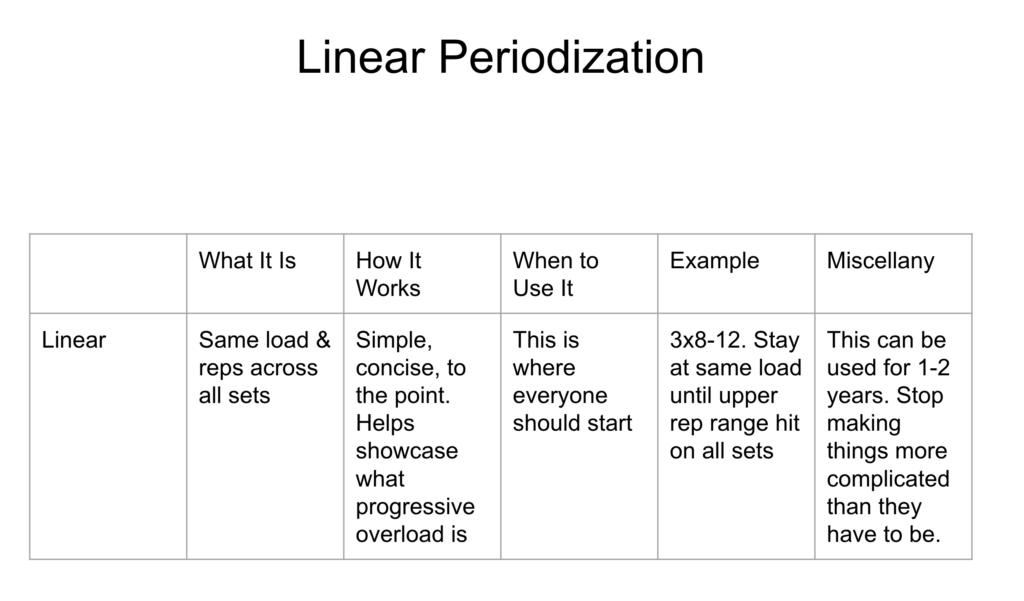
Pretty much  ALL beginners will (and should) start with a Linear Periodization scheme. This not only introduces the concept of progressive overload to them, but does so in a fashion that’s not overwhelming or complicated. And, in all honesty: most general population clients will LIVE here for the duration of their training career. 

3×8-12 will take someone a very long way in their training. Trust me: Phil from accounting doesn’t need contrast sets or Eastern Bloc periodization schemes to peak for his family trip to Toledo this summer.

Obviously the goal is not to keep someone at 3×8-12 the entire time. However, you’d be surprised as to just how long this can go on for. The idea is to start with a load and stay there until 3×12 is achieved on ALL sets. 

Week 1: 100 x 10, 9, 8

via GIPHY

Week 2: 100×12,10,10

via GIPHY

Week 3: 100×12,12,11

via GIPHY

Week 4: 100×12,12,12

Boom shaka-laka. Increase load and get to work.

Rinse, wash, repeat.

The bigger picture of Linear Periodization is that you’ll typically begin with a low(er) set/high(er) rep scheme using light to moderate loads and progress to high(er) set/low(er) rep schemes using moderate to heavy loads.

For the visual learners it may look something like this:

Weeks 1-4: 3×8-12
Weeks 5-8: 4×6-8
Weeks 9-12: 5×4-6

As the weeks progress the volume (total number of sets being done) is staying relatively the same, but the intensity (loads being lifted) is increasing.

Fixed Loading

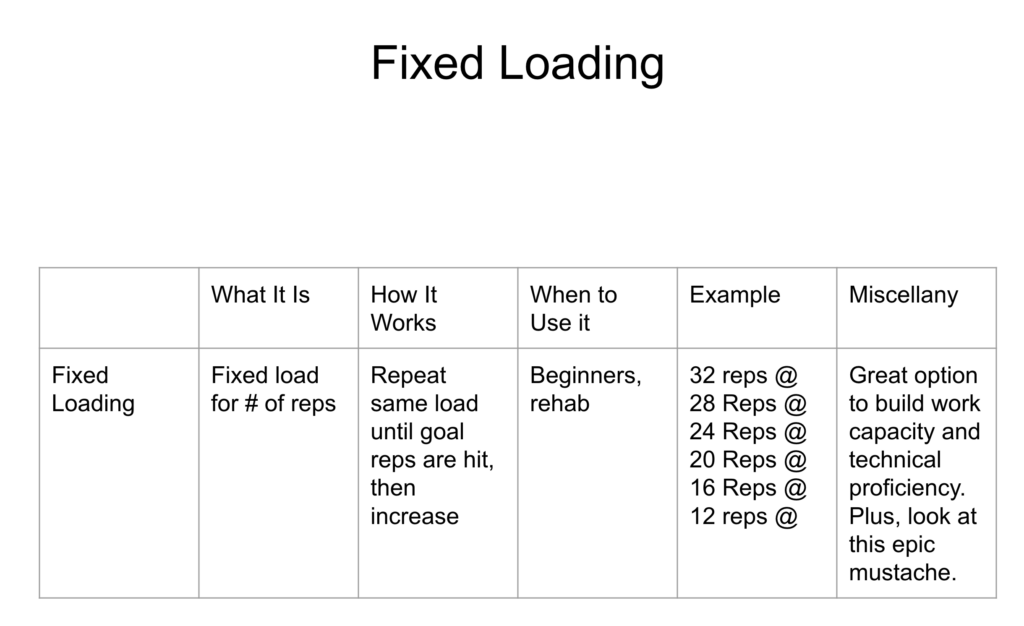
A logical progression from Linear Periodization is something called Fixed Loading. Once a trainee begins to understand how to load his or her’s body and knows what their upper limits are, Fixed Loading is a great option to help push the envelope into more aggressive training.

The idea is to set a fixed load and to then hit a goal number of reps within a training session.

Something to consider here is that the load being used should “match” the rep scheme. Meaning, a higher total rep count would insinuate someone would be using a lighter load and vice versa. A good example would look like this:

Trap Bar Deadlift

32 reps @ 225 (6-8 reps per set)
.
.
.
12 reps @ 300 (2-3 reps per set)

Undulated Periodization

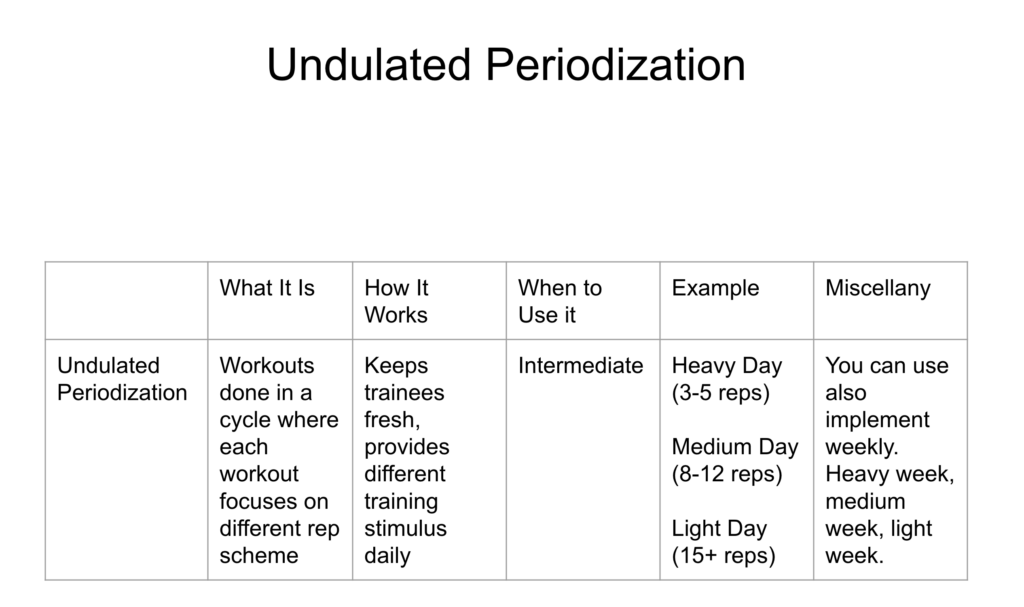
From there, one option that’s massively popular is UNDULATED PERIODIZATION. In short, the concept behind this method is to focus on a specific rep scheme/agenda per workout (or given microcycle; think week to week), or in other words…easy days, medium days, and hard days (from an intensity standpoint).

This is a popular scheme used by many strength & conditioning coaches working with athletes given athletes will typically have “competing” demands (practice, game days, travel, weight-room, etc) depending on the time of year (in-season vs. off-season). However, this is also a very doable approach for many gen pop clients (intermediate to advanced) as it allows for a bit more training variety and provides a different or unique stimulus per training session.

The two most common ways to implement undulated periodization is via a weekly emphasis or a session to session emphasis. Meaning, if you take the weekly approach each session within a week will mirror one another in terms of the end goal.

Week 1: Heavy (all exercises – or at least the main exercises – are completed in the 3-5 rep range)
Week 2: Medium (all exercises completed in the 8-12 rep range)
Week 3: Light (all exercises completed in the 15+ rep range)

The second option is where each session hits every stimulus. The easiest example would be to take the “big 3”  (squat, bench press, deadlift) and break if down that way:

Day 1: Squat variation (heavy), bench press accessory (medium), deadlift accessory (light)
Day 2: Bench Press variation (heavy), deadlift accessory (medium), squat accessory (light)
Day 3: Deadlift variation (heavy), squat accessory (medium), bench press accessory (light)

Stage Loading

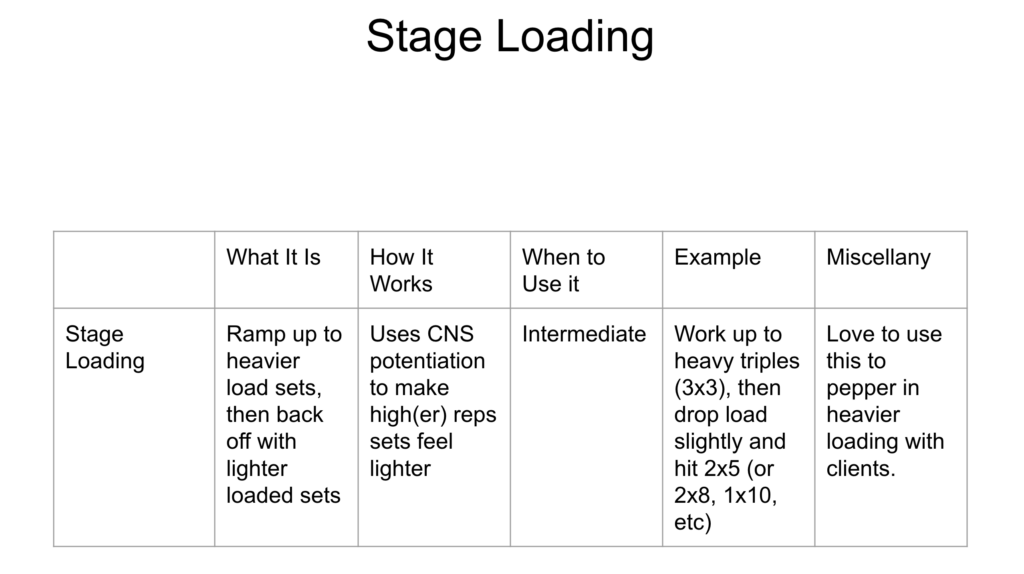
Next up Stage Loading. This is a unique way of training I adopted during my days coaching at Cressey Sports Performance. In a nutshell your client or athlete will ramp up to a challenging (heavy) few sets of 3-6 reps and then perform a few back off sets at a lighter load within a high(er) rep scheme. When you think about it: It’s PAP (post activation potentiation) training 101. Lift heavy shit to “potentiate” more motor unit firing and recruitment, then when you back off, those subsequent loads will end up feeling lighter and less like you’re going to shit a spleen…

…comparatively speaking.

Here’s a quick example of what this would look like:

Front Squats

  • Ramp up to a challenging “stage” of 3×3 (these sets should be close to an RPE 9/10)
  • Don’t die.
  • Back off with another “stage” of 1-2 sets of 10 (added volume)

From there you can periodize things to look like this:

Week 1: 3×3, 1×10
Week 2: 3×3, 1×8 (<— a little heavier)
Week 3: 3×3, 1×5 (<— heavier)
Week 4: 3×3, 2×5

You can also invert the back off sets to begin with 2×5 and end with high(er) rep sets as the week progresses. There are endless permutations here and no ONE right way.

Rest/Pause and Cluster Sets

Speaking candidly, I don’t use any of the following modalities until someone has had a consistent 1-2 years of training under their belt. But I have to say…these are all really fun and I have used both these modalities with beginners in the past to help with work capacity and introduce them to heavier loads in a safe manner.

Important Caveat: Rest/Pause and Cluster Training are often lumped together and I understand why; they are very similar to one another. Kind of like how people confuse or think that Saruman and Sauron from Lord of the Rings are the same person.

WHY WON’T YOU LISTEN TO ME AND GET IT OUT OF YOUR THICK SKULL THAT THEY’RE NOT THAT SAME??!?! THEY’RE JUST NOT! (slams door) 

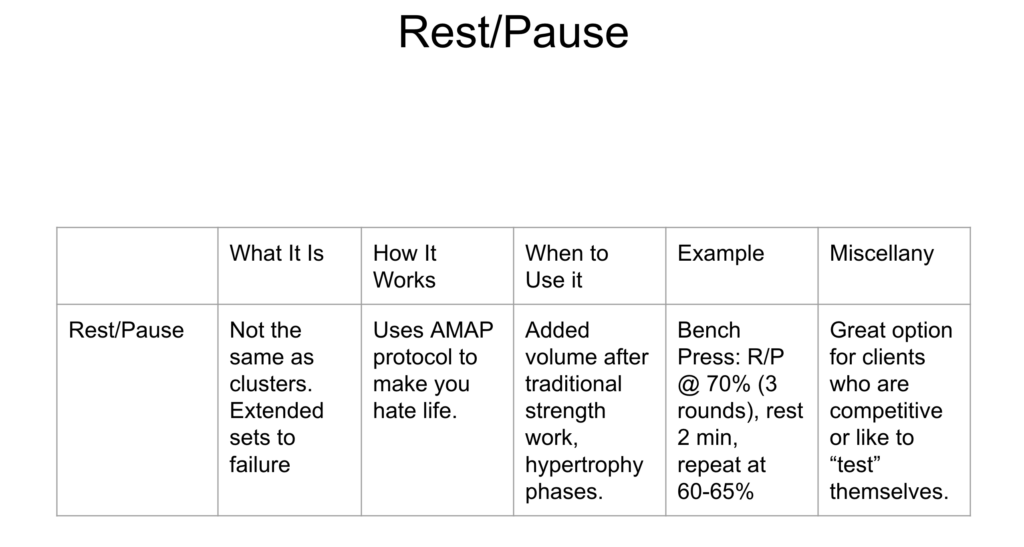
Rest/Pause = extended sets to (technical) failure.

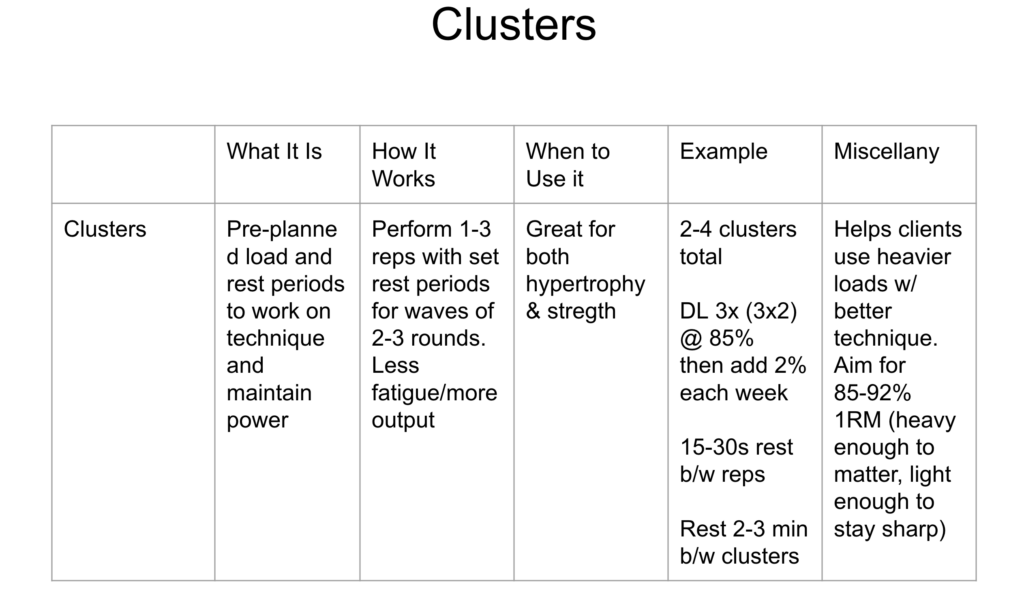
Clusters = pre-planned load and rest periods.

I like to use rest/pause training as an accessory to the main lift of the day as a way to add extra volume in. After the main event (say, bench press) they’ll then do some Rest/Pause training as follows:

  • Set 1: 70% of 1RM for AMAP (as many reps as possible), rest 20-30s, AMAP again, rest 20-30s, one more set to AMAP
  • Rest 2-5 minutes
  • Set 2: 65% of 1RM repeating the same protocol

This is also a great option for clients or athletes who are competitive because the objective then is to try to beat their total # of reps week to week.

Clusters are best used with the main lift of the day. The main benefit is that it allows trainees to work with heavier loads compared to the same weight being done as straight sets (and with better technique because fatigue is managed).

Using the deadlift as an example: Goal is three cluster sets of 2 reps @ 85% of 1RM

  • Cluster #1: 2 reps, rest 15-20s, 2 reps, rest 15-20s, 2 reps
  • rest 2-4 minutes
  • Cluster #2: 2 reps, rest 15-20s, 2 reps, rest 15-20s, 2 reps
  • rest 2-4 minutes
  • Cluster #3: 2 reps, rest 15-20s, 2 reps, rest 15-20s, 2 reps

When I am feeling extra spicy, I’ll even have clients do GIANT CLUSTER SETS where I set a fixed time (5-10 minutes) and they perform 1-2 reps at a given percentage (75-85%) every 30s. By minute four this is common…

via GIPHY

Wave Loading

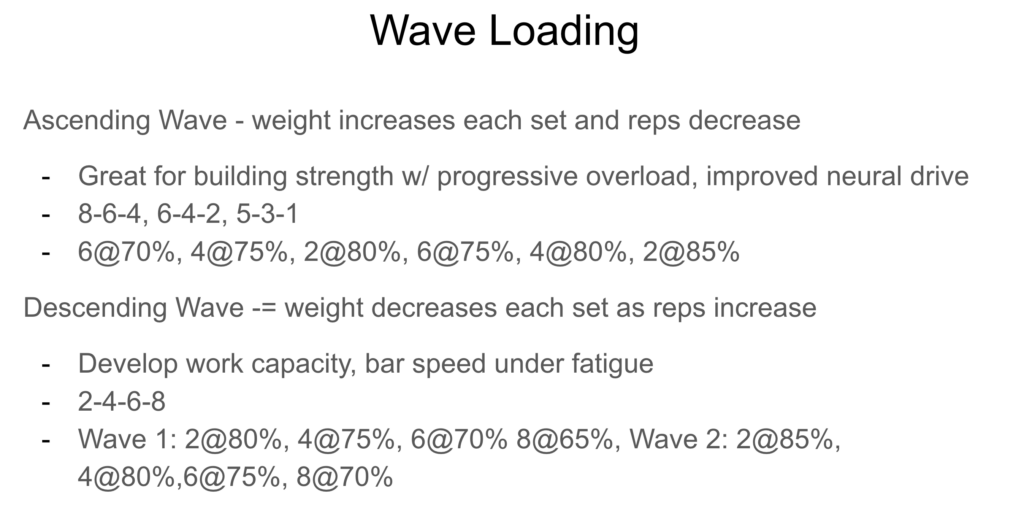
Last but not least is Wave Loading, which is another example of postactivation potentiation. The 1st wave more or less “potentiates” the nervous system into thinking the load(s) used for subsequent waves is lighter than normal compared to the same load performed as straight sets.

Lorem ipsum dolor sit amet, consectetur adipiscing elit. Ut elit tellus, luctus nec ullamcorper mattis, pulvinar dapibus leo.

gajus@123rf.comCategoriesUncategorized

A Fit Pro’s #1 Super Power?

Whether we’re talking about personal trainers, strength & conditioning coaches, physical therapists, athletic trainers, group exercise instructors, yoga & pilates instructors, or, I don’t know, bomb sniffing dolphin trainers1, conventional wisdom tells us that in each example every single one of those professionals would have a strong background in anatomy, kinesiology, exercise physiology, assessment, exercise prescription, exercise execution, manual therapy skills, human movement, and on the 0.001% chance that someone who trains dolphins is actually reading this…mammalogy.

Also, I am assuming one also needs to be a proficient swimmer.

Needless to say, sure, in order to separate yourself from the masses it makes a lot of sense to accumulate a base level of education in myriad of topics to become a bonafide fitness professional. On top of that, other things that come into the foray include (but are not limited to):

  • Interpersonal and communication skills
  • Social and emotional intelligence (empathy)
  • Behavioral and motivational psychology (cough, cough, nudge, nudge…Psych Skills for Fitness Pros Vol I and Vol II is the “go to” source. Check them out HERE).  
  • Nutrition (although, it’s important to respect scope of practice)
  • Active listening
  • Being an voracious proponent of Wu-Tang Wednesdays.

Being well-rounded in all of the above can come across as having some sort of super power given a vast majority of fit pros out there today – especially your run-of-the-mill commercial gym personal trainer – can barely name a rotator cuff muscle let alone have the ability to confidently program for someone who has chronic low-back pain. What’s more, and maybe this is the cantankerous, grumpy, old and bald strength coach –  (waves his invisible cane in the air) “MEH, kids nowadays” – in me talking…

…but I find that more and more young fit pros fail to grasp the one quality that will undoubtedly impress and build unparalleled client rapport.

  • No, it’s not how many letters you have next to your name or how many certifications you have.
  • No, it’s not your ability to quote Zatsiorsky.
  • And, no, it’s not having washboard abs or glutes that can crack adamantium.

The real (and forgotten) super power that separates a sub-par coach from an S-tier coach is…

adaptability.

Possessing the ability to pivot or change course on the fly when a client shows up to a session late (time constraint), divulges a new injury (jacked up their knee playing pickleball), has an inability to perform a given exercise prescribed (an endless assortment of eye-wash I see on Instagram), or has explosive diarrhea (good luck!) is a true super power.

I have never written a perfect program. Meaning, it’s not uncommon for me to divert to plan B or C or even D in a given session because a client’s shoulder is pissed off. Sometimes, due to extenuating circumstances, I’ll need to scrap an entire program because a client decides they no longer have the same goal(s), or maybe I was overzealous as a coach and overestimated someone’s ability level.

It’s on me to figure it out and to do it quickly.

I truly believe that if you can seamlessly and effortlessly roll with the punches and not get flustered when inevitable curve balls are going to happen, provide a fun and practical training experience (even with the shit hits the fan), and demonstrate to clients that there is almost ALWAYS a way to get a training effect despite perceived road blocks…

…you will be a rock star in their eyes, and build a ton of trust and loyalty moving forward. Like I always say: long-term success in this industry has more to do with what clients you can KEEP around for awhile more than how many new ones you can attract month to month.

Categoriescoaching personal training

Looking to Hire a Personal Trainer? Here’s a Short List of Things to Consider

Hiring a personal trainer is a big deal. Maybe not as big of a deal as purchasing a home or a new car (in terms of the initial monetary investment at least), but when you really think about it…
 
…it’s arguably a more important investment because it’s an investment in YOU. Hiring a coach to guide you, show you the ropes, and help you achieve your health/fitness goals (whether it’s to simply feel better, work around an injury, prepare for a competitive season, or be able to deadlift a bulldozer) in the safest and most time efficient way possible can be tricky.
 
I mean, there are A LOT of gyms (and personal trainers) out there; so how do you decide to pick one over another? Where do you even begin?
 

Here Are a Few Simple (and admittedly anecdotal) Guidelines to Consider:


1. Are They Certified?


Tony Gentilcore, CSCS, PhD in General Badassery
 
Some certifications are better than others (and they’re are some I like better than others), but the “gold standard” certifications to look for are ones through the NSCA, NASM, ACE, and Show Up Fitness CPT. Ensuring that whomever you hire has gone through (and passed) some formal education as it pertains to anatomy, physiology, and basic programming is important to consider.
 

2. Can They Concisely Describe What It Is They Do?

 
Watch out for word vomit. Once someone starts describing themselves as a “transformation guru” or, I don’t know, a “body architect,”  you have my full permission to queue up an eye roll parade.
 
They’re a personal trainer or strength & conditioning coach. Or just coach.
 
That’s it. I often find that when someone slaps on some nebulous title to what it is they do…they’re likely compensating for something.
 
Which segues to…
 

3. Do They Offer a Thorough “Assessment” or “Intake” Session?


Any quality trainer will go out of his or her’s way to take you through a proper assessment to better ascertain your current fitness level, discuss injury history & goals, and to consider any “speed bumps” that would prevent you from beginning a fitness routine.
 
If they don’t…run. If you can’t run, walk. If you can’t walk, in-line lunge (<—- sorry, FMS joke) your way in the opposite direction.
 

4. Do They Seem Like a Personable Person to Hang Out With?

 
Sure, you want to hire someone who is knowledgeable, gets results, and places a premium on continuing education, but if having a 10-15 minute initial conversation with them is more painful than walking over broken glass, imagine what an hour will be like?
 
Some of the most successful coaches I know are just awesome people to hang out with and have superior interpersonal skills. It sounds cheesy, but it matters. Part of what builds consistency with a trainer (and hence, a routine) is the fact you enjoy spending time with them.
 
Are there myriad other things to consider? Yes, of course. Asking them to provide client testimonials (or even connecting you to current clients so you can ask them what their experiences have been like) would be a good idea. Do they dress professionally? I know this may come across as me being a bit of a curmudgeon, but nothing says “don’t hire me” than someone wearing a cut-off t-shirt. 
 
Lastly, don’t be timid to do a little reconnaissance on anyone you’re considering hiring by checking out their social media. If they’re feed is more about being a performative asshat (me, me, meeeeeeee), showcasing their physical attributes (you know exactly what I mean) than it is about educating or showcasing their clients then I’d question their experience and expertise.
 
NOTE: I am not saying people can’t have fun, show off their personality, or demonstrate how their pecs or glutes can cut diamonds. But when that’s the ONLY thing they’re doing on their feed that’s a red flag if you ask me.
 
Also, if they’re into Emily in Paris I’d view that as a unhirable offense.
 
Just my two cents. 
CategoriesUncategorized

NEW Workshop: Coaching Competency 2.0: Building the Coach

The fitness industry is broken.

Well, maybe “broken” is too strong of a word. There’s obviously a lot of coaches out there doing great things. And, to be fair: more people than ever are now participating in gym activities compared to when I was first started out in this industry, which was way back in 2002.

You know, when Alias was the #1 show on television and smart phones didn’t exist.

So we’re doing something right as an industry.

I think a better term to use here is “re-frame.” The fitness industry is in dire need of a re-frame. A re-frame where current (and potentially new) fitness professionals learn to understand that long-term success in this industry isn’t tethered to the facade of social media or the 1 in a million chance you’ll go viral. It can happen of course. But the likelihood it’s going to happen to you is about as likely as me growing the hair back on the top of my head.

Without sounding like a grumpy, old man telling you to get off his lawn…

Everyone Wants to Call Themselves an Expert Without Building Any Expertise

I think what gets lost in today’s “hey everyone, look at me!” environment is the fact that YOU NEED TO BE A GOOD (dare I say, COMPETENT) COACH FIRST in order to have any real chance to succeed in this industry. And that’s an amalgamation of knowing the x’s and o’s of program design, physiology, anatomy, and having dipped your toes in both the anecdotal and Pubmed circles when it comes to the latest health and fitness trends.

A competent coach understands there’s value in both sides of the fence. Furthermore, a competent coach isn’t afraid to say “it depends” when asked their opinion on most things.

There’s also the “soft” skills of coaching. I.e., people skills.

A competent coach doesn’t deal in absolutes (no Siths over here!). A competent coach rarely, if ever, uses the terms “everyone,” “never,” or “always” to explain anything.

  • Everyone needs to deadlift with a conventional stance.” Nope!
  • Never eat a carb after 6 pm.” Hahaha, yeah right.
  • “You always need to cater the program to the goal(s), injury history, and ability level of the client.” Um, yeah, that’s a good example of when using an absolute makes sense.

My hope is that this 2.0 version of my popular Coaching Competency 1-day workshop will help bring the masses back to the middle and help “reset” everyone’s mindset. That, yes, social media and all the romanticism involved in that world is a piece of the pie – it behooves everyone to “play the game.” However, it’s not a significant piece of the pie as far as long-term success in this industry is concerned.

Starting early next year I’ll be offering a new workshop for fitness professionals who are looking for REAL advice on building a successful career in fitness.

What this workshop will NOT cover:

  • How to build a social media following
  • Kipping Pull-ups (I still hate them after all these years)

What this workshop WILL cover:

  • What it REALLY takes to build a career in this industry (me free-styling on lessons learned from over 20+ years as a coach: from commercial gym trainer to “B-list fitness celebrity to bonafide gym owner (<— which is something I originally NEVER wanted to touch with a ten-foot pole).
  • How to build rapport (and increase motivation) with clients. A “semi” deep-dive into the Self-Determination Theory
  • How to simplify your assessments and programming to keep clients consistent. Assess what ACTUALLY needs to be assessed
  • How I program for beginners compared to intermediate & advanced lifters.
  • Learn that it’s not necessarily about “how to gain new clients,” but rather “how to keep the ones you already have.”
  • Financial literacy for fitness entrepreneurs (stuff I never learned when I first started out).
  • And probably some deadlifts (because we are talking about me here).

Coaching Competency 2.0: Building the Coach 2026 Schedule

London, UK – Saturday, February 28, 2026

Where: Train Yards Wapping
Cost: £188 (Early Bird – until January 28th) – HERE

Grand Rapids, MI – Saturday, May 16, 2026

Where: Coachman Strength & Conditioning
Cost: $199 (Early Bird) – HERE

* CEUs will be available for every event via the NSCA
** Hugs and Predator handshakes optional
*** I promise I’m not weird
**** Then again, that’s what people who ARE weird say. You know, reverse psychology.
*****Okay, I’m weird.

nd3000@123rf.comCategoriescoaching personal training Program Design

How to Age-Proof Your Program Design Without Watering It Down

How to Age-Proof Your Program Design Without Watering It down

It’s been awhile since I’ve posted a guest post on this site and I figured it was long overdue.

Today’s post comes courtesy of Austin, TX based trainer and gym owner, Nathan Stowe. Nathan is a long-time friend and colleague of mine who has owned and operated his own jam – HERE – for a number of years. He’s worked predominantly with “older” populations for most of his career and knows a thing or two about how to train and write programs for them without treating them as if they’re going to break their hip just by looking at a barbell.

Age Ain’t Nuthin But a Number

I’ve been working with people over 50 on increasing their longevity for over 16 years—way before it was cool. In fact, Pat Rigsby once told me I might have the strongest solo training business in the country for this demographic…

And when I think about how it all started, it still makes me laugh.

I was only a month into my first personal training job, killing it on the sales floor thanks to my background—then I tore my ACL playing a game of “21” with a buddy. I walked home on it. My friend, ever helpful, said, “Well… maybe I should’ve gone to get the car.”

Silver lining? The injury gave me time to get my NASM Corrective Exercise Specialist cert. I figured I’d pair the education with the experience and become the go-to for banged-up clients.

Plus, the gym paid more per session if you had more certifications—so win-win.

When I came back, I was the “knee guy.”

And in a runner-heavy city like Austin, that meant I got a lot of reps with real clients. I found out fast what worked in the real world… and what was just textbook theory.

One day, my manager asked if I’d work with a client who had a back issue. I said, “Matt, I hurt my knee. I don’t know anything about the back.”

He said, “I know. But I trust you the most to figure it out.”

That line changed my career.

I found a guy online named Eric Cressey—maybe you’ve heard of him?

Note from TG: Never heard of the guy…🙃

I devoured everything he put out and got great results with that client. So Matt gave me a shoulder client next. I told him, “Now that’s even farther from knees.”

Same answer: “I trust you the most to figure it out.”

So I did.

Eric led me to Tony (oh, hello!), Dean Somerset, Mike Robertson, Mike Reinold, Bret Contreras… the Mount Rushmore of evidence-based training for adults who don’t want to live in the PT clinic.

The deeper I dove, the more I realized this was it. I didn’t want to be the guy coaching from 5am–10pm every day. I wanted to be the specialist—the “jacked-up but not giving up” coach. Turns out, that meant working with a lot of adults who were free on Tuesdays at 10am and had real stuff to work around—past injuries, surgeries, chronic pain, or fear from all of the above.

And when you work with enough people like that, you start to notice patterns…

Here are five timeless training techniques I use with every client over 50 to make progress without breakdown—whether they want to deadlift their bodyweight in their 70s or keep jumping in their 70s with Parkinson’s (true story).

1. Use Volume Instead of Intensity As Overload

You’d be shocked how many people stall out (or get hurt) jumping from a 15 lb dumbbell to a 20 lb one. But anyone can go from 1 set to 2 to 3.

Or from 8 reps to 10.

We build strength by layering volume—quietly and safely.

2. Use Range of Motion for Overload

Most people in their 60s are tighter than a snare drum.

Rather than chase perfect form out of the gate, I let ROM be the progression.

Start RDLs mid-thigh → then to the knee → then below the knee → then finally to the floor. Same thing with step-ups or split squats—stack 2 inches of range per month, and in a year they’re moving like they’re 20 years younger.

3. Use Tempo for Overload

You noticing the theme here?

More time under tension = more adaptation without jacking up the weight. We’ll add longer pauses. Slower eccentrics. Controlled transitions.

It builds control, resilience, and confidence—especially in people who feel fragile.

4. Glutes and Abs First. Everything Else Later 

We go all-in on glutes and core for six months.

Why?

Because most of my clients come in with knees that feel like cement and glutes that forgot how to contract sometime around 2007.

My go-to progression:

Barbell Glute Bridge → Cable Pullthrough → RDL → Rack Pull → Trap Bar Block Pull → Floor Pull → THEN Squats.

All the while? We pair every movement with isometric ab work to control that pelvis and build true trunk control.

5. Push With the Body, Not Against It

Pushups. Landmines. Bands.

Anything that lets the shoulder blades move and the body find its own rhythm.

Once they can do a picture-perfect pushup? Then we talk dumbbells and barbells. I used to have shoulder flare-ups with half my clients by week 12.

Now?

I can’t remember the last time it happened.

These are just five of the tools I use daily. There are at least a dozen more I could list—and if you’re curious, I talk about all of them on my blog at StoweTraining.com.

About the Author

My name is Nathan “Nate” Stowe, and when I’m not being Ella’s dad or Laura’s husband, I dabble in personal training—helping people in Austin, Texas live longer and get stronger. I write daily, so if you liked this, you can find more at StoweTraining.com.


Categoriescontinuing education

Core Collective 2025 Fall Seminar

Core Collective Fall Seminar: Building the Complete Client

Come to Boston and hang out with us for the inaugural Core Collective 2025 Fall Seminar weekend.

This seminar will include a special “pre-seminar lecture” featuring the co-owners of Core Collective, Tony Gentilcore and Dr. Lisa Lewis on Saturday, October 25th.

This is completely optional of course. Except, is it?

Followed by the full-day seminar on Sunday, October 26th.

Here Are the Deets:

Pre-Seminar Special Lecture (fancier name coming soon) – Saturday, Oct 25th (2-5 pm)

Tony Gentilcore, CSCS & Lisa Lewis, EdD,  Licensed Psychologist, Core Collective Co-founders

Hear more about the why’s and how’s of Core Collective and it’s unique business model. When did the idea of Core Collective come to fruition and what were the myriad of speed bumps and obstacles that arose in the planning process? Buildout costs, lease negotiations, finding the right coaches/practitioners, noise complaints, oh my!

2:00 – 2:30 pm – Registration and Greetings (and likely a Wu-Tang Clan playlist as you enter)

2:30 – 4:00 pmBuilding a Strong Body and a Strong Mind: The Core Collective Model 

4:00 – 5:00 pm –  Using Time Under Tension to Build Physical and Mental Strength

5:00 – 7:00 pm –  Seminar social and networking (location TBD)

Cost = $99.

Click HERE to register.

Full-Day Seminar – Sunday, October 26th (8 am – 5 pm)

The various coaches and practitioners of Core Collective share their expertise and highlight issues surrounding injury, rehab, nutrition, pelvic floor health, and mental health, all while respecting scope of practice and staying in one’s lane.

8:00 – 8:30 amRegistration and Greetings (coffee and snacks provided)

Dr. Lisa Lewis, EdD, Licensed Psychologist

8:30 – 9:15 am – “Staying in Your Lane” and Coaching Your Best

Dan Negron, DPT, Ripple Physical Therapy

9:20: 10:05 amNutrition Hacks and Habits

Cristine Seitz, RD

10:10 – 10:55 amMindfulness Skills in the Gym and on the Field

Aviva M. Katz, PhD, Clinical Psychologist, AMK Behavioral Wellness, LLC

11:00 – 11:45 am Programming that Cultivates Community: Sustainable Semi-Private Training

Issam Hatahet, CPT/CNC/BCS, PPSC, CFSC, BT Strength & Wellness

11:45 – 12:45 pm –  Lunch! (On your own)

12:45 – 1:30 pmTraining Clients with Anxiety

Ben Getman, LMHC, Getman Counseling, LLC

1:35 – 2:20 pmBump to Baby: Exercise Prescription in the Perinatal Continuum 

Mariam Taha, DPT, CSCS, Taha Training and Physical Therapy

2:25 – 3:10 pmCoaching and Strengthening Youth in Sports

Jarrod Dyke, CSCS, First XV Performance

3:15 – 4:00 pmHow Nutritional Skills Translate to Weight Loss

Obinna Ndugba

4:10 – 5:00 pm Finding Your Clients’ Trainable Menu

Tony Gentilcore, CSCS

This seminar has been approved for 0.7 CEUs via the NSCA

Cost = $199

Click HERE to register.
serezniy@123rf.comCategoriescoaching Program Design

Introducing the Beginner to Badass Program

I am happy to announce I have partnered with the popular training app TrainHeroic to offer a new program to the masses titled Beginner to Badass

To no one’s surprise (I hope given the title), the objective of this program is to serve as an introduction to strength training for those who have limited experience doing so. I.e., this program is not intended for the likes of Eddie Hall, Olivia Reeves, or, I don’t know jacked lumberjacks.

No, the ideal candidate for this program is someone who wants to learn to lift weights safely in a realistic manner – no IG influencer vibes here – and in a way that will inspire them to become more consistent, and as a result, competent in strength training.

What this Program Features

    • Structure: 12 weeks of programming done 3x per week to keep you safe and to help you develop the CONSISTENCY you need to be successful. Master the basics of strength training!

    • HD Video Guidance: I have recorded video demoes for every exercise so that you don’t have to play guessing games. Follow the video, check your form, lift heavy things
    •  My Pecs: (👈 did I mention videos are in HD?) Videos are filmed in HD.

    • Expert Instruction: Each video comes with KEY COACHING CUES that are simple and to the point. I’ve been coaching people for over 20 years so you won’t be inundated with complicated concepts that require a phD in word vomit to interpret.

    • The TrainHeroic Platform: You will get seamless access to the program that you can take with you anywhere on your phone. No more PDFs or notebooks. Let the app be your guide to track your progress and stats.

If you’re a beginner and feel intimidated by the weight-room, or have no clue where to start, this program is designed for you. I’ll be there (in the palm of your hand) guiding you the entire time using exercises and principles I use with my in-person clients everyday.

In the same light, if you happen to have a family member, friend, colleague, or significant other who is looking to get started with a strength training program this would be an excellent choice because, you know, I am totally not biased…😉

 This program will be on sale for $29 ($10 OFF the regular price) from today until July 18th. 
 

Ready to get started? Go HERE


Categoriespersonal training Program Design Uncategorized

How Much Weight Should I Use? (revisted)

There are few questions that illicit my inner Jaws theme music than the title of this blog post. Other nominations include

Hey, do you do CrossFit? – DA NUM

So I saw something on Instagram about this detox tea that supposedly makes you shit out your spleen, but whatever. I heard it’s totally healthy and worth it. Thoughts? – DAAAAAA NUM

Babe, can you empty the dishwasher? – DA NUM, DA NUM, DA NUM, DA NUM, DA NUM…

Admittedly, it comes across as a bit weird and hoity toity that I’d roll my eyes at such an obvious question I’d receive given what I do to pay my bills. I mean, would an accountant be so crass as to be annoyed at a client asking whether or not they deducted business expenses from their taxes? Would a family doctor not expect to be pelted with questions about cholesterol or how to manage diabetes on a daily basis?

Would Han Solo be irked about constantly bragging about completing the Kessel Run in less than twelve parsecs?

I think not!

It all comes with the territory and is part of the job.1

To that end, I try my best to be a reliable source of information for my clients and I try to keep things as simple as possible. We live in an era where OVER information is a thing and it’s not surprising to me that so many people are confused and seemingly paralyzed over something as inane and common sense as to whether or not an apple is viewed as a viable snack (and that eating it, despite (evil word) glyphosate!, you won’t cause you to grow a third nipple).

One question I receive on an almost weekly (if not daily) basis is can your pecs cut diamonds? how much weight should I be using on this exercise?

Again, it’s a very relevant question to ask given what I do for a living, and one that, unfortunately, takes a little time to answer. When working with people in person I have this handy protocol I like to call “coaching” where I’m able to give them instant feedback on a set-by-set basis.

I’ll tell them to increase/decrease/or maintain weight on any given exercise as I see fit.

Sometimes I give them a sense of autonomy and allow them to choose how much weight feels comfortable to them (and allows them to execute good form), and then we just make an effort to increase the load in subsequent sessions.

The idea is to give them a maximal training effect using the minimum effective dose without causing harm or pain. Challenge people, encourage progressive overload, but not to the point where they feel like they can’t feel the right side of their face during their workout.

Pretty self-explanatory stuff. Also, here’s a hint: if your client can’t feel their face, please call an ambulance.

Where things get tricky is when people are on their own and don’t have someone telling them what to do.

What then?

Here Are Some Options/Considerations/Whathaveyou

For Beginner Lifters

I like two options:

1. Pick Something

As I alluded to above, just have them (or you yourself) choose a weight that you KNOW can be done with good technique and feels “doable” to them. The research is pretty hefty on this front…

…beginners can use as low as 40% of their 1-rep max on any given exercise and still see strength gains.

In other words, they can look at a dumbbell and get stronger.

You DO NOT need to load them very aggressively at the start. The goal should be to acclimate them to what it feels like to be under load and to build familiarity with the exercise.


Progress from there.

2. Provide a Rep Window

Once the initial shock of lifting heavy things has passed and you’re gaining some competence then what I prefer to do is give a “rep-window” to adhere to. In simplest terms let’s say someone’s program says to perform three sets of bench press at 8-12 repetitions (the rep window).

The goal would be to stay with the same load until the upper rep limit is attained on every set. This could take anywhere from one session to several weeks. With the latter it may look something like this:

Week 1

  • – Set #1: 175×12
  • – Set #2: 175×10
  • – Set #3: 175×9

Week 2

  • – Set #1: 175×12
  • – Set #2: 175×10
  • – Set #3: 175×10

Week 3

  • – Set #1: 175×12
  • – Set #2: 175×12
  • – Set #3: 175×10

Week 4

  • – Set #1: 175×12
  • – Set #2: 175×12
  • – Set #3: 175×12

NOW the weight can be increased 5-10 lbs. and you start the process all over again.

ADDENDUM: While this approach works very well 95% of the time, one thing you have to consider is that some people will invariably undershoot themselves. You’ll give them a rep range to follow (8-12) and they will follow it (increasing load accordingly), but they’ll end up using a load that they can easily perform 20 reps with. Alas, it’s human nature to take the path of least resistance. In this case what I like to do is to toss in a pop-quiz of sorts and to test them to see if they’re pushing themselves enough. On their last set I’ll instruct them to do an AMRAP (As Many Sets As Possible) set. Ideally, if they’re locked in it should look something like 12-10-9-8. If they’re fudging it, it will look something like 10-10-10-17.

Cue death stare here.

For Intermediate Lifters

To set the tone, to me, an intermediate lifter is someone who has had at least 2+ years of (serious) strength under their belt. Meaning, they’ve made a concerted effort to consistently train with barbells, dumbbells, kettlebells, machines, not Orange Theory for a minimum of two years.

At this point we’re likely past the point of utilizing a rep window to direct loading and we need something that takes into account day to day and week to week fluctuations in energy levels, stress levels, and general fuckery.

As I have been known to say in the past: some days we show up to the gym feeling like Thanos with all the Infinity Stones in hand and we can push the envelop with our training. Other days, not so much.

The stronger one gets and the more stress they’re putting on their body, the more important it is to understand that the “juice” isn’t always going to be there and that sometimes it’s just a matter of getting some quality reps in rather than hitting a pre-prescribed load or rep range. To steal a saying from a long-time colleague of mine, and owner of Bonvec Strength (located in western Massachusetts), Tony Bonvechio:

You need to teach people how to load themselves rather than telling them.

One tool to accomplish this is using the RPE or Rate of Perceived Exertion (although I prefer to say Effort) system.

Popularized by renowned strength coach, Mike Tuchscherer, the RPE system is a rating system that describes how hard or how much effort you should be applying to a lift.

Lift heavy things

Generally speaking it looks like this:

RPE 10: Maximal, no reps left in the tank

RPE 9: Last rep is tough but still one rep left in the tank

RPE 8: Weight is too heavy to maintain fast bar speed but isn’t a struggle; 2–4 reps left

RPE 7: Weight moves quickly when maximal force is applied to the weight; “speed weight”

RPE 6: Light speed work; moves quickly with moderate force

RPE 5: Most warm-up weights

RPE 4: Recovery; usually 20 plus rep sets; not hard but intended to flush the muscle

An RPE below four isn’t important.

So for example I may write in a program something like this:

A. Work up to 1×5 @ RPE 8 on Deadlift

B. then accumulate 15 total reps at 90% of top set above (3×5 or 5×3)

In this case if someone ends up ramping up to 1×5 @ 275 on their deadlift (at an RPE 8), then that means they’ll follow that with 3×5 or 5×3 at 90% of 275 which is 245-250 lbs. In this scenario I know that all subsequent repetitions are likely going to be “fast,” clean, and pristine and give the lifter an opportunity to accumulate training volume that won’t destroy him or her in the long-run.

To quote Coach Tuscherer:

If the RPE system seems awkward at first, don’t worry. You’ll get used to it and be able to use it quickly. An easy way to gauge the RPE of a set is to ask yourself how many more reps you could’ve done with a particular weight. This tends to be tough for the training hotheads who always want to go heavy but also for the timid who are afraid to push themselves. You must be disciplined to use this method effectively!

Is this approach perfect and a panacea for everyone. No. But I do find it provides a sound base for trainees to work off of and teaches them to listen to their bodies.


  1. But like many people, I just haaaaaate repeating myself. I can thank the PTSD I got from working at Hollywood Video while in college and having to incessantly repeat myself on a Friday night to annoyed customers that Shrek 2 wasn’t available to rent. ↩︎
wirestock@123rf.comCategoriesUncategorized

Peaks and Valleys of Training

Oh, hello.

Remember me?

It’s Tony.

You know, the guy who used to joke about having pecs that could cut diamonds1 and who also wrote a ton of content on this site?

Well, as you can see 1) I’m still alive, and 2) the website has had a bit of a facelift since I’ve last posted anything. I’m still getting used to it myself. Looks pretty legit, right? RIGHT???

To update you on my life:

  1. I opened a brand spankin new 5500 sq. foot gym here in Boston with my wife, Dr. Lisa Lewis, called Core Collective.2
  2. Julian is now in the 2nd grade.
  3. The best movie I’ve seen so far this year is Sing, Sing.
  4. I’m still jacked.
  5. That’s pretty much it.

Although, if I am being honest, on that last point (the still being jacked part), I’ve been a little more “jacked up” than “jacked.”

I.e, the Cambridge Dictionary definition:

Having strong, well-developed muscles, especially as a result of working out

The fitness industry is likely one of the most fake and fickle industries out there. No where will you find more photoshopped images, self-aggrandizing, and exercises NO-ONE actually performs once the publish button has been pressed.

All of it in an effort to accrue maximum “likes,” comments, and/or potentially more clicks on that industrial strength diarrhea inducer detox tea affiliate link. More to the point, social media tends to be a facade of everyone’s best life. Decadent looking dinner plates on tables. Cat pics. Our best feats and accomplishments. Our best angles under good lighting.
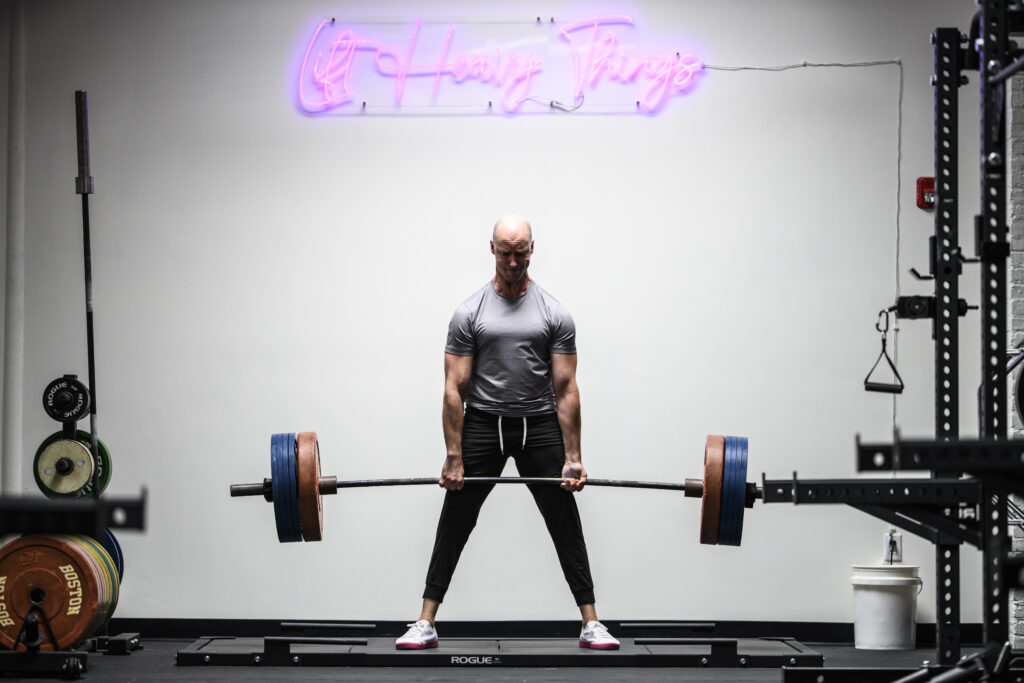
I’m not judging or bemoaning anything. I do it too…to a degree.

Which segues into the inspiration behind my first piece of writing since the last solar eclipse.

Training (and by extension…Progress) Comes in Peaks and Valleys

Lift heavy things

This past March, while walking from my car to the gym, I slipped on a patch of black ice and did what can only be described as the “World’s Fastest and Most Un-Graceful Sissy Squat.”Both of my knees slammed into the pavement and I felt a slight pop in my right.

Needless to say it didn’t feel great. Thankfully, when all was said and done, I didn’t suffer a catastrophic injury, having ruled out any ligament tears or obvious structural damage. However, in the month’s since it’s been an on-going nuisance working around things in order to train and workout the way I am accustomed to.

While I have still been consistent with my training…

#findyourtrainablemenu
#trainablemenu

…to say that I haven’t been frustrated would be an understatement. I’d say that from March of this past year to roughly two weeks ago, it’s been the worst stretch of training in my adult life. My desire to train was less than exemplary, there’s no question I was going through the motions, and not surprisingly all of my lifts took a bit of a hit.

And that’s kinda what I want to highlight.

I want to keep it real and remind people that there are always going to be inevitable speed bumps, road blocks, and general windows of clusterfuckery that will affect your training.

Progress is never going to be linear.

Photo by Nathan Dumlao on Unsplash

There will always be peaks AND valleys

Now, what causes those valleys to occur can be anyone’s guess:

  1. Injury
  2. Work and family obligations
  3. Vacation
  4. Season four of Slow Horses started.
  5. Explosive diarrhea
  6. It’s a Tuesday

The important thing to keep in mind is that, 1) despite what social media will lead you to believe, even those coaches/trainers/influencers you look up to the most have setbacks in their training (trust me) and 2) setbacks are normal and will undoubtedly happen.

There are a handful of strategies I’d encourage you to try when this happens.

1. Again, I can’t reiterate this enough…it’s normal

It won’t last forever, it will pass

    2. Reframe and Prioritize a New Lift or Body Part

    If your knees are cranky and you can’t hit your lower body as aggressively as you’d like, it might be an opportune time to prioritize your bench or overhead press or, I don’t know, your kipping pull-ups.

    Except, there’s never an opportune time to prioritize kipping pull-ups because they’re absurd.

    Photo by Alora Griffiths on Unsplash

    3. Find Your Trainable Menu

    Pigging back on the above, focus on what you CAN do rather than what you CAN’T do. I have never had a client who was working around an injury show up for a session and not feel better by the end of it because they did something.

    4. Choose One Lift, Do That, and Leave

    I actually like this approach a lot when I am feeling beat up (or traveling). Psychologically speaking there’s something to it. I know that if my intention is to train one lift hard and that’s all I plan to do for that particular training session it helps set me up for success. As an example it may look something like this:

    A. Barbell Romanian Deadlift – Work up to 1×5 @ RPE 8

    B. Accumulate 15 total reps at 90% of top set above.

    C. Wu-Tang is for the children.

    Photo by Erik Mclean on Unsplash

    Of course there are a plethora of other scenarios and options to choose from, but those are the ones that come up at the top of my head. I hope they help.

    1. But I wasn’t really joking ↩︎
    2. It’s pretty legit. Half of the space is dedicated toward appointment only personal training. The other half has dedicated “wellness” offices for physical therapy (Ripple Boston), chiropractic services (Stephen Laski), pelvic floor therapy (Dr. Mariam Taha), nutritional services (Cristine Seitz), and mental health therapy. Of note, 2% of the space is sequestered off for freestyle rap battles, Jason Bourne fight scene reenactments, and the occasional hug. Just because. ↩︎