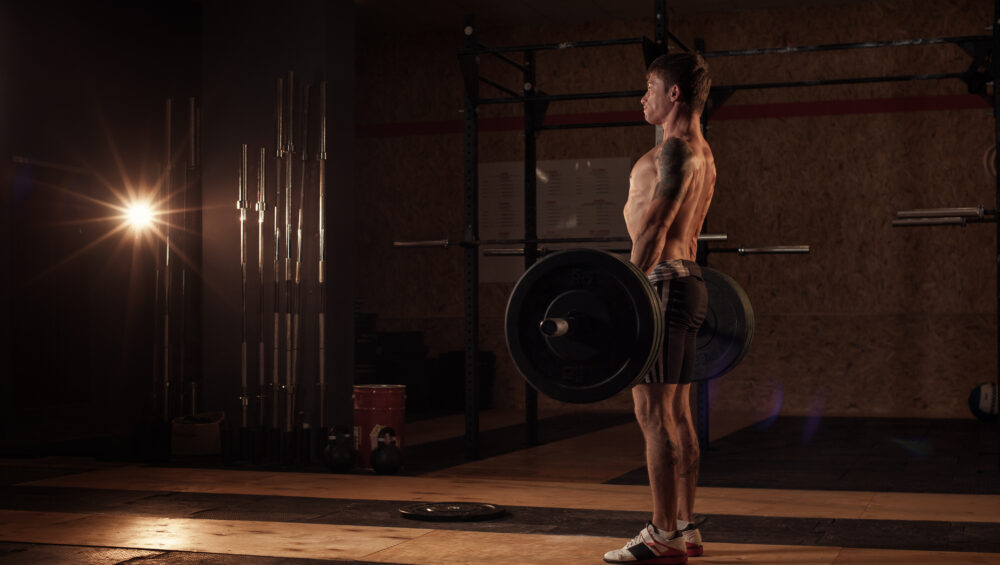
What’s unique about the deadlift – as opposed to the squat or bench press – is that it begins with a concentric, or overcoming, movement.
For a variety of reasons like leverages, mobility restrictions, it’s Tuesday, etc., starting from the floor can be problematic for some people. One simple way to build context, especially as it relates to the starting position from the floor, is to start at the end (or top) with an eccentric, or yielding/negative, movement.
You’ll essentially be performing an eccentric deadlift (RDL) until the barbell reaches the ground. When I have my athletes and clients do this drill I’ll stop them once they hit the floor and say, “Feel that position you’re in right now? That’s what I want to see (and for you to feel) when you begin from the floor.”
It’s a foolproof way to help build familiarity and to not overcomplicate things.
People are often surprised when I state I’m an introvert.
What most people fail to recognize is that “being an introvert” is part of a spectrum. No one is 100% introverted, nor are they 100% extroverted.
Everyone’s a little of both.
Another common misconception is that introversion is somehow correlated with being depressed or sad or downtrodden. In attempting to find a suitable image to go along with this post I simply typed “introvert” into my image finder thingamajiggy on WordPress and was quite surprised (if not slightly appalled) by what appeared on my screen:
Image after image after image of various people looking dejected, anti-social, and altogether unhappy.
It was quite striking, because all “being introverted” means is that you likely need or require a little more down time (or down tempo activities) in order to reenergize and recharge.
I remember when my wife and I first started dating there was a night where I had just gotten back from a full day of coaching and was zapped. All I wanted to do was collapse on the couch and watch House Hunters. Unfortunately (for me) it was a Saturday night and Lisa had already committed us to a get together with a bunch of her friends at a local lounge in downtown Boston.
Ten minutes in it took all the will-power I could muster to not walk out of the place and straight into the path of the #66 bus down the street.
I just stood there with a blank stare and repeated one word answers as she and her friends attempted to engage with me.
“Tony, Lisa tells me you’re a personal trainer?” Yes.
“How long have you been doing that?” Awhile.
“So, what do you think about keto?” Grabs beer bottle, breaks it over the counter, slits own throat.
When we eventually left we had one of our first arguments. Clearly I was acting like an a-hole, but after explaining to her that the last thing I wanted to do after coaching for eight hours was to go to a bar and listen to Panic! At the Disco, we had a better understanding of each other’s needs.
I explained I am not against going out and participating in social events, I just needed a bit of a “buffer.”
Being a coach – inundated with constant noise and non-stop interaction – can be draining.
An introvert requires the antithesis of that in order to feel rejuvenated and ready to go the following day.
To repeat: This doesn’t mean we don’t like to do or be involved in social activities.
Rather, in our free time we generally prefer to:
✅ Read a book ✅ Enjoy a barrage of kitty cuddles.
That’s pretty much it.
One common remark I receive from other coaches and personal trainers is what would I recommend they do to counteract their juices running on empty when they’re in the middle of a long work day?
What can they do when they’re five hours deep into a long work day and have a barrage of sessions yet to complete? It’s not like they can meander off into a hidden closet and take a power nap.
(or can they?????)
Likewise, is the expectation that we have to be the rah-rah, high-energy coach who jumps up and down everywhere and perform cart-wheels after every set in order to be considered “good” or successful?
Listen, the bulk of your clients aren’t expecting a Bad Bunny performance during their session.
Sure, there’s a time & place to amp things up and to be the cheerleader, but I’ve found that more often than not…
…most clients don’t care for the (fake) performative nonsense.
You can still be a switched on and attentive coach without the theatrics.
That being said, it still behooves you, introverted coach, to be proactive and give yourself sporadic breaks throughout the day. These could be brief 15-30 minute windows of solitude when you know you have a full-day looming. Or, when you know you have a solid line-up of clients scheduled, it may be worthwhile to break the day up where you get your own training session in half way through.
BUT MOST IMPORTANT OF ALL: Do NOT fall pray to this idea you have to be a performative coach in order to be seen as legit. That BS may get you likes on Instagram, but it’ll lead to nothing but eye-rolls in the real world. Not to mention it certainly won’t be doing you any favors from an energy conservation standpoint.1
BUT EVEN MOST MOST IMPORTANT OF ALL: Be sure to grace yourself with ample “me time” when you feel you need it. This could be sitting at home binging a show, going to the movies, hanging out at a bookstore of coffee shop, or, I don’t know, perusing your baseball card collection.
Remember: All being an introvert means is that you’re a fucking psychopath you likely require more solo time in order to reenergize.
It’s important to lean into it.
It’ll help make you a more engaged coach and your clients will benefit as well.
If you make a habit of lifting heavy things it’s inevitable you’ll likely experience a few setbacks along the way.
These can range anywhere from the “no big deals” (bloody shins from deadlifting, shoulder niggle) to the dire (disc herniation, explosive diarrhea).
…or worse case, forgetting your squat shoes on squat day.
Suffice to say: Getting hurt is frustrating. Attempting to work around an injury can be even more so.
It bothers me when people default to tossing their hands in the air and surrendering themselves to a two-to-four week window of “rest” and rolling the dice. There’s a lot of good that can be done, even underneath the umbrella of injury. Instead, I’ve long championed the idea of trainees finding their Trainable Menu and focusing more on what they CAN do rather than what they can’t.
Another way to re-frame things is to find your entry point.
In fact…here’s your entry point making an entrance to your next training cycle while you’re working around an injury.
Speaking of entry points: I remember a few years ago when I sat down with Julian to watch the original Jurassic Park. He was four at the time. Now, most coherent parents would start with something a little less scary.
You know, say, Dino Dana or, I don’t know, Care Bears.
Nope, I went with the ginormous, scary T-Rex.
In hindsight, it probably wasn’t the best “entry point” for someone who, at that point, had no idea dinosaurs weren’t real. Again, maybe Toy Story or, hell, Mighty Morphin Power Rangers would have been a more germane choice?
I gotta say, though…
…Julian handled the T-Rex like a champ.
He didn’t blink once. He giggled when the guy sitting on the porto-potty met his demise.
I didn’t know whether to be proud or scared shitless.
Kid’s the next John Wick in the making.
Okay, Cute Story Tony. But WTF Are We Talking About Here?
Yeah, yeah, yeah…
Lifting heavy things.
Entry Points.
I’ve recently been making my way through Dr. Michael Mash’s excellent resource, Barbell Rehab, and giving credit where it’s due…he spends quite a bit if time throughout the course discussing the idea of entry points and how to use the concept to guide anyone’s return back to a specific lift after injury.
Let’s use the bench press as an example.
If someone has pain when he or she bench presses with a straight bar, finding their entry point is nothing more than altering the lift the minimal amount possible in order to gain the minimum desired training effect.
For the visual learners out there it may look something like this:
Adapted from Barbell Rehab
TO BE CLEAR: If pain exists in the shoulder the idea is NOT to automatically regress all the way back to a push-up.
I know some people who’d rather swallow a live grenade than do that. Instead, the goal is to be as specific as possible in order to elicit a (relatively pain-free) training effect.
If someone has pain with a straight bar FLAT bench press, however it alleviates significantly when you switch them to a decline bench press.
Sha-ZAM.
You just found their entry point.
Maybe it’s DB Floor Presses for one person, and yes, maybe it’s a push-up (albeit loaded) for another. The idea is to TRAIN. Moreover, it also could just come down to tweaking their grip slightly or adjusting some component of their technique.
Rehab doesn’t always have to result in sending someone to corrective exercise purgatory.
Likewise, using the squat as an example, sometimes the entry point is using a different bar (Duffalo or Safety-Squat Bar) if the shoulder is the issue, or maybe it’s having someone squat ABOVE parallel if it’s their knee(s) or hip(s) bothering them.
Sometimes, and hear me out, we may have to combine the two: Not a straight bar AND above parallel.
I know what some of you might be saying…”Tha fuck outta here, Tony.”
Yes, it’s true. (please play video below and hopefully get a few LOLs. Or not)
A few weekends ago I was in London teaching a workshop with my friend Luke Worthington.
We had a group of 35 trainers from across the UK (and Europe) eager to learn more about assessment, program design, coaching up common strength movements, and how I rank the Bourne movies.2
One of the main umbrella themes we kept hammering home was that, contrary to popular belief, “tight” hamstrings isn’t really a thing.
Labelling the hamstrings as “tight” is often the default scapegoat and blamed for everything from butt wink to low back pain to male pattern baldness. So it wasn’t surprising to see the flabbergasted reactions from the majority of attendees when Luke and I kept repeating our message.
You would have thought Gandalf rode in on a Unicorn yelling “You shall not stretch the hamstrings!” based on people’s facial expressions.
What’s next: Water isn’t wet? Grass isn’t green? Ryan Gosling’s gaze doesn’t penetrate my soul?
Listen, I’m as skeptical as they come whenever anyone in the health/fitness industry uses the words “everyone,” “always,” or “never.”
Those are three words, when used ad nauseam, immediately scream “shady motherfucker with an agenda,” whenever I hear them.
It’s never the hamstrings. OR You should never eat past 7 pm.
Always avoid gluten. OR If you’re serious about fat loss, always avoid carbs.
Everyone must deadlift from the floor. OREveryone who reads this site is clearly off the charts intelligent and attractive. (<— 100% true).
There are nevertheless exceptions to every rule and circumstance. I’d be remiss not to tip my hat at the notion there are, indeed, people out there who have legitimately tight (or, more to the point, anatomically short) hamstrings.
That being said, I doubt you’re one of them.
I’m not going to sit here and say it’s never the case, but it’s such a rare occurrence that you’re more likely to win an arm wrestling match vs. a grizzly bear than actually having tight/short hamstrings.
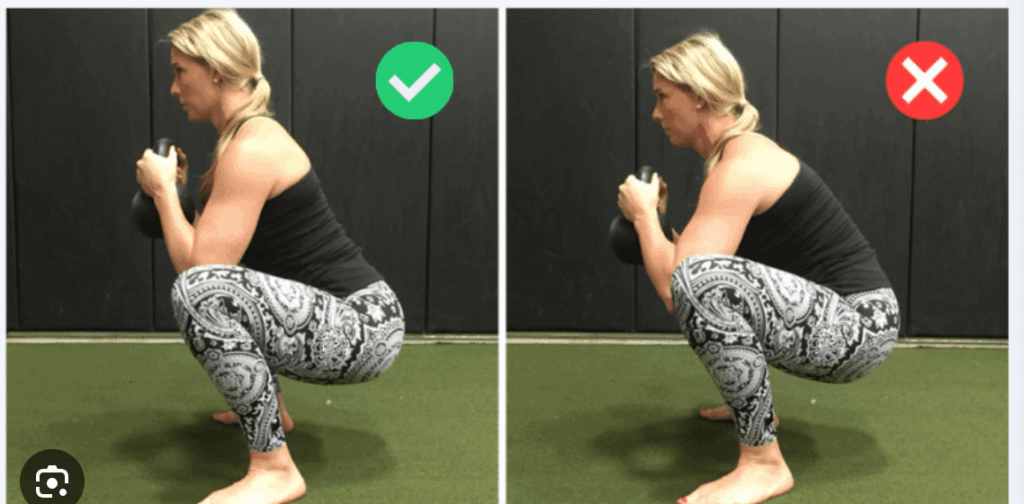
Take butt wink for example.
The common culprit is tight hamstrings (photo on the right).
But if we were to discuss (and respect) basic anatomy we’d note the following:
My pecs can cut diamonds.
The hamstrings are a bi-articular muscle group that cross both the hip and knee joints.
As we descend into deep(er) hip flexion – I.e., squat – the hamstrings lengthen on one end (hips) and shorten on the other (knee), for a net change of nada.
#itsnotthehamstrings.
But How Can We Tell?
It’s uncanny how many people I’ve interacted with in my career who describe having tight hamstrings, and after telling me they’ve been stretching them for 43 years (<— only a slight exaggeration), are still looking for that one magical stretch to cure them.
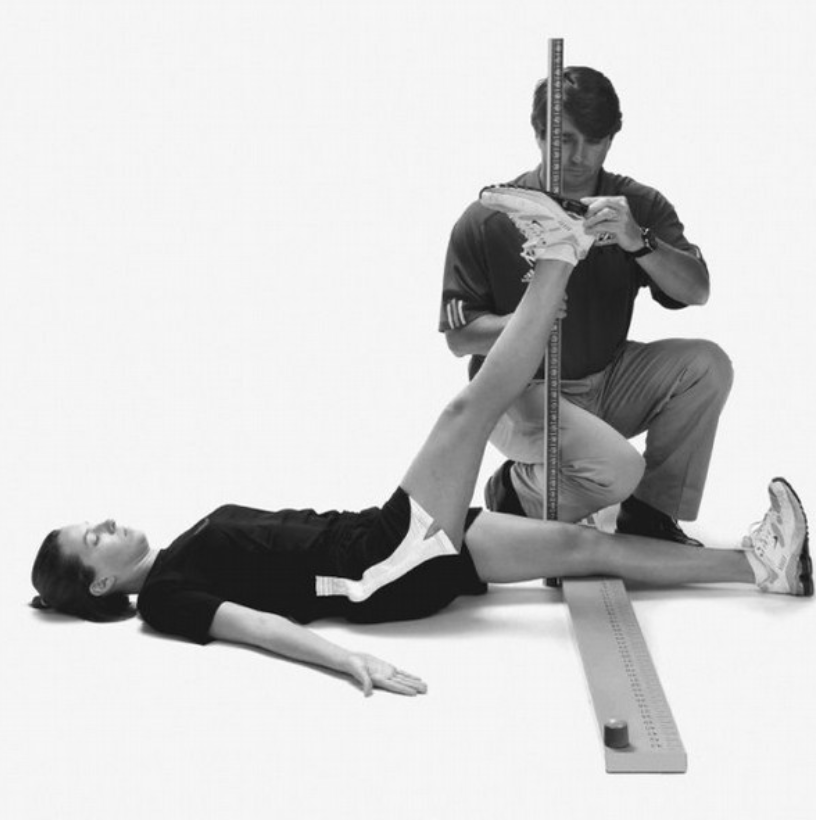
My first step is to plop him or her on an assessment table and ask them to perform a simple screen to ascertain whether or not they do, in fact, have tight hamstrings.
You lie the individual supine and ask them to slowly, while keeping one leg cemented to the table or floor, elevate the other off the table while keeping it as straight as possible. They keep going until they feel the first smidgeon of resistance (or you start to see compensations like the pelvis rotating, the foot rotating, and/or either knee start to flex).
An acceptable ROM is anywhere from 70-90 degrees of hip flexion.
A funny thing almost always happens.
Most people pass the screen with flying colors.
Me:“You don’t have tight hamstrings.”
Them: “The fuck outta here! You mean, there aren’t any other stretches I should be doing?”
Me:“Zero.”
Them: “Zero?”
Me:“Yep, zero.”
[Cue crickets chirping]
This finding doesn’t, however, dismiss the fact said person’s hamstrings still FEEL tight.
So, W……..T……….F?
Something is awry.
To peel back the onion a bit more I’ll then implement a brilliant trick I was reminded of by Ottawa based personal trainer, Elsbeth Vaino.
The Bridge Test
I’ll have the same individual perform a standard glute or hip bridge. They’ll get into position and then I’ll ask “where do you feel that?”
Many will immediately say “hamstrings.”
I’ll then have them perform a 1-Leg Glute Bridge and ask them to hold that position for 10-15 seconds.
Most don’t last five.
“YOWSA…..my hamstrings cramped up.”
Why?
The body’s #1 hip extensor is the glute max, and if it’s not doing it’s job well the body’s #2 hip extensor, the hamstrings, will pick up the slack.
In all likelihood, for most people most of the time, the hamstrings feel tight because 1) they’re overactive and doing double the work and/or 2) pelvic alignment needs to be addressed (more glutes and anterior core = more posterior pelvic tilt = hamstrings are put on slack).
NOTE: the latter point – hamstrings lengthened due to (excessive) anterior pelvic tilt – is why stretching them only feeds the issue. The tightness many feel is neural in nature, not because of true shortness. Stretching an already lengthened muscle only exacerbates things.
Something Else to Consider: Active End-Range Hip Flexion
To add another nail into the “it’s not the hamstrings” coffin I’ll also take a gander at one’s ability to move their hip into (active) end-range flexion.
This “trick” digs into some of Dr. Andreo Spina‘s work on Functional Range Conditioning (FRC) and is another splendid way to gently tell someone to stop stretching their hamstrings.
No diggidy, no doubt.
Final Word
The sensation of tight hamstrings is less about an anatomically short muscle which requires endless hours of static stretching, and more about improving:
Position/alignment of the pelvis via nudging people into a little more posterior pelvic tilt by hammering glutes and anterior core.
Active end-range hip flexion. Allow people to experience this position more often and good things will happen.
By focusing the bulk of your diet or nutrition plan on things like lean meats, vegetables, fruits, “healthy” fat, whole, minimally processed foods, going “off the grid” 10% of the time, and eating foods you enjoy – hello mint cookies-n-cream ice cream! – won’t really make that big of a difference in the grand scheme of things.
Life will go on, you’ll stay more consistent with your plan (and you’ll keep your sanity).
The Rule of 90% can also be applied to co-habitation (put the toilet seat down 90% of the time, and your spouse or significant other won’t want to stab you in the throat) strength and conditioning, albeit in a different context.
I wrote an article on T-Nation.com what seems like eons ago (2006!) titled, coincidentally enough, The Rule of 90%. Catchy, right?
In it I discuss how, if your goal is to improve maximal strength, it’s important to incorporate lifts at or above 90% of your 1-rep max.
Cliff Notes Version: lifting maximal weight (90%+) has a number of effects:
1. Maximal number of motor units are recruited.
2. Fastest MU’s are activated (high-threshold motor units).
3. The discharge frequency (rate coding) is increased.
4. Activity is synchronous.
5. Potential for future hypertrophy gains (especially when you revert back to a “hypertrophy” specific training phase).
6. While some argue whether or not the research is efficacious – it goes both ways – lifting heavy things helps to increase serum Testosterone levels.
7. Lastly, girls (or boys!) will want to hang out with you (<=== it’s science)
How It’s Applied (Watered Down Version, Like A Lot)
Lets say someone’s bench press max is 275 lbs, and the goal for a particular training session is to hit four singles at or above 90%. It may look something like this:
Bar x whatever
135 x 5
185 x 5
225 x 3
250 x 1
265 x 1 (feel good! Eff it, lets go for a PR).
280 x 1 (it was a grinder, but you got it).
From here, it’s important to note that ANY lift at 90% or above (275 lbs), counts. Doing the math, that means any lift which was heavier than 247.5 lbs.
So now we have ONE more single left. I’d opt for a clean rep with good bar speed.
260 x 1 (Nailed it! Lets go pound a protein shake).
Hitting lifts that are 90% or above one’s 1RM isn’t something I’d recommend for beginner or even most intermediate lifters. It takes a lot of experience and “time under the bar” to get to the point where handling that much weight is safe.
To that end, this approach IS NOT something I advocate for those with little training experience (lets say less than a year of consistent training).
However, that doesn’t mean we can’t still apply the principles to great affect.
Something I implement often (because I don’t go out of my way to test 1RM right off the bat) is the idea of ramping up to a 3 RM (rep max) – for that day – and then using the same approach as above, hitting a certain number of sets at or around 90%.
There’s a fair bit of autoregulation and “feel” involved, and results will vary depending on how someone feels any given day (A) like Randy Macho Man Savage after consuming 9000 mg of caffeine or B) a bag of dicks), but it gets the job done.
I’ll simply have someone work up to a challenging triple (set of 3) for that day, and then once they hit it, aim for “x” number of sets at or slightly above 90% of THAT number.
Lets stick with the bench press. Goal is to hit four sets at or above 90% of 3RM.
Bar x whatever
135 x 5
185 x 3
225 x 3 (bar speed is still good)
245 x 3 (starting to slow up, but still passable)
265 x 3 (last rep was a bit of a grinder. We’ll use this as our marker or “top set” for the day).
Doing the math, 90% of 265 is 238.5. So, any lift above that counts (245 and 265, respectively).
As always, I’d opt for clean, fast reps from here and would encourage someone to stick in the 245-255 range for their last two sets.
And That’s, That
Hopefully that makes some sense, and, of course, this is a strategy that could be applied to all the “big lifts” (squat, deadlift, bench press, chin-up, rows). Sorry, Tricep Kickbacks are off the list.
Too, I’d be conservative with how often it’s applied. 1-2 sessions per week would suffice (maybe use it for one lower body movement, and one upper body movement), but once a week would be a nice option for most.
Week 1: ramp up to a 3RM deadlift, hit 3-5 sets at 90%+ Week 2: ramp up to a 3RM bench press, hit 3-5 sets at 90%+ Week 3: ramp up to a 3RM squat, hit 3-5 sets at 90%+ Week 4: ramp up to a 3RM deadlift (try to beat your previous number), hit 3-5 sets at 90%+
So on and so forth.
All in all, I find this is a much more “user friendly” way to implement the Rule of 90% and something that most trainees could easily implement into their training.
They want to be told that 7-Minute Abs (or maybe we’re down to 5-Minute Abs now?) is all it takes to be beach ready, or that drinking an Acai berry detox tea mined from the belly button of a Centaur is the key to fat-loss.
I’ve heard of crazier things on Reels.
And then there’s the high-school athlete who reaches out two weeks prior to tryouts, as if I’m a wizard and all I have to do is wave my wand (and insert a few sets of box jumps) and PRESTO…
…they’re going to be as equally prepared as those athletes who have been training and working out for several months.
It’s quite interesting isn’t it?
Everyone is seeking the silver bullet to success.
However, on the contrary, in my experience, whether someone’s goal is weight-loss/fat-loss, muscle gain, improved athletic performance, general health, or, I don’t know, to beat John Wick in a street fight, the “x-factor” often comes down to the mundane.
The stuff most people scoff at and altogether dismiss in lieu of the new, bright, shiny object in the room.
Like This Stuff
1. Expectation Management
You know how it’s popular nowadays for personal trainers and strength & conditioning coaches to go out of their way to not refer to themselves as personal trainers and strength & conditioning coaches?
You know, stupid shit like…
Body Architect
Human Performance Advocate
Movement Mechanic
Supreme Chancellor of Douchiness to the Douchiest Power
I feel as if I have a superlative title for myself too.
Manager of Expectations
Whenever someone asks me “how long will it take to….[insert goal here]” I’ll respond with “I have no idea.”
Moreover, I’ll say something to the effect of:
“Consider me your Sherpa. I’m here to guide you and point you in the right direction towards your goal(s) to the best of my ability, and to do so in a time efficient, fun, and safe manner.”
And if that doesn’t impress them I’ll say this:
“3×52.”
Meaning, if I can nudge them in the gym 3x per week, 52 weeks out of the year, then it stands to reason some good shit is going to happen.
Rather than place a specific number or time frame on a goal, it’s my job as their coach to titrate their expectations and to reframe things towards the idea of CONSISTENCY.
Then, after a while (and yes, with a bit of butting of heads), they’ll learn that progress is more about appreciating the journey rather than the destination.3
Honestly, whenever I have a conversation with a client/athlete and (s)he is concerned about progress (or lack thereof), before I audit their program/nutrition I’ll look to see whether or not they’re doing the following.
Go for a Walk
I used to think it was cool (and I was doing the industry a favor) being an uppity coach who said stuff like “walking is life, stop saying it’s exercise.”
That was dumb.
It IS exercise, and undervalued.
Not all exercise has to be a ball-buster.
Walking = recovery. Do more.
— Tony Gentilcore (sometimes I sound smart. Or like an old man. Whatever)
What’s more, going for a (brisk) walk is a great way to expend energy in addition to helping to improve mental health.
What’s more (even morer), walking is exercise that’s accessible to anyone with working legs – so it’s pretty hard for someone to conjure up an excuse to not do it.
Do yourself a favor and check out the hashtag #walkeverydamnday and maybe reconsider your position if you’re someone who feels telling someone to go for a daily walk is silly or beneath your superior coaching skills.
2. Go to Bed
I am a huge fan of going to bed.
In fact I am such a fan of going to bed (early) that I’m pretty sure I have entered cantankerous curmudgeon territory at the age of 48.
Maybe stop bragging about getting up at 4 AM every day because #hustleandgrind and the subsequent contrast baths and get some sleep instead?
3. Hydrate
By now some of you reading don’t have enough eye rolls to give. But here’s one more suggestion to bring things to a nice, tidy, conclusion.
Ask your clients whether or not they’re hydrated?
This isn’t so much a “are you drinking 8 glasses of water per day?” kind of question as it is “what color is your pee?” question.
Clearer Pee = good to go.
Pee the color of battery acid = not so good to go.
It’s been clearly shown in the literature that chronic dehydration can affect performance in the weight room – upwards of 8-10%. Likewise, chronic lethargy can be attributed to lack of hydration, in addition to it affecting basic metabolic functions.
I.e., the body’s ability to burn energy is diminished the more dehydrated someone is.4
“Wow, Tony. Telling people to go for a walk, get more sleep, AND to drink more water? This is next level shit. What’s next? Flossing? No, wait…look both ways before crossing the street?”
I get it.
I am not saying anything revolutionary, nor anything we all haven’t heard before.
That being said…
…we do a superb job going our of our way to overlook these factors.
I can’t believe we still have to have this “debate” in 2025.
While it’s not nearly as prevalent of a thought process as a decade or two ago, there are still people out there under the impression that lifting appreciable weight – and therefore, by extension, squatting – will result in big, bulky, and stiff muscles.
Merely looking at a barbell will make you tighter than a crowbar.
I don’t even think that makes sense, but whatever…you get the idea.
The same people who fall prey to this mind-trap are the ones who likely still believe lactate acid causes muscle soreness, creatine is a steroid, starvation mode exists, and that Tom Selleck doesn’t have the sexiest and manliest mustache of all-time.
I could opine judiciously on why I feel the argument that lifting heavy/squatting makes you tight is a tepid and weak one at best, but I’m not going to because 1) this is blog post and 2) it’s not a dissertation (and I’m hangry and need to eat something).
Too, I can respect and appreciate that people are at the mercy of their milieu and can often succumb to the atmosphere, anecdotal experiences, and the echo chambers that feed into their biases.
I get it: You watch one too many Tom Brady documentaries and the idea of touching a barbell (or a tomato) makes you sick to your stomach.
Nevertheless, I do feel it’s a silly stance to take.
“Squatting doesn’t make you tight. Squatting like shit does.”
Make no mistake: There are many nuances to consider with regards to squat technique and what variation, setup, and execution will be best suited given an individual’s injury history, goals, ability level, genetics, and anthropometry.
I don’t think there’s any ONE best way to execute or coach the squat, and I lose a lot of respect for coaches and trainers who play all hoity-toity and think THEIR way of coaching it is the only way to do so.
Again, and this can’t be reiterated enough:
Injury/health history
Goal(s)
Ability level
Genetics
Favorite He-Man character
Anthropometry/leverages…
…all need to be taken into consideration when coaching up the squat.
The internet likes to argue semantics on bar position, hand position, depth, stance, what day of the week it is, barometric pressure, and a myriad of other things that may or may not matter when it comes to enhancing squat technique and performance.
For me, so long as the feet, ankles, knees, and hips are appropriately positioned and loaded (using all the info above as guidance), “neutral” spine is maintained, and we’re doing all we can to prevent any destroying back of pants…
…we’re (probably) accomplishing some good things.
Moreover, if you think about what’s required to pull off a decent looking squat:
We could make the case that everything listed above is a splendid way to “offset” sitting at a desk all day, particularly when you consider a loaded squat will nudge or force people to adopt a little more thoracic extension, which is rarely a bad idea for that population.
By contrast, squatting (and by proxy, lifting appreciable weight) correctly can be viewed as the opposite of making someone tight.
NOTE: For some more insights on how I address squat technique check THIS and THIS and THIS out. Oh, and if your favorite He-Man character isn’t He-Man you need to check yourself before you wreck yourself.6
What’s our obsession with making things hard or complex?
The Lost Art of Simple
I remember when I was a kid all I needed to entertain myself was my bike. I’d ride around pretending I was Knight Rider talking to my bike as if it were KITT.7
“Turbo boost KITT.”
And then I’d pedal faster.
“Oh snap, we’re under heavy fire and need to perform counter measures.”
And then I’d swerve back and forth between trees avoiding every heat seeking missile sent in my direction.
“KITT, eject, eject.”
This is when I’d point my bike in the direction of some sweet jump I’d have constructed, and, well, this would happen:
Nowadays you ask a kid to go outside and play and they’re looking at you as if you have three heads and wondering how that’s even possible without an iPhone in hand. It’s almost as if there has to be some form of technology or gadgetry involved.
A frisbee? No way.
A wiffle ball and bat? Pfffft, whatever.
A tree? Hahahahahaha.
The simple days of simple games are long gone. I mean, I know they exist, and I know there are kids out there still playing hide-n-seek, kickball, and pick-up basketball.
But it’s few and far between. Pokemon Go, seemingly, has replaced the playground.
I can’t help but notice the same parallel in the fitness industry. People (on both sides of the fence: fitness pros and non-fitness pros alike) seem to be under the impression that fancy or complex is somehow better than simple. And maybe even more tragic: many believe that better results are always a result of adopting complex methodologies over the simple ones.
Sometimes this is true. Oftentimes it’s BS.
I’ve had my fair share of other coaches coming in to shadow and observe for a few hours at a time. It’s always an honor and I am more than willing to accommodate. Sure they could spend their time reading Mike Boyle or watching any litany of fitness people on Instagram, but no, some choose to come in on a Saturday to watch people deadlift and listen 90’s hip hop.
One theme I am becoming more cognizant of is how surprised some coaches are about how “simple” my programming is.
There’s very little glitz and glam or shiny bright objects to pivot from the fact that all I really want is for my clients/athletes to become unapologetically brilliant at the basics.
People squat, people hip hinge, and people perform these things called rows, push-ups, and Farmer carries.
You may have heard of them.
Antiques to some, I know.
Furthermore, is my assessment process.
The idea of simple starts there. Unless someone is coming in with a lengthy injury history or is training for something super specific like, say, I don’t know, the Mime Bombsniffing Olympics, what advantage is there in making the assessment more complicated than it has to be?
Taking a more global approach is a fantastic starting point for most people. There’s no need to put them under a microscope. If anything, for most people most of the time, their “assessment” is nothing more than an opportunity to weed out “red flags” by taking a quick peek at hip IR/ER, hip flexion/extension, and other things like overhead shoulder mobility.
In a sense I’m trying to see what their passive ROM is, are there any limitations, and if so, 1) does it match their active ROM and 2) are there any test/re-test strategies I can implement to see an improvement?
To a larger degree (and stealing a quote from my friend, Luke Worthington):
“Can you do the thing that you want to do? Yes. Good. No. Let’s fix that.”
Here’s the Thing: 80% of my assessments are done on the gym floor. There’s only so much poking and prodding I can do on table before A) shit starts getting weird and B) the client starts feeling like a patient.
In reality the assessment should be a watered down training session.
I want to see them squat.
I want to see them hip hinge.
I want to see them get up off the floor.
I want to see them Sparta kick the wall.
I can glean way more information watching people move. And too, they get a taste of what a typical training session will be like with me.
It’s a very simple procedure that, when some coaches observe, comes across as super-duper minimal, and it throws them off, as if to say, “Really? That’s it?”
Yep, that’s it.
People want to train.
They could give two flying shits about their big toe dorsiflexion. Trust me.
Funny Side Story: I was once given a “bad” review at a conference I spoke at because in my topic, “Shoulder Assessment,” I didn’t demonstrate anything “new and innovative.” To which I was like, “Well, since when does shoulder assessment need to be new and innovative?” Why not take the mindset of doing the “boring” screens well?
Note to Self: Bring a flame thrower to next speaking engagement. That will add some innovation.
Going Back to Programming.
This is another component where I feel simplicity has its benefits.
The never-ending game of oneupmanship on social media many fitness pros play is exhausting. This is a conversation for another day, but the LOOK-AT-ME, performative vibe many take is absurd. I watch some of the videos people put up and all I want to do is say “Riiiiiigggghhhhttt.”
I also want to throw an ax into my face, but that’s besides the point.
Comparatively speaking my Instagram feed is probably batshit boring to some people.
A video posted by Tony Gentilcore (@tonygentilcore) on
I can hear the cacophony of “BFD” comments now. “Wow, cool Tony. You have your clients squat. What’s next: A set of chin-ups?
No, wait, Pallof Presses!?!?!”
Actually, yeah. Probably.
Call me crazy, but I’d rather educate and provide a rationale for putting up certain videos/pictures (cute cat pictures aside) than worry about whether or not I’m earning some fleeting social media credibility.
What’s more, you wanna talk about boring and vanilla? Grab two back-to-back programs of any client of mine and it’s a safe bet you’ll see more of a linear periodization approach, which is about as vanilla as things gets. Take my client Sara for example (the woman in the video above).
On the days she trains with me at CORE we tend to focus more on the coaching-intensive exercises like squats and deadlifts. We’ll first hit one of the two hard (generally, lower reps/mid to higher intensity loads) and follow suit with “everything else.”
Here’s how we approached her squats and deadlifts the past two months.
October
Sumo Deadlift (Weeks 1,3), Back Squat (Weeks 2,4)
Week
Sets
Reps
Load
1
5
2
85%
2
Hit 135×1
then
3×5
115 lbs
3
3×1 @90%
then
3×5
75%
4
Hit 140×1
then
3×5
120 lbs
November
Sumo Deadlift (Weeks 1,3), Back Squat (Weeks 2,4)
Week
Sets
Reps
Load
1
4
5
75%
2
135 x (2×1)
then
3×3 @
125 lbs
3
5
5
75%
4
145×1
then
3×2 @
130 lbs
If you pay particular attention to her squat progression, it’s more or less me ensuring she was doing more work each week.
Nothing magical or advanced at all.
And it worked.
She smoked a PR of 145 lbs this past Monday. While listening to Lil Kim. Because that’s how we roll.
Program design doesn’t have to be complex.
All it really comes down to is ensuring you’re coaching your clients well (<– a lost art in of itself) utilizing stances and grips and bar placements that suit their goals and anatomy…
…and that they’re placing a premium on doing more work over the course of several weeks/months.
Simple and Boring. It Works
I’m willing to bet your clients will prefer a simpler approach (if not thrive on it) once you give it a fair shot.
People tend to not need as much novelty as they think. Muscle confusion is a stupid concept. People need consistency in order to master movement.
You don’t always need to increase load. People need to earn the right to increase weight on the bar. Staying within a certain range for several weeks and accumulating volume is often a undervalued way to progress.
Try not to make assessment to much of a thing. Granted, if someone has a lengthly injury history you may need to go down some sort of rabbit hole to figure out what exacerbates their symptoms. And then attempt to address it. But more often than not people will appreciate you not putting them under a microscope. If you treat the assessment as more of a training session and not some sick game to point out every miniscule dysfunction and how much of a walking fail someone is, they’ll be less likely to think you’re a douche.
In the same vein (I.e., I’m “stealing” another idea), my good friend and former business partner, Eric Cressey, wrote a fantastic post titled The Most Important Three Words in Strength and Conditioning that I felt hit the nail on the head, and also served as a bit of inspiration for me. While I’d encourage everyone reading now to click on the link above, I won’t leave everyone in the dark.
What were the three words he alluded to?
“I was wrong.”
It takes a bit of courage and moxy for someone to be so transparent and admit when he or she is wrong. And for whatever reason, compared to other professions, the strength and conditioning community has a really, really, really hard time admitting when it’s wrong.
I shouldn’t toss the whole industry under the bus. That’s unfair and shortsighted. But I’d be remiss not to say there are a fair number of people within the industry who are stubborn and refuse to admit when they’re wrong.
I mean all you have to do is spend ten minutes on social media and you’ll come across any number of petty arguments and dick measuring contests as to who’s right. The steady state cardio crowd argues with the HIIT crowd. The total calories are the only thing that counts crowd argues with the IIFYM (If It Fits Your Macros) crowd. The strength coaches argue with the yoga instructors. The powerlifters argue with the bodybuilders. And everyoneargues with the Vegans.
And NO ONE admits when they’re wrong. Ever.
It’s like the ultimate starring contest…..
Which is why I felt Eric’s post was so refreshing and something that NEEDED to be said. It’s actually okay to admit when you’re wrong. The Mayan Apocalypse isn’t going to start.
All the cool kids are doing it.
And I’d even go so far as to say that admitting when you’re wrong is mandatory for personal growth and development.8
Unless your name is Gandalf or Dan John you can’t expect to be right 100% of the time. Admitting when you’re wrong takes balls (and ovaries!), and I feel most people respect those who are confident enough to accept that they’re not infallible more so than those who pretend to be know it alls.
Which brings me to the other three words.
I remember my first trip to London for a workshop I was teaching, I had a few days to walk around and take in the sights and sounds.
I LOOOOOOOVED London. It was my first trip to Europe, and being a nerdy history buff I was excited to see many of the historical landmarks and architecture that you just don’t come across here in the states. You know, like a 10-11th century castle (The Tower of London) right smack dab in the middle of a city:
Moreover it was bit of a culture shock to have people smile at you and say “good morning.” Likewise, it was equally “shocking” to get used to some of the British slang.
Me: “Can you point me in the direction of Trafalgar Square?”
Brit: “You’d be bloody barmy to go there this time of day. If you fancy it and you’re full of beans, I’d suggest the South Bank. Cheerio. Spot of tea. Winston Churchhill.”
Me: “Uhhhhh, I don’t know?”
Facetiousness aside, this was an easy example of a time where I wasn’t scared to say the words, I don’t know.
Or take a few years ago when Lisa and I were down in Florida and we met with our wedding planner.
Lisa: “Babe, which DJ did you like better?”
Me: “I don’t know.”
Lisa: “Babe, do you want a photo booth during the reception?”
Me: “I don’t know.”
Lisa: “Babe, which table cover do you like best?”
Me: “I don’t know.”
Lisa: “Babe, I swear to god I’m going to punch you in the mouth if you say “I don’t know” one more time.”
Me: “I don’t kn…..wait, huh? OWWWWWWWWWWWWW.”
The point is, there are plenty of incidences in everyday life where we don’t tip-toe around the phrase I don’t know.
Yet in the strength and conditioning world those three words are almost considered taboo. It’s as if admitting you don’t know the answer to something is cause for handing in your man-card.
And that’s unfortunate.
I’d like to think I know the answer to most gym-related things I’m asked…but even on the off-chance I’m flummoxed, I’m not afraid to say it……..
I don’t know
If anything I think the person asking respects the admission MORE than if I tried to pawn off some BS diatribe.
What’s more, I come across as a jerk if, down the road, the person finds out the actual answer and realizes I just made something up on the fly. How am I supposed to build trust – and more importantly, integrity – as a fitness professional if I’m pretending to know the answers?
Listen: It’s impossible to be an “expert” in everything. Ask me how to deadlift, and I’m your man. Ask me to explain the Kreb’s Cycle and you’ll get nothing but crickets chirping.
That said, I do feel it’s in every fitness professional’s best interests to own a niche or topic. Cressey Sports Performance owns baseball training. Mark Fisher Fitness owns Broadway. Molly Galbraith, Nia Shanks, and Joy Victoria own female training. John Romaniello owns fat-loss (and dick jokes). Jon Goodman owns personal trainer development. And I could go on and on with examples.
This isn’t to say that none of the above don’t have experience outside their niche – they absolutely do!
But I guarantee they’re not afraid to say “I don’t know” and are willing to 1) own it, 2) say something along the lines of “give me some time and I’ll find the answer for you,” and/or 3) point people in the direction of someone within their network who DOES have the answer.
Rule of Thumb: don’t pretend to be something you’re not. Accepting your limitations as a fitness professional – and saying I don’t know – is just as valuable as being able to regurgitate all the insertions and origins of every muscle…..in Elvish.
Both are impressive. But it’s the former that separates many of the good trainers and coaches from the great ones.
NOTE: I was perusing some of my old blog posts recently and came across this one. I re-read it and remember how embarrassed I felt when what I describe in the post below actually happened. I felt it resharing it would be a nice reminder to all fitness professionals to remember…you’re always being watched. Act accordingly.
I felt like an asshole yesterday. And when I say “I felt like an asshole,” I don’t mean in the rhetorical “haha, I did something goofy and feel like an asshole” sense. I straight-up felt like a heaping pile of asshole.
HINT: I was an asshole.
To get right to the point: I let a client down. And it was 100% on me.
I hope this will be a lesson to every fitness professional reading that you’re always being watched and that you’re always making decisions – whether directly or indirectly – that will affect your business and people’s perception of you.
However, before I dive into my assholiness from yesterday, I hope you won’t mind if I take a second to butter myself up and break down a scenario where I was less of an asshole.
I think it goes without saying most personal trainers and coaches – at one point or another, have experience working in a commercial gym.
Admittedly, it can (not always) suck. One of the biggest drags is many trainers are left fending for themselves in terms of harvesting their own clients.
This can be a daunting task for those new in the field, are a little more introverted, and otherwise inexperienced.
Whenever I’m contacted by someone asking me advice on this topic, my immediate response is:
“Act as if you’re always being observed or judged.”
A great example would be how you approach floor hours.
Most (new) trainers at most clubs are required/obligated to accumulate “x” number of floor hours per week. It’s more or less the fitness industry’s version of hazing or probation/purgatory, where you walk around the club feeling like a tool picking up after everyone else’s mess.
If I had to liken it to anything, it would fall somewhere between preparing your taxes and jumping into a shark’s mouth as far as things I’d rather be doing.
Anyways, when I had to do it I used it as an opportunity to get in front of as many people’s eyes as possible. I’d say hello, make eye contact, and occasionally offer some advice on technique, unique core exercises, or maybe strike up conversation on favorite GI Joe characters.
You know, cause I was cool.
All told I used my floor hours as an opportunity to provide a service and to reel people in as clients.
And speaking of clients, when I was with one, I’d always, ALWAYS make sure to give them my undivided attention. I’d be on-time, had my programs ready to go, and always prided myself on being more proactive, giving cues and feedback at all times. You know, coaching.
As a result, on many occasions, I’d be approached by other people asking if I had openings because they had been watching and observing me throughout the weeks or months prior.
Little did I know – at the time – that I was constantly be observed and judged.
It resonated with me then and it’s something, still, that’s important to me now. It never gets old when, after working with me for a handful of sessions, a new client mentions how much they appreciate my approach compared to past experiences they’ve had with other trainers and coaches.
They’re being coached rather than babysat for.
I don’t say this to be vainglorious, but interpret it as you will.
But Back to That Me Being an Asshole Part
All of this to say: we all fuck up from time to time. Or, maybe a bit more of a germane way to put it: have a slight lapse in judgement.
Most days I show up 10-15 minutes prior to clients showing up at CORE.
I had two clients scheduled to show up yesterday at 4 PM. 3:30 hit and I was still home prepping the day’s blog post and catching up on emails.
3:40 hit and, while I knew I was pushing my luck (my gym is only a mile from my apartment, but still a 10-15 minute commute that time of day), I had to post the article up on Instagram.
Priorities, right?
“Okay,” I thought to myself, “I’m probably going to be a teeny-tiny bit late. I’ll shoot my clients a quick email to let them know I’m on my way and that I’ll be a few minutes off.”
No biggie.
Feeling justified, I rushed out the door and headed to CORE.
I arrived at 4:03. Both clients waiting outside the side of the building trying to avoid the first oppressively hot day.
Joe, an accomplished businessman here in Boston (12,000 employees answer to him) who just started with me three weeks ago and has been an exemplary client – shows up on time every session ready to work his ass off – was the first to greet me.
“Hey man, it’s past 4 o’clock.”
“Yeah,” I said, “sorry I’m a little late.”
“Stop posting on Instagram and lets get to work.”
He saw my post. He called my BS.
What an asshole I was.
Joe wasn’t malicious or anything, or even that mad. I think. He didn’t even make me being late a thing. He said what he said, and we did, we got right to work. However, his matter of fact way of calling me out on my momentary hiccup really punched me in the gut.
And, honestly, it served as a nice wake-up call.
I’m better than that.
You’re better than that too.
Let this be a lesson: You’re always being watched.