CategoriesUncategorized

Stuff to Read While You’re Pretending to Work: 9/11/12

I don’t like to be that guy who makes excuses, but there are some legit reasons why I wasn’t able to post a blog yesterday (and for that matter, why my blogging frequency may subside a bit within the next few weeks).

On top of my normal writing demands and some smallish projects I have marinating on the side (how’s that for a teaser?), I also have to start collecting my thoughts on my presentation for the Cressey Performance seminar next month, and I was also asked if I’d be interested in participating in MovementLectures.com, which is a fantastic site run by Laree Draper featuring some pretty big names in the industry like Gray Cook, Charlie Weingroff, Alwyn Cosgrove, Dan John, Mike Boyle, to name a few.

To throw my name into the mix alongside those peeps is kind of a big deal for me, and speaking candidly, makes me want to reach for a brown paper bag and start to hyperventilate into it.

What’s more, in the next couple of weeks many of our pro-baseball guys will be making their way back to the facility to kickoff their off-season training (six have already showed up), and to say that things will be getting busy would be an understatement.

In short, I have all sorts of fun activities in the pipeline, but trying to find ample room to squeeze them in is what’s at the heard of the matter.

If only I had a bunk bed!

Note:  My apologies for those who don’t get the movie reference there. If that’s the case, this may help:

 Gender Differences in Fat Metabolism – Mark Sisson

My girlfriend is obsessed with three things:  Channing Tatum, Ryan Gosling, and Mark’s Daily Apple.

She sent this article my way the other day after it herself with the title “I really love this post.”

So of course I read it, and immediately could see why she liked it so much.  Here’s a direct quote from the post which I feel NAILS IT:

Women – don’t be concerned about a little (or more than a little) subcutaneous body fat, especially on your lower body. If you’ve been trying in vain to lose that stubborn jiggle on your thigh, consider that maybe, just maybe it’s there for a reason. Even if you’re not interested in having a child, it’s likely that the presence of lower body fat indicates good health. You don’t have to get pregnant, but the ability to do so is probably a marker of good health, and the research outlined above suggests that classically feminine patterns of fat deposition are healthier than classically male patterns.

Now, as far as that whole Channing Tatum thing is concerned, I don’t see what all the fuss is about. I mean, sure, he can dance like no ones business, has the sultry gaze that could melt anyone’s knees, has abs that could stop bullets, and his lips look as soft as 800 count bed sheets, but…..I can’t, I can’t stop. He’s so.  He’s so…..

Dreamy. GODDAMMIT he’s an attractive man!

Carb Back-Loading Step 1: Breakfast – John Kiefer

As a diehard breakfast fan, I thought I’d never say this, but:  I’m currently no longer eating it.

Well, all I’m really doing is pushing it off till later in the day, but that’s neither here nor there.

Fellow CP coach, Greg Robins, turned me onto some of John Kiefer’s work, and I have to say, it makes a lot of sense.

This article discusses why breakfast – despite what we’ve told since we were kids – may in fact be the most OVERrated meal of the day.

Interesting stuff.

Dude, So and So Got SO Jacked For That Movie: Tom Hardy – Jamie Lewis

Be forewarned:  this site is definitely NSFW!!!!!!! So, if you’re easily offended by potty mouth language and/or graphic images, or you work in a place where you’re surrounded by grandmothers knitting blankets, you might want to wait until you’re in the comfort of your own home to read this post.

That said, it’s freakin awesome!11!1!

For those who don’t know who Tom Hardy is:  he played the character Bane in the latest Batman movie, and he’s also the guy with traps the size of Kansas in the movie Warrior.

As is the case every time an actor transforms his body for a role (Hugh Jackman in Wolverine, Will Smith in I am Legend, Gerard Butler in 300), people want to know how they do it! How are these “normal” people seemingly able to mold their bodies into what mounts to real life superheros?

Well, this post tells you how.
 

CategoriesUncategorized

Science For Smart People

In the strength and conditioning world, you generally have two camps:  those who base everything they do – from exercise selection, what order they place said exercises in, # of set/reps they prescribe, even rest periods – off of what some scientist or researcher has to say on the matter.

I can respect that.  Truly, I can.  I’d be remiss if I didn’t acknowledge that much of what we’ve seen in the past 25+ years in the realm of (enhanced) performance training is the direct result of some very smart people doing a lot of painstaking research.

But I’d also be delinquent if I didn’t note that what’s seen in a lab – where most everything is conveniently controlled – isn’t necessarily what you’d see in the weight room where everything isn’t so neat and orderly.

In short:  results in a controlled environment don’t necessarily equate to the same results out in the real world where projectile vomit comes into play.

Which takes us to the other side of the camp, where those who like to take more of an “in the trenches” approach reside.

These are the people who tend to throw research by the wayside and will just haphazardly do whatever it takes to get the job done, often taking the mentality that “no pencil neck geek who wears glasses, has never lifted a weight in his or her life, and watches Jeopardy “for fun” is going to tell me how to train my athletes!!”

This, too, is flawed (and not surprisingly, often leads to a lot of games lost due to injury).

I like to think that I’m more of a middle ground kind of guy. As much as I absolutely abhor reading and dissecting research (babies are made from rainbows and Chuck Norris’ beard, right?), I understand that it’s an important component to better understanding the human body and how that parlays into writing safe and effective programs.

NOTE:  thankfully, guys like Bret Contreras and Chris Beardsley do most of the research for me!

And guys like Mark Young provide insight on how to actually interpret research.

As well, the weight room can serve as my own “lab” so-to-speak.  I don’t always need some random study to tell me that something works.

“See that barbell on the floor?”  Lift it.  Repeatedly.”

Voila – we now have a badass in the making.

Anyhoo, jumping into the nutritional world, the dichotomy between research and nonsense gets a little murkier.

The mass media certainly doesn’t help matters, what with peeps who should know better, but unfortunately are more concerned with television ratings than giving people sound advice – yes I’m talking to you, Dr. Oz – opening their mouths.

Like this gem, where he told everyone that raspberry ketones are a fat loss miracle (amongst other monstrosities).

Compound this example with the latest “research” (please note quotations, because I could find better research in a cow’s anus) of egg consumption being compared to cigarettes at increasing one’s chances of heart disease, and it’s not hard to understand why many health professionals – myself included – can’t help but bang our heads against a wall.

“Science” isn’t always science.  Or, at least what’s pawned off as science by some researchers (and then regurgitated by eager reporters looking for a quick story) isn’t always truthful or remotely correct. Not by a long shot.

Of course if you’re like me, research can be confusing if not downright impossible to read, and being able to analyze it is akin to long division, or figuring out why it is people actually care about what the Kardashian’s are doing.

Bringing this to a nice – albeit brief – conclusion, what follows is a video by Tom Naughton which does a fantastic job of explaining the faux pas that is “science” and “research.”  Especially as it relates to the mass media.

I thought it was fantastic, and I think you will too. It’s super entertaining and he does a wonderful job shedding light on some of the shady happenings behind the scenes.

Definitely worth the 4o+ minutes if you have it.

CategoriesStrength Training

Hold On For a Bigger Deadlift

I have a special treat for everyone today.  Anyone who’s read this blog for any length of time knows I have a special place in my heart for three things:

Beef jerky (or any form of dead animal flesh, really), Star Wars, and deadlifts.

Today I have a guest post by Adam T. Glass. Adam is currently the No. 2 grip athlete in the country, setting records left and right, and head trainer at Movement Minneapolis.  

He can do all sorts of freaky-deaky things like lift a crap load of weight, bend horseshoes, and rip the space-time continuum in half with his bare hands (the natural progression after phonebooks).

Adam reached out and asked if he could write a guest post on how improving grip strength can correlate very well to improved numbers with the deadlift.  Of course I said yes.

Enjoy!

Almost inevitably, when I reveal to fellow lifters that I am a grip sport specialist, I get asked how to improve grip strength for these two lifts: deadlifts and pull-ups. Many people have been told that training these movements is enough for strong hands — and they believe it. In a sense, they’re right, but not training them the way most people do.

The issue is the equipment. Specifically, barbells and dumbbells are shaped to place minimal stress on the hands when training. A one-inch barbell is designed to be as small as it can be without digging into the palm or fingers. Any bigger and it’s harder to hold onto. A public demand for comfort has led to a narrowing of handles over the years, but that, in turn, has led to a weakening of the hands.

So, it won’t be very useful for me to simply tell you to abandon lifting straps and gloves, or to hold the bar for a beat longer at the top. Instead, I am going to share a few new ways that will actually improve your hand and wrist strength. Work these exercises into your routine and you will find that no longer does your grip fail you on a big pull, and as an added bonus, it will translate to more usable strength outside the gym.

THUMBLESS MIXED-GRIP FAT-BAR PULLING

Eliminating the thumb and placing more stress on the fingers and wrist will translate directly to more hand strength. Deadlifting with this grip — called the “monkey grip” — will train the arms as much as the hips and back. You will need a thick bar or a pair of the ever-popular slip-on grips. (There are a number on the market; the most popular are Fatgripz, the Manus Grips, and the Iron Bull grips. It won’t really matter which you choose for this movement.)

Place your thumb on the side of your index finger, turning your hand in to a flipper. Now set up on the bar with one palm facing you and one facing out in a mixed grip. You will find you have greater bicep and forearm loading here, too.

This is not something I would recommend you attempt at your 1RM deadlift on day one.

This is a grip-specific accessory movement, so use it on your back-off sets with more modest poundage. As you get stronger, you can work up very high weights as your wrist and fingers develop. You will be surprised at the feeling you find in your arm from shoulder to wrist the next day.

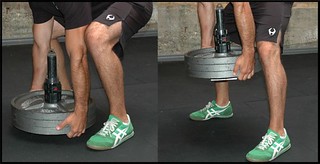
THE FLAT PLATE LIFT

How often have you had to lift something off the floor that wasn’t analogous to the familiar height of 45’s on a bar? Most objects we have to pull off the floor have a lower center of mass and more awkward shape than an easy-to-grip barbell. Related to barbell deadlifting, this will be similar to pulling from a significant deficit.

You will need a loading pin and two very secure locking collars. Start with a small, thin plate or two and then load a few heavier plates on the loading pin, and finally lock down the apparatus with the collars on the top.  Straddle the load, slide your fingers underneath both sides of the bottom plate, and lift it up a few inches. Be careful when you set it down to do it evenly so as to not crush your fingers.

This is the ever-feared combination of round-back lifting with bent arms that will supposedly destroy your spine faster than a side collision…and it’s also the exact same lift you are doing every time you lift a box off the floor. Let’s face it, lifting a 500-pound barbell off the floor is way easier than a 120-pound 36” X 36” box. The leverages are very different, so the joint positions are very different as well.

The plate lift gives you a similar starting position as stone lifting. Most people do not have access to stones, which is a shame, so try this one out instead.

Stay with relatively light weight, but you can expect to move some big weights sooner than later. You can become very strong in this position with some practice. For perspective, several (normal sized!) men in my facility can lift a 400+lb stack of plates.

THE LIFTING STRAP HOIST

It’s en vogue these days to bash lifting straps and people who use them, but that’s nonsense. Straps have their place. Even if you don’t use them, I will share with you an excellent lift that gives you a reason to keep a pair tucked in your gym bag.

Note from TG:  I concur on the straps comment.  They do have a time and place.  I discuss that HERE (scroll to tip #5).

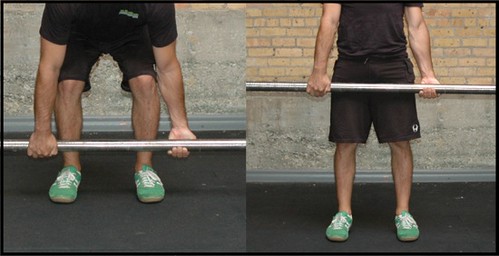
Load some weight on a bar and choke the straps onto the spots where you typically grab it. Position yourself as in a deadlift and grab the straps. This will put you in a neutral grip, with a very tight fist. From here simply hold on and stand up. How simple it that?

This type of lift will train your hand in the fully closed position, which is deceptively challenging. Most people have not trained any of their pulling motions with that tight of a grip.

So How Will This Help With My Deadlift?

A fair question. Slip these movements in to your training for a few weeks and you will find your fingers, wrist, and hand will get stronger fast.

One side effect of adding these in is a far greater volume of pulling weight off the floor, and that is likely a good thing for you. If you are not accustomed to using several types of pulls, it maybe best for you work in just one extra movement per week. For those who are used to doing work, throw them all in and use your better judgment for load and volume.

I will leave you with one specific tip with regard to your normal deadlifting practice. You may have already heard this, but if not it will be more valuable than anything more complicated: Start out your deadlift days with a double overhand grip.

Continue using that until you have to go to a mixed grip. Over the months and years — in addition to a few simple grip drills — you will develop an industrial strength grip.

Author Bio

Adam T. Glass is a world-class grip athlete and heads training at The Movement Minneapolis.  He keeps a blog and training log at http://www.adamtglass.com/ and recently released a comprehensive grip training DVD titled Industrial Strength Grip.

CategoriesUncategorized

Ready to Kickass In the Gym?

I’m back! Yesterday was Labor Day, and for those who don’t live in the US, it’s basically a made up holiday that marks the un-official end to summer (and for the fashion police out there, the end of wearing anything white**).

More importantly, for us Americans, Labor Day serves another, more meaningful purpose.  And that’s to not go into work, baby!

While I was lame and did head to the facility to coach for a few hours yesterday, I was able to snake out a bit early and spend some of the day chillaxing.

I hope many of you reading were able to do the same.

As it so happens, this marks the time of year when many of our high school and college athletes head back to school and our pro (baseball) guys start trickling in as their respective seasons come to an end.

Starting within the next week or two, many of our minor league baseball players will arrive for their 0ff-season training with the Major League guys following suit not too long after that (depending on how the playoff picture develops).

Suffice it to say it’s a fun time of year for us at the facility because we get to touch base with all the guys who have been training with us for the past few off-seasons; as well as welcome a whole host of new players into the CP family.

To celebrate his favorite time of year (and mine for that matter, outside of my Birthday, or any day I don’t have to do laundry), Eric Cressey has placed his renowned flagship product, Show and Go: High Performance Training to Look, Feel, and Move Better, on sale this week at $50 off the regular price.

Now, rather than play the “hey you should buy this because you’ll increase your general level of awesome” card, I thought I’d provide a few quick insights as to why I feel this is a worthwhile product to consider.

1.  Simply Stated:  It Works

I’ve seen with my own eyes the number of staff, interns, and various CP clients who have followed this program and have seen impressive results.

Too, I’ve witnessed countless emails, stories, and testimonials from people all over the world detailing their accounts of smashing deadlift PRs, obliterating their bench press numbers, dominating their competition on the field, finally living pain free, and jumping buildings in a single bound.

People from all walks of life are kicking ass and taking names on this program, and it’s high time you join the party.

2.  No Stone Left Unturned

You’d be hard pressed to find a more comprehensive program that includes everything from soft tissue quality and mobility work, to strength training, movement quality, and metabolic conditioning than Show and Go.

About the only thing it doesn’t include is a bottle of wine, nunchucks, and batteries.


3. Simplicity

Don’t mistaken this to mean that the program itself is easy – that couldn’t be further from the truth!

As with any program, you get out of it what you put into it.

Nonetheless, this program will undoubtedly kick your ass.

Many people are under the assumption that you need a program which uses some advanced algorithm or an eclectic mix of some secret old-school Russian periodization scheme and unicorn tears to get results.

That’s a bit of an extreme example, I know.  But the fact is:  if people would just master the basics and do them CONSISTENTLY, they’d probably see marked improvements in their performance, movement quality, and physique!

Show and Go doesn’t use any smoke and mirrors, fancy pants terminology, or fluff to get the job done.  Quoting Eric himself,  “I coach a ton of people from all walks of life, meaning that this program is based on theories that have been proven “in the trenches.”

And for what it’s worth: in a lot of ways, from a programming standpoint, this is about as close as one can get to training at Cressey Performance without actually stepping foot in the facility.

4. Versatility

One point to consider – and something that can’t be understated – is that you do not need to be an elite athlete to give it a shot!

Eric has had everyone from competitive athletes (professional and recreational), to fitness enthusiasts, to beginners use the program and do VERY well with it.

5.  Convenience.

Sure, you can pay your local personal trainer upwards of $70- $100 per session to take you through some run-of-the-mill, mundane training session, but that’s going to add up after a while.  What’s more, there’s no telling you’ll get the results you want.

With Show and Go, you can follow a program that’s been proven to work time and time again.

Adding to the pot, you’ll also have access to one of the more extensive exercise video databases created for any online program – so you’ll actually SEE how all the movements are supposed to be performed.

If a picture’s worth a thousand words – what’s a video worth?

Anyways, that’s just the tip of the iceberg.  There are a plethora of other reasons to give Show and Go a go (<—- HA, see what I just did there?), but talking about isn’t going to do anyone any favors.  Take action, and see for yourself!

—–> Click Here (That Tickles) <—–

** For the Record:  there’s no excuse, EVER, to wear stone washed jeans. Unless your name is Bon Jovi. Then it’s cool.  But other than that.  Stop it.


CategoriesStuff to Read While You're Pretending to Work

Stuff to Read While You’re Pretending to Work: 8/31/12

Can you believe it’s almost September!!?!?!  I was writing our rent check this morning and I couldn’t help but think to myself, “WTF….September starts, like, tomorrow.”

It seems like yesterday I was excited about summer starting, and now it’s almost freaking over.  The worst part?  I can count on one hand the number of times I had the opportunity to take my shirt off.  That’s just completely unacceptable.

The positive in all this is that 1) I planned a special weekend “getaway” with Lisa and the weather is supposed to be amazing, sooooooooo basically, my shirt is coming off.  And 2) Autumn is my favorite time of year.  Being from the Finger Lakes region originally (in central New York), I grew up appreciating the contrast of colors that would surround the lakes during this time of year.  Luckily New England is just as beautiful in a lot of ways, and I think every person out there with a Y chromosome agrees that nothing beats the smell of college football season right around the corner

Nonetheless, it’s going to be brief today. Here’s some stuff to read to tide you over between rounds of Angry Birds.  It’s Friday, I know you’re not working.

The Hidden Truth about Calories – Rob Dunn

This was sent my way via Twitter, and while I know there are parts of this article that could easily be dissected and ripped to shreds by the nutrition nerds out there, I thought this was a pretty thought provoking piece overall.

Creatine – Examine.com

We get asked quite often about supplements at the facility.  While we first go out of our way to instill in our athletes (especially the younger, more impressionable ones) that eating real, whole, minimally processed foods is the best avenue to travel, I’d be remiss if I didn’t mention that we do view supplements as part of the equation.

Note: We never push supplements onto our clients, but if the topic ever manifests itself, we feel it’s important to provide as much factual, concise, and relavent information as possible.

With our athletes, it usually comes down to helping them filter out the stupid and help them understand that supplements are just that….supplements.  They can serve a purpose, but won’t trump a solid training and nutrition plan.

More importantly, with the parents that entrust us with their kids, it’s about educating them that supplements <=> steroids.

This is never more prevalent than when the topic of creatine pops up.  While it’s the most researched supplement in all of human history – and yes, it’s safe and effective – you’d be surprised as to how many parents, usually as a result of some bloated cautionary tale from their family doctor, are under the impression that creatine is a steroid and causes global warming.

And to their credit, they should be leery and pessimistic.  There’s a lot of shady stuff out there.

I just chuckle and tell them that, no, polar bear farts cause global warming, and that  creatine is completely safe and then hand them a very abbreviated version of the link above (which is arguably one of the most thorough reviews you’ll find anywhere).

60+ Lessons from the 2012 Midwest Performance Enhancement Seminar – Mike Robertson

I was bummed I couldn’t make it out to Indy for this seminar as the line-up was an All-Star cast of  who’s who in the industry. Nevertheless, Mike does a fantastic job of recapping some of the highlights from what seemed to be an amazing weekend.

CategoriesUncategorized

6 Keys to a Successful (Fitness) Blog: The Stuff I Didn’t Get To Yesterday

Yesterday I spent a little time marinating around the topic of fitness blogging, and discussed a handful of characteristics (or tips) I felt would help anyone interested in starting their own blog.

To recap:

  • Serving as the umbrella over this whole conversation is the notion of experience. I feel it’s important to have a few years of experience under your belt actually training people – and getting good at what you do – before you start writing about it and “disguising” yourself as an expert.
  • It’s a bit old school, I know (especially considering the digital age we currently live in).  But there’s something to be said about practicing what you preach.  Sadly, there are many (MANY) fitness professionals out there who don’t even train people, yet because they’re a prolific writer (and good for them if they are), are seen as an expert.
  • This isn’t to say, of course, that one can’t start a blog just for the hell of it to help educate friends or family members (and to gain valuable writing experience), but in general, it helps to gain real life experience.

With the “ranty” stuff out of the way……..

  • Just start.  Quit procrastinating and talking about stating a blog and DO IT!


  • Set a schedule and be consistent with it. You know how when your girlfriend gets mad at you for not taking out the trash when you’re supposed to, and then she gets all pissed and you don’t get any action for like three days?  Well, not sticking with a consistent blogging schedule is roughly the same thing.  Except not really.  You get the idea, though.
  • Content is king. People recognize s*** when they see it.  You can use all the snazzy graphics, fonts, bells, and whistles you want, if you don’t write good content, people won’t want to read what you have to say. Period.

In case you missed it, you can go HERE and read in more detail what I had to say.

Full disclosure:  I should have known better than to dedicated two full days to blogging specific content.  Yesterday’s post wasn’t as popular or “shared” as much as I had hoped, which makes sense given that there’s only a small percentage of people who read this blog who actually blog themselves.

Nevertheless, I need to finish what I started, but I’ll try to keep this one as succinct as possible.

 4. Be Patient

When I first started blogging 30 unique views/vistors was considered a good day.  If I somehow hit 50, I was immediately outside doing cartwheels and kissing babies.

Building a successful blog that garners a decent amount of traffic (and if you’re lucky, results in some additional side income) takes a while.  Usually years.

The cold hard truth is that you’re NOT going to become an overnight blogging sensation.  Despite what many will have you think, you’re not going to have thousands of people flock to read your latest post fledgling on every word and exclamation point you write.

I don’t think I reached 1,000 unique views until 2009 (three years after I initially started blogging). Today, my more popular posts hover around 2000-2500 visitors and my Alexa.com ranking (a free web based analytics ranking site) is 307,303, which ain’t too shabby considering anything under a million is considered respectable.

I’m not saying this to brag. Rather, I’m just saying that it takes a looooong freaking time to build a popular blog.  Unless you’re an analytics Terminator like Jon Goodman.  That guy knows how to do it, and do it right!  He’s built the PTDC into a very successful, very popular site in less than two years.

Now, this isn’t to say that there aren’t ways to do so faster – you’re not handcuffed to Mediocreville forever.

Admittedly, I was a little behind the curve back in the day and didn’t understand the power of social media, but there are some tried and true ways to help increase traffic:

– It bears repeating……..write good content.  If you’re stuff is good, people will find you.

– Write for free.  Offer to write free posts or articles for other sites to help get your name out there.  Their “payment” to you is a link back to your site.

– Write guest posts.  This is probably my first choice as it serves a purpose for both parties.  1.  You get your name out there.  2.  The other guys (whom you’re writing for) don’t have to write a post that given day.  It’s a win-win.

That said, there’s a right way and wrong way to approach the whole guest blogging thing.

What not to do:  Hi, my name is Douchy McDouchyington and I want to write for your site.

I get requests like this ALL….THE….TIME, and I can tell you that those types of emails go straight to my trash folder.

Cold emailing someone out of the blue and asking them for a pretty big favor – when they don’t know you from a hole in the wall – is a ballsy thing to do.

What to do:  Try something like this.

Hi, my name is “Eva Mendes” and I’m a huge fan of your work.  I always love your stuff on T-Nation, and I make it a point to check out your blog on a daily basis. I work as a trainer in “x town or city” and I’m trying to reach out to those people whom I look up to and respect just to say hi and to see if there’s anything I can do to help them out.

And, if I might add, you’re exceptionally brilliant, witty, and good looking.

Okay, that last part isn’t necessary, but something like this is bound to get you on one’s “good side” more so than the first example. Building some semblance of rapport at the beginning is just common sense and will go a longs ways in reducing one’s bullshit meter exponentially.

Speaking firsthand, eventually if he or she offers to write a guest post, I’m usually more than happy to help out assuming what they have in mind is a good fit.

5. Be Yourself

I think a lot of what makes my site so “successful” is because I’m not scared to be me.  I think it’s safe to say that how I write is how I am in person.  I’m not afraid to use a little self-deprecating humor, talk about my cat, and then turn right around and discuss the intricacies of the deadlift.

In his book Writing for Fitness, Rob Fitzgerald  mentioned how some people are internet tough guys, some are nerdtastic and want to quote research, and others play the motivational coach card.

The key, though, is just to be yourself.  Don’t be someone you’re not.

By that same token, have a little fun and don’t take yourself so seriously all the time. Poop!

 6. Interact With Your Readers!

What’s the point of writing if you never interact with your readers!?!?  I always try to respond to all the comments I receive here on this blog (as well as those on Facebook and Twitter).  By doing so, I convey to my readers that I actually care what they have to say (and I do!) and that I value their support.

If you’re going to build the brand of “YOU,” it only makes sense to recognize those who go out of their way to not only comment, but share your work as well.

Shunning or ignoring them is the last thing you should be doing.

And there you have it.  Six keys to building a successful fitness blog.  Were they earth shattering secrets?  No. But I do feel they’ll point people in the right direction.

Have any of your own insights?  Feel free to share them below!

CategoriesMotivational

6 Keys to a Successful (Fitness) Blog

Within any given week I get a handful of emails from people asking me how they can go about building a “successful” fitness blog. In today’s ever increasing digital world (Facebook, Twitter, LinkedIn, The Matrix), it’s readily apparent that if you’re not up to snuff with technology – and all it has to offer – you may be left in the dust.

Do people have actual conversations anymore?

Believe me, I’m far from what you would call a technology geek. My cell phone would be considered an antique by today’s standards, I’m deathly afraid of Excel spreadsheets, and I can barely run a toaster without setting off a 5-stage fire alarm.

But one thing I do know – or, at least have a general grasp on – is blogging, and how fitness professionals can implement and use one to their advantage.

While a simple blog post couldn’t possibly come remotely close to explaining all the ins and outs of blogging, here are a few simple strategies/insights you’ll need to get the ball rolling.

Before we begin, however, let me address the elephant in the room.  Is having a blog even necessary? No.  Does having one mean you’ve finally made?  Um, no.

I can’t reiterate enough my sentiments that one should gain ample experience before (s)he worries about starting a blog.

More important than having a popular blog is actually getting good (really good) at what you do – and actually coach people for a few years – before entering the blogosphere.

Just because you trained five people last week and read a book doesn’t mean you should start a blog about how to train people.

I mean, I made a meatloaf last night, I don’t consider myself an expert.

It’s just my personal opinion of course. And some may roll their eyes at me for being so “old school,” but I really feel that one should have 2-3 years of training experience under their belt before starting a blog.  As a frame of reference, I started as a personal trainer in 2002.  I didn’t start blogging until the fall of 2006. I spent a solid four years honing my craft, trying to get better before I even thought about spreading my knowledge to the interwebz.  That, and blogs didn’t even really start gaining popularity until 2005.  But whatever.

Anyhoo, lets get on with it.

1. Take the Initial Step

I understand this is the Captain Obvious thing to say, but you’d be surprised at how many people don’t quite “get it.”

The first thing to consider is why do you want a blog in the first place?

Some people start a blog because they have a lot on their mind. Others use it as a source of venting.  While others use it to build a brand and get their name out there.

Whatever the case may be, you have to start somewhere. Just saying you’re going to start a blog and then not doing anything about it isn’t going to get you anywhere.

Secondly, just write.  About anything.  One of the major deterrents as to why people are hesitant to begin with is that they feel they have nothing to say. More to the point, they feel as if everything has already been said and that they couldn’t possibly have anything more to add.

Let me let you in on a little secret:  nothing is new, and everything has already been said.

But not in your voice.  And not in your own context.  Using myself as an example: I’m not like Nick Tumminello, or Jim “Smitty” Smith, or Dean Somerset, or any number of other bright guys (and women) who are thinkers and have an innate ability to come up with new(ish) ideas.  I’m more of an interpreter.  I’m able to read what others say and teach and parlay that info to others in an entertaining fashion.

Tracy Anderson is a quack, doesn’t know her ass from her acetabulum, and is about as intelligent as ham sandwich.

https://www.youtube.com/watch?v=HK_A-A7PBXc


See how easy it is!

That wasn’t an original thought.  Many have thought the exact same thing before me, and many will think the exact same thing years from now. In fact, I’m willing to bet that even when aliens visit Earth – when we’re all dead –  they’ll somehow come across that video, scratch their heads, and think to themselves, “who the hell was that idiot?”

Suffice it to say, much like we would tell someone the hardest part about training is actually showing up, the same can be said about blogging.  Just start.  Go to blogspot.com, or blogger.com, or WordPress.com (which is what I would recommend), sign up for free, choose a template, and write.

2. Set a Schedule (and Be Consistent).

Once you are blogging, it’s important that you set a schedule and actually stick to it. Traffic isn’t going to come right away (more on this below), but one of the biggest traffic killers – in other words: deters people from visiting your site – is inconsistency.

This is going to be highly individual depending on one’s schedule. Pick a frequency.  2x, 3x, 4x per week?  Whatever it is stick to it.

I strive for 4-5 posts per week, 3 minimum, and the fruits of my labor have paid off because I’m consistent.

Nothing turns people off than someone who blogs like a champ for a few weeks – providing killer content, increasing people’s level of awesome – only to disappear for a week.  Stuff happens, life gets in the way, and there’s nothing you can do about that.  Giving your readers a heads up (hey sorry everyone, I’m going to be away for a bit fighting terrorists) would go a long way as far as keeping them on your radar.

But if you just disappear, and it’s a running trend, you’re going to have a hard time building a successful following.

3. Content is King

We all know the saying:  if it looks like s***, and it smells like s***, then it’s probably s***.

Don’t write s***.

[Read THIS for some excellent ideas on how to write killer content]

I know a lot of “experts” will say that you need to pick a niche and run with it.  There are plenty of fitness blogs out there which focus solely on fat-loss, some on nutrition, and others on how to go about training bomb sniffing dolphins.

Just go with it.

I like to blog about getting people stronger.  It’s what I know, and it works for me.

Whatever you choose to write about and focus on, you better make sure it’s damn good content.  You need to own it!

To that end a few thoughts:

– Grammar counts too.  I’m no Shakespeare, but I can tell you that if you’re mis-spelling every other word, confusing proper usage of there/their/they’re, and otherwise just showcasing slipshod work, people will call you out on it.

As much as I hate grammar Nazis, there comes a point where you need to call a spade a spade.

NOTE:  I’ll call myself out and state there’s  a handful of misspelled (or even missed) words in this very post. Whatever. Give me a break. It’s blog, not a dissertation. And, I’m not wearing my glasses.

ALWAYS give credit.  Like I said above, nothing is new out there, but if you’re taking credit for things you didn’t say or do, you suck. And someone will figure you out sooner or later.

–  Not every posts needs to be Atlas Shrugged. Lengthy posts – while cool for showing off your writing chops and definitely warranted when you’re writing about something you’re passionate about – will bore the crap out of people after awhile.

In his book Rise to the Top, Jon Goodman mentioned how you should have a schedule of short, to the point posts (400-500 words) that are easily “shared” and help to generate more traffic, and long(er), more elaborate posts to help “keep” your current readers.

An example of the former would be something like a quick mobility exercise, or a brief quip you learned from a DVD.  An example of the latter would this very post which, approaching 1200 words, is probably long enough for today.

Check back tomorrow for some more insight on what makes for a successful fitness blog.

CategoriesUncategorized

Registration Open for the 1st Annual Cressey Performance Fall Seminar

Do me a favor and mark Sunday, October 28th on your calendar. Write “MUST GO TO THIS” with a bright neon colored highlighter if you have to. Better yet, use glitter paint.

Why?

No, it’s not opening weekend of Michael Buble’s new concert tour or the release date of the next chapter in the 50 Shades of Grey hooplah (ladies). And no, it’s not the same weekend as the Victoria Secret wet t-shirt contest or the next Star Wars convention (guys).

As cool as all of those things are (with the exception of the first two), what’s actually going down that weekend is much, much more more awesomer (yes, I just used incorrect grammar). That weekend marks the first of what we hope will be an annual Cressey Performance Fall Seminar.

This event will showcase both the brand new Cressey Performance, as well as the great staff that helped build it, and our outstanding sponsor, New Balance.  We want to make this an affordable event for everyone and create a great forum for industry professionals and fitness enthusiasts alike to interact, exchange ideas, and learn.

Here are the presentation topics:

Understanding and Managing Congenital Laxity

Presented by Eric Cressey

In this era of semi-private training, boot camps, and group exercise, it’s not uncommon for coaches and trainers to try to train all athletes and clients the same. This can quickly lead to injury in a population with significant congenital laxity.  In this presentation, Eric will teach you how to assess for laxity and safely train with it to improve how people feel and move.

The Food Freakshow: What Will You Be Eating in the 21st Century?

Presented by Brian St. Pierre

Burgers grown from dinosaur DNA?  Tomatoes carrying a delicious basil lemon gene?  Red meat with the fatty acid profile of an avocado?  Science is starting to change the way we look at food.  And in the coming years our food will be very, very different.  Want to know what you’ll be eating?  What your kids will be eating?  What your grandkids will be eating?  Let Brian untangle the mystery.  In this talk he’ll discuss what’s on the horizon for those of us who like to eat, and like to eat healthy.  Join him for a fascinating exploration of the future of food – and for useable, practical strategies you can put into action immediately.

“Out with the Old” – A new model for preventing injury and improving performance in the throwing athlete.


Presented by Eric Schoenberg

The system is broken!  Injury rates at all levels of baseball are alarming.  Despite improvements in research, technology, and sports medicine principles, the numbers continue to rise.  Each year, teams work tirelessly and spend millions to recruit, draft, and sign the best talent from all over the world.  However, only a small percentage of that money is invested to keep these athletes healthy and allow them to showcase their talent on the field.  This presentation will help to debunk some common myths, identify disturbing problems, and provide solutions to help keep athletes on the field and out of the training room.

How “Strong” Does An Athlete Need To Be?

Presented by Gregory Robins

In this presentation, Greg will discuss how various strength qualities contribute to an athlete’s power potential. Each sport requires a slightly different blend of these strength qualities to provide for high-level performance.  Learn which qualities athletes need to improve and how to get the job done.

Current Trends in Manual and Manipulative Therapy

Presented by Nathaniel Tiplady

Nate will present a review of Active Release Technique, Graston Technique, Fascial Manipulation, and joint manipulation.  He’ll cover what we know, what we don’t know, and present his thoughts and experiences on the best methods to get people pain-free.

Program Design Considerations for the Young Athlete

Presented by Chris Howard

In this presentation, Chris will discuss important considerations one must take into account when designing and implementing programs for young athletes.  Topics to be covered are exercise selection and progression, creation of a fun training environment, and the role of the strength coach in educating young athletes.  He will stress the fact that young athletes can be trained similarly to adults, but that there are distinctions that need to be made.

How to Get “Fight Club” Abs Deep Squats: Are They Worth It?

Presented by Tony Gentilcore

In this presentation, Tony will highlight research on the squat under various conditions and discuss population-specific considerations one must take into account when programming squat variations.  He’ll discuss improving the squat pattern, as well as exercise recommendations for those who should avoid squatting altogether in their programs.

Location: 

Cressey Performance,
577 Main St.
Suite 310
Hudson, MA 01749

Cost:

Regular – $99 early-bird (before September 30), $129 regular, $149 day of the event
Student (must present current student ID at door) – $79 early-bird (before September 30), $99 regular, $129 day of the event

Date/Time: 

Sunday, October 28, 2012
Registration 8:30AM
Seminar 9AM-5:30PM

Continuing Education:

NSCA CEU pending (seven contact hours)

Hotel Information:

You’ll receive hotel information in a PDF information packet following registration.

Click Here to Sign-up (Regular)

or

Click Here to Sign-up (Students)

We’re really excited about this event, and would love to have you join us! However, space is limited and each seminar we’ve hosted in the past has sold out in less than two weeks, so don’t delay on signing up!

If you have additional questions, please direct them to [email protected]. Looking forward to seeing you there!

CategoriesUncategorized

Cressey Performance Facility Tour

This past Saturday we celebrated the grand opening of our brand spankin new facility. As you’ll see from the video below, we’ve grown throughout the years.  What started as a rinky dink 2200 sq. foot space in the summer 0f 2007, has grown to a current 15,000+ sq. foot mecca of awesome.

The most surreal part? Our new lobby/greeting area is larger than the ENTIRE footprint of the original CP. If you can imagine, at one point, Eric, Pete, and myself shared an office.

Nonetheless, I just wanted to thank everyone who showed up this past weekend to offer their support and to help inaugurate the new space. While many of our athletes, parents of athletes, clients, and ex-interns showed up to get their lift on, there were also a fair amount of fitness friends and colleagues who made a cameo appearance as well including John Romaniello, Sean Hyson, Ben Bruno, Jen Sinkler, David Dellanave, Neghar Fonooni, Alli McKee, and Dick Talens to name a few.

In fact, we all got a pretty epic training session in at the end of the day complete with BBQ. Just to give you an idea of some of the shenanigans that went down here’s Roman and Bruno doing their best Ace and Gary impersonation teaming up on a set of Jefferson deadlifts.

Okay enough of the shenanigans.  Here’s the video. SHA-ZAM!

NOTE: Credit to myself for the Steven Spielberg’esque camera work!  Man, I’m good.

Thanks again to everyone for all their help and support.

CategoriesUncategorized

Moving Day at Cressey Performance

Yesterday was spent moving Cressey Performance from one space to another located roughly 100 yards at the other end of the building.  Surprisingly, we got A LOT more done than initially expected and all that’s left is putting down the new turf and then some aesthetic touch ups here and there (which may or may not include a massive shirtless mural blasted on one of our walls of me taking the bull by the horns, ala Ben Stiller from Dodgeball).

For those who need a visual reference – take a gander up and to the left.

Pretty sweet, right?

All kidding aside, I just wanted to say THANK YOU to everyone who helped out yesterday (and today) for busting their asses start to finish without ever once being asked to do so.  It’s times like this where we feel so blessed and honored to have such awesome clients, colleagues, and friends willing go out of their way to lend a helping hand.

As you might expect, my hands are pretty full today, but I wanted to share a funny video that CP coach, Greg Robins, filmed from yesterday’s chaos starring Eric Cressey’s old desk.

The new Cressey Performance opens up tomorrow (August 25th) at 9 AM.  Yeah buddy!!!!!!!

From the sounds of it, there’s going to be quite the showing of fitness peeps making a cameo appearance: John Romaniello, Sean Hyson, Jen Sinkler, Neghar Fonooni, Alli McKee, Roger Lawson, and Ben Bruno to name a few.

I’m still waiting to see if Alicia Keys got the invitation.

Video tour of the new facility will be posted on Monday!