
Categoriesbusiness coaching

What You Didn’t Expect When You Opened Your Gym: 6 Lessons On Building a Team

It must be “gym ownership week” on TG.com this week.

Yesterday’s post on the effect social media has on the perception of gym ownership – everything is seen through rose colored glasses – was a huge hit.

Today I have guest post by another gym owner, Doug Spurling of Spurling Fitness located in Kennebunk, ME, discussing how to best build a team to help your business thrive.

Doug’s done an amazing job building a successful fitness business and he’s someone I respect a ton. Read what he has to say. He’s smart.

NOTE: Next month I’ll speaking alongside Doug (along with his staff, and my wife, Dr. Lisa Lewis) at the Spurling Spring Seminar. It’s going to be a great event and tonight (3/14) at midnight is your last chance to take advantage of the early bird registration of $50 off.

Copyright: eugenelucky / 123RF Stock Photo

6 Lessons On Building a Team

Hang out in sweats all day long…

Listen to cool music all day long…

Talk shop and change peoples lives…

Life of a gym owner, right?

That’s part of it.

But they don’t tell you about the “other” stuff.

Getting good at marketing, financial statement analysis, strategic planning, holding good meetings, putting out fires, and that you’ll never be able to actually shut it “off.

I’m sure the list could go on and on, but today I want to focus on one particular aspect that I don’t think we spend enough time on as an industry.

HUMAN RESOURCES.

More leads, more clients, and more growth usually means….

More team members.

They are our biggest asset, but can also be our biggest headaches if you don’t know how to lead them.

We thought we got into this business to train people, change some lives, and do it all hanging out in comfy gym clothes.

Now I’m telling you if you want long-term success you need to get really good at human resources.

Today I spend the majority of my time on human resources, team development, holding meetings, and making sure our margins are strong as I run a payroll that exceeds a half a million dollars a year.

I love it, but it’s not what I expected as a gym owner.

I now have seven families I am responsible for, only one of which is mine.

With six full-time team members, that means six people that look up to me, six people that count on me running a successful business so they can get a paycheck next week, six people who live their life mission through my business, and six people who support their families with my business.

Woah!

via GIPHY

That’s a big responsibility when we think about it.

That being said, I’ve made some major mistakes as a leader, but I also feel that I have one of the strongest teams around.

Here are six lessons I’ve learned so far…

1. Hire for Personality, Train for Skill

I want driven, hard-working,  value-focused people, I don’t really care if you can coach a squat.

I can’t train a smile, I can train you how to coach a squat.

We aim to hire people that fit our core values, and then have a strong onboarding system that teaches them the technical stuff like how to coach.

2. Have Clear Systems

We have a master folder called “The Spurling Way.”

Every process in our business is documented under that folder.

There’s no questioning how to do things.

We get feedback when we create a new process, but once it’s put into this folder the team has agreed that this is the way we do things.

We don’t want people that want to do it “their way.”

Follow the system.

Run the play.

3. Hold Good Meetings

I think good meetings are totally underutilized.

Every day we have a meeting.

It starts each day with a daily huddle-a quick 5-minute accountability meeting about what each team member is doing that day and what that needs help with.

We have a leadership meeting every Monday, a coaches meeting every Tuesday, individual meetings every Wednesday, and a team meeting every Thursday.

Now, notice above I said, “good meetings are underutilized.”

Read a book like “Death by Meeting” and learn how to hold good meetings.
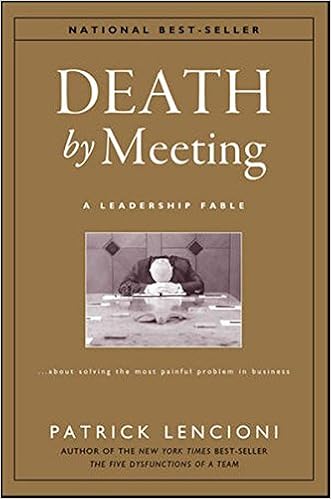
They can be some of the most productive hours of the week, or if done wrong, they can be the biggest waste of time.

4. Balance Multiple Personalities

We can’t have a universal leadership approach.

Each team member is different.

How you talk to one team member is different than how you talk to another.

One may be motivated by public praise, one may want a small note left on their desk.

We use things like the DISC profiles and the 5 Languages of Appreciation to understand how each of us functions and how each of us gives and receives appreciation.

As your team continues to grow the possible communication flaws, the potential drama, and headaches can quickly multiply if you don’t stay on top of it.

Understanding each team member, what they value, how they tick, treating them as an individual, and not have a universal leadership approach is key.

5. Communication Is Key

Communication is not what’s said, but what is understood.

Nothing drives us crazier than when we tell someone something and they don’t do it or don’t follow through with it the way you wanted it to be done.

  • Or you tell Coach A how to do something, they nod their head, and then don’t go it the way you taught them.
  • Or you come in and hear the Coach A hates Coach B but isn’t doing anything about it.
  • Or Coach A is annoyed because they feel they’re working so much harder than Coach B.
  • Or Coach A is complaining about something but then isn’t doing anything about it.

I’m sure you can think of a million scenarios that cause you to pull your hair out as the leader.

However, as the leader, you have to take extreme ownership (good book, btw), and take charge of the situation.

Quite often if you hire good people (see number one), most situations come down to poor communication and/or assumptions.

  • Someone makes an assumption that someone else took care of it.
  • Someone makes an assumption that the person understood what they just told them.

We need to over-communicate with our team, never make assumptions, and make sure that we understand each personality (see number four) and how they like to receive communication.

6. Treat Them the Way You’d Want To Be Treated

Seriously.

Seems like common sense, but as they say, sometimes common sense is not so common.

I get a lot of questions on why I have an all full-time staff, all salaried, all fully benefited, have unlimited time off, and they all work a “normal” 40ish hour work week.

It’s the culture I’m trying to build.

I don’t want people that want to train “their clients.”

I don’t want people that are just here for a paycheck.

I want people that are going to devote their lives to our mission.

I want people that are here for more than just a job.

In order to do that, I need to treat them really well.

That means a good salary, a good schedule, good benefits, constant leadership, constant appreciation, and a constant pitch of why we’re doing this.

Is it easy?

No.

Most months I shed a few tears when the payroll gets withdrawn.

It’s my biggest expense, but I also know it’s my biggest ROI.

The most common message we get from client always comes back to something along the lines of…

“You have the most cohesive team I’ve ever met. You can tell they are here for the right reasons.”

It all comes back to driving the mission, communicating clearly, leading them, and treating them the way you want to be treated.

We all got into this business to change lives, and depending on what kind of impact you want to make, if you want to change the lives of hundreds of people, you’re going to need a team to support you in your mission.

Hope this helps.

Want More?

Next month Doug will be hosting the Spurling Spring Seminar in Kennebunk, ME alongside myself, my wife, Dr. Lisa Lewis, and the entire Spurling Fitness staff.
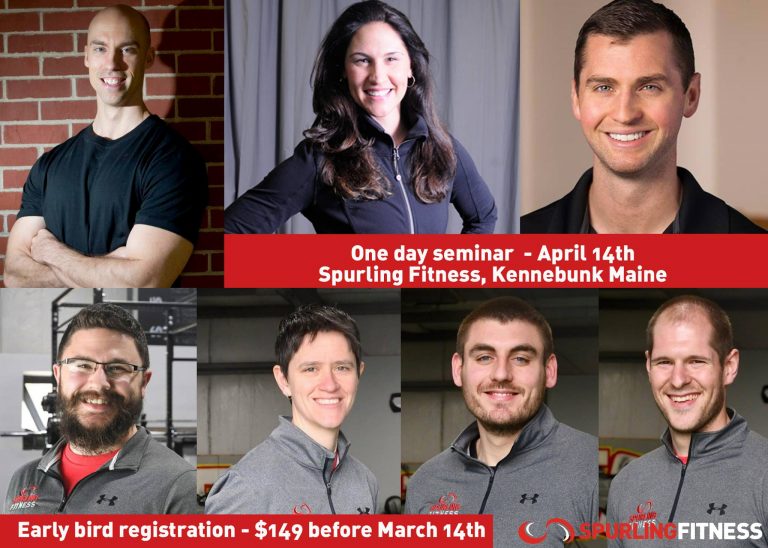
There aren’t many events outside Boston that cater to the fitness community, so this will be an awesome opportunity for any personal trainers, strength coaches, gym owners, or anyone interested in assessment, program design, business, and mindset skills to enjoy a day of learning.

You can read all the details HERE.

ALSO: If you register by TONIGHT (3/14) at midnight you can still take advantage of the early bird registration and save $50.


Categoriesbusiness

What Social Media Isn’t Telling You About Owning a Gym

Long before I owned CORE, and even now, as a current gym owner, I’ve championed the message that gym ownership is not for everyone, and more to the point that it should not be perceived as the holy grail of the fitness industry.

There’s a running theme – which is nauseatingly prevalent on social media – that owning a gym provides some sort of pinnacle, “I’ve made it!” mentality, and that once it happens it’s nothing but rainbows and kitten kisses for everyone.

Sure, the fairy tale ending can happen.

However the reality is, for many….being a gym owner is fucking brutal.

My friend and colleague, Mike Connelly, who’s a recent former gym owner, took the time to write this beautifully honest guest post today on the trials and tribulations (and general dumpsterfireness) of owning a gym.

Cue slow clap.

Copyright: gekaskr / 123RF Stock Photo

What Social Media Isn’t Telling You About Owning a Gym

“I’m so sorry to hear about that.  Must be tough, man.”

I’ve heard that line from a lot of people in the past two months. The reason I’m hearing that so much is because after six years I am moving on from owning my business, Rebell Strength and Conditioning, and all I can think about when it comes up is how happy I am about the situation.

I’m not going to sit here and tell you it all went as I planned and that I’m coming out of this footloose and fancy free.

That’s not the case.

But, since being out of the operation of my business for the last two months, my life has changed and only in positive ways. I’m averaging just about twelve more hours of sleep a week, I’ve lost thirty pounds, my mental health is back to being stable (as stable as it will get anyways), and, most importantly, I feel like myself again.

When you own and run a business, it’s easy to get so caught up in things that you don’t even realize what is happening to yourself.  You think about bills, timelines, clients, marketing, bills, social media posts, blogs, bills, complaints, finding new clients, keeping current clients, bills, programming, systems, bills, platforms that run your business, networking, bills, finding good employees, keeping good employees, how to manage your revenue, and finally…. bills.

It’s a lot.

It’s nauseating at times. To feel stress at a molecular level (Paul Lyngso hit that description on the head) all the time becomes your new normal.

And it sucks.

But you keep going because you’re “living the dream.”

A mentor of mine once described entrepreneurship to me like this:

“There you are, riding the bull that is business, through town. People are cheering for you and admiring your courage to go out and do it on your own. You are revered and respected at the mere mention that you own a small business. Yet, through all the accolades all you can think about is, “how the fuck do I get off this bull?!”

I know that’s not the case for all business owners.

There are some out there that are owning it through and through. These people are running a business and not just getting paid for their hobby. It took me a long time to realize and then admit it, but I never broke through to that level of ownership.

I never owned my business.

My business owned me.

I could go on vacation whenever I wanted, but I always had to add the cost of people covering my work to the price tag. I didn’t have a boss, but a long client list that could, at times, be much worse than a boss.

I had the opportunity to take as much free time as I wanted, but it always came with the sacrifice of progress. When all that became too much, the progress suffered, and once that ship sails, it’s hard to get it back to shore.

As coaches, we should teach our clients to own movement, not just survive it. Well, for a long time I was merely surviving being a business owner. And that, my friends, is not a path to success or happiness.

I’m not writing this to shit all over your dreams of being a business owner.

Nope, far from it.

Nor am I here to make excuses.

I fucked this whole thing up.

I always had good intentions, but that and a nickel will get you a jaw breaker from a vending machine at your local arcade. I wanted to share this with you because the coach in me wants you to move forward with caution. I want you to realize that before you get on that bull, you better have those ducks in line and know that the glory and freedom that often get put on owning a business rarely become a reality.

I want to share this cautionary tale, because chasing down the dream of business ownership seems to be trending in our industry, and I don’t hear too many people talking about why it might be a bad idea.

I’m not the smartest guy around, but I’m not the dumbest either. I’m intuitive and have a wicked creative side. I’m strong willed and will fight to the death at the drop of a hat.

I’m a Marine.

I once did 177 get ups in one hour with a 24Kg bell for a fundraiser and then drank whiskey and danced the night away at a wedding. I can get shit done – when I want to – and that’s the thing about being a business owner that caught up to me.

The accounting, the marketing, the interviewing, the blah, blah, blah side of business that I didn’t like finally became not as fun anymore, so I just let off the gas and coasted.

That’s how you lose $4,000 in revenue in a month, and that’s the thing about losing business, it always goes much, much quicker than it comes.

It wasn’t over a bad customer experience either. In six years I can count those on one hand.

It’s because people move, lose jobs, get in relationships, and any other reason that has nothing to do with you.

There is no amount of success that can protect you from that and for that reason, you can never let up. Never.

Well, I did.

I knew what I had to do, and I just didn’t want to anymore. It didn’t make me happy like it used to. I know, I know, you’re supposed to delegate and hire out for all those items that you suck at, and that brings me to my next shortcoming.

I suck with money.

via GIPHY

I mean, I’m good at spending it without thinking, but I really suck at doing the right thing with it.

If you don’t want your business to own you, you better have a fucking stellar plan for every dollar that comes in the door.  It seems to me that every successful business has a numbers guy somewhere in the mix.

That’s no coincidence.

Then there’s me, just throwing money at things that won’t do me any good in six months, let alone a year.

I paid my staff too much; I charged too little for my product; I wasn’t patient with purchases, and I got into a lease that put me in a position where I was fighting uphill from day one.

I never gave myself a chance, but I never saw it because I always thought that if I treat people better than they would ever expect, then that would motivate them to produce. I thought that if I was aggressive with purchases and leases that it would pay off overall.

I’m not saying that employees shouldn’t be paid well and that aggressive moves don’t pay off. I’m just saying that you should have a plan for everything, and it better make sense to someone that knows numbers.

Have a numbers person!

In the end, that will make or break your business no matter how good your product is.

There are plenty of shitty gyms out there making a large profit because they have their numbers on lockdown. There are also a lot, and I mean a lot, of unbelievable coaches getting their asses kicked because they are not equally as good of a numbers person.

I’ve learned from the many, many mistakes that I’ve made over the years.  I know that I will continue to learn as I sort through and process all of this.

For that, I am grateful.

Any time we can learn from our mistakes it was worth it.

The only thing I’m ashamed of is that I allowed myself to think that my identity and character were defined by a title that I slapped on myself but was never really cut out to live up to.

That kills me a little bit when I think about it.

I let it stress me out and change who I am. It stressed all my relationships and probably none more than the one that I have with my family. My hope is that maybe one or two business owners out there who are feeling alone and completely fucked mentally read this, and it lets them take a breath and realize that they are not bad people or coaches because they are having a hard time with their business.

It’s easy to feel like a failure in that position, but the reality is that you had the guts to take a shot and that’s great. If you’re the type that just cannot go back to working for someone, then I hope this pushes you to get the help you need to right the ship.

But if you’re like me and can be perfectly happy and have a lot to contribute in another arena then I hope this gives you the guts to do the right thing for yourself and the people that you love.

About the Author

Mike Connelly: Former Owner of Rebell Strength and Conditioning for 6 years, current Fitness Director for Fitness Formula Clubs at their Oak Park, Il. location and co-owner/coach at Strength Faction.

Serves as a consultant to the Chicago Blackhawks organization for off-season camps for the past three years.

Categoriesbusiness

Business Advice For Trainers From Trainers

When I first started in this industry my business competence was pretty low. If you asked me what the term “overhead” was or what it meant to itemize business expenses I would have been like “say what again?”

I’m still not someone I’d consider to have a lot of business pedigree, but I think I’ve done pretty well for myself.

My friend Shane McLean went around and asked a bunch of coaches – including myself – some standard fitness business and gym ownership questions that I hope will resonate with people.

Enjoy.

Copyright: ruigsantos / 123RF Stock Photo

Business Advice For Trainer From Trainers

Personal trainers get into the fitness industry because they’ve got a huge passion for exercise and for changing people’s lives. However, some have no idea about the business side of coaching, particularly those who are new to the industry.

Newbie (and experienced trainers) work crazy hours to please clients which makes having any sort of social life outside of work very difficult. Trainers then start to realize there’s more to this coaching gig than meets the eye because:

  1. You’re trading a lot time for little money.
  2. It’s real hard yakka.1

Furthermore, exercise is big business nowadays. According to the website Statista, the US spent 25.8 billion dollars in 2015 on all things health and fitness. (1) That’s a fair chunk of change that has some trainers saying…….

The same hard work that goes into becoming proficient at coaching needs to be applied to the business side also.

But how do you get started?

Don’t worry this Aussie has your back.

I asked some prominent people in this industry – David Crump, Eric Bach, Johnny Tea, Chris Diamantakos, and some cat-obsessed nerd named Tony Gentilcore – a couple of hard hitting questions that will provide you with actionable takeaways on the business side of coaching.

Read on and learn things.

David Crump – Entrepreneur and Coach at DaveCrump.com 

1. At what point in your career did you realize that you needed to know more about the business side of coaching and how did you go about it?

Fortunately, I started my training career in a big box gym and moved into management relatively quickly. This gave me the opportunity to learn more about sales and the business side of fitness early on.

I did, however, realize that this gave me a leg up on many of my contemporaries as soon as I wanted to branch out on my own.

Despite my early advantage, I was still aware that if I wanted to stay ahead, that I would have to continue learning more and I found the most benefit from reading content from some of the big names in the industry as well as reading a lot of books from thought leaders in other industries.

2. What were your go to people/resources that helped you expand your business knowledge?

I can’t overemphasize the importance of having great mentors in this area. Some of the people that I have learned from directly or indirectly include Mark Fisher, Alwyn Cosgrove, Jon Goodman, Thomas Plummer and others.

It should also be mentioned that the experience of making mistakes and learning from them is paramount. Getting to make mistakes on someone else’s dime (at a big box gym) was a very valuable experience.

3. What advice would you give a coach looking to open a gym?

I would tell them to get VERY clear on what they want long-term. Many coaches and trainers think that opening a facility is the most logical next step, but that is not accurate.

Being a great gym owner means being a coach takes a back seat and increasing your level of responsibility exponentially. You have to be prepared to make your gym your number 1 priority for at least the next 5 years.

I think there are a ton of coaches that would be much happier simply renting space someone and having full freedom and control of their schedule and life.

If, on the other hand, someone knows that it is what they really want then I would tell them to start small. That means your first place shouldn’t be your 6000-square foot dream facility with every piece of equipment under the sun.

Instead, starting a modest gym and building it organically will put you in a better financial position to work the kinks out over the first couple years and eventually grow into a larger facility without being up to your eyeballs in debt.

4. The best book you’ve read about business and why?

I can’t narrow it down to 1, but I think there are 3-4 that really helped define my beliefs about business:

  • How To Win Friends And Influence People – Businesses are built on dealing with people and this book really delivers great tips on how to have better interactions and make people enjoy working with you.
  • The E-Myth Revisited – The classic business book that helps newbies learn how to move from being a “technician” to a “manager” of business owner through the use of systems in simple terms.
  • Start With Why – The most successful businesses in the world understand what they stand for and why they exist. This book helps a business owner really crystalize what makes their business unique and how to help customers understand its purpose.
  • Delivering Happiness – Written by the founder of Zappos, this is the best book on business culture, values, and customer service I have ever read.

Eric Bach, CSCS, PN1 and owner of Bach Performance.

1. At what point in your career did you realize that you needed to know more about the business side of coaching and how did you go about it?

My first training job at a big box gym gave me a first class look at the limitations of the personal training industry. Frequent policy changes, ownership transitions, and inconsistent sales goals led to a ton of stress on my business early on.

After I built a full book of business and deep relationships with clients’ ownership cut trainer-take-home pay by 30% to follow a “group training system”. At this point I was left with the decision: let my business be gutted and play the game or rewrite the rules on my own terms.

I decided to rewrite the rules, seek out mentors who had built a business I wanted to replicate and invest heavily in myself by paying for their services.

2. What were your go to people/resources that helped you expand your business knowledge?

Early on I followed the typical path: reading sporadic articles on the internet. I read everything I could on training from coaches like Dave Tate, Jason Ferruggia, John Berardi, Tony Gentilcore, John Romaniello, Jon Goodman, Nate Green, Christian Thibaudeau, and Eric Cressey.

When it came to business I dug into work by Ryan Holiday, Dale Carnegie, Chip and Dan Heath, Seth Godin, and Tim Ferriss.

Not long thereafter Jon Goodman introduced his Viralnomics coaching group to personal trainers looking to build their online business.

He was my first business mentor and pushed me to get out of my comfort zone and start treating my business like, well…a business and not a hobby.

3. What advice would you give a coach looking to open a gym?

Think long and hard whether you’re ready to run a business. Today everyone wants to be an entrepreneur and a business owner, yet no-one ever tells you not everyone is meant to run a business.

There will be long days, short nights, lots of coffee, and a constant battle to improve. While some folks are built for this challenge others simply aren’t.

Make sure you’re truly willing to make the sacrifices needed to create something great from the ground up before exploring leases, equipment deals, and opening a brick and mortar facility.

4. The best book you’ve read about business and why?

The One Thing by Gary Keller – In an age where information travels faster than ever and there’s an endless supply of “tips, tricks, and hacks” it’s far too easy to get bogged down in the minutes.

Trainers looking to build their online business fall into the same trap many of our personal training clients do: getting stuck in a cycle of information overload and inaction.

The One Thing reinforces getting clear on your number one priority for the day, week, month, and year and makes taking action on accomplishing this task the most important focus.

Johnny Tea Strength Coach, Manual Therapist

1. At what point in your career did you realize that you needed to know more about the business side of coaching and how did you go about it?

As soon as I decided to go out on my own and become self-employed in 2008, I realized I needed to learn a ton more about the business side. As new trainers, we tend to start off by thinking to ourselves, “Oh, I don’t care about the money part. I just want to train people and the money will eventually come.”

As we all know, there’s a lot more to it than just winging it and seeing where it goes in business. I’ve always loved the quote “Plan your work and work your plan”. Write down your goals (both short term and long term), and continue chipping away.

I reached out to other fellow colleagues/friends, read books, attended workshops, and picked the brains of some of my clients with a business background, and even brainstormed ideas with a trusted friend (in this case my wife).

With all this information I gathered, I applied the ideas that made sense for my business and made adjustments if needed.

2. What were your go to people/resources that helped you expand your business knowledge?

I specifically reached out to people that I respected in our industry who had a ton of success. Eric Cressey, Pete Dupuis, Chad Landers, Mark Fisher, Tony Gentilcore, John Rusin, Dean Somerset, Eric Bach, Jordan Syatt, John Goodman, John Romaniello, and David Dellanave are just a few names that come to mind, but this list is honestly endless.

Important side note: make sure you go about reaching out to people the right way. Meet with them at workshops/seminars or offer to pay them for their input and time.

Genuinely try to develop a relationship with the person before seeking advice.

No one likes creepy needy people seeking free advice.

3. What advice would you give a coach looking to open a gym?

I would say first ask yourself: why do you want to open a gym? I don’t mean that in a negative way but it’s a valid question. Here are some important questions to consider:

  • Do you want to open a gym because you just want a big fancy building with your name on it?
  • Do you have enough clients to support a gym and what’s your strategy to attract new clients?
  • Have you considered the amount of money it would cost to get started? (Oh, and don’t forget about the hidden fees too).
  • Do you have the capital to cover you for at least 6 months, just in case your business doesn’t start booming like you expected?

A lot of people want to go big and open a gigantic facility like Cressey Sports Performance (awesome facility and people by the way), but are probably better off starting small.

I would recommend possibly considering training facilities/studios that allow you to rent out space. This will give you time to build up your clientele while keeping your overhead cost low.

4. The best book you’ve read about business and why?

This is a tough one because there’s so many good books. I really enjoyed Ignite the Fire and Viralnomics by Jon Goodman because they were written specifically for people in the fitness industry, and gave actionable steps on how to become successful.

Chris Diamantakos NSCA-CPT

1. At what point in your career did you realize that you needed to know more about the business side of coaching and how did you go about it?

When I decided to leave the gym, I was looking to start my own PT business. I realized I knew nothing about business and marketing. I had a small-time frame of six weeks to learn as much as I could and actually apply it.

I picked the brains of a few gym owners and successful freelance trainers I knew and had been directed to a couple fitness business coaches who could help.

2. What were your go to people/resources that helped you expand your business knowledge?

I ended up following Jonathan Goodman and theptdc.com. If you’re wondering why, it’s because Jon personally took the time to answer my questions and he seemed to truly care about improving the fitness industry by helping trainers and gym owners with business.

3. What advice would you give a coach looking to open a gym?

Spend a shit load of time figuring out the niche you want to service and become a true expert in that field.

Realize how you can help these people the most, and continue to work hard at being great. One quote that’s stuck with me from Jon since day 1 is:

“1. Do a really good job 2. Make sure everyone knows about it.

4. The best book you’ve read about business and why?

There are obviously tons of great business resources out there but the one that’s helped me the most directly is “Ignite the Fire.” It’s specific to personal trainers and up to date in terms of marketing techniques.

Tony Gentilcore, You’re Reading His Site Right Now*

* You’re really smart

1. At what point in your career did you realize that you needed to know more about the business side of coaching and how did you go about it?

Not soon enough to be honest.

There’s still a huge part of me that feels I’m behind the curve when it comes to business acuity and savvy.

Then I think to myself, “Huh, I’m making a profit, I’m still getting a nice stream of new clients, and my landlord hasn’t given me an eviction notice yet…I’ve got to be doing something right!?”

To answer the question, though, it wasn’t soon after meeting (and then living with) Eric Cressey that I soon learned the err of my ways. It’s hard to be around a guy like that and not absorb his work ethic and be a little more in-tune with going the extra mile to get better.

If I had to be exact, I’d say the week Eric, myself, and Pete Dupuis decided to put our balls out there and open up Cressey Sports Performance – July 2007 – was when I finally diving head first into more business-related content.2

Alwyn Cosgrove was a major influence on us when we opened up CSP, and from there all I did was following the scent of other successful trainers/coaches – Mike Boyle, Joe Dowdell, Dan John, John Berardi, to name a few – and try to emulate what they read or did.

2. What were your go to people/resources that helped you expand your business knowledge?

Giving credit where it’s due, I feel I was able to live in this unique “learning business bubble” by being in the proximity of Eric and Pete for eight years (I left Cressey Sports Performance in the Fall of 2015).

When I decided to leave I was so scared and nervous.

I thought for sure I’d fail.

Low and behold I was quite surprised to realize I didn’t suck at business as much as I thought I would.

In fact, I took solace in something I used to hear Pete always say:

99% of operating a profitable and efficient fitness facility is application of common sense.

That sentence alone helped mute a lot of my self-doubt and negative self-talk about business.

I mean, in a sense, business can be dwindled down to one simple act:

Don’t spend more than you collect.

Does your facility really need that expensive leg press machine or life-size early 90’s Mariah Carey statue?

3. What advice would you give a coach looking to open a gym?

The holy grail in this industry is NOT owning a gym.

There’s a connotation that you’re only successful in this industry if you own a gym.

That’s bullshit. And if anyone wants to read more of my thoughts on that I’d encourage them to check THIS out.

I could sit here and wax poetic on all the reasons why someone would and would not want to open their own gym.

I’ll just say this: I think every trainer should work in a commercial setting for 2-5 years before the words “gym ownership” are uttered. It’s times used to learn the craft, to get really good, and to understand how to develop relationships with people from all walks of life.

4. The best book you’ve read about business and why?

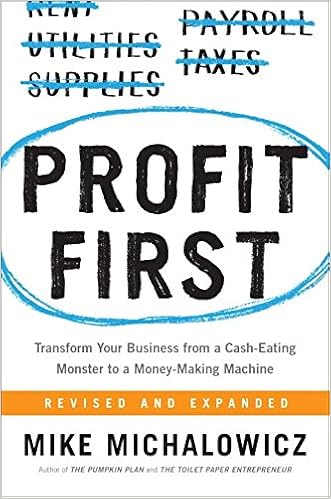
Profit First by Mike Michalowicz, hands down.

No one book has helped shape my approach to running my business than this book.

About the Author

 Shane “The Balance Guy” McLean, is an A.C.E Certified Personal Trainer working deep in the heart of Texas. Shane believes in balancing exercise with life while putting the fun back into both.

Categoriesbusiness coaching

3 Secrets From MBSC Thrive

Today’s guest post comes courtesy of MBSC Thrive coach, Sean De Wispelaere. When it comes to fitness entrepreneurship – NOTE: commercial gyms trainers this still applies to you – everyone’s always looking for that one “trick” or slight “edge” that will help separate themselves from the masses and serve as the tipping point towards success.

Below are a few things that Sean has noticed from some of the of the top performing coaches have in common within the Thrive program/system.

1). Do You

Gary Vaynerchuck, a well-respected entrepreneur and social medial savage, spoke  at the USC Entrepreneur Talk a few years back. He had 60 minutes on the clock, walked in, and told the class that the only piece of advice that matters is that they have to identify what they are good at and go all in on that.

He then asked if there were any questions. Savage

Relating that back to the coaching or training, you have to find out who you are as a coach and be really good at making sure your clients see that authentic you. If not, you will always be missing “something” and it will affect your ability to succeed at the level that you want in this industry.

It looks like all of our teachers, parents, and Dr-freaking-Seuss were right. I typically don’t trust anyone wearing a striped hat and bow tie…unless they advocate eggs (or even green eggs)…if Dr. Seuess had a rhyme-y coffee and deadlift book he’d be a triple threat.

Anyway, the majority of coaches or trainers who I have seen fail are the ones who fail to be their authentic self.

The clients are being 100.01% authentic when they buy your services.

That means that they need your help, that they cannot do this on their own, and believe that you’re the one who can help them.

So, when you’re not authentic they will sniff it out over time and as a result they will end their time with you. They usually say that they “can’t afford it anymore,” or “they have a new job that messes up their schedule,” or “King Leonidus power-kicked them into a deep dark hole.

…Regardless of their reason, it comes down to this harsh truth, in my opinion: They don’t trust you. You’re supposed to be the person that helps them succeed with something very challenging and when “something just doesn’t feel right,” you’re done.

Your clients should know some of your quirks, your interests, and why you do what you do.

Warning: there’s a line.

If one of your quirks is that you like to go to Comic-Con, cool. But they shouldn’t know that you went to Comic-Con last week, got hammered, and made 1-5 bad decisions with a Pikachu.

There is no cookie-cutter way of doing this. I’ve seen badass coaches who are the pump-up/hype coach, coaches who are quiet but remember EVERYTHING about their people, coaches who are uber-nerds and give their clients superhero personas, coaches who send a weekly newsletter to their clients just to let them know what is upcoming this week and highlight some clients.

Do you.

You have to be the person that you truly are and not the version that sounds good when you meet someone at the next fitness conference.

Outside of all of the things that can make you, you, here are the things that you have to be able to say ‘yes’ to:

  • Do you believe in your clients?
  • Do you lead by example and eat, train, and live the life that you’re advising?
  • Do you like people?

If your answers to the above aren’t an unequivocal “YES,” then find a way to make them a part of who you are. If you are unable to do that, then you might have to consider a different path. Sorry, but it’s true and might save you a lot of headache down the road.

2) Develop A Firm Philosophy

Your philosophy should be one that your clients can understand.

Keep it simple.

It will go a long way when they are telling their friends about you and WHY your workouts are different than the other programs in your area. On that note, spend the time educating your clients (not all at once…drip it out over time, Turbo). Develop an army of people spreading your good word and impacting your overall culture.

You can’t just be another “get sweaty as F%$k” workout in 2017. There is WAY too much of that and you won’t stand out.

A few tips to develop, re-work, strengthen, or badass-ify your philosophy:

  • Simplicity is king
  • It has to be one that you believe in so that your enthusiasm about it is contagious
  • Let it marinate…
    • When you hear a new idea or see a super sweet new piece of equipment don’t become immediately turned on (whoa, whoa…outta the gutter, Nasty) or turned off by it. Let it marinate to see if it actually fits into your philosophy and then make the call.
  • Don’t be afraid to neglect certain ideas that oppose your message But you’re just as proud of what our products don’t do as are of what they do.” – Jason Fried, ReWork
    • Too many coaches and trainers think that they have to know everything about everything and include all of the things into their philosophy. I am not saying that you shouldn’t strive to be diverse, but it is ok to take some pressure off of yourself. It wasn’t until I read the above quote that I had a simple way of telling people why we don’t do that one flashy exercise that their friend on Instagram does.The quote is now my gift to you and I hope it helps you say “no” and have that be a positive thing more often.

You are the professional and that is why they hired you. If you let the clients dictate the workout, then why would they keep paying you? Also, remember to have fun (seriously, it’s ok.)

3) The Dirtiest Word in the Industry: Sales

via GIPHY

Disclaimer 1: I am well aware it is not about the money. There are 100 other reasons as to why this is the best industry in the entire world, but most coaches are not in a place where they can do it for free.

I have seen aspiring coaches who deeply wanted fitness as their profession, but couldn’t make it financially so they got a job that they didn’t love because it paid the bills. So, though it isn’t all about the money, it is a business and if you want to have the financial means to make it a profession that you are fulfilled in then below are some good business thing-things to keep in mind.

Disclaimer 2: If you have a product, people will buy it. Yes, it really is that simple. They will buy it and tell their friends about. Cool. That is all good and fine, but too many coaches and trainers wait for that to happen. If you want to expedite the process, here are a few ideas to consider.

Referrals

How many referrals per month are you getting? If you have 20 clients and got 4 referrals that is 20%.

How much can you increase that % by each month?

How to increase:

Ask!

Why can’t you have a special group session each month with all of your clients? One that is on-the-house and at the end you let them know that the biggest compliment that they can give you is to bring in a friend to experience what they have. Hand out some “bring a friend” workout cards and let them know how much you appreciate them.

Voila.

New Leads

Outside of marketing via social media (that is a 1,000.5 page article on it’s own)…

Look, I get it. Asking people to workout with you can be a tricky task. Whether you’re in a big box gym or a studio setting this is always a hot/awkward topic. If you’re the type that is able to just walk down the street and grab five leads for a workout…awesome, you don’t need any help and enjoy that cool horn, you’re a unicorn.

But, if you’re like the rest of us…

Drawing up leads:

  • Have a weekly or monthly 15-minute KB workshop -or- 2 secrets of fat-loss nutrition tips -or- back pain reducing warm up, etc
  • Promote it by telling everyone when they check-into the gym
  • Get promo cards made up and pass them out
  • Get it on the Group Fitness Schedule

If you’re not getting New Leads

Outside of marketing via social media (that is a 1,000.5 page article on it’s own)...

…in a big box gym, then all of the above topics work well for corporate in-services. Most companies in your area would LOVE to have a health professional come in and talk to their staff. Be audacious enough to reach out to the right people to make that happen.

Conversion

If you give 10 people an introductory workout and ask them to continue training with you, how many say “yes?” 30% is acceptable and upwards of 80% is REALISTIC if you’re damn good.

How to increase it you ask? Well, let’s go to school.

  • How good is the initial workout or assessment that you give just before you ask for the sale?
  • Do people understand why your services are unparalleled?
  • Have you asked your clients why signed up with you and leveraged those reasons into that initial workout with future leads?

Do you consider yourself a student of sales or just blow off that idea as if it is insulting? If you have a product that you are truly proud of and one that can help people live a better life, then why aren’t you proud to influence as many people as possible with that?

When was the last time you read a sales book and had a good mindset about it? Are they relatively corny? Yes, but, there just might be a few valuable tools in them to help you grow your venture.

“Time-the-heck-OUT! Sean, you didn’t give any advice in the above conversion topic at all.”

Or did I? Figured I go out with a Mr. Miyagi moment, Danielson.

* Special moment: To say that writing with Tony Gentilcore, the first fitness blog that I read AND respected, is an honor just doesn’t seem like a strong enough word. Dreams come true.

Thanks for reading and Kaizen on, Beast.

About the Author

Who am I?

Sean De Wispelaere. I have been with MBSC Thrive since the developmental years in 2010 and have contributed to many areas within the company. Mainly in program quality, coach development, and making sure that all of our locations have the support that they need to reach their wildest dreams. Featured in Men’s Health, Women’s Health, Prevention, Runner’s World, Vitamin Shoppe, Bicycling, and Seandthrive.com.

MBSC Thrive licenses facilities across the world with the Mike Boyle Strength And Conditioning program and branding while fueling it with proven business systems.

Categoriesbusiness coaching fitness business personal training

Fitness Industry Survival Tips

Surviving in the fitness industry is tough. Now, granted, this isn’t The Revenant…we don’t need to worry about wrestling grizzly bears or anything. But it is pretty cut-throat out there and the one’s who “survive,” and do well, are the ones who can separate themselves from the masses.

Today’s guest post by strength coach Travis Hansen showcases some ways you can do just that.

Copyright: enki / 123RF Stock Photo


Fitness Industry Survival Tips

Trying to be successful in the fitness industry is a lot harder than most people tend to think.

The temptation for instant gratification and fly by night credibility is a very strong one, and provides with it a common misconception that you won’t have to grind on a regular basis, learn, and actually train people, not to mention generate legitimate results to remain alive in the business.

I’ve heard from a few credible sources that far less than 10 percent of individuals who start in the fitness business remain alive after a decade, and based on my experience that definitely seems to be pretty true.3

In this article I am going to share with you some arguable principles that I’ve utilized over the course of the past 12 years to stay alive and grow both my online and personal/athletic training business. I am by no means the most successful individual and I’m sure that many others could add to the list, but I honestly think the issues I am going to share with you are essential to your survival if you love this business and ultimately want to help people. I think everything stems off of the two factors I just mentioned and they serve as the groundwork for everything else to help lead you on your way.

So here we go….

#1- What Room Are You In?

Something that is very common I noticed from other trainers or even just the general public, is that there seems to be a constant battle in determining who knows more than the other person, or someone immediately jumps out and gets defensive if their current thought process is challenged by someone who may in fact be right.

I would be willing to wager a bet that our industry is far more guilty of this problem compared to any other profession with all of the hyped up trends that are out there still, hands down!!!

If you watch closely you will notice that the best in the business often times have their note pads out, eyes locked in on the person they are interacting with, ears open wide when they are trying to learn anything they can take away from the present conversation, and more times than not, don’t engage in these petty intellectual ego driven arguments that accomplish zero in the long run, unless the individual is just that damn stupid and asking for it.

As Mike Boyle once said:

“ There is a reason we have two ears and one mouth.”

The harsh truth is that you should probably spend the first 10 years of your career searching out the people who make you uncomfortable and dumb for the moment and eventually it will all start to make sense, and I guarantee you will be surprised just how much better you get.

The last thing I want to discuss in this regard is that something world renown coach and gym owner Zach-Even Esh once said that really resonated, and that is that people are often times uncomfortable and unsupportive of successful people as it makes them introspect and assess where they are at relative to their goals.

I honestly feel if that you start admiring successful people and try to emulate and even beat them then good things start to happen.

Don’t hate congratulate!

#2- Sacrifice

What a lot of surviving comes down to is how much you’re willing to do and sacrifice in order to achieve your goals.

Once you have mentally committed to doing whatever the hell it takes in order to achieve your goals without being illegal or walking over someone in the process then eventually you can start to grow.

I remember when I first got into this business I would buy and immerse myself into any fitness related material I could get my hands on to help build a solid learning filter. I was working 6-7 days per week for 8-12 hours per day. I would contact and pester any expert that would respond back to me with questions I had.

Luckily I stumbled across some great people that I still consult with today. You need very strong mentors and a network to better yourself and help your people.

#3-ASK FOR HELP

Never be afraid to ask for help or admit to your clients that you do not know something.

This only improves your credibility and earns more trust from your people in the long run.

Conan O’Brian once said in his late night talk show that saying you don’t know is often a sign of intelligence.

If you elect to retain your massive ego and state of ignorance, then you are only setting your education and growth back, and eventually your people are going to catch onto your bullshit and you will join the massive crowd of fly by night trainers that exist in our society today.

And remember you are only as strong as your network or alliance.

#4- Re-Invest

If you pay attention on social media, many times the high level practitioners and coaches in the field will send you subtle hints on how to be successful by showing you pictures of their personal training library and such.

There is also generally a very robust “Resource” section on every one of their websites where they show you where they learned from and how to improve your potential knowledge gaps.4

Your success will be ultimately determined by how smart you are, how hard you work, and how much you invest in your education and business. I never personally took out a business loan, but every paycheck and sometimes my whole paycheck was dedicated to learning material or small equipment purchases that accumulated into a bigger and bigger training setting or environment.

And then eventually once people see that you know what you are doing, you’re legitimate, and you get results, then they will more than likely invest in you and the ball just keeps growing bigger and bigger!

About the Author

Travis Hansen has been involved in the field of Human Performance Enhancement for nearly a decade. He graduated with a Bachelor’s degree in Fitness and Wellness, and holds 3 different training certifications from the ISSA, NASM, and NCSF.

He was the Head Strength and Conditioning Coach for the Reno Bighorns of the NBADL for their 2010 season, and he is currently the Director of The Reno Speed School inside the South Reno Athletic Club.

He has worked with hundreds of athletes from almost all sports, ranging from the youth to professional ranks. He is the author of the hot selling “Speed Encyclopedia,” and he is also the leading authority on speed development for the International Sports Sciences Association.

Categoriesbusiness rant

Porcelain Post: Why I Don’t Charge People Money to Observe or Shadow Me For a Day

NOTE: the term “Porcelain Post” first came to fruition last year from an email exchange between Brian Patrick Murphy and Pete Dupuis. Without getting into the specifics, it describes a post that can be read in the same time it takes you to go #2. 

Huh, I guess that was more specific than I thought.

Either way, the objective, I hope, is to still provide actionable content.

Enjoy.

I don’t charge people money to shadow, observe, or otherwise come hang out with me for a day. I understand why some coaches may choose to do so, I guess, but for me it’s not my cup of tea.

A few weeks ago I had a woman reach out and pre-pay for an assessment.5

However, she didn’t want an assessment. All she wanted was to come into CORE for a few hours, observe, maybe ask a few questions, and I suspect listen to some sick techno beats.

Here’s the email she sent:

“Hi Tony! I’m getting ready to book an initial session with you but I wanted to give you a heads up that I just want to come by and chat. It’s for networking not training. I’m a fan and since I now live close by, just wanted to say hello! :)”

It was a Ron Burgundy moment for me for sure:

via GIPHY

While it was very thoughtful and respectful of her to do so (and definitely made my head a few notches bigger), I immediately refunded her her money.

I refuse to charge people money to come to CORE to observe or shadow for a day. It’s an ideology I adopted from my years at Cressey Sports Performance.

This isn’t to talk smack towards or look down upon those coaches or facilities who choose to do so – it’s their prerogative. However, a common “defense” I hear of WHY some coaches/facilities charge money for others to come observe is due to “trade secrets” or for “proprietary reasons.”

Come on, really?

You think you’re that innovative and that special that what you’re doing is completely foreign to the rest of the industry?

Trust me: Unless you’ve somehow managed to crack the space-time continuum or figured out a way to keep kipping pull-ups from not making my corneas perpetually bleed, what you’re doing at your fancy schmancy gym isn’t that special or unique.

Someone’s been doing what you’re doing long before you graced the world with your version of contrast sets.

Moreover, and this is purely my own experience, I have never lost clients by allowing other coaches to come in and talk shop. I don’t view them as competition with some nefarious agenda to fleece my clients from me.

Don’t get me wrong, I know I’m a good coach, and for some clients it’s about learning my super secret 5-point death touch deadlift technique fixer-upper method. But if I’m going to keep it real: I also know the bulk of people who continually work with me do so because I’m not a dick and am generally a pleasant human being to be around.

It’s one thing to charge $$ for a mentorship or workshop where information is exchanged and there’s an expectation of service. However, to charge people to stand on the side, out of the way, silently, with their notebooks in hand, maybe asking a question or two (or god forbid, three)?

Mmm, I don’t get it.

I don’t know, I just feel it’s the least I can do to pay it forward and allow other colleagues to come in and observe what I do. It’s an honor, actually, anyone would want to stop by and debate best He-Man characters hang out with me for a few hours. I have nothing to hide. And, honestly, business is still good.

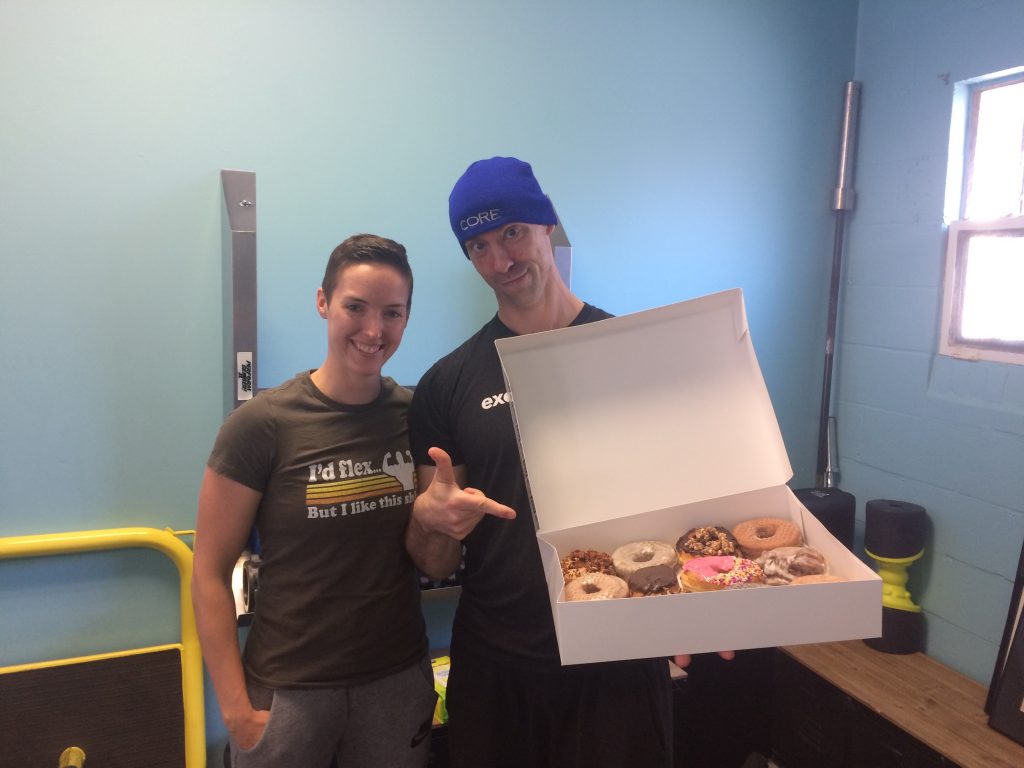
HINT: bring donuts….;o)

My intention isn’t to come across as some hoity-toity, superior-than-thou a-hole. I have no doubts some coaches have legitimate reasons for charging people to come in to observe for a day. However, I can’t help but think there’s a subtle lack of “feel” out there.

Just my two cents.

No, but seriously, bring donuts.6

Strength coach, Meg Julian, stopped by CORE this past weekend. She nailed it.

Categoriesbusiness Media

Should You Invest In Your Own Website?

My website – the one you’re reading right now – is, in many ways, a family member to me. I know it seems a little weird, borderline crazy, to refer to a website as a family member…but hear me out.

It gives me an immense sense of pride and accomplishment. It provides sustenance. And, much like what happens to you when you’re crazy Aunt Jane comes to visit, it can drive me batshit crazy sometimes.

This site has gone through several iterations and “face-lifts” through the years, and I’d like to use today to describe the journey as it’s a topic I am often asked from other fitness professionals:

– Why did you start it?

– How’d you do it?

– When and why did you decide to hire someone to make a customized site?

– What were the advantages (and disadvantages) of doing so?

– How long did you clench your sphincter when you realized how much it would cost?

I hope this helps.

Copyright: bowie15 / 123RF Stock Photo


Should You Invest In Your Own Website?

I believe the short answer here is a profound “yes!” Paying for (investing) in having a website professionally made is, in a roundabout way, a way of investing in yourself.

However, I could just as easily say “it depends,” and/or “only when the time is right.”

Out of the gate I don’t believe most need to worry about hiring someone to make them a customized site; at least not right away. The ROI just isn’t there when you only have a handful of clients to begin with and the only people reading your stuff is, well, lets be honest, your mom is the only one….;o)

I do feel it’s important for people to have access to you, though. Meaning, I think it behooves any fitness pro to have a generic website that explains who you are, your experience, maybe take the time to describe your ideal client, as well as your contact information.7

If you really want to throw people for a loop maybe include a video of you doing an interpretive dance to an Adele song. I don’t know, I’m just spit-balling here.

My First Website

Your first website doesn’t have to be all fancy pants. My first site was something I jimmy-rigged from Blogspot.com. I think it’s called Blogger.com now.

NOTE: there are plenty of free website to help you get started nowadays: WordPress, Medium, etc.

The main selling point was that it was free, idiot proof, and I could pick from several templates to get things up and running quickly.

It was 2006 and I had just started getting several articles published on T-Nation.com, so of course I needed my own website goddammit. You know, cause I was someone important and had important things to say.

I signed up for a free account and within minutes I had my very first website.

Regrettably, wading in a pool of my own bravado and naivete, I named my freshly minted website, of all things, “The G-Spot.”

My last name started with “G,” I thought it was witty, and there’s a reason why I never went into marketing. I’m sure if someone dug deep, they’d be able to find it.8

This all happened within a few months of me having moved to Boston right when I had started working at a posh club downtown. During my free time between clients I’d head to the cafe and write maybe two posts a week, mostly concentrating on common myths and misconceptions I’d come across via conversations with them:

  • Why Sit-Ups Are a Bad Idea
  • Did You Know Deadlifts Mold Badonkadonks?
  • Why Squats Are the Awesome
  • No, You Existential, Metrosexsual Douche, HAN SHOT FIRST

Alas, the “G-Spot” served it’s purpose. It allowed me a place to hang out with myself, an opportunity to practice my writing, and served as a “home base” for people to get a hold of me.

The Step-Up Blog

My big “blogging break” came a few months after starting The G-Spot. I had started working with a client who worked at the Boston Herald and she mentioned to me they were looking for someone to provide online content for their health/fitness blog.

She asked if I’d be interested, I said okay, and internet history was made.

Well, not really.

I did grow the “Step-Up” blog to one of the more frequented blogs on their site, and ended up staying there for close to two years, writing 3-5 posts per week. It was an awesome experience and definitely gave me some added prestige to be affiliated with a known brand.

During that time I continued to write for T-Nation, started getting courted by places like Men’s and Women’s Health9, and also helped start and co-found a little ol’ gym called Cressey Sports Performance.

Things were going well and it soon dawned on me it would work in my favor to start writing for myself again, on my own site

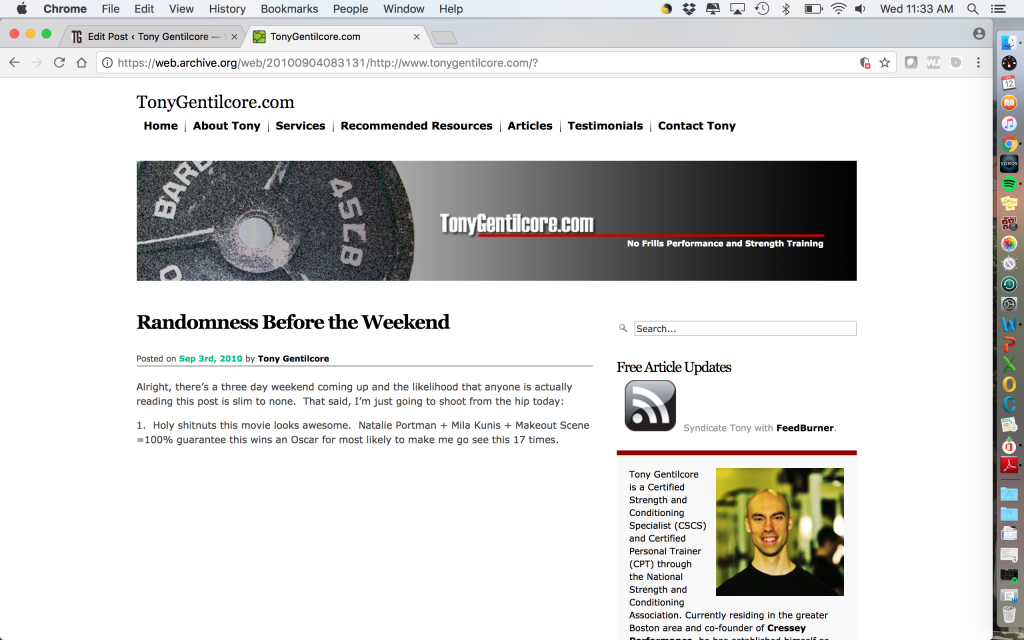
TonyGentilcore.com – #1

I still wasn’t at a point where I felt I needed to hire someone to customize a site for me. But I also recognized I didn’t want some vanilla looking site that looked like everyone else’s.

What to do, what to do?

I ended up trade-bartering services with a friend. I was good and making people diesel and he was good with 0’s and 1’s. I offered to write him several months of programming in exchange for a website.

BOOM.

Again, nothing too fancy…but a step above what most people had at the time. I even took the picture of that weight plate on the home page. No big deal.

My “homepage” was the blog itself, but I also added tabs like “Services,” and “Recommended Resources.” The latter two, in addition to the blog, allowed me a little more opportunity to monetize the site, which was a goal of mine all along.

TonyGentilcore.com – #2: When Shit Got Real

In 2009-2010 I decided it was time to put on my big boy pants on and hire someone to make a customize website for me.

At that point I had accumulated close to 5+ years of content and my blog was starting to become a legitimate added source of revenue via affiliate income and distance coaching inquiries.

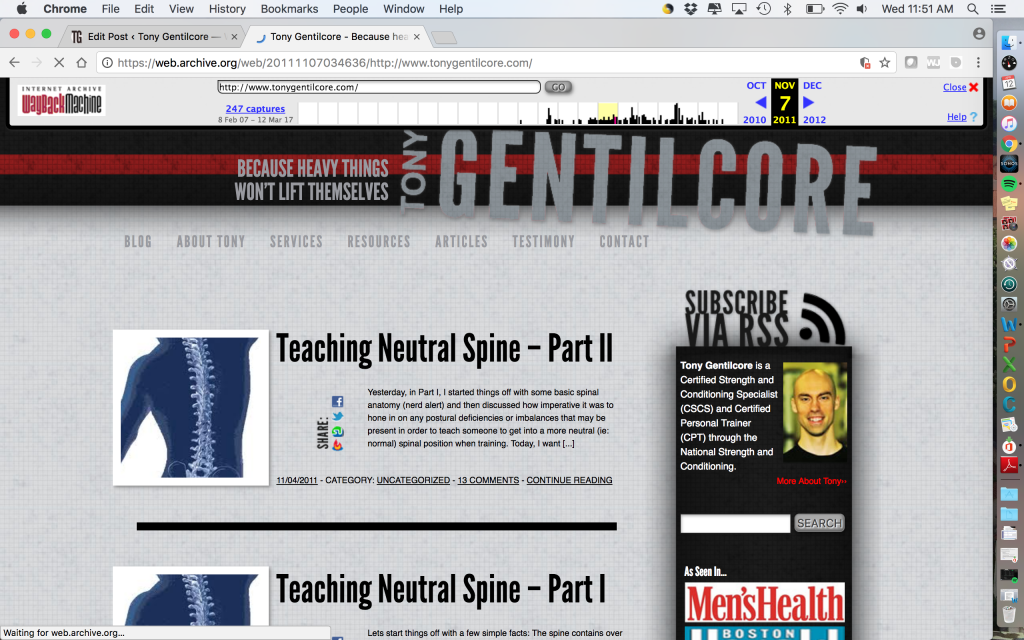
I figured if I wanted to take my site to the next level I’d need to make it stand out. I reached out to Copter Labs, and they produced this gem:

It consisted of many of the same functions/features as the previous website, but looked way sexier and appealing, and had all the bells and whistles to boot.

It wasn’t cheap – to the tune of a few thousand dollars.

Whaaaaaaaaaaaaaat?

via GIPHY

Putting things in perspective, though, I had reached a point in my career where investing in myself seemed a wise move.

You know the saying “you have to spend money to make money“?

It applied here.

The design and features alone weren’t the selling point for me, nor is it where I felt I received the most value.

It was the BENEFITS they provided.

First off, I have no effing clue how to make a website. I can barely run a microwave without blowing up my apartment.

Many companies make beautiful websites, but why I chose Copter Labs was because I knew they knew the fitness market.

Moreover, I knew they’d take care of every detail from the photography to the general functionality of the site.

It’s something I heard Mike Samuels write about recently:

“No one gives two shits about features.

What people care about is the BENEFITS.

What’s the specific outcome they’re going to get?

I see this a lot when I talk to clients for the first time.

You ask them why people should buy their product and they say things like –

– The design is incredible.
– They get a different task every day
– I only use the finest ingredients

Okay. Cool.

None of these are bad, but none of them compel people to buy either.

They’re very ‘nice’ … and nice is the most abhorrent, repugnant, obnoxious thing to be.

If you TRULY believe that these features matter, then run the ‘so that’ test on them.

For example –

‘The design is incredible SO THAT this course is much easier for people to follow than any other on the market.’

“I only use the finest ingredients SO THAT the meals stay fresher for longer, and taste so much better than generic, crappy microwave meals.”

However, this isn’t to short-change the importance of a baller design. I DO feel it matters, especially now, in an age where everyone is vying for everyone else’s attention.

I think one of the biggest things people don’t pay attention to is the value of design. A well designed website, visually appealing / aesthetically pleasing, one that stands out from the crowd, one that doesn’t look like it was built on top of a template, can, and almost always will separate you from the masses

[IMPORTANT NOTE: Assuming, of course, your content doesn’t suck]

People can tell the difference and know when they’re visiting a poorly designed website. What’s more, they can tell how it “feels” while using the site. It may seem low quality, hard to use, disorganized.

What’s the point of this site?

While it may seem obvious to the business owner, it’s never that obvious to the site’s visitor.

How does a potential client find what they’re looking for? Do they have to work at it, click a bunch of links and read through a bunch of unorganized copy? The site’s design and structure should lead them right to their answers.

A template can’t design a website for you. A site builder platform can’t either. Just like an app can’t be a personal trainer, an app can’t be a web designer either.

TonyGentilcore.com – #3

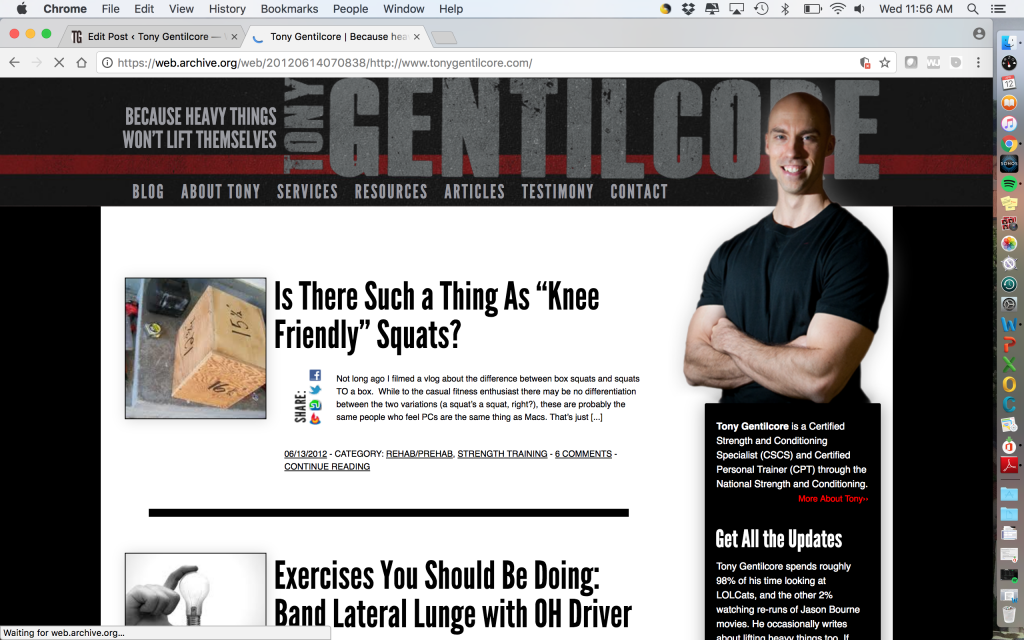
Maybe a year or so later I hired Copter Labs again to give the site a bit of a face-lift.

A crisper look to say the least.

And, what can’t be appreciated by a screenshot alone was the “flow” of the site. That was improved as well. If you had the ability to scroll down on the picture above you’d see an area to sign-up for my newsletter as well as links to all my social media accounts.

Flow is crucial.

It didn’t (and doesn’t) take a rocket scientist to navigate the site. If you wanted more info on me and what I was about you’d click the “About Tony” tab, if you wanted to read more articles I had written, you’d click “Articles” tab, or if you wanted to hear a cacophony of hip-hop horns all you had to do was click on my left forearm.

The ultimate Easter Egg.10

TonyGentilcore.com – #4

Is what your eyes are transfixed by today.

The last update was back in 2014 and at that time I had ZERO idea my site wasn’t compatible with mobile devices and tablets. I had noticed a slight drop in traffic which resulted in me eating more Ben & Jerry’s Ice Cream and watching Julia Roberts’ movies. It was a dark time in my life. I don’t want to talk about it.

Here I was thinking I lost my blogging mojo and that I should just give up and become a crazy cat lady, when the real issue was there were a fair number of people unable to read my site because they weren’t able to access it via their mobile devices.

Giving credit where it’s due, Copter Labs were a head of the curve, recognized the snafu, and went in and fixed it…amongst other things, like, connecting an email marketing platform to build targeted audience segments, and helping me to plan out a more diverse e-commerce section in the near future.

And, possibly, a photo gallery of my cat.

In reality, the site is always a work in progress. I am constantly tweaking this and changing that. And that’s the beauty of it: while the shell is 100% customized to me and my goals for the site, the deeper levels – adding services, speaking engagements, new resources, etc – are what I have control over at all times.

That’s That

This isn’t a love-letter to Copter Labs. And just to throw it out there I receive zero kickback from mentioning them.11

I wanted to write this today because it’s something I am constantly asked by many fitness pros, young and old, and I wanted to share my experience(s). I DO feel there’s value in hiring someone to customize a site for you, but would caution people to do so too quickly before they’re ready.

But if you are going to do it, there’s a lot of shady people out there. I’ve heard several stories of people spending several thousand dollars on website developers only to be disappointed, or worse, left empty handed.

I wouldn’t steer you in the wrong direction. I got your back. If this is something you’ve been on the fence on, consider my peeps at Copter Labs and give them a shout. They’ll take good care of you.

I’m out.

Categoriesbusiness

The Art of Getting Your Shit Together

Getting your shit together is a skill that escapes even the best intentioned and seemingly organized people. This is especially true in the fitness industry, where the expectation is we work while others don’t. All…the…time.

In today’s guest post by Chicago-based strength coach, Mike Connelly, owner of Rebell Strength & Conditioning, he shares some of his insights on how to balance the teeter-tottering of work/life balance.

Copyright: vicnt / 123RF Stock Photo

The Art of Getting Your Shit Together

If you read Tony’s last blog, The Grind: Hashtags, BS, Truth, and a Little Too Much at Times, and found yourself questioning your value in “the grind” then I have some good news for you. You’re not alone. I hate “the grind”. Can’t stand it.

You know what I like? I like spending time with my wife and daughter. I like going out for some drinks with my friends on the weekends. I like reading books that have nothing to do with what I do for a living. I like watching documentaries. I just really, really, really like not working.

There, I said it and I meant it.

Don’t get me wrong. I do like coaching people. I like managing a team, setting goals, and accomplishing goals too. But, and I’m going to steal a gem of a thought from our industry, I want to use the minimum effective dose to get that shit done.

If we want to cut the fat off of our work load then we are going to have to first determine what is fat and what is essential to our success. It takes some effort and help to get your shit together but I can tell you, without hesitation, that it is well worth the trouble.

Here’s a couple of things that helped me get my shit together. I hope they help you too!

1) Make Sure You’re On the Right Path.

We spend a lot of time outside of ourselves these days. We are heavily influenced by the outside world, leaving little to nothing coming from within ourselves. That can be a huge detriment to our productivity. A lack of confidence in creating our own paths leads us to chasing someone else’s and we end up completely void of any idea of what WE want out of this.

When I first started coaching I had this idea that I wanted to be that guy that can rattle off a bunch of science terminology and statistics from studies and that would legitimize me as a coach. I was overcompensating for never having finished school and thought it was going to keep me from ever being successful.

I wanted to follow the path of the coaches I admired, which is logical. Here’s the thing though, I was chasing a ghost. I am not the coaches I admire. I am just me and that’s just fine. I don’t have a laundry list of pro athletes that I train. I do work with some, but the overwhelming majority of my business is with general population clients.

Do they need me to recite Anatomy Trains to them for them to achieve their goals? Nope. Do I need to revolutionize training to grow my business and make people happy? Nope.

Here’s what I need:

  • I need to create a community that provides comfort and motivation to those that choose to be a part of it.
  • I need to be competent in the basic training facets. In my book, that’s one form of an assessment, one method of movement preparation, a solid template to build my programs from and an understanding of what differentiates programs, and a reliable network that I can refer my clients to should a problem arise that is outside of my lane.

Believe me, if you find one of each of these facets, that is all you need. If it works, it works. No need to pile on.

The point here is that while it took a while, I have finally found MY path. In discovering that, I have been able to cut the fat off of my to do list and save myself a ton of time. If you want to know what will make you happy in your work, the answer lies within you and not on social media.

2) Huge Dumps Are Healthy.

For a very long time I lived under the lie that I didn’t need to write things down to be organized and productive. My thought was that my accomplishments to this point were proof that my “system” worked.

That’s special, isn’t it?

What I was disregarding is the fact that regardless of what my perception of my level of success and happiness to this point was (which were somewhat miraculous considering the dumpster fire that I have going on in my head sometimes), tightening the screws on your processes is never a bad idea.

Enter the brain dump.

Every Sunday I perform a ritual. I lather myself in shea butter, light my favorite candles, put on some Yanni and spend an hour inside my head. Some of that is true. Well, ok, it’s an hour that I spend inside my head.

It is somewhat of a ritual though.

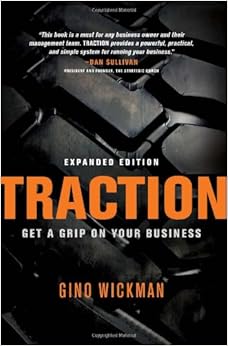
I do get away from “the noise” to center myself and dig through the rocks inside my head. Not literal rocks, although if you have met me before you may wonder. I use “rocks” in the sense that it is used in Gino Wickman’s book, Traction. “Rocks” are the big things that I want to get done in the long term. They are my big goals that are comprised of a ton of smaller points to work through.

While a legit list of “rocks” is going to be relatively small, the action steps that get you to your “rocks” can be lengthy and hard to keep track of. Unless of course you take some time every week to check yo’self.

A good brain dump will clear your head, relieve you of stress, and leave you with a list of steps that will help you dominate your work week in a clean and efficient manner. Knock that shit out every Sunday afternoon and I will bet you dollars to donuts that you will sleep like a baby come Sunday night. That’s right! No more Sunday Scaries (that’s what my wife calls stressed induced insomnia)!

Brain dumps are not only good for clearing your head, but they will keep you laser focused throughout the week. Keep that list with you and use it as a guideline for what you need to get done. This will keep people like me that get distracted by shiny objects on task. It might take some practice and getting used to, but once you get it down you will not know how you survived without it!

3) Find Your Bible

Now that you’ve dumped your brain out what are you going to do with what you came up with?

Figuring this out wasn’t easy for me because even though I had started doing my brain dumps, I was still left with the task of organizing all of it’s products. It’s a legit obstacle that presents itself in different ways to everyone. The key is to find some sort of tool that works best with how your brain works.

My good friend, Todd Bumgardner, uses a notebook. He’s a hipster. If something like that works for you, go for it.

I need a little more structure and flow. Something that looks and performs cleaner. For me, the Action Day Planner works like a charm. It has a simple and manageable layout that does not confuse my apish mind.

Does it matter what you use?

No. Just use something that you can log all of your brain dumps and weekly notes in for easy reference. Anything above legal paper folded into your pocket should suffice but it’s going to depend on your style and what you need to keep up with the task. I suggest that you not just buy any old planner. Shop around and flip through them until you find one that makes sense to you.

And That’s That

There it is. Three things that will help you organize your grind and leave you with as much time as possible to do the things that we actually want to do. And let’s face it, if you are telling us that working more is something you actually want to do, you are full of it.

If you would like to gain a deeper understanding of how I have successfully organized my time and so much more, join us in Chicago on May 6th and 7th for the Spring Strength Faction Seminar. HERE is a link with more information

Categoriesbusiness rant

The Grind: Hashtags, BS, Truth, and a Little Too Much at Times

I’m a firm believer you get what you work for. Nothing just happens. You don’t miraculously earn a decent income, hit a new PR in the gym, pick up three new clients, get an A on your history paper, or finally beat Mike Tyson in Punch-Out without some modicum of effort and hard work.12

Copyright: wamsler / 123RF Stock Photo


Hashtags like #grind or #grindcity or #grinding worry me. For starters, some people (certainly not all) use them as a way to cover up the fact they’re lazy AF and to give off the perception they’re somehow working hard (or to be more colloquial: crushing it). It worries me because it gives off a false sense of accomplishment.

Such hashtags are commonly accompanied with an epic picture of a cup of coffee, or, if someone is going to tap into their inner Scorsese, maybe a laptop (with a cup of coffee conveniently placed next to it for added effect).

It’s the age we live on nowadays. Where we can bullshit ourselves (and everyone around us) that we’re somehow better or more work ethicy (<– not a word) than everyone around us. It’s never been easier to curate a life that seduces adoration.

I’m not holier than thou. I don’t deny I do it. As of late, every picture that my wife and I have put up of our now 7-week old son is of him smiling or being super cute.

“Look at us. Parenting is sooooo easy. #nahnahnahnahnah.”

Okay, there was this one. No glitz and glam here.

Easy peasy.

A post shared by Tony Gentilcore (@tonygentilcore) on

Whenever I see all those different iterations of #grind on social media regurgitated by coaches and personal trainers alike part of me can’t help but think to myself, “what’s so impressive or vainglorious about going to work?”

But then I think about how many of those same people are listening to every podcast or 2-minute clip of Gary V on Facebook about the grind and how you have to work your ass off if you want anything to happen and to make something of yourself.

Work, work, and more work. You can sleep when you’re dead.

To some extent I couldn’t agree more. I wouldn’t be where I am today if I didn’t work my ass off:

  • I remember all those mornings getting up at 3:45 AM in the dead of winter in central NY to open the gym for members.
  • I remember working as a commercial gym trainer for FIVE years before I even smelled my first professional athlete.
  • I remember 6-7 day work weeks when we first opened up Cressey Sports Performance. 12-14 hour days to boot.
  • I remember writing articles for my site – everyday – knowing that only 50 people (okay, 20) would read it on a good day.

As much as I’m a fan of telling people to embrace the ass-kicking and inevitable failures that are bound to happen, and that there are many sacrifices that will be made in the name of entrepreneurial shenanigans13, I also, too, encourage people to know when to tone it down or turn it off.

Go to the movies.

Have a date night.

Spend time with your kids.

Read a non-fitness, non-business, non-existential-money-making-life-changing-x-y-z-book-that-was-only-written-by-the-author-so-he-or-she-would-increase-the-chances-of-being-hired-by-a-fortune-500-company-as-an-consultant-and-nothing-written-in-the-book-will-have-relavance-to-your-fitness-studio book.14

Watch Netflix. Even better if there’s some chill involved.

In short: have a life.

Recognize that part of being “successful” (whatever that means to you) is recognizing there’s only so much “grind” you can muster before you want to toss your face into a brick wall. You’re not going to lose demerit points if you decide to go bowling with some friends on a Friday night instead of scouring PubMed for the latest studies on moment arms and hip extension torques during a deadlift

Bret Contreras and Greg Nuckols are the only two people I know who would happily choose the latter. But they’re also super nerdy. And super good looking and classy (in case they’re reading)….;o)

There’s a work-life balance that’s going to be different for everyone. And trust me: there will (and should) be times where you’re dragging ass and grinding.

I just encourage you to find a little more life to fit into the scheme of things.

#micdrop

Categoriesbusiness coaching fitness business

The Pros and Cons of Online Training

I started utilizing distance coaching back in 2005 before “distance coaching” was a thing. Hell, Facebook was barely a thing at that point in time, but I managed to survive.

Come to think of it I didn’t get my first cell phone or laptop until 2006, so it’s any wonder how I was able to turn distance coaching into a viable source of income for myself.

Copyright: everythingpossible / 123RF Stock Photo


It’s taken years, of course, to turn it into a viable source of income, and, admittedly, there are innumerable coaches out there who have built online training empires that would make what I have built seem like an anthill compared to their Taj Mahal.

Fuck those guys…;o)

Just kidding. It’s altogether impressive to see how successful some people have gotten with their online training businesses. Kudos, and well done.

Nonetheless, I wanted to take today and discuss my experiences with distance coaching: Why I do it, the pros and cons of doing it, mistakes I’ve made along the way, and whether or not you should considering dipping your toes in the water.

Copyright: warrengoldswain / 123RF Stock Photo


Above all, when it comes to online training, you need to ask yourself this question:

Are You Doing It For the Right Reason(s)?

There’s a fairly naive notion that those who do online coaching are living the high life. They’re traveling the world on their hovercrafts writing programs and answering emails while sipping Pina Coladas. Indeed, for some, this is very true. I mean, hovercrafts are awesome.

However it’s not the norm.

If you’re entering the world of online training under the guise that that is normal, and that you’re going to be making between a metric boat load and metric shit load of money without any effort, let me say this:

“HahahahahaahahahahaahahahahahaahahhwytZARWQEtwqEagfhagtawrhdAFr5HAHAHAHAHA.”

Personally, I’d make the argument that online coaching is more time consuming and more of a grind than people are led to believe. Then again, those who believe otherwise are the ones who think all you need is a YouTube page, a smart phone, and nice smile to build a bonafide fitness business.

Basically it comes down to this:

  • If you decide to enter the world of online training (only) to make a bunch of money, good luck. I doubt you’ll last long.

  • If you decide to enter the world of online training to actually help people (first), to offer a good service with integrity, and then yeah, eventually, maybe make some decent money, now we’re talking.

Those Who Do Online Training Gooder: A Huge Caveat

I didn’t take on my first online training client until 2005. I had just moved from Syracuse, NY (where I had been working in both corporate and commercial gyms for the previous three years) to Danbury, CT where some guy named Eric Cressey convinced me to move to to start working with him at a local gym in the area.

A client of mine (back in Syracuse), Bobby, emailed me after a few weeks and asked if I’d still be interested in writing his programs? I like to think he couldn’t live without my witty personality and incessant GoodFellas quotes.

Until he had asked it had never dawned on me to write programs in a distance-based fashion. I was like, “uhhhhhhh, sure.”

I had a digital camera, a desktop computer, a sick bicep peak (<– very important), and an Excel spreadsheet.

I made it work.

But how?

Looking back my systems were terrible. But that’s also comparatively speaking. What I had access to back in 2005 in terms of technology paled in comparison to what is available today. I might as well, proverbially speaking at least, have been shucking corn with a scythe. Or, I don’t know, playing video games on an Atari 2600.
Bobby would send me a check via snail mail, I’d write his program, email it to him, and then if he had any questions I’d either have to write a Tolstoy’esque email back explaining every step of every exercise, or attempt to send him an impromptu video, which, honestly, back then, was more of a pain in the ass than writing everything out.

There was no such thing as YouTube. How did we survive?!

But it worked because of one thing, and it’s something I can’t repeat enough: I had years of experience training people in REAL LIFE.

To that end……

I think the best online coaches are those coaches who have experience training people in-person for a few years and then transition to some degree of distance coaching.

“It’s only when you work with people in person, gain a better understanding of their diversity and how to properly cue and coach different people with varying goals, current/past injury histories, and ability levels, and then have experience APPLYING what you read and watch to an actual individual, that you’ll (likely) be more successful virtually.”

In the years since I have developed better systems and my online coaching business is loaded with my own required desiderata – my laptop, PayPal account (to accept and send payments), DropBox (t0 receive and critique training videos), set of questionnaires, intake info, and screens (sent via vide0) to better ascertain prospective clients’ needs, a relationship with Exercise.com and their use of their sweet platform, not to mention my baller Spotify chill mix for optimum program writing prowess and badassery.

But what about the pros and cons (for both client and coach) of online training? What are they?

The Client

Cons:

Since I like to get bad news out of the way first (like, I’m writing this post with no pants on) let’s start with those, in no particular order:

  • Your coach isn’t actually there with you: That’s sort of the point of distance coaching right? But unless you’re highly motivated, you’ll find this as an excuse to not make it into the gym or skip certain parts of your training session. Lame.
  • Feedback comes later than you need it: Since you’re (hopefully) sending videos to your coach you won’t know until after you’re done with your lift if you performed things up to their standards.


  • It’s really easy to find a shit coach: If you spend 10 minutes browsing the fitness related hashtags on Instagram, I bet you could find about 50 random guys and gals who just finished training for their first show and are dying to offer you one of the limited spots in their online training group. Who knows what this person knows and where they learned it. If you don’t do your research you’ll end up wasting your money on some random jabroni.
  • It can be tough to form a relationship: If you found your coach online, it can sometimes be tough to form a relationship with them. Really, who wants to keep spending money on someone that they don’t have a great relationship with? And if you haven’t really bonded with them or trust them, why would you keep killing yourself in the gym for them? This is why I always make it a point to send random pictures of my cat here and there. Because it builds rapport, and because she’s awesome.

Pro’s:

Enough of the Debbie Downer talk! There’s a lot to love about working with a coach as a distance client!

  • It’s cost effective: This is just a fancy way of saying cheap! The cost per session of working with most distance coaches is substantially less than paying for them in person and is typically even way cheaper than paying for an atrocious trainer in person. For just a few bucks per lift you can have a great coach write your programming for you; it’s awesome.
  • Low stress: What do I mean by this? I mean that you don’t have to worry about schedules nearly as much as in person. You work weird hours and want to train at 2 am? Sure, pyscho, go train at 2 am.
  • You can work with just about anyone: As long as a coach is taking clients and you can afford them, you can work with just about any coach in any realm of fitness. It doesn’t matter where they are located; you can get a Chinese weightlifting coach, a Brazilian booty coach and a Turkish get-up coach if you want.
  • It can last a lifetime: If you’re lucky enough to find a coach that you have a good relationship with, trust and see results with you can train with them essentially forever. Regardless of where either one of you moves, the training relationship can remain solid.
  • A good community: I’m lucky that my coach (yes, I have a coach) had done such a good job with his distance coaching prior to me hiring him. When I started working with Greg, The Strength House had a vibrant online community where people are able to post videos to get feedback from Greg and Tony B. as well as other clients who may know what they are talking about. It makes a huge difference with staying accountable to my program.

The Coach

To be truthful, a lot of the points that are true for clients are true for coaches. It can be tough building a relationship with someone that you’ve never met.

Cons

  • There is a world of shit out there: People move like crap, and it’s hard to “manage” people from a distance unlike you can in-person. Being able to instantly provide verbal and tactile feedback is what gives in-person coaching a more than slight edge over online training.
  • More challenging to keep clients accountable: Are your clients really doing what you tell them to do? Are they really doing their deadbugs and dedicated warm-ups or skipping them in lieu of extra bicep curls in front of the mirror?
  • It Can Get Weird – Like that one time I started with a new male client and while on a bus on my way to NYC to visit friends I opened up all the postural pics I had him send me. Sorry random woman who looked over at me looking at half-naked pictures of a man. #awkward.
  • There’s a lot of moving parts: To be an effective distance coach means having a few systems in place that work really well and those can be difficult to manage.
    • A good way to track programs and ensure clients get them in time.
    • An effective means of communication, or else you’ll end up with an abyss of emails and texts to answer. Personally, though, I rarely give out my cell phone number for this very reason.
    • A good video library to pull demo’s from.
    • A solid network of coaches and trainers in other cities to be able to reach out to for help (Hey, I’ve got a client in your city, they’d like to meet with you for an hour and work on their hip hinge)
    • A strong system to collect and track payments.
  • Distance coaching isn’t for everyone: Truthfully, some people really just do need one-on-one in person training. Maybe the client isn’t motivated enough, maybe their needs are beyond what you can provide via an email or Facebook message. While it will mean you lose their monthly fee, this is definitely a client you should help find a local trainer to help them with their immediate goals.
  • It’s not all butterfly kisses and rainbows: Despite what the internet tells you, most people who do online training also have another job. Very few can live off their online business alone. It can be a drag to come home after coaching (or working) an 8-hour day only to have an inbox full of client questions and inquiries. As I alluded to above: online coaching, I find, is more time consuming than people think – especially if you lack having systems in place.

Pros

  • You can work with anyone: This is by far the coolest part. Right now I do remote coaching with people all over the world. I have clients all over North America, Europe, and even the Middle East. Many people have limited access to quality coaching and online training allows me the opportunity to work with people I otherwise would never cross paths with. Note to Optimus Prime, I have a few spots open.
  • It’s a decent bump to your income: I’m not going to tell you it’ll make you a millionaire, but I remember when I first started I told myself I wanted online training to help me cover my rent each month (and maybe pay for my then Match.com membership). It did and has since. Pretty cool.

Note: Match.com profile was deleted when I met my wife….;o)

  • Clients for life: If you’re good at what you’re doing, you’ll have clients that you’ll keep around forever. Also, since we in the fitness industry know that word of mouth advertising is more effective than anything else, happy clients will tell their friends and family.
  • It’s honestly fun: I really enjoy this part of my job. It takes me out of the daily routine of local clients that I work with and gives me something else to think about. It has become another skill to try and master and I like that challenge. Figuring out how to get great results with someone training in their home gym in North Dakota is much different than having that same person in front of you in your gym. You learn how to broaden your horizons as a coach and try to always get better and improve your systems.

Ultimately it’s up to you to decide whether or not online training is your cup of tea. I think when done well, for the right reasons, and with the right systems in place, coaches (and clients) can do very well. However, when taken for granted and with little attention to detail, it can be more detrimental than helpful.

Register for the Online Trainer Academy


My good friend, Jon Goodman, has developed what I believe is one of the best resources out there with regards to becoming a bonafide online trainer. If I had something like this back in 2005 my systems would have been much more organized, and I’d probably be married to Jennifer Lopez. True story.

Enrollment is extremely limited and only happens twice a year. Enrollment for early birds will begin February 21, 2017 (tomorrow!) and will close a few weeks thereafter. If you hurry, you can go HERE to download the Lasting Laws of Online Training and get onto the early bird list to save $200 off registration.

Do it.

DO IT.