So excited to head down to DC tomorrow to visit some old friends. Lisa and I should be able to actually board the plane this time with Julian.1
I’ve got a lot of entrepreneurial shenanigans to take care, not to mention packing, before we leave…so lets get right to this week’s list of stuff to read.
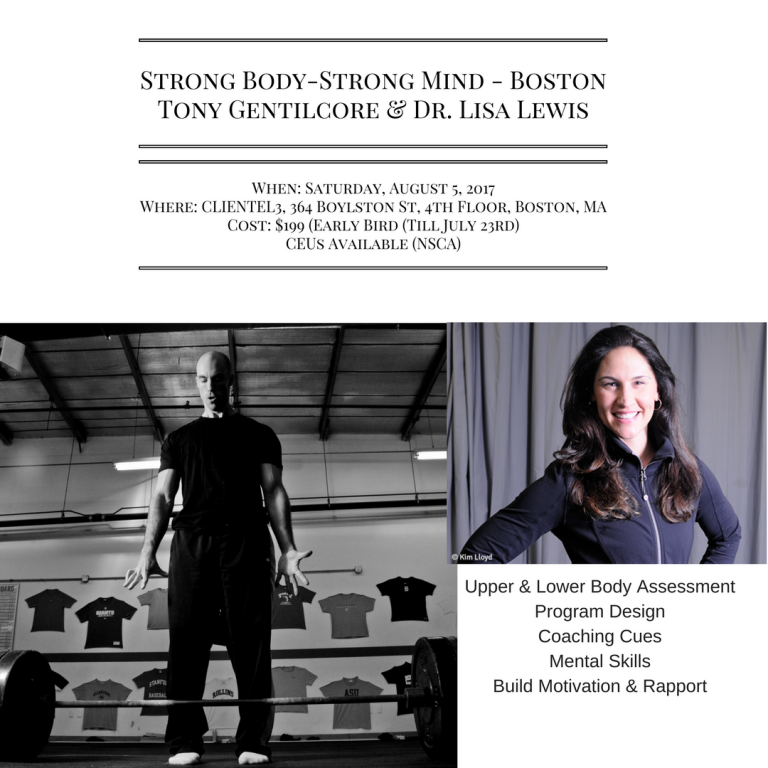
I’m really excited to announce the Strong Body-Strong Mind Workshop, coming to Boston (finally!) later this summer.
The idea is simple: there’s a corner in the industry that’s underserved….mental skills.
There are a lot of people out there who write about “mindset” and describe themselves as mindset coaches (whatever the heck that means) who, by and large, have zero academic background in that department.
Lisa, SPOILER ALERT: she’s my wife, went to school for that shit.
I went to school to help turn people into badasses.
So, why not combine the two?
Lisa can speak to building competency and discussing how to build the skills to develop rapport with clients. I can speak to getting people bigger, stronger, and faster.
Strong Body-Strong Mind = see you there? Here’s the itinerary2
Our Vancouver shindig in April sold out, but Dean and I have recently announced a stop in Orlando, FL later this year, October 21-22nd at Spark Fitness.
I’ve never been to Orlando. There’s no way in hell I’m visiting Disney World.
3. Stuff I Was Sent, Thought Was Cool, and Thought You’d Want to Check It Out
One of the best things about this site, outside of my uncanny wit and LOLcat memes, is the fact I get offers for people to send me free shit. Many offers I respectively decline as I feel it wouldn’t be a good fit for my audience.
NOTE TO AUDI: Sending me a free car would TOTALLY be a good fit. Just sayin.
But every now and then I get sent stuff that’s pretty dope. Like….
**FYI: I receive zero kickback from recommending the following products.
They sound amazing, and more importantly stay in your ears.
And they do fancy shit, like track your heart-rate via the integrated fitness app, in addition to providing audio coaching during your workouts (if you so choose).4
I tried them out during a recent squat workout and they worked superbly. Likewise, my wife, Lisa, who’s a headphone snob looooooooves them. They’re basically hers now.
If you’re looking for a pair of shorts that you can wear during a brutal deadlift session or CrossFit class and/or showoff at the next Catalina Wine Mixer…these are it.
Forgive the aloof and standoffish tone. I recognize the term “scapular winging” is a thing and that it can be an actual, real-live, medical diagnosis with dastardly consequences.5
But more on that in a minute.
It’s just that, in some ways, I find a lot of fitness pros – personal trainers, strength coaches, and even physical therapists – can often be a little too liberal with use of the term. They toss it around with little understanding of what it actually means and with little “feel” on how it’s interpreted by their clients and athletes.
I’ve long championed the sentiment that most (not all) fitness pros use the initial assessment as an opportunity to showcase how much people suck at doing things and how broken they are, and that, for the mere cost of a 215 pack of training sessions (the equivalent of a really, really nice Audi), they’ll fix you.
Pffffft, who wants an Audi anyways?
Here’s how a typical conversation goes:
Client: “Hey, I’m thinking about hiring someone to train me.”
Douchy Trainer: “Great, I’d be glad to help. We need to start with an assessment so I have ample opportunity to showcase how much of walking ball of fail you are and how I alone can fix you.”
Client: “Uh, okay. When do we start?
Douchy Trainer: “Right now, take off your shirt.”
Client: “Not going to buy me dinner first, huh? Kidding, okay, BAM.”
[takes off shirt]
Douchy Trainer: “Oh……….MY………..GOD.”
Client: “What? What’s wrong?”
Douchy Trainer: “I’m sorry to have to tell you this, but, you may want to sit down for this.”
Client: “Okay. What is it?
Douchy Trainer: “I’m sorry to have to tell you, but, but…..you have scapular winging.”
Client: “Is….that bad?”
Douchy Trainer: “I honestly have no idea how you’re able to walk, let alone speak complete sentences. We need to fix this ASAP.”
And this is where the trainer turns into that a-hole nun from Game of Thrones walking the client, Cersei style, down to the training floor to take them through a bevy of corrective exercise drills.
Now, admittedly, the key words used to find this picture were “most fucked up, dumpster fire of a case of scapular winging on the internet,” so don’t get too alarmed.
This is a legit, medically diagnosedcase, and not at all normal.
In a general sense, when we say “scapular winging” all we’re saying is that the shoulder blade comes or “wings” off the ribcage.
It’s sorta tricky because this pretty much describes everyone. You, me, George Clooney, your second cousin’s brother-in-law’s nephew’s Little League coach, literally, everyone, has some form of scapular winging.
So, what is it then? How much is too much? And, more importantly, what, if anything, should we do to fix it? Do we even need to fix it?
Dr. Quinn Henoch of Juggernaut Training Systems described this beautifully not too long ago. In short: a true case of scapular winging, like what’s pictured above, is a neurological condition where the Long Thoracic Nerve isn’t doing it’s job of innervating the Serratus Anterior (who’s job it is to adhere the shoulder blade to the ribcage).
The approach or fix in this case hasn’t anything to do with turning on “x” muscle or performing x, y, and z corrective exercises.
It’s not quite that simple.
Scapular Winging: What It Isn’t
I’ll tell you this much: we don’t have a pandemic of people walking around with true scapular winging. The vast majority of people you’ll encounter are owner’s of a completely healthy Long Thoracic Nerve.
They’re not broken. There’s nothing super duper nefarious happening.
What’s likely the culprit is a lack of tension and motor control.
The fix, then, is……..Drum roll…..
LOAD
If we can figure out ways to introduce load and subsequently, tension, this will not only help to turn shit on (without having to go down the 19-part corrective exercise rabbit hole) but also help people get into better positions via a little introduction to protraction.
Want to “cure” someone’s scapular winging in a matter of seconds?
Watch this. Closed-chain movements, protraction in general, is kind of magical.
Wall Press & Push-Ups That Don’t Suck
Pretty cool, right? That’s some Gandalf shit right there.
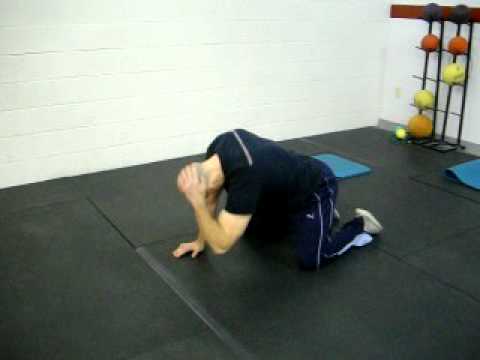
Quadruped Rockback w/ Floor Press
Typically the Quadruped Rockback is a a screen used to gauge active hip flexion ROM and to ascertain someone’s appropriate squat depth based of his or her’s anatomy. However, after listening to Mike Reinold speak on the topic it’s also a great drill to cue people into more protraction and upward rotation
Floor Press w/ Upward Rotation
Taking the floor press a step further, we can take away a base of support (and force the stabilizing arm to work that much harder in order to maintain position) and then incorporate some upward rotation.
Wrap Up
The umbrella theme here is not to dismiss scapular winging as an actual diagnosis. It is a diagnosis. It’s just not as common as people think, and I wish more fitness pros would stop jumping to conclusions so fast.
Oftentimes the fix is just to coach people up, introduce some load, and get them into better positions.
Last Chance to Save $100 off Complete Shoulder & Hip Blueprint
Last week Travis Hansen wrote part one and covered some arguable topics that you can focus on as a trainer/coach to help improve your personal and online training business over the long-haul.
It’s a very competitive world and there are many sub-fields within the training industry that you can explore to try and make a living and attempt to specialize in. (i.e. fat loss, muscle building, bodybuilding, powerlifting, Olympic lifting, Crossfit, athletic development, bootcamps, corrective exercise, etc. etc.)
Trying to stay general and master all areas of training development is a pipe dream and self-limiting.
Just take a quick look at the best in the business, and they are once again sharing something by having a specific brand or niche.
Granted you could make a very strong case that these guys could hold their own in just about any type of debate about a specific subject matter.
Nonetheless, most have a specialty because training is extremely competitive and technical when you get into the nitty gritty and discover lots of depth on a topic. And as I mentioned in part #1, this is yet another reason why you will need a sound network, so that you know who to turn to when an issue originating in an area outside of your target specialty occurs.
Also, bear in mind that there is much overlap between speciality’s which will require strong foundations across many types of training, but be sure to be real with yourself always and make it a point to identify your limits and knowledge gaps.
2. Practice What You Preach
This one probably pretty much goes without saying at this point, but I still think it’s worth mentioning.
If you want immediate attention and respect from clients and athletes in the short-term then all you need to do is look the part.
For example, if you want to train bodybuilders then be a bodybuilder. If you want to attract football players then play collegiate or even pro football and watch the initial waves of players that come knocking on your doorstep.
But does all of this guarantee that you are going to keep clients coming back in for more?
Hell no.
Why?
People inevitably want what they want, and this is results!
Although, having gone through the type of training you are preaching will award a temporary competitive advantage since you have gone through the process…beyond that you will have to gorge yourself with info and be a “student.”
This is why you see many pro superstars that don’t evolve into becoming coaches after their career’s are finished. They didn’t learn all of the x’s and o’s. Training goes beyond just hard work and talent. You have to really dedicate yourself to craving more knowledge and learning both the science and art of training.
Conversely, on the other end of the spectrum you have guys that have very little experience in a style of training, but are absolutely phenomenal and world class at what they do. There are several examples but it’s not important.
These individuals are brilliant intellectually, and can identify angles and interpret information and research differently from the rest of us. They are of course the exception, and are few and far between though.
And just so you don’t think I’m talking out of my ass, here is a comparison video from years ago of me walking the walk:
I was running consistent mid to high 4.4’s from multiple people hand timing me. And there happened to be one day where I felt superhuman and did record a 4.31 (4.54 fully electronic)!
What I was really proud of is that I spent half of a decade trying to improve my speed because I love speed training.
I started at a 4.7-4.8 initially.
I researched every technique, book, research study, program, and periodization model that I could find. My goal was to run a 4.3 naturally, and once I did that I lost all of my motivation and wanted to help others with a similar passion in becoming as fast as possible.
Since then there has been hundreds of athletes follow our training system and become much faster. Which brings me to the next factor.
3. Build Your Portfolio
Early on in my training career I would spend money on business cards, pamphlets, etc. in hopes of generating business leads and potential clients since I had just become self-employed and hated the corporate scene.
This was the approach that was advocated by my circle at the time, but I must admit that it didn’t feel right at all and I quickly dismissed the idea and went a different route altogether.
I asked myself why am I trying to sell a service with out much evidence that it works, along with a crystal clear understanding of what I’m actually doing?
And that is when I decided to commit myself to constant learning and daily practice.
Moreover, I wanted to make the absolute most out of each opportunity that I had training each client.
My learning to client ratio at the time was like 9:1.
I wasn’t making really any money, but I had a large window of time that I could capitalize on outside of training to gradually improve my training skill set. Anytime outside of that was focused on being social and staying sane!
And then I would train my ass myself.
Over time, I had taken care of a lot of people, and my clientele incrementally started to grow. But my whole mission of being results based and results driven has never changed and never will.
Do good work and people will come. Word of mouth will start to surface, and then eventually you will have something tangible that you can really market and sell to the public.
4. How Do You Respond to Failure?
How you respond specifically to acts of failure is going to be a huge determinant in how far you go I’ve found out.
Like anybody, you are going to always take your lumps in this business or any for that matter.
I think a big key factor is trying to minimize your failures and not make things harder on yourself than necessary. I can tell you firsthand that I’ve had days where I’ve completely sucked, cried, broke shit, sat there and shook my head in disbelief, and questioned whether or not it was all worth it, or if I really wanted to do this anymore.
A big part of the reason for this I think is because I have ridiculous goals and always have since I was 8 years old. And when you are miles and miles away from were you want to be, well it f*%ken sucks.
But when you start to become and remain accountable with yourself and you are constantly learning and practicing your craft with full effort, then it all starts to make sense eventually and things begin to fall in place slowly.
Wrap Up
On a final note, I really sincerely hope these two pieces may have enlightened you on a few things you may not have thought about with the profession and my full intention is to help you as much as possible.
Stay patient, grind, laugh, have fun, and try not to worry too much or be too critical of yourself. It will eat you alive!
About the Author
Travis Hansen has been involved in the field of Human Performance Enhancement for nearly a decade. He graduated with a Bachelor’s degree in Fitness and Wellness, and holds 3 different training certifications from the ISSA, NASM, and NCSF.
He was the Head Strength and Conditioning Coach for the Reno Bighorns of the NBADL for their 2010 season, and he is currently the Director of The Reno Speed School inside the South Reno Athletic Club.
He has worked with hundreds of athletes from almost all sports, ranging from the youth to professional ranks. He is the author of the hot selling “Speed Encyclopedia,” and he is also the leading authority on speed development for the International Sports Sciences Association.
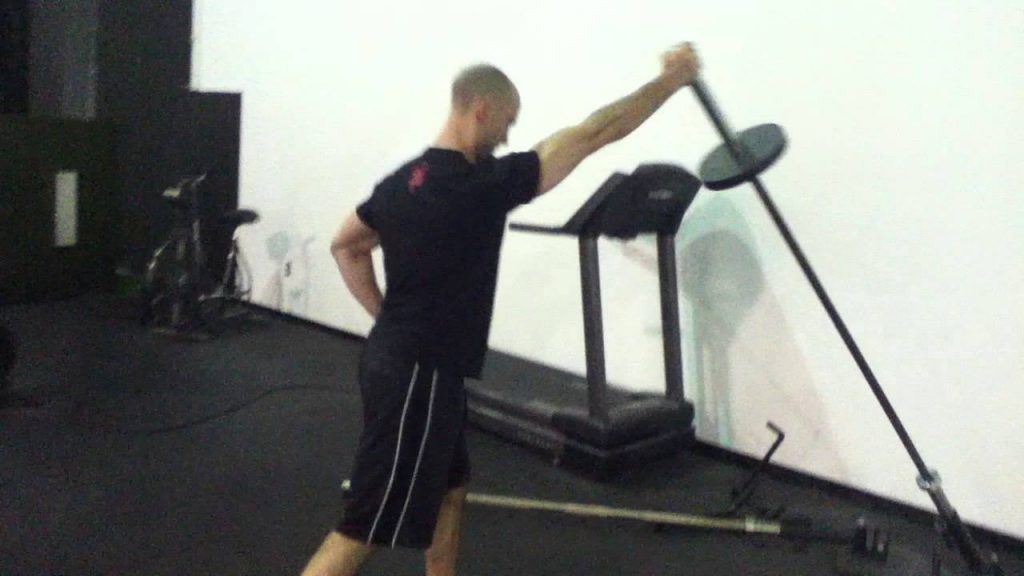
I’ve long been an advocate of the landmine press. Not only is it one of my favorite “shoulder friendly” pressing variations, but it’s one of my favorite pressing variations in general.
It gets you jacked and ripped and your shoulders feeling like a million bucks. If it’s performed correctly.
The landmine press doesn’t come without it’s own set of snafus and mistakes. Below is a quick video I shot that breaks down a few “big rock” things to consider as far as execution and common mistakes people make when performing it.
(Cough, cough, hint hint): If you want to dig a little deeper on shoulder (and hip) shenanigans you should check out Complete Shoulder and Hip Blueprint, currently on sale at $100 OFF the regular price through July 5th.
My flagship resource, Complete Shoulder and Hip Blueprint is on sale, like right now, for the first time ever, at 50% off the original price.
Why?
1. My (business) partner-in-crime6, Dean Somerset, is Canadian and we figured it would be a nice way to celebrate our respective country’s Independence Day.
Unity is swell.
2. My 5-month old, Julian, goes through a ton of diapers. That shit’s expensive.7
3. Why not?
It’s gotten amazing reviews and feedback from trainers/coaches from around the world, and I’m not at all biased when I say it’s pretty much the greatest fitness resource ever produced in the history of ever.
Don’t worry: I’ll be writing some actual new content in the upcoming days to coincide with the sale. Content that will educate and make you a better coach.8
In the interim I wanted to rehash some older(ish) posts that touch on some of the topics Dean and I cover in the course. Even if you don’t want to buy anything – did I mention it’s HALF OFF? – the info is fantastic, and you’ll be smarter. And more attractive.
Shoulder impingement is a garbage term. A lazy term. But that doesn’t mean you shouldn’t know the difference between the two, the mechanisms involved, and how to train around each issue.
Taking the approach that everyone should squat or deadlift (or whatever) the same way, with the same stance and setup, like we’re all molded to fit into the same textbook algorithm of perfection is unfortunate.
Surviving in the fitness industry is tough. Now, granted, this isn’t The Revenant…we don’t need to worry about wrestling grizzly bears or anything. But it is pretty cut-throat out there and the one’s who “survive,” and do well, are the ones who can separate themselves from the masses.
Today’s guest post by strength coach Travis Hansen showcases some ways you can do just that.
Trying to be successful in the fitness industry is a lot harder than most people tend to think.
The temptation for instant gratification and fly by night credibility is a very strong one, and provides with it a common misconception that you won’t have to grind on a regular basis, learn, and actually train people, not to mention generate legitimate results to remain alive in the business.
I’ve heard from a few credible sources that far less than 10 percent of individuals who start in the fitness business remain alive after a decade, and based on my experience that definitely seems to be pretty true.9
In this article I am going to share with you some arguable principles that I’ve utilized over the course of the past 12 years to stay alive and grow both my online and personal/athletic training business. I am by no means the most successful individual and I’m sure that many others could add to the list, but I honestly think the issues I am going to share with you are essential to your survival if you love this business and ultimately want to help people. I think everything stems off of the two factors I just mentioned and they serve as the groundwork for everything else to help lead you on your way.
So here we go….
#1- What Room Are You In?
Something that is very common I noticed from other trainers or even just the general public, is that there seems to be a constant battle in determining who knows more than the other person, or someone immediately jumps out and gets defensive if their current thought process is challenged by someone who may in fact be right.
I would be willing to wager a bet that our industry is far more guilty of this problem compared to any other profession with all of the hyped up trends that are out there still, hands down!!!
If you watch closely you will notice that the best in the business often times have their note pads out, eyes locked in on the person they are interacting with, ears open wide when they are trying to learn anything they can take away from the present conversation, and more times than not, don’t engage in these petty intellectual ego driven arguments that accomplish zero in the long run, unless the individual is just that damn stupid and asking for it.
As Mike Boyle once said:
“ There is a reason we have two ears and one mouth.”
The harsh truth is that you should probably spend the first 10 years of your career searching out the people who make you uncomfortable and dumb for the moment and eventually it will all start to make sense, and I guarantee you will be surprised just how much better you get.
The last thing I want to discuss in this regard is that something world renown coach and gym owner Zach-Even Esh once said that really resonated, and that is that people are often times uncomfortable and unsupportive of successful people as it makes them introspect and assess where they are at relative to their goals.
I honestly feel if that you start admiring successful people and try to emulate and even beat them then good things start to happen.
Don’t hate congratulate!
#2- Sacrifice
What a lot of surviving comes down to is how much you’re willing to do and sacrifice in order to achieve your goals.
Once you have mentally committed to doing whatever the hell it takes in order to achieve your goals without being illegal or walking over someone in the process then eventually you can start to grow.
I remember when I first got into this business I would buy and immerse myself into any fitness related material I could get my hands on to help build a solid learning filter. I was working 6-7 days per week for 8-12 hours per day. I would contact and pester any expert that would respond back to me with questions I had.
Luckily I stumbled across some great people that I still consult with today. You need very strong mentors and a network to better yourself and help your people.
#3-ASK FOR HELP
Never be afraid to ask for help or admit to your clients that you do not know something.
This only improves your credibility and earns more trust from your people in the long run.
Conan O’Brian once said in his late night talk show that saying you don’t know is often a sign of intelligence.
If you elect to retain your massive ego and state of ignorance, then you are only setting your education and growth back, and eventually your people are going to catch onto your bullshit and you will join the massive crowd of fly by night trainers that exist in our society today.
And remember you are only as strong as your network or alliance.
#4- Re-Invest
If you pay attention on social media, many times the high level practitioners and coaches in the field will send you subtle hints on how to be successful by showing you pictures of their personal training library and such.
There is also generally a very robust “Resource” section on every one of their websites where they show you where they learned from and how to improve your potential knowledge gaps.10
Your success will be ultimately determined by how smart you are, how hard you work, and how much you invest in your education and business. I never personally took out a business loan, but every paycheck and sometimes my whole paycheck was dedicated to learning material or small equipment purchases that accumulated into a bigger and bigger training setting or environment.
And then eventually once people see that you know what you are doing, you’re legitimate, and you get results, then they will more than likely invest in you and the ball just keeps growing bigger and bigger!
About the Author
Travis Hansen has been involved in the field of Human Performance Enhancement for nearly a decade. He graduated with a Bachelor’s degree in Fitness and Wellness, and holds 3 different training certifications from the ISSA, NASM, and NCSF.
He was the Head Strength and Conditioning Coach for the Reno Bighorns of the NBADL for their 2010 season, and he is currently the Director of The Reno Speed School inside the South Reno Athletic Club.
He has worked with hundreds of athletes from almost all sports, ranging from the youth to professional ranks. He is the author of the hot selling “Speed Encyclopedia,” and he is also the leading authority on speed development for the International Sports Sciences Association.
I’m really excited to announce the Strong Body-Strong Mind Workshop, coming to Boston (finally!) later this summer.
The idea is simple: there’s a corner in the industry that’s underserved….mental skills.
There are a lot of people out there who write about “mindset” and describe themselves as mindset coaches (whatever the heck that means) who, by and large, have zero academic background in that department.
Lisa, SPOILER ALERT: she’s my wife, went to school for this shit.
I went to school to help turn people into badasses.
Lisa can speak to building competency and discussing how to build the skills to develop rapport with clients. I can speak to getting people bigger, stronger, and faster.
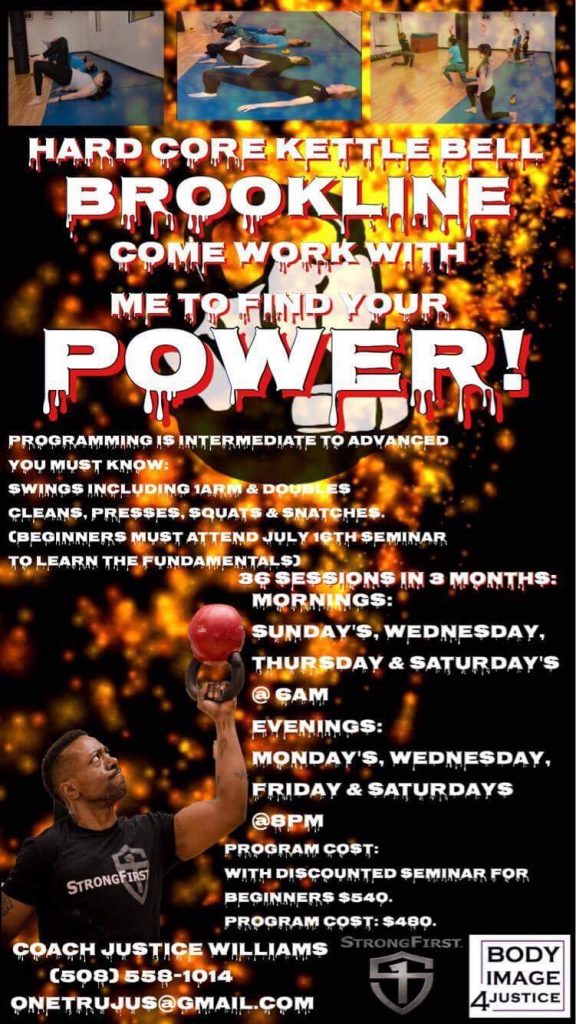
I’m pleased to announce that StrongFirst certified instructor, Justice Williams, will now be running kettlebell specific classes out of CORE starting next month.
You know, kettlebells, those cannonball looking thingamajiggies.
If you’re a beginner you’ll need to first attend the Fundamentals class on Sunday, July 16th where Justice will go over all the foundational moves like the deadlift, Goblet squat, swings, and Get-up.
If you’re already a KB enthusiast you can jump right into the program which will run for three months (meeting 3x per week) at CORE.
This will be an excellent opportunity get accountable, get fit, and learn kettlebell-specific movements all under the tutelage of an amazing coach. Check the flyer above for contact information.
3. Lift and Learn Workshop – CORE
If you’re a beginner, another great opportunity will be the Lift & Learn Workshop hosted by strength and conditioning coach, Jarrod Dyke.
Lifting weights can be intimidating:
Where do I start?
How do I warm-up?
How much weight should I use?
How often should I train?
Crap, did I leave the stove on?
Jarrod will spend an afternoon answering these questions (and more) in this FREE workshop on Sunday, July 23rd. For more information go HERE.
The Summit’s organizer, Ryan Ketchum, and I caught up yesterday and chatted a little on what I’ll be speaking about.
It’s a quick listen, about 15-20 minutes, but I discuss some things I feel are often neglected when it comes to program design. Things not many fitness professionals hit on; and it has nothing to do with the x’s and o’s of program design.
Groin strains can be a stubborn son-of-a-bitch. Once you have one, it’s one of those pesky injuries that never really seems to go away. In today’s guest post by strength coach and physical therapist, Sam Spinelli, he breaks down some common ways to resolve the issue.
Groin strains are often a hard problem for people to manage. We see them present in many different populations and occur with a wide range of activities. Strains are common in sports such as baseball, hockey and soccer where this is a huge demand on the groin.
With the groin musculature being a collection of numerous muscles, it is involved in so many different movements – flexing the hip, extending the hip, bring the knee towards midline, internally rotate the hip, and externally rotate the hip.
Due to the involvement in these movements, the “groin” can get stressed while performing them, but also get strained when the opposing movements are done as well.
For example, the adductor brevis (one of the higher up groin muscles) acts to adduct, internally rotate, and flex the hip.
If strained, during those three movements the muscle will be challenged to contract.
In contrast, during hip abduction, external rotation, and extension the adductor brevis will get lengthened. When the adductor brevis is strained, excessive lengthening can increase the damage to the vulnerable tissue.
The first step to managing these strains is to get things to calm down. Check out THIS article for more on that in regards to strains.
Get Long
When we say get long, we are talking about having someone comfortable with allowing the involved musculature to elongate.
This isn’t trying to lengthen the actual tissue – which is a topic we will discuss in a separate article/video series – but have the tissue be able to express the range it actually has with ease.
Below is a series of options – foam rolling, less dynamic movements, and more dynamic movements.
We start off with foam rolling as a means of helping in the short term, which we can use to help reduce the perception of tone in the tissue. Ideally this is used only briefly and removed as soon as possible so we are not relying upon it.
The less dynamic movements are one which have less involved movement, fewer joints involved, and more support. These are a great starting point for moving and reducing fear in individuals coming off a groin strain.
The more dynamic movements are things that will have more transfer to daily life and sporting activities.
Once we are in the phase of building things up, we will shift our focus to exercises to help make the tissue more resilient. In particular, we are going to start off with an approach to get long and get strong.
Soft Tissue – Adductors
Split Stance Adductor Mobilization
Frog
Frog 2.0
Lateral Lunge
Cossack Lunge
Cossack Squat
Get Strong
A muscle that is stronger can handle more stress placed upon it. This is why developing the musculature related to this injury can help in the future. In particular, we will look to increase the strength of the groin muscles, but also that of the abdominals.
When we look at where most of the groin muscles originate, we can see they share a common insertion with some of the abdominal muscles. This can be like a tug of war between the muscles. If we have one side not holding up its part, then we can be left with imbalanced force production and a not optimal tension-length relationship. This is often overlooked and can lead to reoccurring issues – which is why we address it here.
We use a similar approach here of utilizing less dynamic movements initially to help target the groin muscles, then build in more dynamic movement and load over time.
For the abdominals we use an approach of challenging the abdominals in both a isometric and isotonic format. This helps to integrate static strength to hold position, but also strength in being able to manipulate the pelvic positioning.
Adductor Strengthening
Side Lying Adduction
Feet Elevated Side Plank – Top Leg Only
Feet Elevated Side Lying Adduction
Lateral Lunge – DBs
Lateral Lunge – 1 Rack
Band Resisted Lateral Lunge
Abdominal Strengthening
Reverse Crunch
Hanging Knee Raise
Hard Style Plank
An Example Introductory Session
Upper Body Lift +
A1. Split stance adductor mob x10 x3sets
A2. Side lying adduction x10 x3 sets
B1. Frog x10 x3 sets
B2. Reverse Crunch x10 x3sets
As you start to build strength and comfort, we can progress to:
Modified Lower Body Lift (RFESS, deadlifts, etc.) +
A1. Lateral Lunge – DBs x6 x3sets
A2. Hard style plank – 3(10s) x3sets
B1. Feet elevated side plank – top leg only x3(10s) x3 sets
B2. Hanging knee raise
Wrap Up
Over time you would want to keep progressing the variations while also building to more advanced movements involving power, agility, and requiring greater motor control of positioning.
Move well, lift heavy, stay healthy,
Author’s Bio
Sam Spinelli is cofounder of The Strength Therapist, a company devoted to educating people about strength training for rehab and performance.
Coming from the great white north of Canada, Sam spent 5 years working with high level hockey as a strength and conditioning coach. Currently he has taken up a nomad status in the United States to pursue his doctorate of physical therapy and hang out with really smart people (Like Tony G).
Outside of spending his time reading research papers and drinking coffee, he is a competitive strength athlete in sports such as powerlifting, weightlifting, and strongman.
On the “Like It” side of the fence are powerlifters, people who like to lift heavy things, Gandalf, and otherwise those who view it as a basic movement pattern (hip hinge) which helps people get bigger, faster, stronger, more resilient, less likely to breakdown, and less likely to die during the impending zombie Apocalypse.
Gracing team “Hate It” is an eclectic group as well. While there are exceptions in each example given below, in my experience, those who have beef with the deadlift tend to be primary care practitioners, some physical therapists, some chiropractors, some fitness professionals, 90% of yoga instructors, every person with a vested interest in selling a product preying on women’s irrational fears of getting bulky, and rabbits.
I can’t explain it. Rabbits are weird.
Believe me when I say this: The list above is not concrete. I have many friends and colleagues who are physical therapists, chiropractors, yoga instructors, and the like who are fans of the deadlift and use it routinely with their clients/athletes/patients.
It’s just that, more often than not, whenever I do hear someone speak ill of it, it’s almost always someone with a lot of letters next to his or her’s name (or with limited experience in the weight room).
Take this recent email I received from a chiropractor friend of mine:
“If you could be of assistance I would love to share your opinion on deadlifting with some of my colleagues who feel it is detrimental to the low back. One doc feels it could be responsible for pars fractures in the lumbar spine, I agree with you not likely if done correctly.”
To answer your question:
1. Seriously, I can’t explain the rabbit thing.
2. A Pars Fracture is one of the most common causes of low back pain in general population clients, but also adolescent athletes. It involves a small connecting bone in the lumbar spine called the pars interarticularis, and it’s an area that’s (generally) compromised when excessive extension and rotation of the spine enter the mix.
As far as youth athletics is concerned, I saw this a lot in my time at Cressey Sports Performance as a result of one of two scenarios:
A sedentary kid jumps right into playing a rotational sport (baseball) without any window of preparation. These were the kids who would wait until a week or two before the season started before participating in any strength & conditioning work.
An overzealous kid (or, rather, parent) plays a sport, one sport, year round, and develops a pattern overload injury.
In both cases there can be deleterious effects, at worse, a condition called Spondylolisthesis or “spondy” or end-plate/pars fracture.
With regards to general population, many of the above still applies. But usually it’s a sedentary lifestyle resulting in poor hip mobility, t-spine mobility, which then compromises spine integrity resulting in faulty movement mechanics.
I.e., being “stuck” in extension.
As an example:
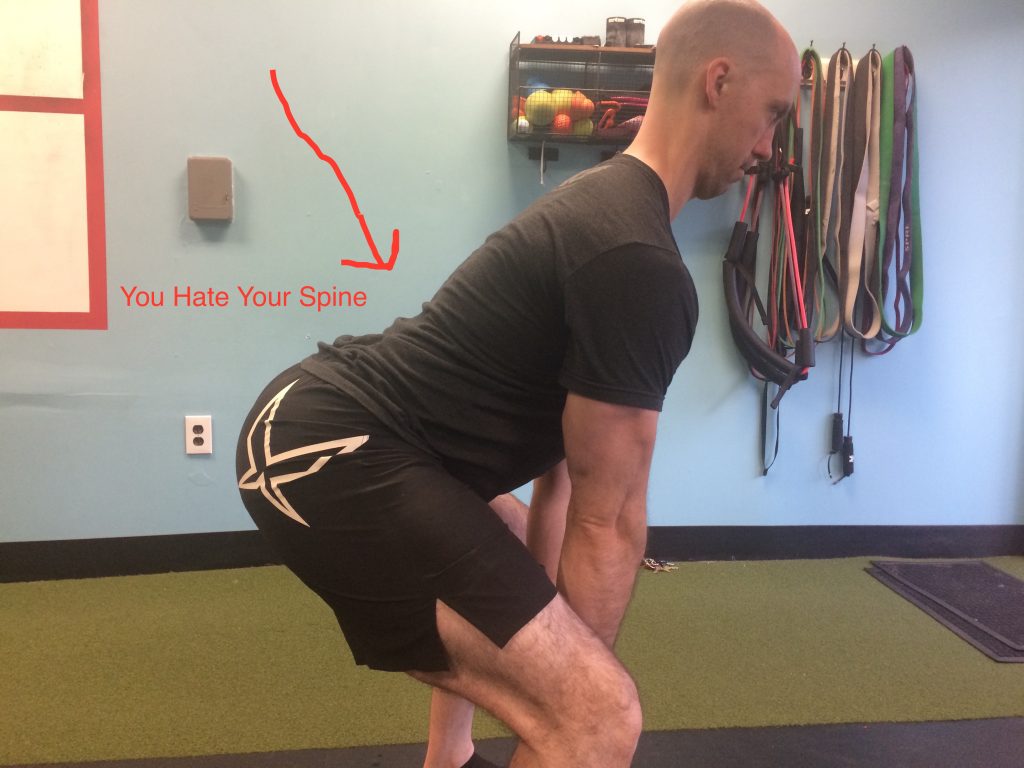
Deadlift Setup: Overarch/Gross Extension/Gross in General
Deadlift Setup: Doesn’t Make My Corneas Want to Jump Out of Their Sockets
In the first picture there’s an exaggerated extension pattern, which, over time, could (not always) have negative ramifications on spine health.
If so, fix it!
Clean up/regress the pattern to where someone is successful, limits compensation patterns, and can “own” the movement. Remember: A deadlift isn’t just a loaded straight bar on the ground.
Don’t demonize an entire exercise and label it the root cause of a specific type of back pain because you’re unable to coach it well or understand how to scale it correctly to fit the needs, injury history, and ability level of an individual.
What’s to say any ONE thing is the culprit in the first place? We don’t really know what cause back pain:
Lack of hip internal rotation.
Repetitive flexion, repetitive extension.
Weak anterior core.
Weak glutes.
Kitten cuddles.
It could be anything.
I think any health/fitness professional who frames any one exercise or modality as all-encompassing “dangerous,” at all times, for every individual, and is the root-cause of any one specific injury, is doing the industry a disservice.
The words we use and how we frame things can set a toxic precedent.
Messages That Can Harm People With Back Pain
Note: I found this list somewhere on the internet and saved if for a time I’d need it, like this. I have zero recollection where I found it, and I don’t even remember there being a source.
Regardless, thank you to the person(s) who made it. Please don’t sue me for plagiarism.
Promote Beliefs About Structural Damage/Dysfunction
“You have degeneration/arthritis/disc bulge/disc disease/a slipped disc”
“Your back is damaged.”
“You have the back of a 70 year old.
“It’s wear and tear.”
Promote Fear Beyond Acute Phase
“You have to be careful/take it easy from now on.”
“Deadlifts are dangerous/you should avoid deadlifts from now on.”
“Your back is weak.”
“You should avoid bending/lifting.”
Promote Negative Future Outlook
“Your back wears as you get older.”
“This will be here for the rest of your life.”
“I wouldn’t be surprised if you will always be in pain.”
“Back pain doesn’t mean your back is damaged. It means it’s sensitized.”
“Your Back pain can be sensitized by awkward movements, postures, muscle tension, inactivity, lack of sleep, stress, etc.”
Promote Resilience
“It’s very rare to do permanent damage to your back.”
“Your back is one of the strongest structures of your body.”
Encourage Normal Activity and Movement
“Your back gets stronger with movement.”
“Motion is lotion.”
“Protecting your back and avoiding movement can make things worse.”
Because It’ll Make You Feel Better To Say It
“The next time you tell me deadlifts are bad or dangerous, I’m going to tell you to eat a bag of dicks.”
Or, Maybe Don’t Do That and Take This Sage Train of Thought From Dean Somerset
“Anything “could” be bad if done improperly, or for the wrong reasons, wrong volume/load, or in people who don’t qualify to do the exercise. I would say it’s best to not blame the exercise as a cause, but to understand the mechanism of the injury and see if the exercise could contribute to it or not. There’s a lot of injuries that can come from deadlifts, not limited to only pars fractures.
I wouldn’t avoid programming them for people due to this alone, but would progressively build people up to doing them well and under control with a load that is within their abilities to perform and recover from appropriately.”
We owe it to ourselves (and the industry) to be a little more open-minded, responsible, and less magnanimous at making such boisterous claims.[WU-TANG’s FOR THE CHILDREN.[/efn_note]
If you’re like me, you hate listening to the sound of your own voice. For me it ranks somewhere between nails scratching a chalkboard and a whale passing a kidney stone.
Not pleasant.
Which is to say: I get invited onto a number of podcasts each month to talk about training, deadlifts, and LOLcats, and I rarely (if ever), re-listen to any episode I appear on.
This isn’t to say I don’t believe I had anything good or insightful to say, or that I wasn’t entirely witty or downright charming.
Of course I was….;o)
However, it’s just, you know, listening to the sound of my own voice is equivalent to this:
I had a recent appearance on the StrongCast Podcast with Vidura Rajapaksa. He sent me a heads up the other day that my episode went live and out of curiosity I pressed “play.”
I don’t know what it was: the fact it was the first podcast I recorded without my braces, it was a Thursday, I don’t know…..but I sounded amazing.
It was as if Adele took over my vocal chords once I started breaking down individual anatomy variances and squat depth.
“Hello…..”
Okay, in all seriousness, I had a blast recording this episode and if you’re sitting there stuck at your desk or maybe in transit to work or home and want some time to kill give it a listen.