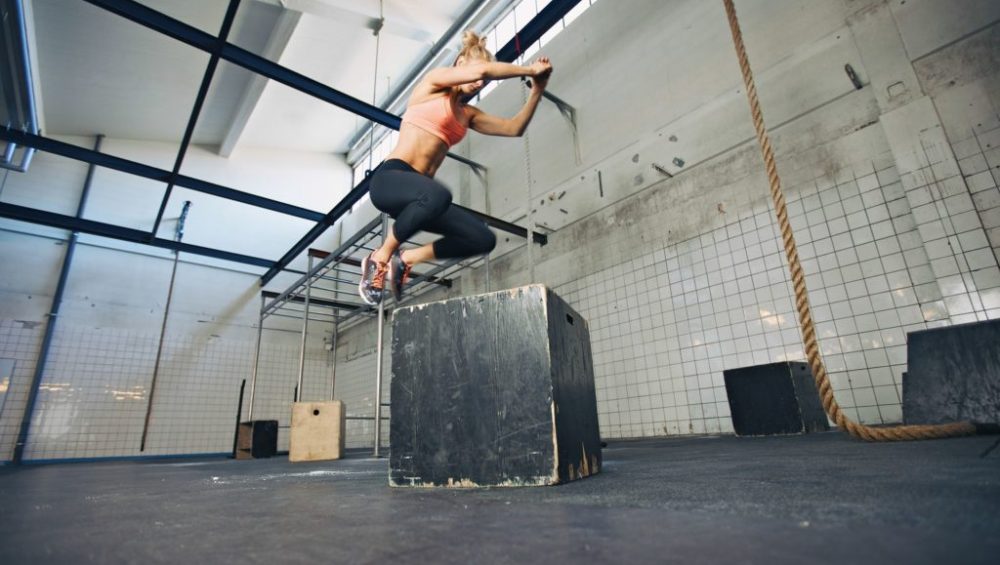
Now, before anyone gets their panties in a tissy….I am not against box jumps. I implement them into my training as well as into the programs I write for other people and think believe they have a time and place (as does most any other exercise in existence1).
I mean, any strength coach or trainer worth his or her weight in paleo brownies understands their role in helping to train explosiveness and athleticism. And, if we were to peel back the onion a bit further, we’d note the REAL benefit(s) of box jumps are:
Force summation, Rate of Force Development, or learning to put force into the ground.
Landing mechanics: or, learning to absorb force.
It’s not to try to jump onto a box at the highest height possible or to perform them for endless repetitions.
Dumb
Really Dumb
Dumber
Commentary on Video #1
Before the record button was pressed you know those two guys were thinking to themselves “Dude, if you hit this jump it’s going viral and you’re totally going to get laid tonight.”
He’s lucky he didn’t break his back or neck.
Commentary on Video #2
Considering the number of banged up knees and scraped shins I’ve come across I really wish CrossFit would begin to understand that box jumps aren’t a great conditioning tool, and that there’s an abyss of better options.2
Hell, running over your right arm with a Honda Civic would be better than high-rep box jumps.
Commentary on Video #3
Yeah, yeah, I get it: It’s JJ Watt, it’s an old video, he’s an elite professional athlete, he nailed it, quit belly aching Tony.
Admittedly that was a baller jump and I too would have full confidence in JJ’s ability to jump over Mordor and then some. However, from a cost-benefit standpoint…..as a coach who’s worked with plenty of high-level athletes myself, I wouldn’t touch that with a ten-foot pole.
I have to wonder, though, did the coaches in that video prescribe or allow this to happen because they felt it would make their athlete better, or because they were chasing YouTube views and likes?
Not worth the risk. Refer to video #1.
My Real Beef: Not Box Jumps, But HIGH Box Jumps
A few months ago I watched a stellar video by Nick Tumminello where he went into detail on why he didn’t like HIGH box jumps, and he made a brilliant point I had never thought of before.
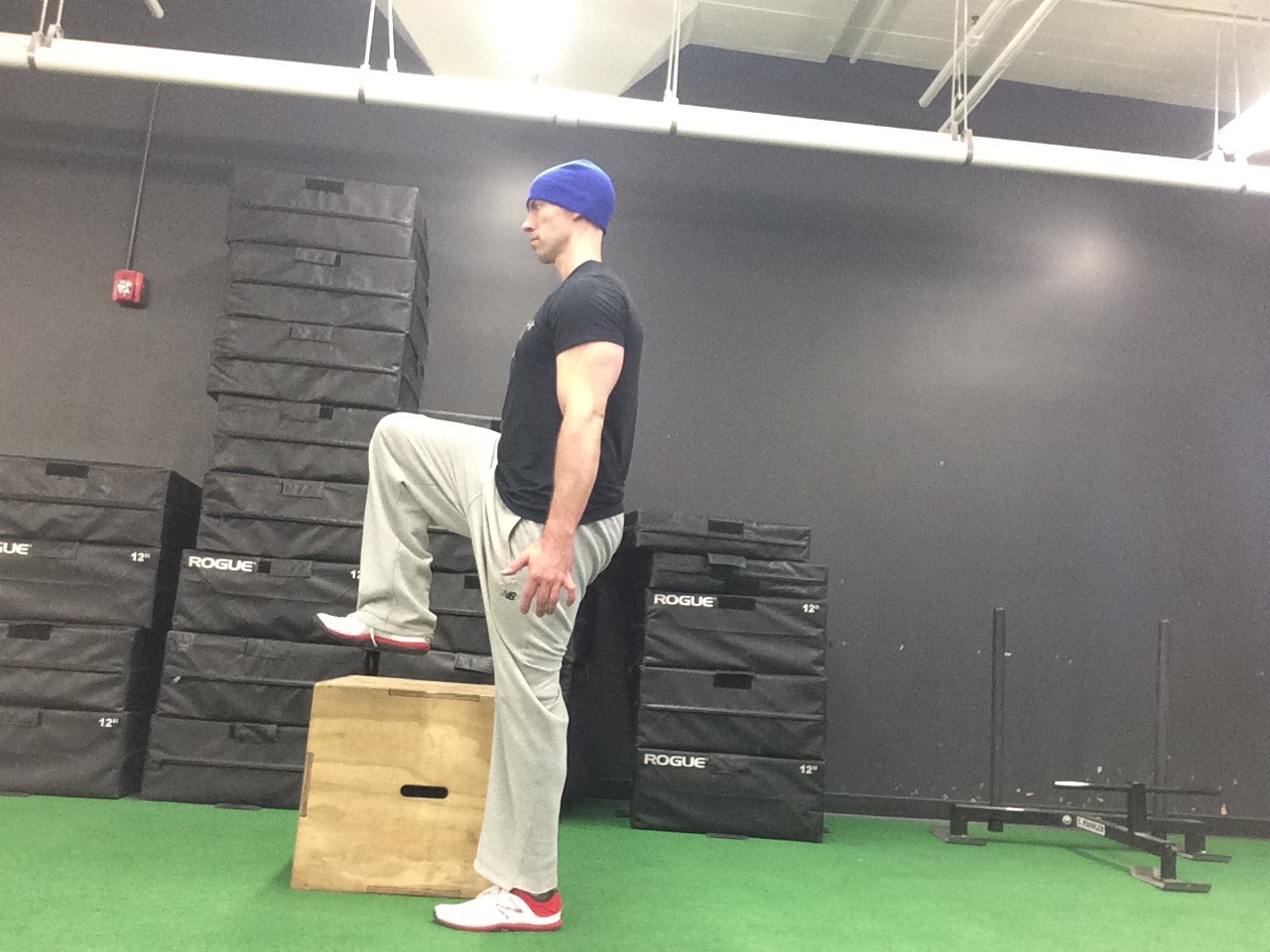
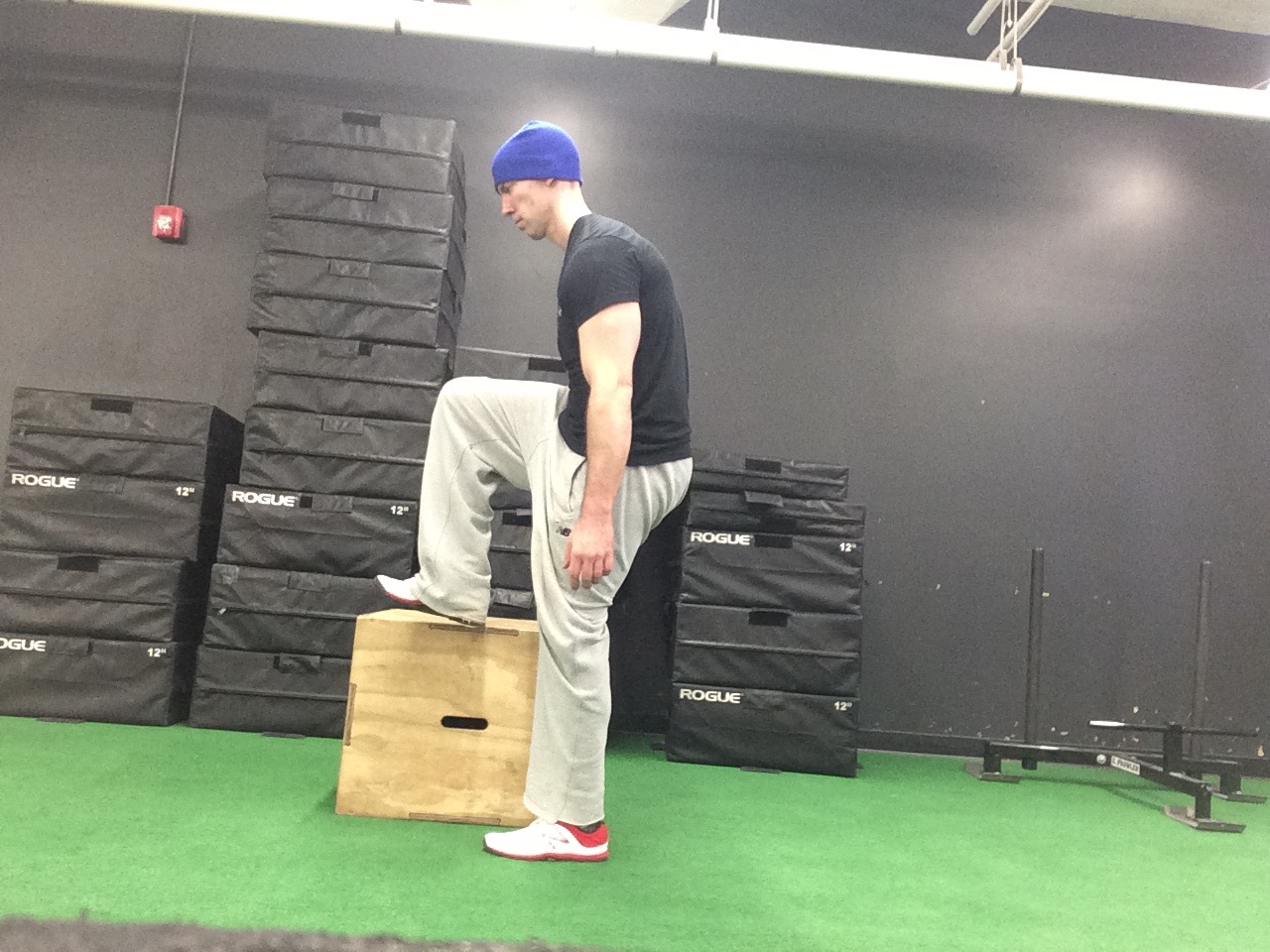
High box jumps reward those people with excellent hip mobility, particularly those with great hip flexion. Here’s an example:
Stand next to a high box and lift your leg in the air.
The distance from the bottom of your foot to top of box is the “real” distance you’re jumping. Not so impressive now, huh?
And this is what the same jump looks like when someone doesn’t have the ability to clear ample hip motion:
They start cranking through their lumbar spine, over and over and over and…..”awwwww, goddamit I blew out my back again.”
“Ma, meatloaf! We want it.”
And speaking of the lumbar spine, how many times do you watch someone perform their box jumps and it ends up looking something like this:
Box Jump: Poor Landing
Happens all the time right?
Yuck.
If your box jumps look like this you’re using too high of a box and are reaping ZERO benefit from doing them.
How you start (chest up, knees slightly bent and not caving in, athletic position) is how you should end. Like this:
Box Jump – Good Landing
Another not so great thing thing many people end up doing is landing too loud on the box. Remember: one of the main benefits of the box jump is absorbing force.
Box Jump – Loud Landing
If someone can hear your box jumps in Idaho you’re doing them wrong.
Instead, you want to make sure you land softly, or what I like to tell my clients “like a ninja.”
Box Jump – Who’s the Ninja? You Are That’s Who
A Few Other Random Thoughts
Even with a (seemingly) low box height, the idea is to cue your clients to jump as high as they can (and then to land soft). External cueing works wonders here:
Try to hit your head on the ceiling.
Jump away from the ground.
OMG, there’s a snake!
I like to program box jumps for low reps. Sets of 1-3 are ideal.
Moreover I LOVE performing box jumps on lower body days prior to squatting or deadlifting as it serves as a nice way to potentiate or wake up the nervous system.
Perform 3-4 sets of 1-3 reps and you’re good to go.
I personally hate the term bootcamp as the connotation is that all participants are there to get yelled and screamed at and otherwise Full Metal Jacketed for an hour.
I find those instructors who rely on the drill sergeant approach tend to be compensating for a lack of differentiating their ass from their acetabulum3 In today’s guest post, Cressey Sports Performance strength camp coach, Frank Duffy, helps shed some light on a few lesser known factors that can help make your large group training classes more effective and enjoyable.
Large group training classes, commonly deemed bootcamps, often get a bad rap for the training they provide. Injuries and cases of exercise-induced health conditions, like rhabdomyolysis, are more prevalent than ever before. Sleep and nutrition play critical roles, but running ourselves into the ground day-in and day-out with our training is a surefire way to end up on the shelf injured over time.
Your training shouldn’t crush you. Plain and simple.
Quality over quantity, just like anything we do in life, is something I continuously hammer home to our Strength Camp members here at Cressey Sports Performance (CSP). While the program’s variables are entirely in our hands as coaches, there are other ways to dictate the intensity of training environment subtly.
1. Set the Tone Through Music
Nope, this isn’t a joke.
I have zero research to back this up, but I truly believe the music you have blaring through your speakers plays a huge role in regards to the intensity of your training floor. Powerlifters will always love their hardcore metal, the female high school athletes will always love their pop music, Tony Gentilcore will always love his Wu-Tang Clan and Tiesto.
Note from TG: Tony’s Techno Tuesdays will live on F.O.R.E.V.E.R
The CSP Strength Campers I work with are primarily in their late-30’s to mid-50’s, and don’t want Avenged Sevenfold blasting at 5:30 in the morning. Instead, we rock out to Bon Jovi, Bruce Springsteen, Pearl Jam… the list goes on.
It’s much less aggressive and music that most of our clients grew up with, making it much more enjoyable. It also helps that they tolerate my tone-deaf voice whenever Summer of ‘69 comes on.
Target the age range and musical interests of your clientele. It makes the training much more fun and shows them that it’s not about your own personal preference.
2. Preach the Importance of “Filler” Exercises
Our clients come to us for a kickass workout, not to sit through an hour of mobility exercises. However, I make sure that every training session entails one or two unloaded mobility drills as filler exercises to our heavier movements. My favorite way to do this is by implementing Controlled Articular Rotations (CARs) into the supersets prescribed.
I use CARs because they’re bodyweight movements that could be performed every single day without a single piece of equipment. It’s also a great way to learn how to control joint end-ranges of motion, where we typically get injured.
By getting clients to move through their end-ranges of motion in a controlled environment daily, we’re able to maintain and even expand our current mobility. Improved mobility equates to better movement with training and everyday life, why wouldn’t we want this? It’s important to hammer this point across to your clients, regardless of what route you take to improve their quality of life.
Monday and Friday are our primary strength training days, where we’ll train the squat on Monday and deadlift on Friday. In between our warm-up sets, I’ll always prescribe shoulder or scapular CARs in order to improve our range and control with overhead movements. They’re also a great way to give the lower body rest in-between sets.
These slots aren’t just limited to CARs, though. I absolutely love dead bugs, plank variations, kettlebell pullovers, and other drills for core activation in between our heavy lifts. It’s important to avoid exercises that will crush your clients for their squats and deadlifts in these filler spots.
Here’s an example I’ll use for our Friday training sessions: A1.) Deadlift 4×5
*A2 and A3 are performed during warm-up sets of the deadlift.
There’s a million different ways of going about this. Find what works best for your clients; it helps when they enjoy the exercises.
3. Talk to Your Clients
As cliche as it sounds, communication is key in all aspects of life. An important part of providing a great training experience to your clients is your ability to talk and learn about them. Everybody has a unique voice, and your job should be to listen to what each client has to say.
The ability to hold a conversation throughout a training session is also a great way to gauge how your clients are exerting themselves as well. Anything above 140 heart beats per minute is typically above the threshold in which normal conversation could no longer be held. This is a zone I’ll stray away from for long durations. As fatigue kicks in, form likes to go out the window.
Note From TG: Do you know your client’s spouse’s name? Pets’ names? Do you know their favorite movie or television show? Do they know where the term “cottenheadedninnymuggins” comes from?
TALK TO THEM!
I try to target 110 to 140 beats per minute with our Wednesday circuit training, which is a sustainable zone for longer periods of time. It’s also what our industry considers the “sweet spot” for improving overall aerobic capacity.
Our clients aren’t equipped with heart rate monitors, so assessing their ability to hold small talk is my judgement tool for how they’re exerting themselves. If you don’t have monitors at your disposal, I highly suggest you do the same.
Large group does not correlate with extremely high-intensity training modalities. Just like private, and semi-private models, your large group training service will produce much greater results when you stray away from running your attendees into the ground. Of course, you’ll always have your fitness junkies that want to give 110% effort every session. It’s our job to explain to them the importance of submaximal training’s benefits, and how exercise is only a sliver of the pie.
If you’re not sleeping adequately, eating properly, maintaining stress levels that life’s situations throw at you, can you really overcome these obstacles with a training session that leaves you crawling out the door?
I’d argue not.
Making your clients better isn’t entirely about the time they spend with you lifting iron. Make it a point to talk to them about their sleep patterns, maybe ask what they had for dinner last night, when was the last time they took note of the color of their pee?, or, I don’t know, maybe discuss the last episode of The Walking Dead. All of it is information that not only will help you help them, but will also build a better sense of camaraderie.
Author’s Bio
Frank Duffy is the Head Coordinator of Strength Camps at Cressey Sports Performance. As a Functional Range Conditioning Mobility Specialist (FRCms) and Precision Nutrition Level One Nutrition Coach (Pn1), Frank tries to tailor the program around longevity through optimal movement and nutrition habits. You can learn more though his website, www.frankduffyfitness.com and his Instagram account…HERE.
Today’s guest post comes courtesy of central NY based strength coach, Justin Kompf. Justin’s written several guest posts for this site and I always appreciate his contributions.
Today’s post is one that every coach should read. We may feel some athletes are “dogging” their workouts and get mad, and we may not like every client we work with. That’s okay. But that doesn’t mean we shouldn’t treat each person with respect and understand that people are often much more than the behaviors they demonstrate on any given day.
In middle school I played the trombone (and if you must know had a bowl cut too). In fact, when asked to describe my young awkward years, I often tell a story of carrying my trombone in one hand and a stack of books in the other only to have those books knocked out of my hands by some nice classmate.
I didn’t like playing this instrument, I had been doing it for a few years and just wasn’t having fun. To express my distaste for the trombone, I would intentionally mess up in practice. Rather than play to the beat I would basically play whatever the hell I felt like.
So why do I tell this story?
From the small screenshot of my behavior you might come to the conclusion that I wasn’t putting in any effort.Maybe you would think I was a bratty little kid who was just trying to be funny. But what if, given the situation I was in, I was actually giving my best effort?
When we look at s small screenshot of behavior we ignore the person as a whole. We might ignore the fact that six months prior I had tried to tell my instructor I was not having fun and would like to quit only to be disregarded. We might ignore that I would rather be playing basketball or that I didn’t enjoy being the person that lugged around a 4-foot instrument through middle school.
When we look at the fact that I felt I was being forced to do something I didn’t want to do and wasn’t having fun doing it, my behavior shouldn’t seem surprising. Maybe I actually was doing the best I could with the situation I was in.
The notion that people are doing their best in all circumstances resembles a psychological concept called unconditional positive regard (which is towards others) and unconditional positive self-regard (which is towards oneself).
I believe that holding a mindset of unconditional positive regard (UPR) is a crucial component to being a great coach.
This is especially true when we are working with people who want to change health related behaviors such as exercise and diet. UPR means holding no conditions on acceptance of an individual, caring for people and recognizing that each person is unique with different backgrounds and experiences. It does not mean you have to like everyone you work with or even approve of their behavior, but it does mean withholding judgment.
To me this mindset means the acceptance of behaviors with the capacity to evaluate and then self-regulate to make healthier or better choices.
It is the belief that once you consider an individual’s circumstances, and realize that their observable behavior does not define them as a person, that people are trying their best. This is a mindset that can be accepted not just towards others but towards oneself.
When you experience UPR towards yourself you are able to, in a non-threatening way, evaluate all of your behaviors and feelings. Negative feelings about behaviors can easily threaten our sense of self-worth and cause us to engage in further negative behaviors to avoid self-evaluation.
Being human, every coach has had negative thoughts about their clients or athletes behaviors. Maybe an athlete is having an off day and you become upset about their effort levels or listening ability. You might think, “Why isn’t this kid busting his ass to be a better athlete?”
You might be training a client who consistently breaks their dietary plans and wonder what is so hard about eating a salad or having a protein shake for breakfast rather than a bowl of cereal. You might wonder why you care more about your client’s health than they care about their own.
If you’ve been coaching long enough you’ve inevitably heard the saying “people don’t care about how much you know until they know how much you care”.
Often times when you are coaching you will in fact care more about a client or athlete’s well-being than they care about their own. You will have many occasions where the people you are working with will make mistakes. Your job is to evaluate how you can help without judging these behaviors.
It is your responsibility to look at the people you work with as more than just a set of behaviors.
When an athlete or client fails to give what you perceive to be 100% effort, rather than assuming that they are lazy imagine what could have happened to them that day. Maybe they had two tests, maybe a family member is ill, or they are having relationship problems.
It is your job to listen and show that you place no conditions on how you care about them as a person. Their performance in the gym or adherence to health behaviors should not affect how much you care.
‘Unconditionality,’ then, means that I[you] keep on valuing the deeper core of the person, what (s)he basically is and can become.
Once this sense of UPR is established you can help the person you are coaching work towards healthier behaviors in the face of whatever other struggles they are currently dealing with.
Summary
Accepting this mindset is conscious work and also unlikely to be maintainable every second of the day.
I’ve found working towards owning this mindset makes coaching and teaching more enjoyable.
Every day I work with people that seem to be lacking effort. I have athletes that could work harder, I have students that could listen better and I, like all humans, engage in behaviors that are in conflict with how I see the best version of myself to be. This is human nature, every single person, acts in ways that are in conflict with how their ideal self would operate.
But every person can also work towards pursing their own unique steps towards self-growth. Adopting this accepting and unconditional positive mindset can be helpful in evaluating and changing health related behaviors.
Author’s Bio
Justin is the head strength coach at SUNY Cortland. He is also a lecturer in the kinesiology department at the university. Cortland hosts a health and wellness conference each year, this year on April 8th. Speakers will include Tony Gentilcore, Dr. Lisa Lewis, Brian St. Pierre, David Just and Mark Fisher. For more information go HERE.
Note From TG: The conference linked to above is $60 to attend. That’s a steal considering the quality of presenters coming in and the information that will be shared. Students: you can’t use the excuse of “that’s too expensive” because I know full-well you’re spending that much (if not more) drinking on the weekends. Fitness Pros: this is Cortland, NY, in April, for $60. Shut up and get your butt there…;o)
I started utilizing distance coaching back in 2005 before “distance coaching” was a thing. Hell, Facebook was barely a thing at that point in time, but I managed to survive.
Come to think of it I didn’t get my first cell phone or laptop until 2006, so it’s any wonder how I was able to turn distance coaching into a viable source of income for myself.
It’s taken years, of course, to turn it into a viable source of income, and, admittedly, there are innumerable coaches out there who have built online training empires that would make what I have built seem like an anthill compared to their Taj Mahal.
Fuck those guys…;o)
Just kidding. It’s altogether impressive to see how successful some people have gotten with their online training businesses. Kudos, and well done.
Nonetheless, I wanted to take today and discuss my experiences with distance coaching: Why I do it, the pros and cons of doing it, mistakes I’ve made along the way, and whether or not you should considering dipping your toes in the water.
Above all, when it comes to online training, you need to ask yourself this question:
Are You Doing It For the Right Reason(s)?
There’s a fairly naive notion that those who do online coaching are living the high life. They’re traveling the world on their hovercrafts writing programs and answering emails while sipping Pina Coladas. Indeed, for some, this is very true. I mean, hovercrafts are awesome.
However it’s not the norm.
If you’re entering the world of online training under the guise that that is normal, and that you’re going to be making between a metric boat load and metric shit load of money without any effort, let me say this:
Personally, I’d make the argument that online coaching is more time consuming and more of a grind than people are led to believe. Then again, those who believe otherwise are the ones who think all you need is a YouTube page, a smart phone, and nice smile to build a bonafide fitness business.
Basically it comes down to this:
If you decide to enter the world of online training (only) to make a bunch of money, good luck. I doubt you’ll last long.
If you decide to enter the world of online training to actually help people (first), to offer a good service with integrity, and then yeah, eventually, maybe make some decent money, now we’re talking.
Those Who Do Online Training Gooder: A Huge Caveat
I didn’t take on my first online training client until 2005. I had just moved from Syracuse, NY (where I had been working in both corporate and commercial gyms for the previous three years) to Danbury, CT where some guy named Eric Cressey convinced me to move to to start working with him at a local gym in the area.
A client of mine (back in Syracuse), Bobby, emailed me after a few weeks and asked if I’d still be interested in writing his programs? I like to think he couldn’t live without my witty personality and incessant GoodFellas quotes.
Until he had asked it had never dawned on me to write programs in a distance-based fashion. I was like, “uhhhhhhh, sure.”
I had a digital camera, a desktop computer, a sick bicep peak (<– very important), and an Excel spreadsheet.
I made it work.
But how?
Looking back my systems were terrible. But that’s also comparatively speaking. What I had access to back in 2005 in terms of technology paled in comparison to what is available today. I might as well, proverbially speaking at least, have been shucking corn with a scythe. Or, I don’t know, playing video games on an Atari 2600.
Bobby would send me a check via snail mail, I’d write his program, email it to him, and then if he had any questions I’d either have to write a Tolstoy’esque email back explaining every step of every exercise, or attempt to send him an impromptu video, which, honestly, back then, was more of a pain in the ass than writing everything out.
There was no such thing as YouTube. How did we survive?!
But it worked because of one thing, and it’s something I can’t repeat enough: I had years of experience training people in REAL LIFE.
To that end……
I think the best online coaches are those coaches who have experience training people in-person for a few years and then transition to some degree of distance coaching.
“It’s only when you work with people in person, gain a better understanding of their diversity and how to properly cue and coach different people with varying goals, current/past injury histories, and ability levels, and then have experience APPLYING what you read and watch to an actual individual, that you’ll (likely) be more successful virtually.”
In the years since I have developed better systems and my online coaching business is loaded with my own required desiderata – my laptop, PayPal account (to accept and send payments), DropBox (t0 receive and critique training videos), set of questionnaires, intake info, and screens (sent via vide0) to better ascertain prospective clients’ needs, a relationship with Exercise.com and their use of their sweet platform, not to mention my baller Spotify chill mix for optimum program writing prowess and badassery.
But what about the pros and cons (for both client and coach) of online training? What are they?
The Client
Cons:
Since I like to get bad news out of the way first (like, I’m writing this post with no pants on) let’s start with those, in no particular order:
Your coach isn’t actually there with you: That’s sort of the point of distance coaching right? But unless you’re highly motivated, you’ll find this as an excuse to not make it into the gym or skip certain parts of your training session. Lame.
Feedback comes later than you need it: Since you’re (hopefully) sending videos to your coach you won’t know until after you’re done with your lift if you performed things up to their standards.
It’s really easy to find a shit coach: If you spend 10 minutes browsing the fitness related hashtags on Instagram, I bet you could find about 50 random guys and gals who just finished training for their first show and are dying to offer you one of the limited spots in their online training group. Who knows what this person knows and where they learned it. If you don’t do your research you’ll end up wasting your money on some random jabroni.
It can be tough to form a relationship: If you found your coach online, it can sometimes be tough to form a relationship with them. Really, who wants to keep spending money on someone that they don’t have a great relationship with? And if you haven’t really bonded with them or trust them, why would you keep killing yourself in the gym for them? This is why I always make it a point to send random pictures of my cat here and there. Because it builds rapport, and because she’s awesome.
A post shared by Tony Gentilcore (@tonygentilcore) on
Pro’s:
Enough of the Debbie Downer talk! There’s a lot to love about working with a coach as a distance client!
It’s cost effective: This is just a fancy way of saying cheap! The cost per session of working with most distance coaches is substantially less than paying for them in person and is typically even way cheaper than paying for an atrocious trainer in person. For just a few bucks per lift you can have a great coach write your programming for you; it’s awesome.
Low stress: What do I mean by this? I mean that you don’t have to worry about schedules nearly as much as in person. You work weird hours and want to train at 2 am? Sure, pyscho, go train at 2 am.
You can work with just about anyone: As long as a coach is taking clients and you can afford them, you can work with just about any coach in any realm of fitness. It doesn’t matter where they are located; you can get a Chinese weightlifting coach, a Brazilian booty coach and a Turkish get-up coach if you want.
It can last a lifetime: If you’re lucky enough to find a coach that you have a good relationship with, trust and see results with you can train with them essentially forever. Regardless of where either one of you moves, the training relationship can remain solid.
A good community: I’m lucky that my coach (yes, I have a coach) had done such a good job with his distance coaching prior to me hiring him. When I started working with Greg, The Strength House had a vibrant online community where people are able to post videos to get feedback from Greg and Tony B. as well as other clients who may know what they are talking about. It makes a huge difference with staying accountable to my program.
The Coach
To be truthful, a lot of the points that are true for clients are true for coaches. It can be tough building a relationship with someone that you’ve never met.
Cons
There is a world of shit out there: People move like crap, and it’s hard to “manage” people from a distance unlike you can in-person. Being able to instantly provide verbal and tactile feedback is what gives in-person coaching a more than slight edge over online training.
More challenging to keep clients accountable: Are your clients really doing what you tell them to do? Are they really doing their deadbugs and dedicated warm-ups or skipping them in lieu of extra bicep curls in front of the mirror?
It Can Get Weird – Like that one time I started with a new male client and while on a bus on my way to NYC to visit friends I opened up all the postural pics I had him send me. Sorry random woman who looked over at me looking at half-naked pictures of a man. #awkward.
There’s a lot of moving parts: To be an effective distance coach means having a few systems in place that work really well and those can be difficult to manage.
A good way to track programs and ensure clients get them in time.
An effective means of communication, or else you’ll end up with an abyss of emails and texts to answer. Personally, though, I rarely give out my cell phone number for this very reason.
A good video library to pull demo’s from.
A solid network of coaches and trainers in other cities to be able to reach out to for help (Hey, I’ve got a client in your city, they’d like to meet with you for an hour and work on their hip hinge)
A strong system to collect and track payments.
Distance coaching isn’t for everyone: Truthfully, some people really just do need one-on-one in person training. Maybe the client isn’t motivated enough, maybe their needs are beyond what you can provide via an email or Facebook message. While it will mean you lose their monthly fee, this is definitely a client you should help find a local trainer to help them with their immediate goals.
It’s not all butterfly kisses and rainbows: Despite what the internet tells you, most people who do online training also have another job. Very few can live off their online business alone. It can be a drag to come home after coaching (or working) an 8-hour day only to have an inbox full of client questions and inquiries. As I alluded to above: online coaching, I find, is more time consuming than people think – especially if you lack having systems in place.
Pros
You can work with anyone: This is by far the coolest part. Right now I do remote coaching with people all over the world. I have clients all over North America, Europe, and even the Middle East. Many people have limited access to quality coaching and online training allows me the opportunity to work with people I otherwise would never cross paths with. Note to Optimus Prime, I have a few spots open.
It’s a decent bump to your income: I’m not going to tell you it’ll make you a millionaire, but I remember when I first started I told myself I wanted online training to help me cover my rent each month (and maybe pay for my then Match.com membership). It did and has since. Pretty cool.
Note: Match.com profile was deleted when I met my wife….;o)
Clients for life: If you’re good at what you’re doing, you’ll have clients that you’ll keep around forever. Also, since we in the fitness industry know that word of mouth advertising is more effective than anything else, happy clients will tell their friends and family.
It’s honestly fun: I really enjoy this part of my job. It takes me out of the daily routine of local clients that I work with and gives me something else to think about. It has become another skill to try and master and I like that challenge. Figuring out how to get great results with someone training in their home gym in North Dakota is much different than having that same person in front of you in your gym. You learn how to broaden your horizons as a coach and try to always get better and improve your systems.
Ultimately it’s up to you to decide whether or not online training is your cup of tea. I think when done well, for the right reasons, and with the right systems in place, coaches (and clients) can do very well. However, when taken for granted and with little attention to detail, it can be more detrimental than helpful.
My good friend, Jon Goodman, has developed what I believe is one of the best resources out there with regards to becoming a bonafide online trainer. If I had something like this back in 2005 my systems would have been much more organized, and I’d probably be married to Jennifer Lopez. True story.
Enrollment is extremely limited and only happens twice a year. Enrollment for early birds will begin February 21, 2017 (tomorrow!) and will close a few weeks thereafter. If you hurry, you can go HERE to download the Lasting Laws of Online Training and get onto the early bird list to save $200 off registration.
NOTE: the term “Porcelain Post” first came to fruition last year between Brian Patrick Murphy and Pete Dupuis. Without getting into the specifics, it describes a post that can be read in the same time it takes you to go #2.
Huh, I guess that was more specific than I thought.
The Birddog Exercise: Please, Start Coaching It Right
The birddog exercise is a common drill used in many components of health/fitness. It’s most commonly utilized within yoga/pilates circles and referred to as either the donkey kick or chakaravakasana. Which, as we all know, is Elvish for, “doing something poorly and making my corneas jump out of their sockets into a fiery volcano.”
Okay, that’s not true.
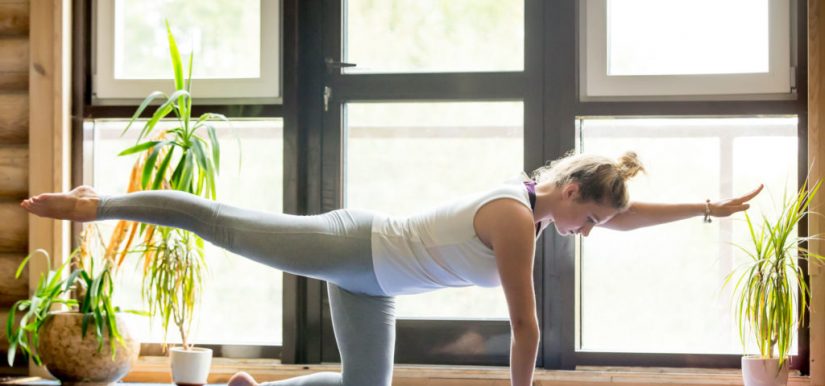
But we all know that the bulk of people performing this exercise, whether they’re in a yoga class, performing it on their own, or following the tutelage of a strength coach or personal trainer, end up looking like this (not always, but enough to warrant an intervention in the form of this brief post):
The birddog exercise not only targets the back, but also the hip extensors. It also, and more importantly, teaches the discipline of using proper hip and shoulder motion while maintaining a stable spine.
The picture shown above is the complete opposite of that. What we see instead is a gross exaggeration of lumbar (lower back) extension and a lengthening of the rectus abdominus compounded with excessive rib flare and cervical extension.
Essentially this person is tossing up a ginormous middle finger to any semblance of spinal stability.
Now, in fairness, maybe the woman pictured above was coached into that position for a specific reason:
Prepping for the World “How to Eff Up Your Back” Championships?
Because it’s Wednesday?
I don’t know the true details. Maybe I should lighten up.4 But what I do know is that I find little benefit in performing the birddog, and it’s likely doing more harm than good.
And when I see it performed this way it makes me do this:
What’s most frustrating is the reactions I get from some people when I ask them to perform the birddog. I’ll get someone coming in with a history of low-back pain, and after taking them through a series of screens to see what exacerbates their symptoms I’ll then have them demonstrate this exercise.
What follows is typically a few eye-rolls and a seemingly crescendo of “come on Tony, really? I’ve been doing this exercise all along, can we please turn the page?”
Low and behold 9/10 (if not 10/10), the same person who has been complaining of weeks/months/years of low back pain in addition to a bevy of other fitness professionals espousing the merits of the birddog, when asked to demonstrate it, ends up looking exactly like the second picture above.
Case in point. I had an eval with a new female client last week. She was a referral from another trainer located here in the Boston area and she informed me that this client had been battling some chronic low-back shenanigans for the past few years. To the other trainer’s credit: much of what she had been doing with this client was spot on (and I have zero doubts this client was coached very well). However, the birddog lends itself to be one of those “hum-drum, don’t worry, I got this” exercises where people (I.e., the client), when left to their own devices, becomes complacent and lackadaisical in its execution.
Play close attention to the before and after videos below:
A post shared by Tony Gentilcore (@tonygentilcore) on
Before = her execution of the exercise was “feeding” into her symptoms and most likely resulted in a kitten dying.
After = ticker tape parade for coaching!
With a just a few subtle cues and a “molding” of the exercise to better fit her current ability level, we were able to significantly clean up her technique and the exercise not only felt more challenging, but she felt better.
The difference maker was placing a ValSlide underneath her moving leg so that she’d be less likely to fall into extension.
From there, with the leg fully straight, I then had her lift her foot off the ground an inch or two and then “OWN” the movement/position.
She then held for a 3-5s count, performed 3-5 repetitions per side, and we then fist pumped to some Tiesto.
Coaching oftentimes involves paying closer attention to the details, even with the more mundane exercise that we often take for granted. With the birddog it often behooves us to slow people down, get a little more hands on with them (provide more kinesthetic awareness), and hold then accountable to be SPOT ON with their technique each and every rep.
This is what separates correctives and programs that work (and serve a purpose) and those that lead to less than exemplary results due to haphazard execution.
Of course, I love the Goblet squat. As you should too. It’s a wonderful little exercise that serves as a “catch all” to groove a better squat pattern. And on top of that…it’s super versatile. As you’ll come to realize after reading this excellent guest post from Shane McLean.
The Goblet squat has revolutionized the way the squat is being performed and taught throughout the world. If don’t know what a Goblet squat is, I’m getting Dan John to come over to your house and slap you upside the head.
If you don’t know even who he is, I suggest you Google him. Pronto.
Dan John stumbled upon this excellent exercise by chance.
“Years ago, I was faced with teaching 400 athletes to squat correctly. I attempted move after move and lift after lift, yet I failed every time.
I saw glimmers of hope from teaching one kid the Zercher squat and a few picked up the pattern when we lifted Kettlebells off the ground but nothing was really working.
The answer was somewhere in between a Zercher and a Potato squat. It came to me when I was resting between swings with the weight held in front of me like I was holding the Holy Grail.
I squatted down from there, pushed my knees out with my elbows and behold, the goblet squat.” (1)
I guess you can say he choose wisely.
Thanks to Dan’s discovery people in gyms everywhere have discovered the joys of squatting. The Goblet squat is an exercise that’s great for beginners and advanced exercisers alike.
But what makes the Goblet squat so good?
Holding the weight anteriorly encourages you to stand up straighter, get that upper back tight and puff out that chest which sets the table for good squat. Furthermore, the weight acts as a counter balance that encourages you to sit between your legs and not over your knees.
For most gym-goers, the Goblet squat may be the only squat you’ll ever need. It beats squatting on a stability ball by about a trillion. Why do people do that?
Now that I’ve established the Goblet squat is the bomb, let’s look at some variations so you can squat like a boss.
1. Goblet Box Squat
If it’s been a while since you’ve squatted or you’ve never done a Goblet squat before, this variation is a good starting point. Reducing the range of motion combined with a reference point with the box will help you groove proper technique.
Pairing this with single arm press/pull combined with a mobility drill works like a charm. For example:
1A. Goblet Box Squat
1B. Single Arm Row
1C. Half Kneeling Hip Flexor Stretch
2. KB Goblet Squat with Lowering
Tony calls this lowering but I’d prefer to calling this a biceps curl. Any excuse to work on the guns, right?
The pause at the bottom of the squat with the ‘curl’ helps you ‘own’ the bottom position and creates extra tension in the anterior core and the posterior chain. It’s going to tickle the legs a little also.
Pairing this with a suitcase carry will provide a greater challenge for your lungs and grip strength. Try this little finisher that I borrowed from Dan ‘the man’ John.
How do you make Goblet squats more enjoyable? By adding a looped resistance band of course. Adding a band to the kettlebell helps you control the eccentric portion of the movement and provides extra resistance on the concentric portion also.
Furthermore, some gyms don’t have big enough kettlebells to challenge advanced lifters and adding a band helps…… or hurts depending on your perspective.
This exercise can be done for straight sets but if you’re feeling ambitious you can pair this with a little exercise called the Goblet lateral walk. For example
1A. Goblet squat with band 8-12 reps
1B. Goblet lateral walk 8-12 steps each side
1C. Your grip will love you
4. Goblet Squat 1 ½
Adding a half a repetition to this exercise will make you hate life but will increase tension in your legs, anterior core and the posterior chain. These factors will give you a lower body of steel.
This exercise can be used as a finisher at the end of your leg training or can be super-setted with a core exercise for a rousing good time. For example:
1A. Goblet squat 1 ½
1B. Push up position plank
5. TG Addition: Goblet Elevator Squats
A nice progression for 1-1/2 rep Goblet squats would be elevator squats. I learned this one from my good friend Ben Bruno.
Here you’ll squat down into the bottom position, come 1/2 way up, back down again, then 3/4 of the way up, back down, and then stand tall. This is a great option for those who A) can’t think of any other way to make them hate life more and/or B) have limited options in terms of load you can use (the increased time under tension is a leg killer).
Wrapping Up
The Goblet squat makes it possible for most people to squat with good form and to reestablish the squat pattern for those who have ‘lost’ it. This also doubles as an excellent mobility exercise for the lower body.
Start choosing squats wisely. Incorporate the Goblet squat into your routine pronto and make Dan a happy man.
About the Author
Shane “The Balance Guy” McLean, is an A.C.E Certified Personal Trainer working deep in the heart of Texas. Shane believes in balancing exercise with life while putting the fun back into both.
Teaching a beginner how to squat well can be challenging. There’s no denying there are a lot of moving parts that can derail our best efforts to do so.
My intention of this quick-n-dirty post isn’t to break down the squat in its entirety. For that I’d encourage you to check out Greg Nuckols’ How to Squat: The Definitive Guide.
It’s basically the War and Peace of squat biomechanics and technique. Except, you know, not written by a Russian.
Instead, my goal today is to hammer home a few candid points when working with beginners on their squatting technique.
1. “Beginners” in this sense could mean a 13 year old who’s never touched a weight or a 57 year old who’s had a few decade hiatus. And everything in between. Male, female, athletes, non-athletes, centaurs, you name it.
2. The squat is a basic human movement pattern. Unfortunately, in today’s world, we don’t move as much as we used to, and subsequently many struggle with the movement. Oftentimes one’s only source of physical activity is if or when they get their butts to the gym.
And even if they do that, there’s no guarantee they exercise in a range of motion below a certain degree of hip flexion.
There’s truth to the common phrase “if you don’t use it, you lose it.”
This isn’t to insinuate that everyone has to squat to a certain level or that you’ll lose some street cred if you happen to not squat ass-to-grass. As I’ve repeatedly stated on this blog everyone is different (leverages, anthropometry) and it’s silly, nay, fucking moronic to think everyone has to squat deep.
So whenever I work with a beginner or someone coming off a significant injury it’s on me – the coach – to take the time to groove a solid squat pattern.
This rarely (if ever) involves placing a barbell on someone’s back on Day #1.
Why?
Because I said so….;o)
Many people lack the requisite t-spine (extension) and shoulder mobility (abduction/external rotation) to hold a barbell in that position without it feeling weird of wonky.
Many lack the kinesthetic awareness to sit back (and down) in a fashion that emulates a squat.
There’s no Golden Rule that we have to load people right away.
I’m more concerned with teaching proper position.
It’s that last point – teaching proper position – that’s a game changer in my eyes. You see, many people tend to “sit” in a state of perpetual (excessive) extension where their pelvis tilts forward, otherwise known as anterior pelvic tilt (APT)
To be clear: APT is not bad or wrong or needs to be fixed. It’s normal. However, when it’s excessive it not only places more strain on the spine (particularly the facet joints), but it also leads to poor alignment where the diaphragm and pelvic floor point in different directions.
Within PRI (Postural Restoration Institute) circles (<— total nerd fest) this is called the “Scissor Position.” What we’d like to strive for is what’s known as the “Canister Position,” where the diaphragm and pelvic floor are aligned or stacked on top of another.
Another way to think of it, is something I stole from Dr. Evan Osar.
“Think of your pelvis as one ring and your rib cage as a bunch of more rings. What you want is to stack those rings on top of one another.”
Mike Robertson is also a fan of this approach and even goes a step further and notes the importance of reaching, and how that can have a positive effect on one’s overall positioning. When we “reach” we nudge ourselves into a little more posterior pelvic tilt (back to “neutral”) and we then achieve proper diaphragm/pelvic floor alignment. Bada bing, bada boom.
If all of that comes across as me speaking Elvish, watch this video.
Plate Loaded Front Squat
The plate loaded front squat is now my “go to” squat progression when working with beginners. It’s something I’ve used for years for a few reasons:
1. The plate serves a counterbalance as one squats down towards the floor helping them to learn proper torso positioning and balance. It’s makes things infinitely easier with regards to sitting back & down into a squat.
2. Pressing the plate out front also helps to better engage the anterior core musculature. This is so crucial. I can’t tell you how many times people have come in for an assessment telling me stories of trainer upon trainer telling them how “tight” they are because they couldn’t squat past parallel. Prior to coming to me they had spent years, years stretching and working on any number of hip mobility drills.
Thing is: they weren’t tight. People rarely are. Or, at least it’s rarely ever that cut and dry (tight vs. not tight). In reality most are weak and unstable. For many, their nervous system is putting on the brakes because it perceives a lack stability. By having trainees press the plate out front it automatically forces the core to fire – thus providing more stability. And miraculously they’re able to squat deeper.
And I come across as the next Professor Dumbledore.
Moreover, it was Mike Robertson who pointed out to me the added benefit of the plate loaded front squat. The “reach” results in better diaphragm and pelvic floor alignment.
It teaches people context, and to own the “canister” position (preventing the ribs from flaring out). That way, when they progress to barbell variations, they’ll have a better understanding of what we’re after and what will (in all likelihood) allow them to perform at a higher level for longer periods of time reducing the risk of injury.
Want More Mike Robertson Nuggets of Programming Badassery?
I owe much of my programming savvy to Mike Robertson. It’s little nuggets of wisdom (as demonstrated above) that helps to separate him from the masses. I’ve always enjoyed his approach and way of explaining things. There aren’t many coaches who have the innate ability to take complex topics and “dumb them down” for the masses (like myself).
His excellent resource, Physical Preparation 101 is currently on sale at $100 off the regular price from now through this Friday (2/10).
It’s basically his entire philosophy on program design. 12 DVDs of Mike Robertson knowledge bombs. I have zero doubts the money you invest in this will pay for itself tenfold in client retention.
Soooo, I’m a dad now. Lisa was a CHAMP all throughout, and I’m confident we’ll be heading home today from the hospital. As a heads up, you can expect just as many pics of my kid as my cat…;o)
I’m still a little busy, so please enjoy today’s guest post from strength coach Erica Suter.
Every time I write an article, I may sound like I want to chop everyone’s balls off. Truthfully, I get fired up with certain themes in the strength and conditioning world, making my prose honest, raw, and at times, harsh. My article on fitness celebrities, for example, was one of those topics I approached with fervor and sass.
Today’s topic is no different. So let’s dive in:
Sport Specific Training
For the past 5 years, I’ve been lucky to work in both the strength and conditioning, and skills-based realms of performance enhancement. I’m a Certified Strength and Conditioning Specialist who helps athletes get strong, but I’m also a licensed USSF soccer coach who teaches technical soccer skills. I keep my CSCS side separate from my technical side. I’m either in the weight room blasting Skrillex, or out on the soccer field working on my tan:
Knowing both worlds certainly makes me aware of the distinction between strength and skill work.
But alas, confusion still arises. Especially amongst parents, I get questions like:
“So do you do sport specific training for soccer players?” “Can you get Little Johnny to have a stronger throw-in with medicine ball work?” “Can you do female soccer specific ACL injury prevention?”
Full disclosure: Getting kidnapped by orcs from the Lord of the Rings sounds way cooler than explaining sport specific training to parents.
Note From TG: Hahahahahahahahaha. That was good. I’m stealing it.
I do, however, want to play the part of the understanding strength-skills coach and share some knowledge on this topic. Here goes nothing.
What Is Sport Specific?
Sport specific has been sensationalized in the strength and conditioning industry as a method of training that mimics a specific skill of one’s sport in the weight room. Often, strength coaches are pressured to train sport specific, especially because they have access to a plethora of fancy gadgets and gizmos.
However. Advanced equipment can be more problematic than effective.
We do not have to kick a heavy medicine ball to build a stronger soccer shot. Nor do we need to tie a golf club to resistance bands to generate a more powerful swing. We do not need a baseball attached to a sling shot to improve pitching speed. And we do not need to strap a spontaneously combusting jetpack to a track athlete to get them to sprint faster. Sorry if that was extreme.
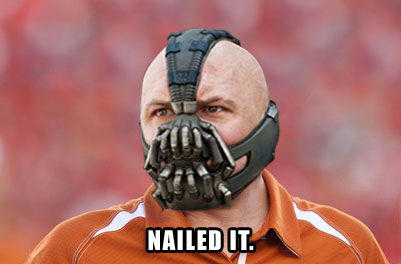
Put simply, the more flashy tools we add, the quicker faulty motor patterns arise and skills-based mechanics go down the drain. Not to mention, an athlete will not be able to perform a skill based movement through it’s full range of motion. This can lead to decreased skills performance, weakened neuromuscular firing, less power output, and increased chance of injury. I get it: cool equipment makes parents “oooh” and “ahhh” and makes strength coaches look like magical fairies that shit sparkles. Alas, I digress. Some things to consider: – Practicing a sport with a weighted vest doesn’t allow for pristine sprinting mechanics. – Performing soccer 1 v. 1 moves with a resisted harness does not allow players to explode with the ball at maximal speed to beat a defender. – And running sprints with a Bane Mask while holding a football and wearing your helmet and pads is well… stupid.
Two Different Jobs
The strength coach’s role is to get athletes stronger and less prone to injury through proper strength, power, and energy systems training.
In the other corner, the skills and team coaches help with improving the soccer kick, the bat swing, the golf swing, the hockey shot, and the tennis serve. It is not the strength coach’s job to bring the court, field, or ice rink into the weight room and duplicate these actions with loaded contraptions. That is why we have distinguished differences between Certified Strength and Conditioning Specialists and licensed sports coaches.
Strength coaches don’t mimic skills in the weight room. Rather, they mimic movement patterns that will enhance a skill.
As an example:
Skill: Shooting a soccer ball
Movement patterns: hip extension, hip flexion, core stability, hip stability, ankle stability, plantarflexion, transfer of force through the trunk. Planes of motions: frontal (plant foot and hip stability), saggital (kicking leg), transverse (transfer of force through core and hips for shot accuracy). Weight Room “Sport specific” exercises: Dead lifts, hip thrusts, single leg hip bridges, plank progressions, psoas activation, lateral step ups, medicine ball rotational slam, single leg bridge variations, to name a few. Single Leg Bridge Progression:
Lateral Step Up:
Psoas/Core Activation:
What we do in the weight room is already “sport specific” to some degree, as strength coaches provide athletes the fuel that is needed to powerfully and deliberately execute skill-based movements.
But if we reallyyyyyyyy want to be sport specific, then the athlete must PLAY MORE OF THEIR SPORT. Going to drop the mic right there. Thanks.
About the Author
Erica Suter is a certified strength and conditioning coach, soccer trainer, and fitness blogger who has worked with athletes and non-athletes for over 5 years. She is currently a strength coach at JDyer Strength and Conditioning, and also runs her own technical soccer training business in Baltimore, MD. Her interests include writing, snowboarding, and reciting Lord of the Rings quotes to her athletes and clients.
At the expense of sounding like an uber meathead, squats pretty much solve anything. You want to be stronger? Squat. You want more muscle? Squat. You want to lose fat? Squat. You want to beat Captain America in an arm-wrestling match? Squat.
About the only thing squats can’t do is help you grow hair, make you an omelet, and cure cancer5.
There’s a reason squats are a staple in most weight training routines, and today’s guest post by strength coach, George Kalantzis, breaks down the proper progressions most people should consider when starting for the first time.
Enjoy.
The Squatzzzz
“If you want bigger arms- squat. Squatting makes everything grow.”
Sergio Olivia, 3 time Mr. Olympia, on offering advice on how to get bigger.
Squatting has been around for centuries. It is one of the primary movements that Dan John says can impact your life, and also one of the best movements for mass strength and muscle development. Yet unfortunately squats are still one of the most neglected and butchered exercises in the gym.
But Why?
Squats are tough and working hard separates the strong from the weak. Squatting heavy stresses the entire body and it takes a lot of will power and strength to put something heavy on your back, drop down, and stand back up. Therefore most people neglect them altogether.
Then you have some people who claim squats are bad for your knees and stick to leg extensions and leg presses. While it is true that squats can place a lot of stress on the knees, it is typically the form and amount of volume that is the cause of knee pain.
In fact, from a exercise science point of view leg extensions can actually place more stress on the knees than squats because they are an open chained exercises. Open chained exercises like leg extensions cause the quadriceps to contract and pull on the knee ligaments and surrounding muscles without counteraction of the hamstrings. Squats actually recruit both the hamstrings and quadriceps.
Research (Escamilla, 98) supports that squats generate twice as much hamstring activity as leg presses and leg extensions. That same research suggests hamstring recruitment is advantageous to enhancing knee stability and functional capacity of the hips. Squatting does not sound that bad now does it?
Ok, I’m Ready Where Do I Start?
It is always important to start with an assessment to figure out where the you will stand in reference to squatting. Tony wrote an in depth post on that HERE.
Mobility Drills
After establishing a baseline, it is time to begin start preparing the body to squat. Starting with some light soft tissue work and warm-up drills will help prepare the body for full ranges of motion needed to squat and prime the nervous system.
Most people have a hard time reaching full depth in a squat and I have found that it is usually a lack of mobility in the areas of the hips and ankles often leads to compensations in the squat..
Core Engaged Deadbug
A deep squat requires proper pelvic position. If you arch your back to hard during a squat , your femur will have a hard time moving around in the hip socket. This is often the cause of the butt-wink.
A core engaged deadbug will help you learn how to keep the ribs down and control the pelvis which are needed for a good squat pattern.
Wall Hip Flexor Mobilization
This drill really teaches you how to keep your glutes tight, extend the hip and flex the knee at the same time to get a deep stretch in the quads. You should focus on getting the range of motion through your hips and not lower back.
Kneeling Glute Mobs
I love this mobilization drill because it really looses up the posterior chain and allows you to safely work on hip internal rotation without cranking on the knee.
Ankle Mobilizations Drill
An often-overlooked area of squatting tends to be the ankles. In order to squat to full depth the ankle needs around 4 inches of dorsiflexion. If the ankle is lacking the appropriate mobility, you may see yourself coming up n your toes, or not hitting appropriate depth.
Squat To Stand With Reach
By the time you have complete the other drills your body should be primed to squat. The squat to stand synchs the entire body and recruits all the muscles needed to perform a good squat. If you have a hard time getting into this position, you may no the ready to squat to full depth.
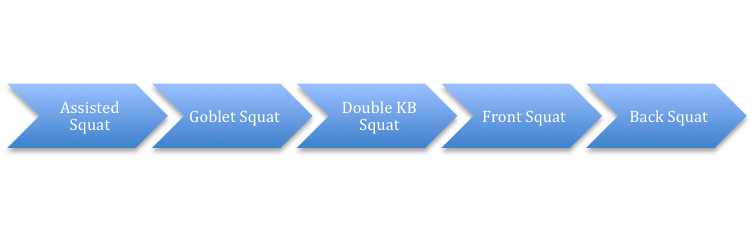
Assisted Squat
Assuming no pain or restrictions are present a great place to start is an assisted version of the squat. There are many ways you can do an assisted squat, but I like using a suspension trainer for assistance.
Holding a suspension trainer allows the trainee to work on static stability and groove a great pattern. Make sure the trainee maintains a neutral back position and uses as much assistance as needed in order to get to the bottom position.
Bodyweight Squat Versions
Once someone has mastered the assisted squat, it is time to move onto a bodyweight squat. Here you can really learn how to squat to full depth and drive up under control.
Sometimes people will have trouble with their heels coming up of the ground. If that is the case, you can create a little heel lift with plates or shoes to help the body recognize how to sit back onto the heels and reduce coming up off the floor.
Another common error for someone just learning to squat is a knee collapse. A great trick for that is to put a mini band around the knees. The bands feeds into the bad movement pattern by pulling their knees farther in and the body reacts by correcting the movement.
Goblet Squat
For most people, a goblet will be the basis of a squatting program. Legendary coach Dan John says that goblet squat is all a lot of people will need and there is a good reason behind that.
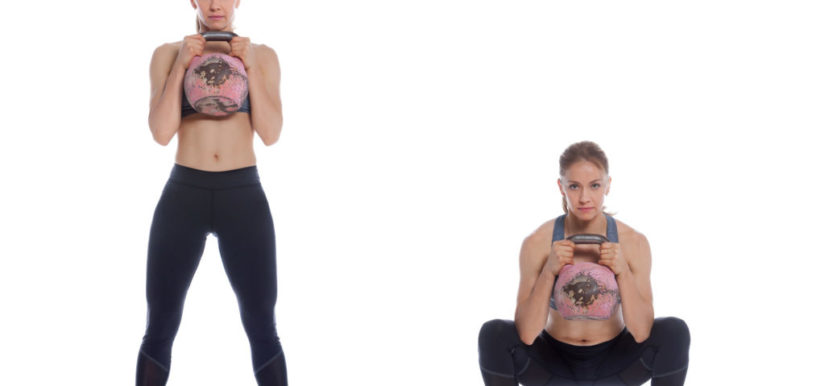
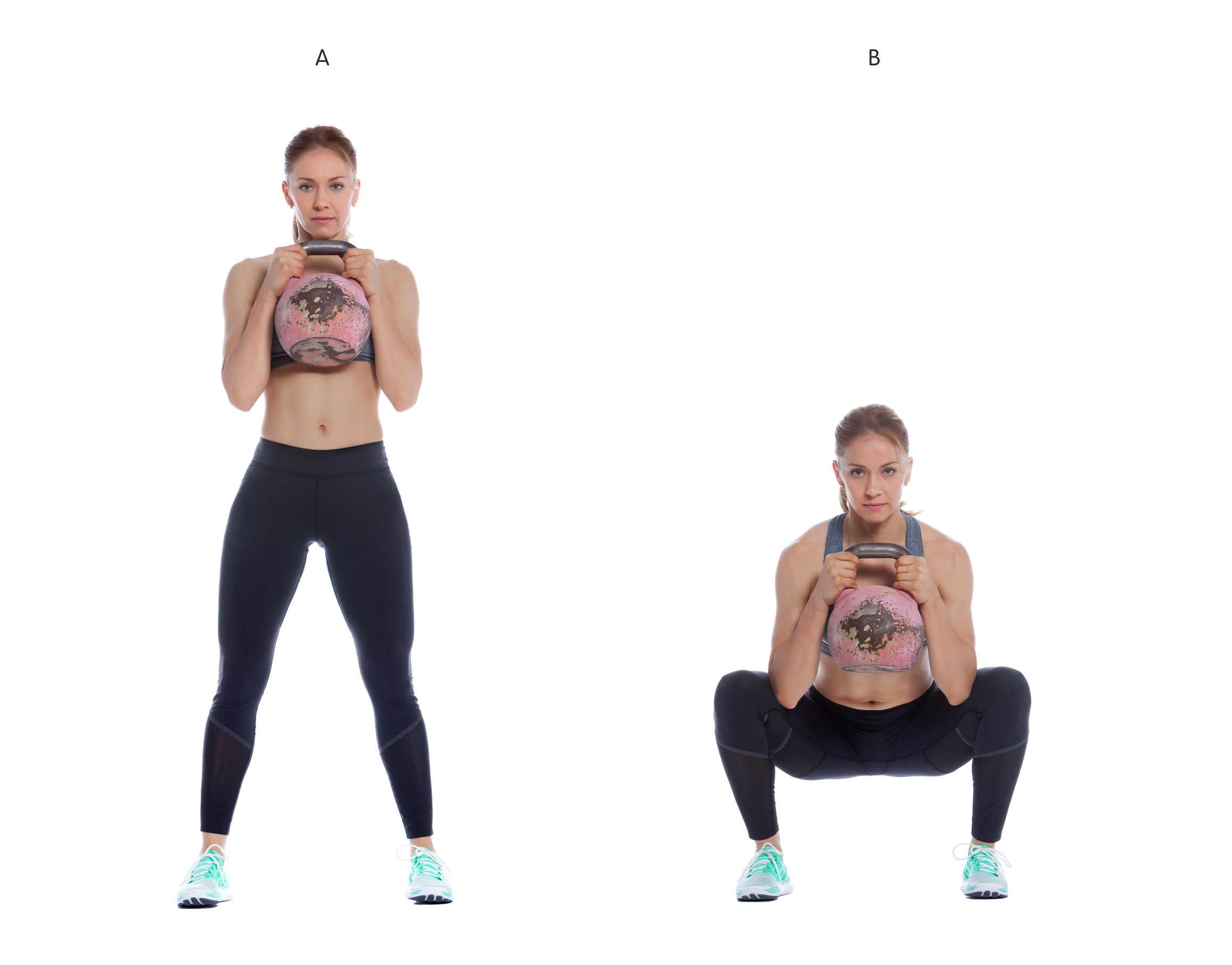
Grab a Kettlebell or dumbbell and hold it close to your chest. With your elbows pointing down, lower your body into a squat. Allow your elbows to be inside your knees and put pressure on the outside of your heels to help keep your knees out. Return to the starting position.
Many people are under the assumption that the Goblet Squat is just this plain ol’ vanilla squat variation that offer no variety. Au contraire! There are any number of ways to make it more challenging.
Goblet Squat Against Wall
Cannot seem to keep your back straight and knees from caving in? Try the goblet squat against the wall. Face a wall with your feet around 6-12 inches away from it and work to actively pull down into the squat.
Start further away and work closer to the wall, as you get more comfortable with the position.
Goblet Squat With Pause
Mastered the regular goblet squat? No problem, try a pause in the bottom of the squat. Pause reps will keep you honest, and really challenge your strength because you cannot rely on the momentum to pop back up from the bottom.
Goblet Squat With Heartbeat
This is one of my favorites to use with people, and it is one version that is not used that much. I first saw it from Mike Robertson when I was learning progressions for group training. It is great for people who have shoulder issues and really challenges the core.
Offset KB Squat
Holding a kettlebell on one side of the body will expose any asymmetries from side to side and really teach the body to own the position. Try to really focus on driving through the entire foot rather then shifting to the side of the kettlebell.
Double KB Front Squat
It only makes sense that once you have mastered the above it is time to load up. The double KB front squat is a great squat version because it really teaches you to sit down rather than back and down.
Essentially what you get is all abs and quads without demanding mobility requirements. It can be very humbling if you have never tried this before.
Front Squat
If you have become comfortable with the KB front squat and are ready for more of a challenge it is time to move on the barbell front squat.
Just like the KB, barbell front squats are all abs and quads. They are great because you have to really sit down into the squat rather than sit back or you’ll loose the bar. Due to the position of the bar your body must learn to stabilize the core instead of using back muscles to stand up. If you constantly get stuck hitting depth on a back squat this is a great exercise for you.
Back Squat
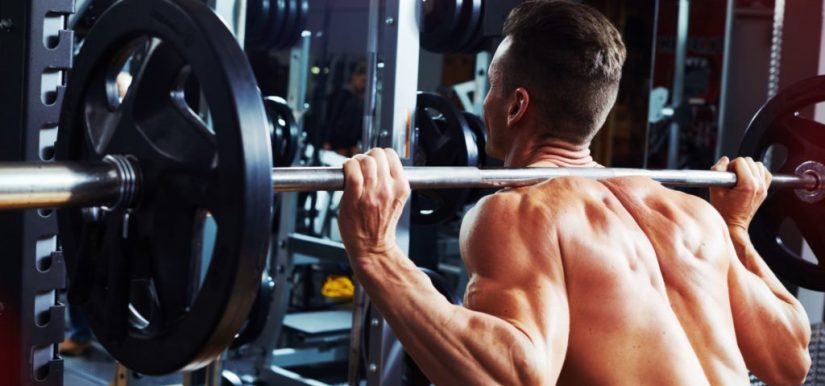
At this point, we have covered a lot of information on squatting. The back squat requires tremendous strength throughout the quads, hamstrings, glutes, hips, abs, and back. There is a reason why most people mess the exercise up or neglect it all together. If you have truly mastered the above exercises then it might be time to try a back squat out.
If you want to learn how to set-up, Tony wrote an awesome post HERE.
Conclusion
Squatting is a lot tougher then it seems. Consider hiring a coach for help on some of the barbell work, and if you are just starting out, goblet squat variations will surely get the job done. Try not to be a hero and start with something that is in between.
Quick things to consider before squatting:
If it hurts, you should hire a coach for an assessment and or see a qualified physical therapist.
Not everyone is made to squat to full depth or made to squat.
Squatting with a bar is not for everyone
When you first start out, you will not need that much weight, typically 45-55 % of your true max. Working on technique and conformability with the different squatting positions should be your first goal before trying more advanced versions.
References
1) Escamilla RF, Fleisig GS, Zheng N, Barrentine SW, Wilk KE, Andrews JR. Biomechanics of the knee during closed kinetic chain and open kinetic chain exercises. Med Sci Sports Exerc. 1998 Apr;30(4):556-69.
About the Author
George began his time at Cressey Sports Performance as an intern in the fall of 2013, and returned in 2014 as CSP’s Group Fitness Coordinator, overseeing all Strength Camp coaching and programming responsibilities.
George is a veteran of the United States Marine Corps and was awarded an honorary discharge after eight years of service. He possesses an MBA from Southern New Hampshire University and is currently attending massage school to become a licensed massage therapist.
Outside of CSP, George maintains a fitness-related blog that can be found at www.sgtkfitness.com.
To be blunt: I don’t feel what I do is all that special or altogether revolutionary. But it’s a topic that came up a lot earlier this week when I asked the Twitterverse for some ideas on what they’d like to see me write about in the future.
@tonygentilcore1 Creating buy-in from your client, how much time you spend on an assessment in the first couple of sessions, break it down!
Much of the time the entire process starts with a swipe right an email. Someone reaches out and expresses an interest in coming to my studio in Brookline, MA so I can take a look at their bum shoulder or low back, or maybe to have me audit their deadlift or squatting technique.
They’ll be a few back and forths and I’ll try my best to articulate to them what my assessment will cover. I’ll ask for a little background information – training history, any current/past injuries I need to be aware of, or whether they’re Team Jacob or Team Edward?6 – and then I’ll break down the general flow of the assessment and what they can expect.
In short, I’ll inform them that I divide the session into two parts: The “poking and prodding part” and the “pseudo training session part.” The part where I incessantly blurt out movie quotes is just a given.
The goal, for the poking and prodding part, is to see if any red-flags pop up from a “is anything I’m doing causing any pain standpoint?” and a “do they have the mobility/flexibility of a rusty crowbar standpoint?”
Likewise, the goal of the pseudo training session part is to ascertain general movement quality and to not bore them to tears.
I explain this to them in a much more professional and succinct manner.
Once we’ve established a date/time to meet up I’ll send them the address of the studio (you would think this is obvious, but I can’t tell how many times I have forgotten to do so), pre-payment options if they so choose (PayPal Button), as well as my Health Questionnaire I’d like for them to fill out prior to coming in (to help save time).
An important point I’d like to note about my health questionnaire (I am not saying you have to do this) is that I consider this an opportune chance to start building a rapport with the client. Most people know what to expect from a standard health questionnaire. Questions regarding their family history, past/current injuries to note, allergies, and what (if any) medications they’re taking are all par for the course. Mine questionnaire is no different.
However, out of nowhere I’ll hit them with questions like:
What’s your favorite movie?
What’s your pet’s name?
Have you ever been bitten by zombie?
Such things help break the monotony and serve as conversation stimulators. Plus they demonstrate I don’t take myself too seriously and that I’m cool as balls.
The Face to Face
Now it’s go time. We finally meet face to face.
I’ve championed this sentiment in the past but it bears repeating:
“The main objective for me when starting with a new client is to not treat the assessment as an opportunity to showcase how much of a walking ball fail they are. It serves no purpose IMO to point out every…single…thing they suck at. Rather, my goal is to do anything and everything I can to demonstrate to them success.”
If they’re coming in with shoulder pain and they lack shoulder flexion, what can I do to 1) help them get out of pain? and 2) demonstrate movements that they can do (pain free)? Moreover, can I use the Test/Retest protocol to see an increase in ROM in shoulder flexion?
If I can accomplish one of those things within an hour, if not all three, it’s a safe bet I’ll likely achieve an easy “buy in” on their end. I’ll also kindly ask them to refer to me as Gandalf from that point on.
I’ll begin each assessment with a 5-10 minute window where we discuss our feelings. Normally I’d rather jump into a shark’s mouth than discuss my feelings with anyone, but it’s about them not me. The best thing I can do is shut up, ask questions, and listen and use the word “why?” a lot.
Example 1
Them:“I want to lose ten lbs?”
Me:That’s cool, why is that? What benefit do you think you’ll receive in attaining that goal?
Example 2
Them:“My goal is to compete in my first powerlifting meet.”
Me (after I high-five them):“Cool. why is that? What benefit do you think you’ll receive in attaining that goal?
Example 3
Them:“I’d like to get stronger.”
Me:“Yeah, that’s cool but it says here your favorite movie is The Matrix Revolutions, is that right?
Them:“Yep, I love it.”
Me:“Get the fuck out of my gym.”
Sometimes people talk for a few seconds, while others go on for several minutes (and then some). Either way, by getting THEM to talk – and asking why? – I’ll get a better idea of where their mindset is at in addition to having a better appreciate of where they’re coming from.
Something else to note here is that, often, coaches will use the interview process to ask about coaches and trainers the person may have worked with in the past and their experiences with them. I think it’s a good idea to ask. However, what I find is all too common is some coaches take it as an opportunity to lambast the other coach.
“Your previous trainer did whaaaaat? That’s so stupid!”
Don’t do that.
Just nod your head, say something to the affect of “huh, that’s interesting,” and move on. You’re not doing yourself any favors by talking smack about other fitness professionals. In fact I think it comes across as very unprofessional.
It’s Time to Poke and Prod
NOTE: Just realized this comes across as slightly creepy. Rest assured things stay 100% PG.
At this point I’ll take out my training table and start the formal assessment. To be honest: while I do have a checklist I work off of, no two assessments are the same. Having the checklist helps, but everyone’s different. While there is some overlap, what I look at and how I assess a 22-year old college baseball player can be quite different compared to a 47-year old accountant with limited exercise experience.
To that end, every fitness pro approaches assessment differently. I’ve taken the FMS and use portions of it all the time. However I’m going to try my best to cater the assessment to match the person standing in front of me. That’s the beauty of having my own spot. I can do whatever the heck I want.
If that means going off the beaten track so be it.
I’d be remiss not to mention it’s inevitable there’s going to be a degree of bias. One’s training philosophy and values will come into play. For example I’m a “strength” guy. I like getting people strong (while also helping them feel a little more athletic). Despite my assessment I’m still going to have people deadlift, squat, press, row, carry, lunge, and perform first pumps x infinity to Annie Mac radio.
Some may be like, “WTF Tony. What’s the point in doing the assessment, then, if all your going to have them do is the same stuff you have everyone else doing?”
Fair question.
The assessment helps me figure out someone’s starting point. More to the point, the assessment helps me figure out what variation of those lifts will be the best fit given their goals, ability level, and movement quality.
As an example, I use the table assessment to perform a hip scour and gauge hip (IR/ER) ROM. If someone has 45-50 degrees of ER and 20-40 degrees of IR (and appropriate hip flexion ROM) it’s a safe bet they’re okay with squatting below 90 degrees (or with most anything else I’d have them perform on the gym floor). If not, well, I’ll adjust.
I can also perform further “screens” to see if the lack of ROM is due to actual “tightness” or if all I have to do is work on someone’s REACTIVE stability:
I can also use the Shoulder Flexion Screen to see whether or not overhead pressing is a good idea.
In the end, I’m not going to sit here and say you MUST do “x, y and z” because I don’t know what you should or shouldn’t be doing. All I know is that there’s no one right way, but that getting people OFF the table is more valuable to me.
The Pseudo Training Session
The poking and prodding part takes, maybe, 15 minutes to complete. 20 minutes tops. Sometimes less.
I don’t want people feeling like a patient and I’d much rather get them on the gym floor doing stuff. I get more information this way anyways.
Here’s where I’ll take a look at their hip hinge, squat, and single leg (front plane) stability. If need be, I’ll regress or progress accordingly. For some a hip hinge is showing them a cable pull-through.
For others it’s an actual deadlift.
Remember: SHOWING THEM SUCCESS is crucial.
Show people what they can do, and don’t perseverate on what they can’t.
At this juncture I’ll also begin to showcase some of the “correctives” I may want them to do. Some may need to prioritize their T-spine mobility or maybe we need to spend some time activating their glutes. Or, maybe we need to show them a good movie, like The Royal Tenenbaums.
I’ll also break down why (and how) I want them to foam roll and do their soft-tissue work, and then I’ll basically take them through a quick training circuit. This may come down to a short-n-sweet A1-A2 circuit for a few sets. Or, I don’t know, maybe we’ll take our shirts off and perform bicep curls for ten minutes.
Either way I’ve done all I can to have (hopefully) given them a positive experience and a better idea of my coaching style, what a typical training session would look like, and how I’m going to help them increase their general level of badassery.
Buy in = they give me their credit card number….;o)
PS: If you’re really interested into diving into my assessment process check out mine (and Dean Somerset’s) resource Complete Shoulder and Hip Blueprint.




















 George began his time at Cressey Sports Performance as an intern in the fall of 2013, and returned in 2014 as CSP’s Group Fitness Coordinator, overseeing all Strength Camp coaching and programming responsibilities.






.jpg/290px-Annie_Mac_(2).jpg)