New year resolutionsCategoriespersonal training Program Design psychology

Reframing the Way You Make Your New Year’s Fitness Resolutions

I can sense the eye rolls already.

“Really, Tony? A post on New Year’s resolutions? How profound and unimaginably unique!”

Touche.

I can appreciate that there’s no shortage of similar posts you’ve undoubtedly come across in recent days. You’re likely thiiiiiiis close to introducing your forehead to the keyboard in front of you.  What could I possibly have to say that’s any different or inspirational or less vomit-in-your-mouth(ish) that hasn’t been regurgitated ad nauseam already?

Read on…

New year resolutions

I Promise This Will Be Different

To follow the lead of my coach (I.e., I’m just going to cut and paste), Sarah Moorman, who had some sage words to share herself on the topic:

Almost 40% of the population makes New Year’s Resolutions. From that number, a vast majority of resolutions are within the gravitational pull of health/fitness:

  • Eating habits
  • Exercise habits
  • Building a pair of pecs that can cut diamonds
  • You know, stuff like that

However, much like Sarah, I’m more of a fan of, actually…I’ll just let her say it:

“I’m largely in the camp of setting goals about consistency to help set new habits. For example, instead of a weight loss goal of a specific number of pounds, I advise you to hit your calorie or macro goals 6 days a week.”

“Why?

If someone is more consistent with hitting their calorie goals, their focus is on their eating habits as opposed to the weight on the scale.”

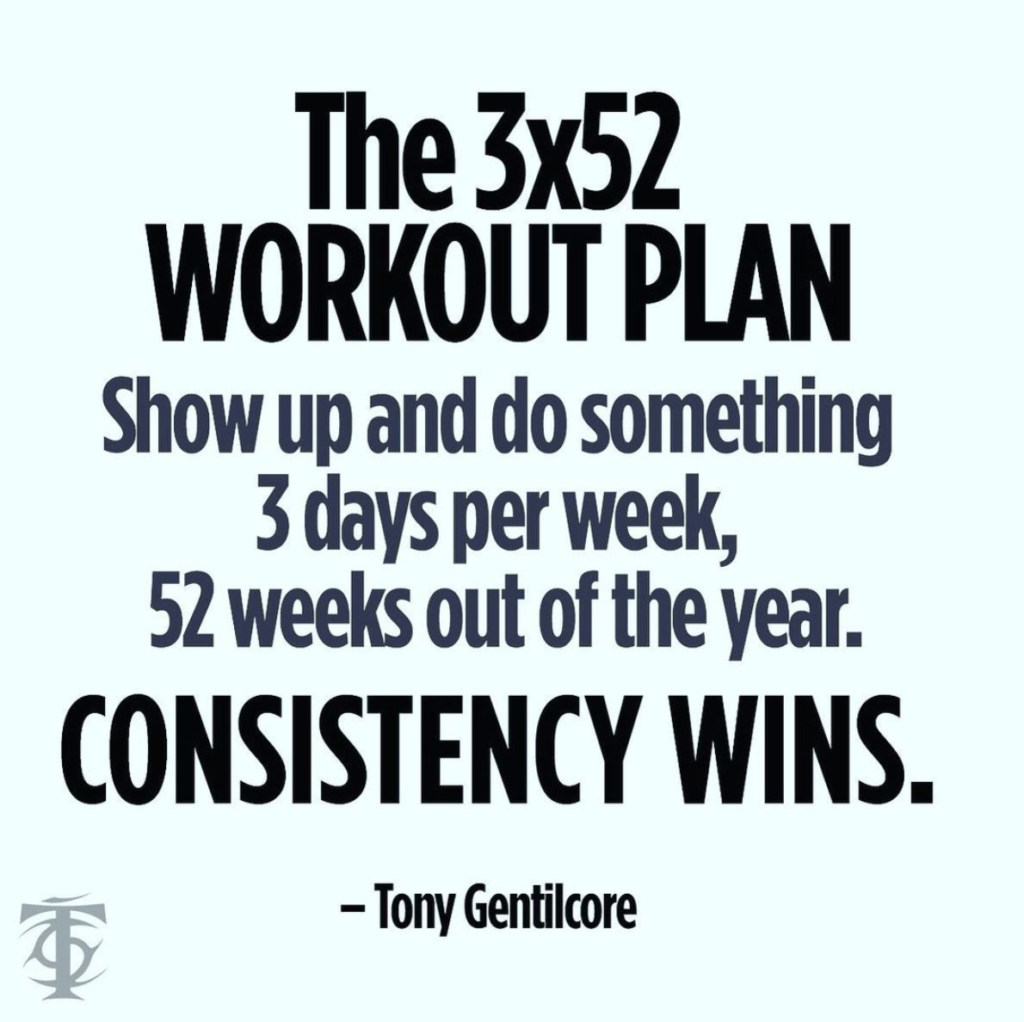
To parallel this viewpoint, the other day T-Nation.com memed me, which is always an honor.

I’ve long championed the 3×52 mentality.

Do something (anything) 3x per week, 52 weeks out of the year (preferably with an emphasis on lifting heavy things1), and something stellar is bound to happen.

Why THREE days and not:

  • 4?
  • 5?
  • 6?
  • 7?

Well, because for most people 3x per week is a number they can wrap their head around; it’s not intimidating.

It’s doable.

It emphasizes REALISTIC consistency.

Like I said, T-Nation made the meme and then posted it up on their IG account the very same day. I had to chuckle at a number of the initial comments:

  • “6×52 is better.”
  • “No days off!”

So on and so forth.

I have a hunch that if I made a Venn diagram and the circles consisted of:

1️⃣ I have zero kids.
2️⃣ I have no family responsibilities.
3️⃣ I am not a coach and/or I read a book on fitness, once.
4️⃣ I like to brag about my 225 max deadlift and/or my entire identity is tethered to how many followers I have on IG.

That that would pretty much represent the type of person who would end up right smack dab in the middle of the diagram and who would make such asinine remarks.

Listen, you’re not a Spartan warrior or a Navy SEAL.

Relax.

Being hardcore (or pretending to be online) doesn’t get results long term. It’ll work, for a bit. Maybe. And then you realize you’re NOT Rambo or Valentina Shevchenko.

Photo Credit: Wikipedia Commons

Being a bit more realistic with the degree of consistency needed and more importantly, expectations one places on one’s self, is key.

It’s human nature to dive right in and to go from zero to 60 without really thinking things through:

  • Says here this detox tea is legit. After 47 days my body will be cleansed of all these pesky “toxins” and I’ll be able to see sounds! Fuck my liver and pancreas. They don’t know what they’re doing anyway.
  • I haven’t exercised since before the pandemic, so I may as well start with some German Volume Training.

We all think we’re more advanced then we are and that we can skip all the seemingly unnecessary & annoyingly rudimentary steps to go from Point A (where we currently are) to Point B (where we want to be) in the fastest way possible.

Can people attain their health/fitness goals in such a haphazard way?

Sure.

But it rarely sticks, because they fail to hone in on the necessary habits to make things click long-term.

So, with 2022 upon us I encourage you to consider reframing the way you go about making your resolutions. Instead of saying “I want to deadlift a bulldozer” say something like “I want to follow a strength training program 3x per week for the next 52 weeks.”

The latter will undoubtedly be more palatable and realistic.

CategoriesExercises You Should Be Doing personal training

Two Ab Wheel Rollout Variations: 1 Entry Level, 1 John Wick Level

Ab wheel rollouts are a common choice for those looking to work their (anterior) core muscles. The main objective of the exercise of course is to make you hate life resist too much extension of the lower back.

In short: It can be considered a (mostly) anti-extension exercise.

Today I wanted to quickly share two different variations:

  • One entry level (that pretty much anyone can perform, and serves as a nice starting point for most).
  • One John Wick level (that pretty much only world class assassins can pull off).

Let’s go!

Copyright: oskanov

But First

I’d be remiss not to at least go into some detail on proper set-up and technique of a standard ab wheel rollout. There’s no since in re-inventing the wheel (👈 ha, I love puns) here, because I actually posted about this on my IG feed not too long ago:


View this post on Instagram


A post shared by Tony Gentilcore (@tonygentilcore)

I hope that helps.

That said, performing a rollout on the floor can still be a rather aggressive choice for many people to start off with. Most lack the requisite strength/stability to get remotely close to the floor which can be deflating. I don’t know about you, but I’d rather try my best to demonstrate as much success as possible to a new client rather than make him/her feel like something is too challenging or out of reach.

Or, worse case: Painful.

To that point, I came up with the following regression that I feel works really well:

Incline Rollout


These are a great entry point for people just starting out with rollouts as the inclination helps to keep them from “falling” into their lower back excessively.

For those of you looking for something a bit more challenging I offer this:

Anchored Rollouts


Giving credit where it’s due: I originally got this one from strength coach Mike Volkmar and upon seeing it for the first time was like 1) this is awesome and 2) I’m an asshat for never thinking of this myself.

As he points out, anchoring the ankles against the band activates the hamstrings, turning off the hip flexors.

As a result, climate change is resolved!

YAY. WE DID IT EVERYONE. Congrats.

(In all seriousness, give these two variations a try and let me know what you think).

Categoriespersonal training Strength Training

Strength Training For the Real World

Just to be clear: This blog post has nothing to do with the reality series, The Real World…😉

Speaking of which, I crushed that show in its early days. I watched every season up until Paris (season 13); after that it kinda lost its luster for me. Watching people make out in hot tubs wasn’t my idea of must-watch-tv.

(Excuse me while I go catch up on The Bachelorette).2.

Nope, today’s guest post, written by NY-based personal trainer Elaine Studdert (who wrote THIS post on sustainable fitness on this site a few months ago), pertains to strength training as it relates to “real world” activities like yard work, rough-housing with your kids, hauling suitcases, and fighting off a pack of ninjas.

We’re enamored if not programmed to think that the more advanced an exercise or program the better it must be. That couldn’t be further from the truth.

Enjoy!

Copyright: daizuoxin

Real World Strength Training

I’m a proud hockey mom to three boys. As my boys grow older their hockey equipment grows with them. Back when they were just little Mites, I’d carry their bags – which were heavy but manageable.

Fast forward to the Pee Wees and Bantam divisions, those same hockey bags have gotten exponentially bigger in size and weight. Even though they carry their own gear now every once in a while they need a hand. This is one of the many reasons I need to maintain the ability to pick up heavy stuff.

And this is true for everyone, whether it’s a hockey bag or a trash bag. In all of our lives, there will be situations that require heavy lifting.

This is real world training.

Training that doesn’t take place in a gym.

This is the type of training we need more than that weekend boot camp class.

Carrying suitcases, hauling groceries, walking up a flight of stairs, picking up your kids/grandkids, running after your dog, moving furniture, picking laundry up off the floor, etc.

The list goes on and on.

These everyday activities may not seem like a workout. In fact, we usually take for granted our ability to manage these tasks, until it becomes a challenge. That’s why it’s so important to put the work in every day. Being consistent over time will keep you in form to be capable of these everyday activities.

In the healthcare industry these movements are called ADL’s (activities of daily living).

Basic self-care activities that people do on a daily basis. We learn these basic skills as young children. As we play, run, jump and navigate the playground our body is figuring it all out and getting stronger. It’s important to find your adult playground to maintain this functional movement.  Maintaining the ability to perform ADL’s as we get older should be top priority.

So even if we’re not training for a sporting event, we should technically be in training every day for life.

How Do We Get Fit for Life?

Real life requires us to:

Squat – ex. getting up and down from a chair

Hinge – ex. pick something up off the floor

Push – ex. Push a shopping cart

Pull – ex. opening a car door

Carry – ex. holding a suitcase or grocery bags

Training these movements with external resistance or load is essential for maintaining muscle mass. And as we age, we want to hold on to our muscle as long as we can.

This doesn’t mean we have to be become bodybuilders or Olympic lifters. For most of us, this just means picking up some weight and performing these movement patterns 2-3 times per week. Strength training with movements that mimic real life will prepare you for all the activities you do on a daily basis.

It’s really as simple as that.

Where do we start?

The overwhelming amount of fitness information and resources we have access to can be confusing and complicated, especially for someone who is new to exercise.

  • What is the right plan?
  • Who do I follow on Instagram?
  • What app do I download?
  • Which device do I need to monitor my activity?

Breaking it down to the simplest components will make it less intimidating. Don’t overthink it. The quality of the exercises is way more important than quantity. Just start with the fundamentals and take it from there. Put one foot in front of the other and the rest will happen.

Here’s a Sample @Home Workout

A1. Squat: Goblet Squat w/ Lowering

A2. Hinge: Band Pull-Through

A3. Push – Gripless FacePull to Press

A4. Pull – Band Row Rotational Row w/ Weight Shift

A5. Carry – Goblet Carry


Carrying some weight, making small gains day in and day out, pushing yourself hard but not killing yourself. It all adds up and keeps us in shape to do the things in life we enjoy.

About the Author

Elaine Studdert is an ACE Certified Personal Trainer based in Westchester, NY. She trains clients virtually and in-person at HealthyFit in Mamaroneck. Elaine specializes in functional movement and kettlebell training. She loves to work with clients who are looking to improve their quality of life through movement. See her most recent article on virtual fitness training at Larchmont Loop.

Follow Elaine on social media: Instagram: @elainestuddert

Categoriespersonal training

Meet In the Middle

There’s no question we’re living in polarizing times; no one can seem to meet in the middle on anything:

  • Politics
  • Religion
  • COVID/masks/vaccines
  • Who’s the best Batman…

If there’s any degree of disagreement the brass knuckles are coming out. We see a fair share of the same sentiment in the fitness industry and with today’s guest post, Shane McLean pontificates on that point a bit further.

Copyright: xwinggames

Meet In the Middle

Remember when you used to meet up with a friend and you would meet in the middle? They didn’t want to go all the way over to your house and you didn’t want to go all the way to theirs, so you met in the middle. When I was a kid, it seemed a fair deal because I rode my bike everywhere.

Now it seems (to me) we live in a world of extremes, and no one meets in the middle. It’s either this or that. It’s fact or it’s fiction. You support me or you’re dead to me. Plus, if there are two differing points of view, you must side with one or the other.

This is often exacerbated (in my opinion) by the mainstream media and even on TV shows.

Extremes sell and get you fired up.

If you support one side or the other for whatever reason, it’s easy to draw a line in the sand and put your money where your mouth is. How’s that for back-to-back use of clichés? On second thoughts, don’t answer that.

Although today’s political climate has its fair share of extremes, I also see this in the health and fitness realm.

Warning: Soap Box Moment

Before the rant, here’s where I’m coming from:

  • I’ve been a personal trainer for twelve years
  • Freelance fitness writer for over six years
  • Been writing a fitness blog for over seven years
  • Volunteer for the Personal Trainer Development Center where I consume a metric ton of fitness content.

I’ve read, written, coached and performed a lot of exercise. This doesn’t make me an authority, but it does make me a loud mouth with an informed opinion. If you dislike opinion pieces, stop reading. If you wish to be more informed as to see clearly through the murky waters of the fitness realm, hold on to your keyboard.

It will be a bumpy ride.

The Middle Doesn’t Sell Well

Extremes sell because they get attention.

Nothing brings this more to light more than social media because it takes a lot to get consumers attention while they’re doom scrolling. And being on social media more than I should, here’s what I’ve gathered about what sells and what doesn’t.

Nothing polarizes trainers, coaches, and consumers more than diets and methods of exercise. Whether it be Keto, Atkins, Vegan, (insert all diets here) or high intensity training, CrossFit, Zumba, or kettlebells (insert all training methods here).

To get attention in a crowded marketplace and more sales, you need to stand out from the crowd. And some trainers, coaches, etc. go to extremes by either

  • Performing circus tricks that kind of look like exercise
  • Saying only this works and nothing else does
  • This food will get you fat so buy this instead3
  • You’re exercising all wrong and you must do this for gains
  • Eliminate this and add this (whatever their selling) to get long-lasting results
  • Stop making these diet and exercise mistakes and do this instead.

Or variations of all the above.

Now, I’m not saying this is wrong and I’m not denying people trying to make a buck no matter how dubious their claims are. Because (cliché alert) fools and their money are soon parted.

But I’m going to let you in on a little-known secret that seems obvious that you’ll be smacking your hand into your forehead repeatedly saying ‘why, why, why didn’t I think of that.’

Are you ready?

Everything works. Yes, even the Thigh Master. Or Zumba.

The trick is what to do when the extremes stop working.

Here’s What Doesn’t Sell

Extremes do work because there is a time and place for most things.  There are times to go to extremes to get the results you want.

Plus, people are entitled to their extreme opinions too. My only problem is when these people are presented with overwhelming evidence to the contrary and they still hold on to their beliefs.

But that’s a story for a different time.

Here’s what I feel aren’t the biggest sellers nor doesn’t it generate lots of attention.

The basics and moderation, otherwise known as the middle.

The middle for resistance training involves the regression and progression of hinging, squatting, lunging, pushing, pulling and locomotion (carries, sled work etc.) And the middle for nutrition is a caloric deficit for fat loss, caloric surplus for muscle gain and eating more like an adult and not a child.

Yes, there is a lot of wiggle room as I’m taking the broad view here.

Moderation is taking the long-term view and not just the short-term strategy of losing 10 pounds in 6 weeks.

Quoting a well-known coach, he suggests you need to spend more of your time doing either a:

“Moderate diet (not a huge caloric deficit, surplus or mass elimination of food groups). Combined with Hard training (more sets, reps or more days exercising).

Hard diet (bigger deficit or surplus with elimination of foods) Combined with Moderate training (less sets, reps, and training to support you goal).”

Now extreme dieting and training programs (at the same time) are doable but only for a limited time. Think of it (another cliché alert) as burning the candle at both ends. You burn bright for a while and after a while there is no wax to burn.

But moderation and the basics aren’t as sexy or sell as well as extremes.

Wrapping Up

This is not a knock-on trainers or coaches who use attention grabbing content or exercises to generate sales, likes and followers. But be aware there is plenty of room in the middle performing the basics with moderate diet and exercise.

Because doing a little over the long haul will give you the best chance of success. Save the circus tricks for the professionals.

If you’re looking for an exercise program to get you back on track, check out my 6-week program right here.

About the Author

Shane “Balance Guy’ McLean”  is an A.C.E Certified Personal Trainer working deep in the heart of Louisiana with the gators.

Categoriesfitness business personal training

The Hybrid Training Model For Personal Trainers

My man Gavin McHale is back with another excellent guest post this month. If you missed his last article on lead generation you can check that out HERE.

This month, as the title implies, is all about how personal trainers can (and should) lean into more of a “hybrid” training model that doesn’t rely on IN-PERSON training only and allows you to better leverage your time in order to 1) make more money and 2) resist the urge to throw your face into an ax from work overload.

Give it a read. It will make a lot of sense and I hope afterward it’ll provide some inspiration to you to make some subtle changes in your approach to the services you provide.

Copyright: michaeljung

The Hybrid Training Model For Personal Trainers

I climbed into my truck and sat back with a huge exhale. I had just finished another ‘day at the office’ and, as usual, I was absolutely exhausted. 

It was early afternoon, I had been up since 5AM and on the training floor since 6:30, eating and drinking coffee on the go. I was finishing up my 4th cup of coffee for the day, knowing it would affect my sleep but needing it to prop myself up for the evening full of clients that I had in about 4 hours.

via GIPHY

The ‘00’s Pop Punk’ playlist had played at least three times through on repeat that morning.

The plan was to whip home for some lunch and some work on the business before heading back to the gym – another few hours of client sessions on deck. In reality, I knew I’d get home, crush some food and pass out for the entirety of my time at home, barely dragging myself out of bed to get there on time.

I loved my training clients and I got to provide them with the best hour of their day on the training floor. 

And, by this point, I got to do it a lot. 

I had built my personal training business up to nearly 30 clients, with upwards of 25 semi-private and private training sessions a week. 

Business was buzzing… but the thoughts started creeping in…

via GIPHY

My girlfriend of two years and I barely got to see one another. When we did, I couldn’t even keep my eyes open for a full movie and had to leave any social gatherings by 9PM thanks to my 5AM alarm the next day.

How long was she willing to put up with an absent partner?

I knew I wanted to have kids at some point in my life, and I wanted to be the dad who could do school drop-offs and pick-ups and coach the sports teams; not the one who always ‘had to work’.

We loved to travel, even just for extended weekends. But I couldn’t enjoy my time away, panicking about lost revenue and possibly unhappy clients.

But the worst part was that I wasn’t making the money I knew I could be. I wasn’t having the impact I knew I could.

I was making a decent paycheck every month, but it was just enough to pay my bills and allow me a bit of freedom. I was pinching pennies and living paycheck to paycheck while working a ton, with a university degree and numerous certifications behind my name.

And honestly? I was just fucking tired…. ALL. THE. TIME.

It didn’t add up.

Especially since the only solution I knew was to take on more clients and do more of the same… something I didn’t have the capacity for without sending myself down a spiral to burning out and being single well before my 30th birthday.

That’s when I was forced to get creative.

I began by asking myself the one question every single service provider should start with (I was just a little behind the curve): How can I best serve my clients?

via GIPHY

(GIF added by me, Tony, because if nothing else I keep thing professional.)

I knew they loved their workouts and I loved working with them, but the majority of them weren’t getting the results they wanted because that 1-3 hours a week they spent with me would never offset the poor lifestyle choices they were making during the other 165+ hours every week.

Let’s be real, even though I loved doing it, grinding it out on little sleep and caffeine was not the best service I could provide. The cup I was pouring from… was empty and I didn’t have the systems in place to help them change their lifestyle beyond a couple sweat sessions a week.

And since I had no more capacity for more training sessions and they didn’t have the time to come to the gym every day,

I had to find a better way.

Enter, the Hybrid Training Model

This model created a win-win for me and my clients.

The win for me is that I got to stabilize my monthly income by charging for an entire package instead of session by session and got some of my time back, all while providing a better service to my clients.

The win for them? Straight up better results without having to schlep to the gym and back every day or pay thousands a month for a trainer.

This model would allow me to continue doing what I did best, training clients on the gym floor, but not have to live there, eating every meal out of tupperware, trying not to spill it on the turf and taking bites between coaching cues.

The hybrid model I built and refined since includes 5 key areas:

  1. In-person coaching
  2. Regular activity programming
  3. Nutritional guidance or intervention
  4. Belief and habit building
  5. Accountability

If you look at the traditional training model – the one that left me half sleeping in my truck at the end of the work day, I covered maybe 1 or 2 of those bases… at best.

And, in most cases, the trainer isn’t being paid for anything but their time spent in the gym with each client. You can say the pricing reflects programming time and nutritional information and accountability, but it really doesn’t.

When your clients are paying session by session, they see the value in having you in the room coaching them.

That’s it.

Your clients are also financially incentivized by this model to actually miss sessions. If they’re low on energy or just don’t feel like it, they’ll miss a session and either save money that month or stretch their current package out over a longer period.

Bottom line: your income is unstable and they don’t get the best service.

In order to build this model out and be able to market and sell it, you have to ask yourself a lot of questions and completely reshape the way you provide your service and charge for it.

1. In-Person Coaching

  • How often do they need instruction lifting weights? 
  • How often do they want to come to the gym?
  • Do you have the space and ability to do semi-private training with them?

2. Regular Activity Programming

Basically, this includes any part of the programming that doesn’t require you to be there, coaching them.

  • Can you program some or most of their workouts to be done on their own? 
  • Do they have a gym membership or access to equipment at home?
  • Are there parts of the program where they don’t need to be in the gym like walking, running or mobility work?

3. Nutritional Guidance or Intervention

Any type of transformational program is incomplete without some form of nutritional guidance. If they already trust you enough to train them, then you’re probably the best person to guide them through some basic nutrition principles.

For most general population clients and goals, this is simple habit building. No need to go too deep and risk moving outside your scope.

You can either build your own curriculum or outsource this completely. When I was coaching, I outsourced this to Precision Nutrition and set my clients up on their year-long ProCoach software.

4. Belief and Habit Building

My most successful clients were the ones who made massive mindset shifts throughout my program. Over the time we worked together, they became better versions of themselves, which provided the outcome they wanted.

In my opinion, this is a non-negotiable in any coaching program, especially if you want to stand out from the Pelotons and the Orange Theory’s. 

  • What do they need to learn to be able to shed their old skin and step into a new, better version of themselves?
  • Can you create a simple weekly or bi-weekly curriculum over 2-3 months that will allow them to do that?

5. Accountability

Finally, accountability is what they’re actually paying for.

Let’s be real – everything you (and I) coach can be found with a quick Google search if they know where to look. 

Information and even education is no longer valuable like it used to be. What is? Accountability and a safe space to fuck up and learn.

Plus, the more skin they have in the game (i.e. the more you charge for this full spectrum service), the more accountable they’ll be.

I’m not sure how many free downloads you have sitting on your laptop, but I have plenty that I haven’t even opened… no skin in the game.

In Its Simplest Form, This is the Hybrid Coaching Model

I won’t lie, this will be more work upfront for you. But, as I learned throughout this process, if you can “work hard once” setting everything up, you make your life a whole lot easier down the road.

This will allow you to charge a monthly price for the whole package and stabilize your pay while actually working less and giving your clients the best chance at seeing the results they’re looking for. 

No more never-ending selling of 10 or 20-session packages and no more needing to send out the same resources over and over to every single client who asks about keto or intermittent fasting.

You run the show and make sure all the bases are covered. They get the best of what you can offer and you get the most out of your time, energy and expertise.

About the Author

As a Kinesiology graduate, Gavin McHale quickly realized that following the traditional business model would lead to trading more time for more money.

Over the course of 8 years, Gavin built a 6-figure hybrid training business before founding the Maverick Coaching Academy in 2019.

Since then, Gavin has left the gym and gone all in helping other strength coaches build their businesses. He has made it his mission to fix the broken fitness industry and connect other amazing humans to the highest version of themselves.

IG – @gavinmchale1

The Coach’s Playground Podcast

maverickcoachingacademy.ca

Categoriespersonal training

A Personal Trainer’s Credo

Principles?

Treatise?

Standards?

Maybe I should have used some other fancy schmancy word instead?

Whatever the case may be, if you’re a personal trainer what follows are some potent “rules” you should be following.4

Copyright: uladzislauzaretski

A Personal Trainer’s Credo

1. Write Programs For the Client’s Goals (Not Yours)

You may think it’s badass to be able to deadlift 3x your bodyweight or look like He-Man (and I’d agree5), but that doesn’t mean all your clients will feel the same way.

  • Some people will want to look good for an upcoming life event (like a wedding).
  • Some people may want to reduce their chronic lower back pain.
  • Some may want to not pull their hamstring crush the competition in their recreational softball league.
  • And others may have a goal to grow a lumberjack beard.

The examples are endless.

(I’m just gonna toss it out there that, not coincidentally, a healthy dose of deadlifting will likely be on the docket for every one of those goals).

Your job as the fitness professional is to write (safe & efficient) programming that caters to the person standing in front of you. Weird, right? Who would have ever thought that one of the best ways to improve client retention is to do that?

Note sarcasm.

2. Actually Do Your Job (Coach!)

Fitness business legend, Thomas Plummer, is famous for referring many personal trainers as “clipboard cowboys and girls.”

Meaning, many portray themselves as nothing more than glorified (and disinterested) rep-counters.

At a rate of $70-$100 per hour no less!

In my experience, what separates the great trainers from the sub-par ones is the fact the former actually does his or her’s job…

…they coach!

They routinely provide feedback, make adjustments, and progress/regress exercises according to one’s health & injury history, goal(s), as well as ability level.

In short: They give a shit.

3. Being a Hardo is Lame

I’ve never really understood those coaches/trainers who feel the need to showcase this incessant “hardo” I-am-going-to-beat-you-into-the-ground-now-KNEEL-BEFORE-ZOD! attitude.

via GIPHY

You do you.

However, it’s also been in my experience that most people, most of the time, don’t respond well to that sort of silliness. It may work for a week or two, but before long the schtick is going to get old.

As renowned strength coach, Mike Boyle, has routinely said throughout the years…

“Don’t be an asshole.”

Or, maybe Mike didn’t say that? But it sure sounds like something he’d say. Did Gandhi say it? Either way, it resonates with me.

Instead, I feel the more cogent approach is to unabashedly champion SUCCESS with your clients.

Demonstrate and focus on things they CAN do rather than what they can’t. 

I’m going to tell you right now, most people are not going to be able to walk in on day #1 and perform a pristine barbell back squat. If you’re the type of trainer who insists on forcing it onto everyone, you’re going to fail, and more to the point you’re most likely going to turn people off from training.

This is not to say that that individual may one day have back squats placed in their program. I love back squats and think they’re a splendid exercise for most people to master. That being said, it’s imperative to ensure you find everyone’s appropriate “entry point” to certain exercises and movement patterns.

A Goblet Squat is generally a better entry/starting point for most trainees over a back squat. The former will feel more natural and doable.

The latter will often be seen as intimidating and feel like fire ants eating away at their hips and lower back. Then again, this is where BEING A COACH comes to fruition. Ensuring the appropriate joints are doing the work and are loaded correctly during a squat (and that the client feels the correct musculature firing) is the job of the trainer.

You don’t have to be hardo to accomplish those things, though.

You can absolutely do it in a manner that’s accessible to the client and prioritizes success.

4. Wash Your Shaker Bottles (For the Love of God)

Self-explanatory.

5. Practice What You Preach6

Call me crazy but I like to actually test drive an exercise before I put it into a program for a client.

Likewise, it’s rare for me to put a “concept” into program – density sets, drop sets, 5/3/1, undulated periodization, rest/pause training, nunchucks – and not have experienced or toyed around with it myself.

How can I expect my clients to “buy in” to something if I myself haven’t done so?

Integrity is important to me and it’s something I don’t take lightly.

You shouldn’t either.

Categoriesmindset personal training

The Hard Truth About Back Pain

Happy Labor Day to my American readers.

Happy Monday to everyone else…;o)

Today’s guest post comes courtesy of TG.com regular, Shane McLean. Most will be able to commiserate because it deals with an annoying topic most of us are very familiar with: Cross-Fitters low-back pain.

We can seemingly do everything perfectly – lift with impeccable form, do our mobility work, even do an extra set or two of deadbugs & birddogs – and yet still be clotheslined by a bout of back pain.

It stinks no matter which way you look at it.

But it’s not a death sentence.

Copyright: belchonock

The Hard Truth About Back Pain

Google back pain and you come up with about 1,550,000,000 results.7  There’s no shortage of information about back pain, the symptoms, the different types, how to treat it and how to prevent it. When you’re suffering from back pain, it’s easy to be overwhelmed with all this info.

Plus, not to mention all the conflicting advice because various treatments and exercises work for different people. What worked for me might not work for you. Pain and healing are highly individual things, I think.

Back pain causes loss of income, loss of mobility, stress,  large medical bills and costs employers big money because of sick leave, health insurance etc.

Back pain is a big deal, no doubt.

You can do all the right things, diet, exercise and move right but back pain doesn’t care. It can rear its ugly head at any time you move suddenly, bend down to pick something up off the floor or when you’re wrestling with your kid.

Then you’re in a world of hurt.

There’s a school of thought that suggests back pain is preventable if you strengthen your core, have good posture, get strong and not sit or stand too much. But back pain doesn’t care. You control what you can control and let the chips fall where they may.

Truth About My Back Pain

The truth about my back pain is it was my fault.

See, I love to deadlift, but I was doing it all wrong. Rounding the lower back while pulling a barbell from the floor repeatedly is NOT a recipe for a healthy spine. Eventually something had to give. And it did.

Around nine years ago I felt a ‘snap’ in my lower back and didn’t think anything of it. Some low-grade pain around my lower back and I ignored it like any gym meathead would, hoping over time the pain would go away.

But the more I ignored it, the worse it became, to the point where lifting, playing with my kids and sleeping didn’t happen. The pain had taken over my life and it was all-consuming. To cut the world’s smallest violin story short, I had three herniated disks.

Now the disks have healed but my pain has not. More on that later.

When You’re In Pain

If you’ve ever put your back out, you’re probably thinking you’re the only one who’s suffering (because pain is all-consuming) but this is not the case. 80% of the population of the US, at some point will suffer from chronic or acute back pain.

And about 2% to 10% of people who experience low back pain develop chronic back pain.

A lot of people choose to go under the knife to fix this because of their doctor’s recommendation, but this doesn’t always work, as shown here. Plus, I’ve encountered many people who have had multiple back surgeries and they’re still in tremendous pain and their quality-of-life sucks.

Sometimes the solution causes more problems.

Get Back On The Horse

You’ve heard the saying ‘get back on the horse’ when you’ve been knocked down.

Get up, dust yourself off and go again.

You cannot change what happened. Dwell on it, yes but you cannot change it. Better to wipe the slate clean and go again.  And this is usually great advice but for back pain it’s a little different.

via GIPHY

The countless times I’ve come back to the deadlift after injury there’s a real fear, I’ll do it again. The more I focus on correct form and set up doesn’t make this fear go away. But this fear is a two-way street. It forces me to do it right, which is a good thing.

But I lose confidence in my body to perform because of this fear and this is a bad thing.  You may think this is mumbo-jumbo, but injuries have both physical and psychological consequences, and a common post injury response is elevated fear of re-injury. (1)

The loss of confidence is real and is a little talked about consequence when coming back from an injury.

Another ‘Truth’ About Back Pain

This is a case study of N=1 (me) and my experience with back pain and training clients with back pain. Barring lower back strains and waking up on the wrong side of the bed, once you’ve damaged your spine, like herniated disks the pain doesn’t magically go away.

The injury may have healed but the pain remains.

In the case of herniated disks, the fluid that leaks out between the disks which causes the nerve pain and discomfort gets dissolved by the body over time. Then there’s nothing pressing up against the nerve so the pain should all go away, correct?

I’ve suffered from low-grade (1-2 out 10 on the pain scale) and extreme lower back pain (5-7 out of 10) almost daily for the past nine years. Granted it’s not the same level of pain generated by a herniated disk and it’s not constant, but it’s still pain.

Low grade back pain doesn’t stop me from training, but it does make me more aware of my set up and form. It makes me more conscious of my posture and daily movements too and this is all positive. Extreme back pain almost puts me on the ground.

This is not.

After surgery, rehab, Physical Therapy or Chiropractic care for back aliments, the severe pain may go away but the discomfort may haunt you like Casper the friendly ghost.

Wrapping Up

Back pain, whatever form it takes, sucks.

You lose confidence in your ability to perform everyday movements and fear re-injury. But it does make you aware of taking good care of it. Because if you don’t, your back will tell you in no uncertain terms.

Note From TG: As an adjunct to Shane’s sage words, I’d highly recommend reading THIS article I wrote recently on why training with pain present is an inevitable (if not important) part of the healing process.

About the Author

Shane “Balance Guy’ McLean”  is an A.C.E Certified Personal Trainer working deep in the heart of Louisiana with the gators.

References

  1. Chao-Jung Hsu et al. Fear of Reinjury in Athletes. Sports Health Mar/Apr 2017;9(2):162-167. doi: 10.1177/1941738116666813. Epub 2016 Sep 20.
Categoriespersonal training Program Design Rehab/Prehab Uncategorized

Should You Train Through Pain?

We live in a world surrounded by inevitabilities:

  • Summers in Florida will be hot.
  • Winters in New England will be cold..
  • People will perform stupid antics on social media (the latest being the Milk Crate Challenge)

Additionally, if you’re an active person, particularly if you lift weights, unless you’re name is Wolverine, it’s inevitable you’ll (probably) experience pain during exercise.

Maybe your knees will feel a little cranky after a serious squat session or your shoulders will be mad after prioritizing the bench press for several weeks.

What’s more, many people after a hiatus due to injury have to navigate the rehab process, which can be a painful experience and about as fun as sitting on a cactus.

Pain is never desirable.

Then question, then, is…

…should you train through pain if it’s present?

Should You Train Through Pain?

[email protected]

Well, it depends.

If you have a knife lodged in your thigh, no.

You should go to the ER.

However, if we’re discussing any of the aforementioned scenarios highlighted in the introduction my response is an emphatic “YES!”

Albeit, with some caveats.

If you want to elicit change, you need to move. When we move, we induce something called mechanotransduction, which is just nerd speak for “tissue begins to heal.”

Pain, when DOSED ACCORDINGLY, can be beneficial during exercise. When we push into a little pain there’s generally better short-term results than if not.

Whenever I’m working with a client/athlete experiencing pain during exercise (especially in a rehab setting) I like to use a “pain threshold” scale.

On a scale of 1-10 (1 = no biggie, I got this and a 10 = holy shit, a panther just latched onto my carotid), exercise should hover in the 2-3 realm.

Elaborating further, my friend and colleague, Tim Latham of Back Bay Health in Boston, uses a stoplight analogy when it comes to pain during exercise:

  • 0-3 on the pain scale = green light. GO.
  • 4-5 = yellow light. Proceed with caution and modify ROM, technique, sets/reps, etc
  • 6-10 = red light – stop and revisit at a later time.

Let’s Put This Into Action

Let’s say I have a client who had ACL surgery a few months ago and has been cleared by their doctor and physical therapist to begin more aggressive strength training.

My expectation isn’t that (s)he is going to walk in on Day #1 and feel like a million bucks; there’s going to be some degree of discomfort. However, I am not going to shy away from it and attempt to avoid it at all costs.

Remember: A little pain is okay, if not preferred. It’s imperative to challenge the body. I’d make the argument that a lot of what inhibits or slows down the rehabbing process for many is the threat of UNDERloading.

I.e., doing so little that the body is never forced to adapt to anything.

Tendons, muscles, and bones NEED (appropriate) load in order to heal and come back stronger.

Taking my ACL client through the process I may have them start with a deadlift. So long as their pain stays within the 0-3 range, it’s all systems a go.

If that number jumps to a 4-5 it doesn’t mean we have to omit the exercise altogether. Instead we do the following:

  • Modify ROM – Elevate the barbell off the ground (less knee flexion)
  • Modify Tempo – When in doubt, slow down. It’s actually quite profound how effective this simple tweak can be.
  • Adjust Technique – Play around with foot position or stance to see if something feels more comfortable.
  • Adjust Volume – Sometimes we’re too overzealous with volume and need to ramp up more slowly.

If the pain threshold at any point falls in the 6-10 range then we know we’ve overstepped our coverage and we need to stop that exercise immediately and regress.

It’s not a perfect system and there’s no doubt an aspect of subjectivity to things, but I hope this helps encourage people to not be deterred if pain is present during exercise.

It can be an important cog in the healing process.

Categoriesbusiness coaching personal training

Success in the Fitness Industry: Reality vs. Expectations

Copyright: saknakorn

Success in the Fitness Industry: Reality vs. Expectations

People who know me well know how much I’m obsessed with movies. I enjoy reading about them (what’s coming out or on the horizon of coming out), debating them (what’s the better 1997 release: Boogie Nights or Good Will Hunting?), and whenever possible…

…watching them.

I’ll watch pretty much any genre – drama, horror, comedy, thriller, documentary, John Wick, anything.

However, what may be unexpected is how much of a fan of romantic comedies I am.

  • Notting Hill
  • You’ve Got Mail
  • Love Jones
  • Forgetting Sarah Marshall

Put a girl in front of a boy (or boy in front of a girl; or boy in front of a boy; or girl in front of a girl), add some sexual tension, witty dialogue, & ensuing high jinks and I’m there.

(Added intrigue if somehow there’s ninjas and/or a threat of a nuclear holocaust involved).

NOTE TO SELF: Begin screenplay for When Harry Met Sally meets The Sum of All Fears (with a supporting comedic role provided by a Xenomorph XX121, you know, the alien from Alien). 

That shit will just write itself.

One of my all-time favorites (and highly underrated) romantic comedies is (500) Days of Summer.

There’s much I love about the movie, but one thing that stands out is a scene right smack dab in the middle titled “expectations vs. reality.

In it, Tom (the protagonist) is meandering to a dinner party in the hopes of re-kindling a relationship with a recent ex (Summer).

The entire scene is shot as a split screen with one side of the television labeled expectations; or what Tom hopes to happen. A night where he & Summer flirt, are entrenched in captivating conversation, and, in fact, seemingly fall back into love.

Simultaneously, the other side of the screen showcases reality. A night where Tom and Summer exchange a few pleasantries, but in the end he’s off in the corner of the room sulking realizing Summer has moved on from their relationship, and he eventually walks home…

…alone.


GODDAMIT, who’s wearing the onion shirt around here?! I’M NOT CRYING, YOU’RE CRYING!

Anyway, I can’t help but notice a parallel theme in the fitness industry…

…an “Expectation vs. Reality” tug-of-war with regards to what REALLY yields success.

EXPECTATIONS: Many (not all) are intoxicated by the illusion that all you need to be “successful” is to have read a few books and to look the part.

REALITY: Success is an overlap of the x’s & o’s of program design, knowing your functional anatomy, and having general competency when it comes to exercise technique & execution, to name a few.

But too, a large, and necessary (and often eye rolled at) part of the cog is the soft skills of coaching:

✅ Developing Client Rapport

Getting results for the people who pay you to do so is an important component of this. I mean, if we’re looking to build trust & rapport with our clients this would seemingly be step #1. However, I’d make the case that before that can even happen it is important (nay, crucial) to go out of our way to plant the seeds of “CONNECTION” first.

Meaning, be more relatable, accessible, and approachable.

What does that even mean?

Seek out other avenues/interests that you have in common with your clients. I obviously use movies a fair bit to do this. But you can also bring music or television into the mix. Maybe you’re a dog lover or think turtle neck sweaters are cool?

Finding common likes/dislikes – outside of exercise – amongst your clients is a wonderful means of building rapport.

✅ Listening

Admittedly, this is a hard skill to learn; we all loving hearing the sound of our own voice. However, as a fitness professional having a keen sense of knowing when to shut the fuck up is imperative.

For example, whenever I have an initial assessment with a potential new client I go out of my way to have him/her do the bulk of the talking.

Early in my career I’d do the exact opposite and try to “win” conversations.

“Wait, wait, wait, hold on, wait. Did you just say you do a lot of cardio to flush out lactic acid from of your system? Well, actually, lactic acid isn’t an acid at all and is actually a beneficial source of energy for your muscles. It’s pretty common knowledge. Anyway, you were saying?”

In hindsight I can’t imagine how many clients I lost because I was trying to impress them with big words.

Today, I just keep (most) of my thoughts to myself and do a lot more listening than winning.

✅ Basic People Skills

Smile, say hello, look people in the eyes, show empathy, be punctual, write programs that actually cater to THEIR goals, check in with your clients during their session (how do they feel? do they feel the exercise where they’re supposed to be feeling it?), never undervalue the power of a non-obvious courtesy laugh (😉), and always provide a safe space and an overwhelming sense of unconditional positive regard.

Also, when in doubt…more Wu-Tang!

✅ Not Being an Uppity Douche

Self-explanatory.

And That’s That

I don’t care if you can deadlift a bulldozer or that you sleep with a copy of SuperTraining underneath your pillow. If you’re not taking the time to flex, hone, and enhance your soft skills as a coach you’ll never separate yourself from the masses.

CategoriesAssessment personal training Strength Training

A Tale of Two Squat Patterns: An Assessment Case Study

I know, I know.

What a dry, bland, title for a blog post.

But if I would have titled it what I wanted to title it:

“That Time I “Fixed” Someone’s Squat In Five Minutes, BOO-YAH, God Damn I’m Good. And While I’m Here Bragging About Myself: Did I Ever Tell You About That Time I Almost Single Handedly Won the Sectional Championship For My High School Baseball Team Back in 1995? Oh, And I Made Out With a Girl Once.”

…that would have been over the top.

Kudos to you for clicking on the link anyway.

You’re cool.

Copyright: saamxvr

A Tale of Two Squat Patterns (But Seriously, Though: I Did Fix It In About Five Minutes

Last week I had a gentleman come to CORE for his initial assessment. After some initial back-and-forth and pleasantries we got into the topic of his training and injury history. He had noted that he had never really participated in strength training before and after digging a bit further he also noted that he’d had a history of chronic lower back pain (L3-L4).

Most people can commiserate.

A vast majority reading these words right now have likely experienced some form of low-back pain in their lifetime.

(raises hand)

It’s never fun and can leave most people in a seemingly never-ending state of frustration and despair. In dealing with many people in the same predicament throughout my career as a coach & personal trainer my goal during their initial session isn’t to spend it telling them how much of a walking ball of dysfunction they are.

via GIPHY

Rather, my objective is to take them through a few rudimentary screens, watch them move, see if anything exacerbates their symptoms, and if so, modify things to see if we can reduce them.

Low back pain is very common and has myriad of root causes:

✅ Tight this
✅ Overactive that
✅ Inactivity
✅ Aberrant movement patterns
✅ Losing a street fight to Jason Bourne
✅ It’s Tuesday

Whatever.

It’s rarely ONE thing, which makes it altogether impossible to look someone in the eyes and say, definitively, “x is why your back hurts.”8

Which is why I prefer to get people moving during their assessment.

It’s easier for me to ascertain and glean a larger picture of things when I can watch someone show me their movement strategies through a variety of tasks.

Don’t get me wrong: I’ll perform several screens on an assessment table: Thomas Test, Craig’s Test, Slump Test, active vs. passive ROM, etc.

However, I also believe it’s important (if not crucial) to get them off the table and have them demonstrate to me how they choose to move.

It’s simply more information.

Without any prompting from me (I didn’t want to coach him on how to perform the “test”) here’s what my client’s squat pattern looked like:

Before


Notice how he immediately “falls” into an aggressive anterior pelvic tilt as a descends toward the floor? Likewise, notice the speed or lack of control as he lowers to the ground?

Furthermore, notice anything as he finishes at the top and “locks out” his hips?

He hyperextends his lower back.

I.e., he finishes with LUMBAR extension rather than HIP extension.

I had him watch the same video above and then broke down in more detail everything I explained here (and that my suspicions were that those may be the culprit of his low-back woes).

I then spent a few minutes breaking down some simple “squat technique tenets” I like to pass along when breaking down the movement with clients.

✅ We talked about foot pressure and corkscrewing his feet into the ground (to help ramp up torque in the hips).
✅ We also discussed the abdominal brace.
✅ I broke down the canister position and how that’s ideal (rib cage down and stacked over the hips)
✅ I reiterated that the squat is equal parts breaking with the hips & knees simultaneously so the net result is squatting DOWN, not BACK.9
✅  I wanted him to think about “pulling” himself down toward the floor rather than falling.
✅  Lastly, I encouraged him to “finish tall” at top; to squeeze his glutes (lightly) rather than ramming his hips forward.

Five minutes later this happened:

After

By no means was it a perfect squat (does that even exist?), but that wasn’t what I was after.

I was seeking PROGRESS.

And I think we achieved that.

Here’s a top (before)/down (after) comparison:


The bigger indicator, though, was that he had zero pain while squatting after these minor tweaks to his technique were made. And it didn’t take me giving him a laundry list of “corrective exercises”  in order to “fix” it.

Sure, I could have told him to foam roll for 37 minutes and stretch his hip flexors, followed by an abyss of varying glute medius exercises…

…and he likely would have felt better as well.

However, we wouldn’t have really addressed anything.

In short: Help people find their trainable menu. COACH them. Show them what they CAN do, rather than barking at them what they can’t.