People will perform stupid antics on social media (the latest being the Milk Crate Challenge)
Additionally, if you’re an active person, particularly if you lift weights, unless you’re name is Wolverine, it’s inevitable you’ll (probably) experience pain during exercise.
Maybe your knees will feel a little cranky after a serious squat session or your shoulders will be mad after prioritizing the bench press for several weeks.
What’s more, many people after a hiatus due to injury have to navigate the rehab process, which can be a painful experience and about as fun as sitting on a cactus.
However, if we’re discussing any of the aforementioned scenarios highlighted in the introduction my response is an emphatic “YES!”
Albeit, with some caveats.
If you want to elicit change, you need to move. When we move, we induce something called mechanotransduction, which is just nerd speak for “tissue begins to heal.”
Pain, when DOSED ACCORDINGLY, can be beneficial during exercise. When we push into a little pain there’s generally better short-term results than if not.
Whenever I’m working with a client/athlete experiencing pain during exercise (especially in a rehab setting) I like to use a “pain threshold” scale.
On a scale of 1-10 (1 = no biggie, I got this and a 10 = holy shit, a panther just latched onto my carotid), exercise should hover in the 2-3 realm.
Elaborating further, my friend and colleague, Tim Latham of Back Bay Health in Boston, uses a stoplight analogy when it comes to pain during exercise:
0-3 on the pain scale = green light. GO.
4-5 = yellow light. Proceed with caution and modify ROM, technique, sets/reps, etc
6-10 = red light – stop and revisit at a later time.
Let’s Put This Into Action
Let’s say I have a client who had ACL surgery a few months ago and has been cleared by their doctor and physical therapist to begin more aggressive strength training.
My expectation isn’t that (s)he is going to walk in on Day #1 and feel like a million bucks; there’s going to be some degree of discomfort. However, I am not going to shy away from it and attempt to avoid it at all costs.
Remember: A little pain is okay, if not preferred. It’s imperative to challenge the body. I’d make the argument that a lot of what inhibits or slows down the rehabbing process for many is the threat of UNDERloading.
I.e., doing so little that the body is never forced to adapt to anything.
Tendons, muscles, and bones NEED (appropriate) load in order to heal and come back stronger.
Taking my ACL client through the process I may have them start with a deadlift. So long as their pain stays within the 0-3 range, it’s all systems a go.
If that number jumps to a 4-5 it doesn’t mean we have to omit the exercise altogether. Instead we do the following:
Modify ROM – Elevate the barbell off the ground (less knee flexion)
Modify Tempo – When in doubt, slow down. It’s actually quite profound how effective this simple tweak can be.
Adjust Technique – Play around with foot position or stance to see if something feels more comfortable.
Adjust Volume – Sometimes we’re too overzealous with volume and need to ramp up more slowly.
If the pain threshold at any point falls in the 6-10 range then we know we’ve overstepped our coverage and we need to stop that exercise immediately and regress.
It’s not a perfect system and there’s no doubt an aspect of subjectivity to things, but I hope this helps encourage people to not be deterred if pain is present during exercise.
It can be an important cog in the healing process.
Success in the Fitness Industry: Reality vs. Expectations
People who know me well know how much I’m obsessed with movies. I enjoy reading about them (what’s coming out or on the horizon of coming out), debating them (what’s the better 1997 release: Boogie Nights or Good Will Hunting?), and whenever possible…
…watching them.
I’ll watch pretty much any genre – drama, horror, comedy, thriller, documentary, John Wick, anything.
However, what may be unexpected is how much of a fan of romantic comedies I am.
Notting Hill
You’ve Got Mail
Love Jones
Forgetting Sarah Marshall
Put a girl in front of a boy (or boy in front of a girl; or boy in front of a boy; or girl in front of a girl), add some sexual tension, witty dialogue, & ensuing high jinks and I’m there.
(Added intrigue if somehow there’s ninjas and/or a threat of a nuclear holocaust involved).
NOTE TO SELF: Begin screenplay for When Harry Met Sally meets The Sum of All Fears (with a supporting comedic role provided by a Xenomorph XX121, you know, the alien from Alien).
That shit will just write itself.
One of my all-time favorites (and highly underrated) romantic comedies is (500) Days of Summer.
There’s much I love about the movie, but one thing that stands out is a scene right smack dab in the middle titled “expectations vs. reality.
In it, Tom (the protagonist) is meandering to a dinner party in the hopes of re-kindling a relationship with a recent ex (Summer).
The entire scene is shot as a split screen with one side of the television labeled expectations; or what Tom hopes to happen. A night where he & Summer flirt, are entrenched in captivating conversation, and, in fact, seemingly fall back into love.
Simultaneously, the other side of the screen showcases reality. A night where Tom and Summer exchange a few pleasantries, but in the end he’s off in the corner of the room sulking realizing Summer has moved on from their relationship, and he eventually walks home…
…alone.
GODDAMIT, who’s wearing the onion shirt around here?! I’M NOT CRYING, YOU’RE CRYING!
Anyway, I can’t help but notice a parallel theme in the fitness industry…
…an “Expectation vs. Reality” tug-of-war with regards to what REALLY yields success.
EXPECTATIONS: Many (not all) are intoxicated by the illusion that all you need to be “successful” is to have read a few books and to look the part.
REALITY: Success is an overlap of the x’s & o’s of program design, knowing your functional anatomy, and having general competency when it comes to exercise technique & execution, to name a few.
But too, a large, and necessary (and often eye rolled at) part of the cog is the soft skills of coaching:
✅ Developing Client Rapport
Getting results for the people who pay you to do so is an important component of this. I mean, if we’re looking to build trust & rapport with our clients this would seemingly be step #1. However, I’d make the case that before that can even happen it is important (nay, crucial) to go out of our way to plant the seeds of “CONNECTION” first.
Meaning, be more relatable, accessible, and approachable.
What does that even mean?
Seek out other avenues/interests that you have in common with your clients. I obviously use movies a fair bit to do this. But you can also bring music or television into the mix. Maybe you’re a dog lover or think turtle neck sweaters are cool?
Finding common likes/dislikes – outside of exercise – amongst your clients is a wonderful means of building rapport.
✅ Listening
Admittedly, this is a hard skill to learn; we all loving hearing the sound of our own voice. However, as a fitness professional having a keen sense of knowing when to shut the fuck up is imperative.
For example, whenever I have an initial assessment with a potential new client I go out of my way to have him/her do the bulk of the talking.
Early in my career I’d do the exact opposite and try to “win” conversations.
“Wait, wait, wait, hold on, wait. Did you just say you do a lot of cardio to flush out lactic acid from of your system? Well, actually, lactic acid isn’t an acid at all and is actually a beneficial source of energy for your muscles. It’s pretty common knowledge. Anyway, you were saying?”
In hindsight I can’t imagine how many clients I lost because I was trying to impress them with big words.
Today, I just keep (most) of my thoughts to myself and do a lot more listening than winning.
✅ Basic People Skills
Smile, say hello, look people in the eyes, show empathy, be punctual, write programs that actually cater to THEIR goals, check in with your clients during their session (how do they feel? do they feel the exercise where they’re supposed to be feeling it?), never undervalue the power of a non-obvious courtesy laugh (😉), and always provide a safe space and an overwhelming sense of unconditional positive regard.
Also, when in doubt…more Wu-Tang!
✅ Not Being an Uppity Douche
Self-explanatory.
And That’s That
I don’t care if you can deadlift a bulldozer or that you sleep with a copy of SuperTraining underneath your pillow. If you’re not taking the time to flex, hone, and enhance your soft skills as a coach you’ll never separate yourself from the masses.
But if I would have titled it what I wanted to title it:
“That Time I “Fixed” Someone’s Squat In Five Minutes, BOO-YAH, God Damn I’m Good. And While I’m Here Bragging About Myself: Did I Ever Tell You About That Time I Almost Single Handedly Won the Sectional Championship For My High School Baseball Team Back in 1995? Oh, And I Made Out With a Girl Once.”
A Tale of Two Squat Patterns (But Seriously, Though: I Did Fix It In About Five Minutes
Last week I had a gentleman come to CORE for his initial assessment. After some initial back-and-forth and pleasantries we got into the topic of his training and injury history. He had noted that he had never really participated in strength training before and after digging a bit further he also noted that he’d had a history of chronic lower back pain (L3-L4).
Most people can commiserate.
A vast majority reading these words right now have likely experienced some form of low-back pain in their lifetime.
(raises hand)
It’s never fun and can leave most people in a seemingly never-ending state of frustration and despair. In dealing with many people in the same predicament throughout my career as a coach & personal trainer my goal during their initial session isn’t to spend it telling them how much of a walking ball of dysfunction they are.
Rather, my objective is to take them through a few rudimentary screens, watch them move, see if anything exacerbates their symptoms, and if so, modify things to see if we can reduce them.
Low back pain is very common and has myriad of root causes:
✅ Tight this
✅ Overactive that
✅ Inactivity
✅ Aberrant movement patterns
✅ Losing a street fight to Jason Bourne
✅ It’s Tuesday
Whatever.
It’s rarely ONE thing, which makes it altogether impossible to look someone in the eyes and say, definitively, “x is why your back hurts.”1
Which is why I prefer to get people moving during their assessment.
It’s easier for me to ascertain and glean a larger picture of things when I can watch someone show me their movement strategies through a variety of tasks.
Don’t get me wrong: I’ll perform several screens on an assessment table: Thomas Test, Craig’s Test, Slump Test, active vs. passive ROM, etc.
However, I also believe it’s important (if not crucial) to get them off the table and have them demonstrate to me how they choose to move.
It’s simply more information.
Without any prompting from me (I didn’t want to coach him on how to perform the “test”) here’s what my client’s squat pattern looked like:
Before
Notice how he immediately “falls” into an aggressive anterior pelvic tilt as a descends toward the floor? Likewise, notice the speed or lack of control as he lowers to the ground?
Furthermore, notice anything as he finishes at the top and “locks out” his hips?
He hyperextends his lower back.
I.e., he finishes with LUMBAR extension rather than HIP extension.
I had him watch the same video above and then broke down in more detail everything I explained here (and that my suspicions were that those may be the culprit of his low-back woes).
I then spent a few minutes breaking down some simple “squat technique tenets” I like to pass along when breaking down the movement with clients.
✅ We talked about foot pressure and corkscrewing his feet into the ground (to help ramp up torque in the hips).
✅ We also discussed the abdominal brace.
✅ I broke down the canister position and how that’s ideal (rib cage down and stacked over the hips)
✅ I reiterated that the squat is equal parts breaking with the hips & knees simultaneously so the net result is squatting DOWN, not BACK.2
✅ I wanted him to think about “pulling” himself down toward the floor rather than falling.
✅ Lastly, I encouraged him to “finish tall” at top; to squeeze his glutes (lightly) rather than ramming his hips forward.
Five minutes later this happened:
After
By no means was it a perfect squat (does that even exist?), but that wasn’t what I was after.
I was seeking PROGRESS.
And I think we achieved that.
Here’s a top (before)/down (after) comparison:
The bigger indicator, though, was that he had zero pain while squatting after these minor tweaks to his technique were made. And it didn’t take me giving him a laundry list of “corrective exercises” in order to “fix” it.
Sure, I could have told him to foam roll for 37 minutes and stretch his hip flexors, followed by an abyss of varying glute medius exercises…
…and he likely would have felt better as well.
However, we wouldn’t have really addressed anything.
In short: Help people find their trainable menu. COACH them. Show them what they CAN do, rather than barking at them what they can’t.
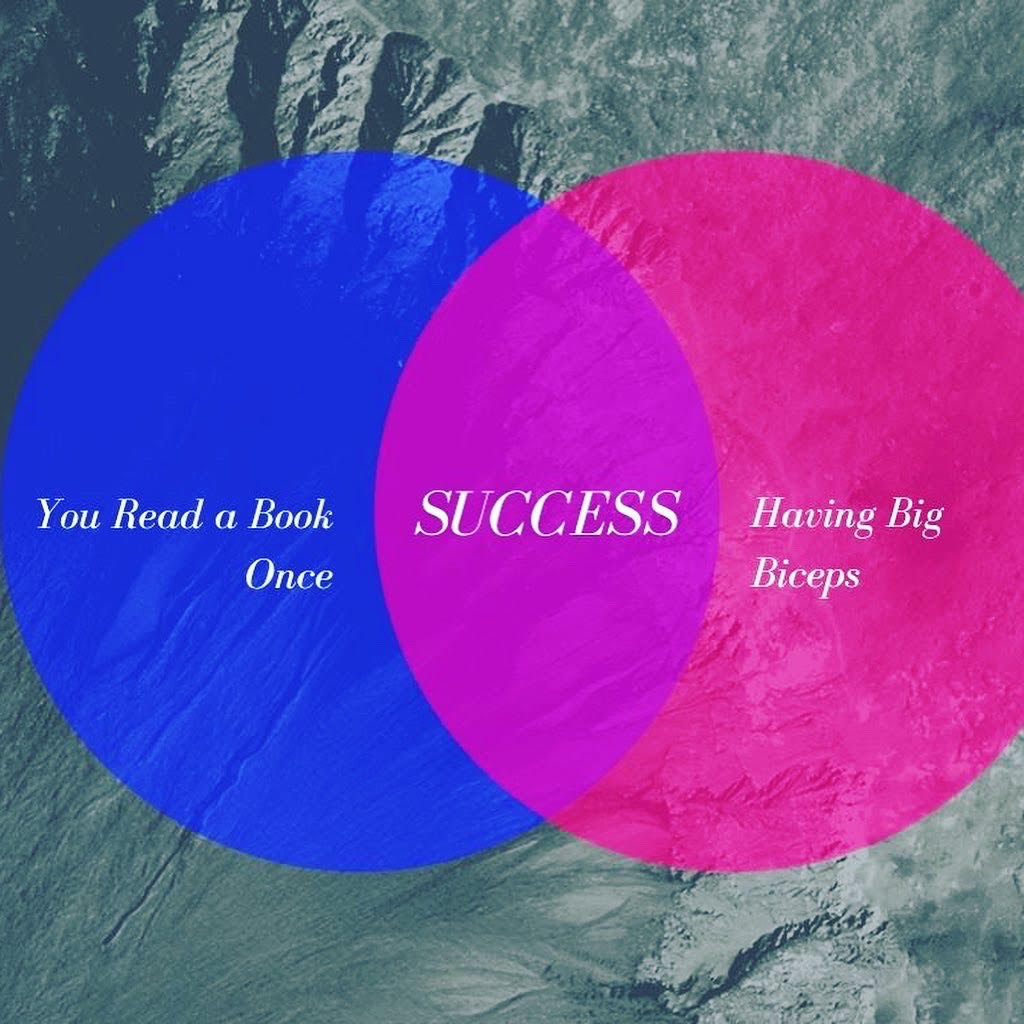
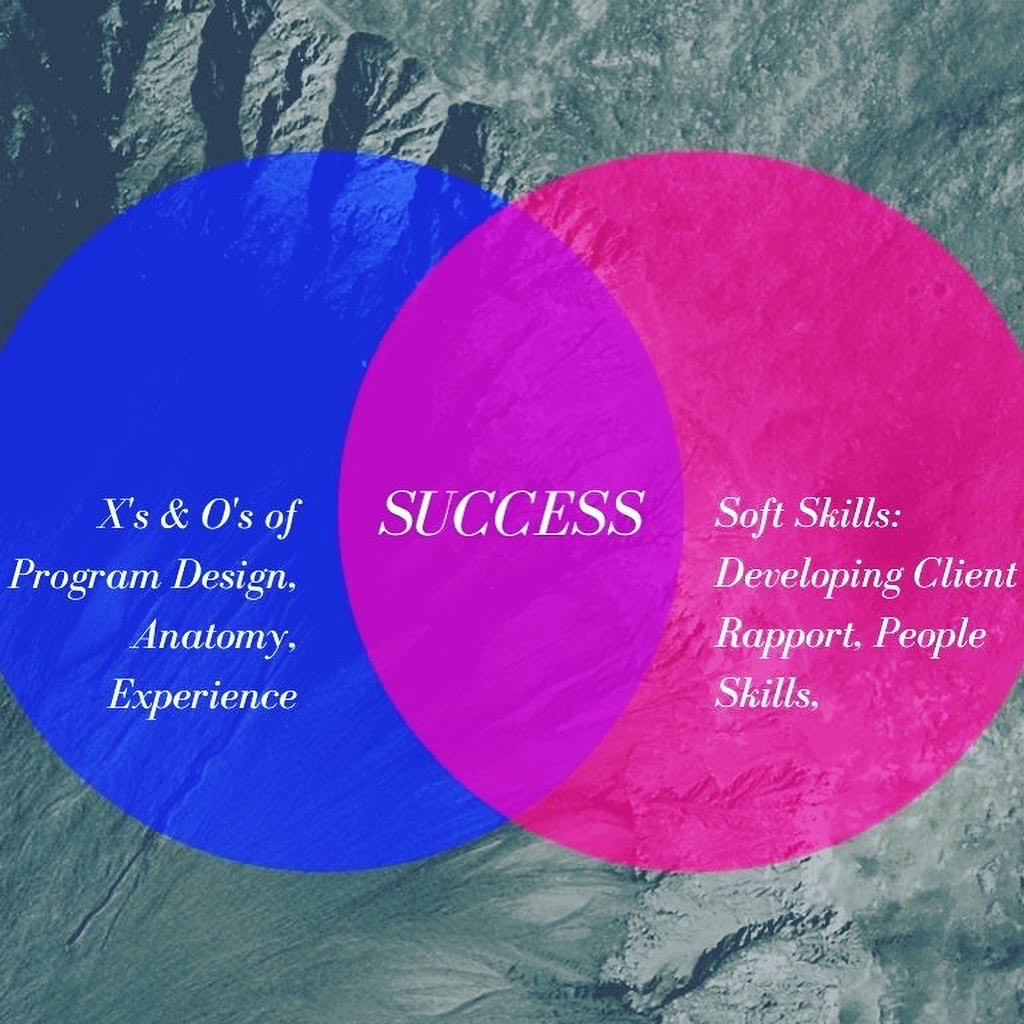
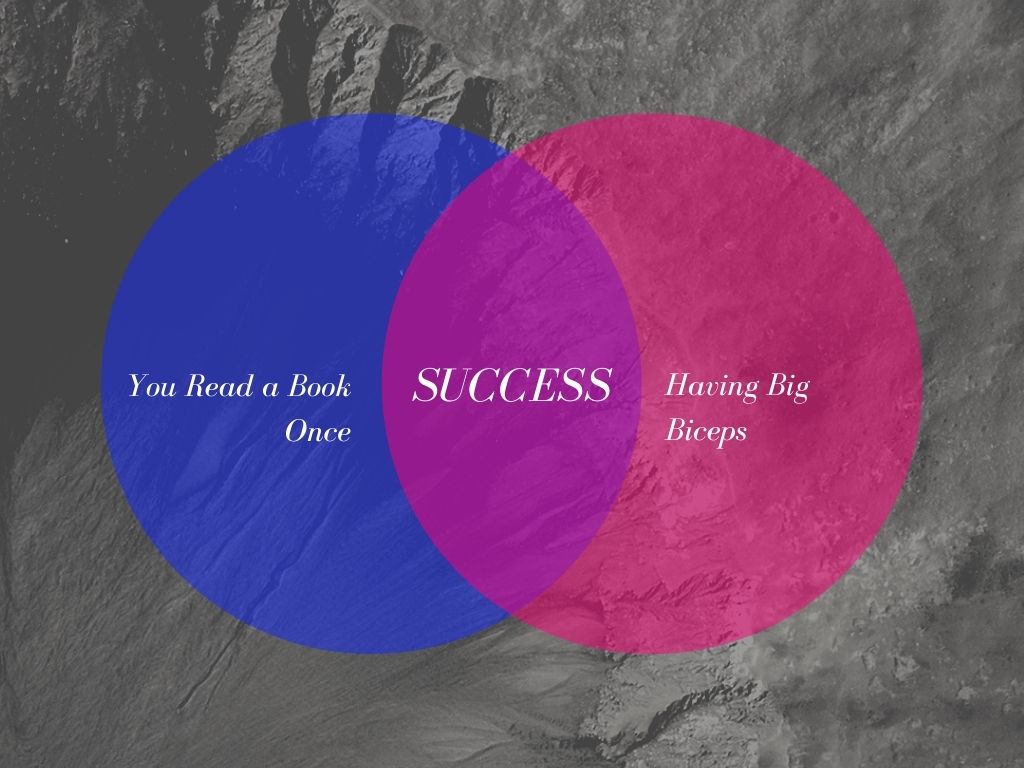
Venn diagrams can be a very useful tool to help illustrate the relationships amongst a finite group of things. Circles that overlap have a commonality while circles that don’t overlap do not share those traits.
Let’s use the fitness industry as an example.
“Success” as a fitness professional can be broken down like this:
LOL – Just kidding.
It’s actually more like this (overly simplified, of course, for brevity’s sake):
There’s no shortage of resources out there highlighting the stuff on the left. It only makes sense that a personal trainer knows how to coach a squat or that they can differentiate one’s ass from their acetabulum, and there’s an abyss of ways to gather and learn that information.
On the right side, however, things becomes a bit more convoluted. Those things are less talked about and as a result are harder to learn (much less appreciate their importance).
Today’s guest post by Michigan based fitness trainer, Alex McBrairty, highlights the right-hand side. I promise you that if you’re a fitness professional this information is relevant and will undoubtedly help you grow your business.
How the “Friendship Formula” Can Enhance Your Fitness Business
Clients work with coaches who they enjoy being around.
At the end of the day, most clients don’t know the difference between good advice and bad advice, but they can tell the difference between having a good experience or a bad one.
Providing a good experience boils down to being able to connect with your clients.
But do you know how to connect with clients in a meaningful way, one that shows them you care and have their best interests at heart? The purpose of this article is to help you understand the psychological foundations for connecting with others. This process involves more than small talk and having the courage to go out and meet others.
Fortunately, the art of human connection can be broken down into a relatively simple formula.
We’ll call it, “The Friendship Formula.”
There are three core components of this formula: familiarity, likability, and vulnerability. Each component fulfills a particular role, creating a feedback loop that allows the relationship to reinforce and strengthen over time. If you learn how to implement this process like any other system in your business, you can attract and sign more clients, improve retention rates, and build a thriving coaching business helping people.
Familiarity
In 1950, researchers studied the community life of a group of veterans living in the same housing complex [1]. The results they found were surprising. One of the best predictors of closeness between individuals was their physical proximity to one another.
This same effect was repeated in another study completed in 1967 measuring the social interactions and relationships among college freshmen sharing the same dorm. Physical proximity was again a strong predictor of the strength of closeness between students—roommates were most likely to become friends, followed by neighbors immediately next door, then neighbors down the hall, then lastly by neighbors on a separate floor [2].
Proximity Principle
The proximity principle is the idea that mere physical closeness increases interpersonal attraction. In other words, repeated physical exposure to the same people increases the likelihood that you will become friends. This is due in part to the mere exposure effect and the attribution of perceived similarities (more on this in a bit).
Mere Exposure Effect
Another psychological phenomenon that supports the benefit of physical proximity is the mere exposure effect. This states that we tend to prefer things that are more familiar to us.
Think of your favorite comfort foods.
Likely you consumed these foods often as a child, and it is this familiarity that creates your sense of comfort upon re-experiencing them.
Additionally, studies have shown that we even prefer words that we hear more often [3]. If the proximity principle sets you up for increased familiarity, the mere exposure effect comes in for the alley-oop to allow this familiarity to breed into increased positive emotions toward you. Combined, they set the stage for a new connection to blossom.
Christina Abbey, an online fitness coach, understands how to create this proximity and exposure on the gym floor. Whether she’s training clients, performing her own workouts, or just being available to socialize, she makes sure she is visible to other gym patrons.
As Abbey said, “People like what they are familiar with. If they constantly see you crushing your workouts and being a positive motivator to others, you will be the obvious choice when they’re ready to ask for help.”
The first step in creating new connections with other people is to ensure you are being repeatedly exposed to them. Being seen on the gym floor, attending parties and events they might also be attending, participating in similar activities, and being generally as visible as possible leads to this familiarity.
This could also include online visibility—via social media posts and interactions.
Andrew Coates, fitness coach, writer, and host of the “Lift Free and Diet Hard” podcast, is a big supporter of creating this familiarity via a strong social media presence. Coates suggests being consistent on your platform, following and interacting with your followers, and regularly sharing high-value content. Combining those elements creates a sense of “being around,” which can breed that familiarity with you and your work that can draw in potential clients.
Likability
The second component of creating new relationships is establishing likability. People won’t want to be around you, nor give you their money, unless they like you. Being liked is so important, in fact, that Dr. Robert Cialdini identified it as one of the six principles of persuasion in his book, Influence.
Note From Tony: I shoulda included a picture of the book Influence here, but decided on Gizmo instead; one of the most likable creatures ever. EVER!
There are two core concepts important to understanding how to create likability: similarity and reciprocity (another of those persuasion principles).
Perceived and Actual Similarities
The power of the proximity principle lies in our assumptions about others. When we come into frequent contact with the same people, we often assume we have more things in common than that which is immediately evident. These perceived similarities lead to a greater sense of liking.
This occurs for a few reasons.
First, we craft our own self-identity, at least in part, by those we choose to associate with. This is called social identity theory. If we maintain a particular view about who we are as a person, we are more likely to self-select individuals who support that view—people who hold similar interests, personality traits, and world views [5]. We like those similar to us because they prove that we are who we think we are.
The second factor that leads to our favorability toward similar others is that it makes the relationship easier to maintain. When we become friends with individuals who carry wildly different views, or behave in very different ways, it exposes us to a greater likelihood of potential conflict with these individuals.
For example, imagine a trainer who took a drill sergeant approach, and a client who responded best to positive affirmations.
These differences would increase the likelihood of conflicts arising in the future. The coach’s lack of positive regard actively discourages the client instead of giving them the push that the coach expects. Now the coach wrongfully believes the client is unmotivated, and the client believes that the coach simply doesn’t care enough to acknowledge them. Befriending those different from us exposes us to these potential disagreements.
Therefore, if you want to give yourself an edge in establishing bonds with new people, work to identify and reinforce any similarities that might exist. This could include values, hobbies, food preferences, even favorite book genres; the possibilities are endless.
Looking at Coates’ towering figure, you wouldn’t immediately know that he’s an avid fan of fantasy fiction, comic books, and video games. These hobbies allow him to connect with individuals who share those interests, even when they might have little else in common. As Coates put it, loving “nerd culture” before it was cool doesn’t always align with growing up active, so his shared interest in that material allows him to connect better with this audience.
Tony Gentilcore, CSCS, has worked with everyone from powerlifters, figure competitors, moms, CEOs of big companies, and everyone in between. Gentilcore takes a two-tiered approach to finding similarities with his clients.
The first is to focus on the fact that both he and his clients are there to get the best results possible for the client. In other words, they’re both playing for the same team. (This focus on teamwork can also help create shared experiences. More on that in a minute.)
His second strategy is to ask about movies. In fact, Gentilcore includes a question in his intake asking new clients to share their favorite movie. As he says, “It serves as a nice ice-breaker. And on the off-chance that there’s awkward silence at any point during one of their initial sessions, I can always bring it up: ‘So, John, Eyes Wide Shut huh? what’s your favorite scene?’”
Fidelio. Cue awkward silence.
Even if there aren’t any immediately identifiable similarities between you and another person, you can almost always find some sort of shared interest or aspect of your backgrounds if you dig deep enough. Let your natural curiosity take over and explore the interests of others.
Reciprocal Liking
We have an inherent need to both act fairly and be treated fairly. As a result, whenever someone does something for us, be it a favor or giving a gift, we have a tendency to want to repay the giver in kind. Usually this is completed through a favor completed at a later time or a gift given in exchange. This effect also extends to our relationships with others.
When it becomes clear that others like us, we feel compelled to reciprocate by liking them in return [4], a concept referred to as reciprocal liking. Therefore, if you want to create new relationships with others, start by showing your liking toward them. In exchange, they will likely take a more favorable view toward you and be more open to establishing a relationship.
One simple way to create reciprocal liking is to tell your clients explicitly and regularly that you appreciate their business and truly enjoy working with them. This approach has such a big pay-off that it’s astonishing more professionals don’t do it as a consistent part of their practice. (And if you don’t enjoy working with them, you have a different kind of problem and may need to reevaluate what you’re doing on a bigger scale.)
Even if you seemingly have nothing in common during your first interactions (you can’t readily find any similarities), let your curiosity take over.
The best way to demonstrate liking and be interesting is to be interested.
Inquire into their interests and other areas of pride. Ask meaningful questions that allow you to learn more about the individual whom you’d like to create a connection with. Surely, if you are truly curious, you will eventually find something you have in common. You might even create a new shared interest that didn’t exist before.
In fact, this is one of Abbey’s favorite parts of the job:
“It’s a unique experience to not only work with people from all walks of life but to build relationships and connect with them over time.” She admits that sometimes it’s harder to find these similar interests. In these situations, she uses as many clues as she can, “T-shirts can give you a huge insight about what people are into. Places they’ve been, events they attended, or bands they love. If you are really listening, then you’ll likely discover at least one thing you have in common.”
When Mike Doehla, founder of Stronger U Nutrition, started his company, he had no idea about entrepreneurship or running a business. Two of his early clients were involved in multiple businesses in his area, and through them he began to learn more about it.
Because of them, Doehla eventually made the decision to quit his day job and focus on building Stronger U full-time.
I guess you could say that was a good choice, given that Stronger U has now helped tens of thousands of clients across the globe. Doehla’s interest in entrepreneurship remains. He’s gone on to be involved in seven other businesses and constantly reads about the subject. His passion for entrepreneurship started because he wanted to learn more about his clients.
Being regularly visible to and present with those you’d like to befriend increases your familiarity to them, which, in turn, improves your likability and their potential desire to want to connect with you. Building on shared connections and expressing your genuine appreciation for your clients further enhances your likability.
Both of these factors are relatively superficial, however, and while important for initially establishing a relationship, by themselves they are not sufficient to cultivate deeper bonds. For that more enduring connection, you’ll need to create vulnerability in order to develop closeness and trust.
Vulnerability
Vulnerability is defined as a state of being that exposes us to the possibility of being hurt or harmed, either physically or emotionally.
Being vulnerable in a relationship involves sharing our biggest dreams, our deepest fears, our greatest joys and our worst pain. This act of complete openness is often avoided by so many simply because of the risks of this exposure. By giving this information to another person, we give them the power to do us harm.
Yet, while it may seem so hard to be vulnerable with another person—especially someone we don’t know very well—research has shown that this vulnerability is actually the key to creating deep, meaningful relationships with others [6].
The Power of Shared Experiences
Why does vulnerability do such an excellent job of bringing people together into meaningful relationships? At least part of the effect can be explained by concepts presented by Sebastian Junger in his book, Tribe (and his ideas are supported by prevailing research).
The connectedness created through vulnerability is established because we bond best through shared emotional experiences with others, both positive and negative [7,8]. The ability to identify these shared experiences—through the openness created from being vulnerable—is what allows the connectedness of the relationship to solidify.
Mike Doehla knows how important these shared experiences are. In his work, the topic of cancer comes up and causes quite a disruption in clients’ emotional state and focus. As Doehla put it, “The last thing on people’s minds after a cancer diagnosis, or death, is what they’re going to eat. I’m a pretty open dude, so I would share my story often.”
The story he’s referring to is about losing his mom to cancer when he was just 23 years old.
“When I lost my mom, nothing else mattered, especially eating well. I wanted my clients to understand I could relate, and I knew what was most important in that moment. And it wasn’t the food. It was the family and the feelings. In these situations, I would always make sure people knew I was here and I did not expect perfection of any kind. I was just a shoulder they could lean on who could help minimize extra stressors if they needed it.”
Gentilcore is unbashful when it comes to discussing his personal journey with mental health and how he still routinely speaks to a therapist on a monthly basis. He sees how society prides itself in our ability to bottle up and compartmentalize our thoughts and feelings, and his openness can sometimes take clients by surprise.
“I often bring up my past bouts with depression with clients (when appropriate), if for no other reason than to emphasize how helpful it was for me that I started seeing a therapist. My thought is that if I am open about my experiences, then maybe it’ll be enough of a nudge to encourage a client of mine to seek out help if he or she needs it.”
Not only does sharing their stories create a shared emotional experience between each of these trainers and their respective clients, but their clients likely feel heard and validated, too—the opposite of being judged. When you can express your humanity, your clients will feel valued and cared for.
There is no better customer service strategy.
Empathetic Balance
While vulnerability appears to be the most important factor in creating closeness with others, proper judgment should be used when deciding when it is appropriate to share these experiences and feelings. Creating shared experiences allows us to empathize with others—the ability to feel the emotions they feel.
This means we can feel the positive emotions expressed by others, but it also means we will experience the negative emotions, too. If you are overly sharing your negative experiences and feelings with others, it can have the opposite intended effect by causing others to avoid future social interactions with you because they don’t want to be drawn into your negative energy.
If you are constantly “dampening the mood,” others will seek to avoid your company.
Think about what happens when a client upsets this balance with their constant negativity. Abbey and Coates agree that if this negativity becomes too great, the best course of action is to refer out or otherwise get rid of the client. Doing so can protect your energy and allow you to be more positive toward the other clients in your care.
Imagine if the situation were reversed?
A trainer who brings too much negativity is going to repel clients.
It is important, then, to not only use vulnerability as a tool to deepen relationships, but also to balance negative openness with positive openness—sharing your dreams, aspirations, and joyful experiences in addition to your fears and bad experiences.
Strategic Vulnerability
When considering when to create these shared experiences using vulnerability, remember the two most important factors: relevancy and empathetic balance.
You should share moments of vulnerability as they become relevant to the conversation, seeking to balance positive and negative experiences. Additionally, make sure the conversation remains directed to your client.
Disordered eating is something that most people never seek professional help for. Knowing this, as soon as Abbey’s clients begin to show signs of disordered eating, she uses that moment to open up about her own struggles with disordered eating.
Her goal in sharing her experience is first to let them know that they are not alone and shouldn’t feel ashamed.
Additionally, it’s to help them feel validated and encouraged to seek help from a registered dietician as well as support from people they trust. Opening up about her own struggles is a very personal subject, but it opens the door to creating deep bonds with many of her clients.
It takes a certain level of bravery to open yourself up to someone else.
Your client may not always be the first to share.
You may find yourself being vulnerable without an immediate return of vulnerability from the other person. This is normal and may just mean they need more time to feel comfortable. Fortunately, this doesn’t necessarily mean your openness was in vain. Once you’ve experienced your first offering of vulnerability, you have introduced a newer, stronger level of familiarity—which will breed greater likability and future moments of vulnerability.
Bringing It All Together
You now have the tools to better connect with current and future clients. Yet, there is one imperative piece of the puzzle missing that you must supply: a genuine interest in wanting to connect with others.
Most people are very aware when someone is being fake, and faking any of these steps can lead to disaster. You must be genuinely curious about others and want to make a connection with them in a real, authentic way.
Also consider that once a connection is established, it requires work to maintain. You must continually traverse this loop so long as you want to prevent the relationship from going stale.
Think of close childhood friends whom you no longer visit frequently. You’ve likely been very familiar, liked, and vulnerable with them during periods of your life. Now that you’ve grown apart, the relationship is not as close as it once was. This can happen to any relationship, even those with the closest of friends and loved ones, let alone your clients, without the proper care and attention it deserves.
You can use this formula again and again to reach and connect with more people. With this knowledge, you are better prepared to build new relationships to boost your client roster and retention rates. Building strong relationships will inevitably lead to greater success in your business.
About the Author
Alex McBrairty is an online fitness coach who owns A-Team Fitness in Ann Arbor, Michigan. Obese as a child and teenager, he blends fitness and psychology to help his clients discover their own hidden potential.
He has a bachelor’s degree in psychology from the University of Michigan and is certified by the National Academy of Sports Medicine.
His articles have appeared in Breaking Muscle and The Personal Trainer Development Center, and he’s contributed to Muscle & Fitness, USA Today, Men’s Fitness, and Prevention.
Do you exhibit a hip/weight shift (swaying to the left or right) when you perform a squat? It’s one of the more annoying things that can happen in the weight-room.
It ranks somewhere in between people who don’t re-rack their weights and kipping pull-ups.
Admittedly, it’s rather common and almost always a benign occurrence; most people never even notice it unless they’re routinely filming their squat sessions.
And when that is the case, I can understand someone’s “itch” to want to solve the conundrum. I mean, things could go awry down the road and manifest into pesky hip or knees issues.
A Case Study: How to Address a Hip Shift During the Squat
I received the following email earlier this week:
“I was looking to see if I might be able to send you some videos for a squat assessment. I have been having issues leaning to my right for some time and cannot for the life of me figure out what is causing the issue. I’ve followed you for years and trust your judgement!”
I responded back with a “sure, I can take a quick look,” and in swift fashion I got this in return:
“Some initial feedback would be great.
Some things to note before watching:
Though subtle, I find my left hip lower than my right on both the descent and ascent of the squat (as you can probably see).
My right hip flexor/quad tends to be tighter than my left usually.
My left glute has always been tighter than my right
History of SI joint hypermobility (in the past) but has not caused me issues for over a year. I used to have issues with my sacrum shifting around and causing misaligned hips which was quite painful.
I do not have any pain barbell squatting or semi sumo deadlifting but I do feel the unevenness when I squat especially.”
https://www.youtube.com/watch?v=-OGaW1JmADw
For Starters
That’s a pretty good lookin squat if you ask me.
After reading her “heads up” commentary before watching the video I was half expecting a dumpster fire when I pressed play.
Au contraire – all things considered, that’s a very passable squat.
However, given her past injury history, her own words of feeling the “unevenness,” not to mention you can see a subtle weight shift to the right with each repetition, I had some thoughts.
It’s funny, I perused my blog archives to see whether or not I had written on this topic in the past, and as it happens I did!
Back in 2015 I wrote THIS post where I discussed the idea “feeding the dysfunction,” a concept taken straight from renowned physical therapists (and creators of the Functional Movement Screen), Gray Cook and Lee Burton.
The gist goes like this:
You see a weight shift, say, to the right. In this scenario you grab a band and wrap it around the individual’s waist and as he or she squats, you pull the band in the direction of the shift, essentially “feeding the dysfunction.” The idea is that reactive neuromuscular training (RNT) trains the nervous system to recognize a faulty movement and to encourage body to correct course.
In the broader consciousness of health/fitness it’s an okay approach. It 100% works. In the years since writing that blog post, however, I’ve gone out of my way to reduce my use of the word “dysfunction” with clients. I don’t like the connotation the word breeds; that the individual is in some way broken or needs fixing.
Some people hear or see the word dysfunction and they’re ordering an exorcism.
Myself?
I hear or see dysfunction and I think “well, outside of extenuating circumstances (past/current injury history, whether or not there’s pain present), it’s fairly normal.”
Everyone is a bit different and moves in different ways. What’s more, there are, what, seven billion people on this planet currently? Is the expectation that everyone, everywhere, in the history of ever, is going to squat (or move) the same exact way?
Okay, Tony, We Get It, Personal Growth, Blah Blah, Blah…WTF Did You Tell Lisa To Do?
This, I said this:
“I totally see what you’re saying when you say your left side is lower than your right. I don’t think we need to get too far into the weeds as to whether or not that “needs” to be corrected (or even if it’s bad).
While slight, the hip shift IS there, and I think there are one of two things you can try”
1) Lean Into the Asymmetry
(NOTE: I actually wrote my thoughts on asymmetry HERE a few years ago).
I asked her to externally rotate (open up) her right foot more and to take note whether or not that improved her weight shift?
If so, there’s her answer.
People are built differently and what this would suggest is that her right hip socket is likely more retroverted compared to her left and that that side requires a bit more ER.
For many, using a “symmetrical” stance is akin to attempting to fit a square peg into a round hole. We don’t live in textbooks, so we shouldn’t train like it either.
She tried it and (no surprise to me) saw an improvement:
https://www.youtube.com/watch?v=CcKlqEkC8EI
But Tony, Won’t Having Her Squat With An Asymmetrical Stance Lead to More Issues Later? What’s Next: Telling Her to Club a Baby Seal? No, Wait, To Go Keto?
Relax.
I truly don’t feel having someone perform a handful of sets with an asymmetrical stance is going to cause irreparable harm. I mean, I’d make the case that forcing symmetry is leading to more issues. Besides, if a certain stance feels better, feels more secure, stable, and powerful…why wouldn’t we want to lean into that?
Furthermore, the human body is a bit more resilient than that. If it can survive plagues, saber-toothed tigers, and Michael Bay Transformer movies, it can withstand a few sets of asymmetrical squats.
Further furthermore, this is why we use things such as single leg work to help fill in the gaps. There’s a reason why we write well-rounded training PROGRAMS. You know, to address stuff.
So anyway, moving her foot out a bit seemed to have solved the issue. This strategy will work for most people, but what happens when it doesn’t?
2) Listen to Katie St. Claire
This scenario reminded me of something my colleague, Katie St. Claire, discussed last year. She showed a video of one of her clients who also had a hip shift to the right on her squat.
Katie recommended the woman perform 15 hip bridges (off the wall) on her LEFT side only.
Now, why the LEFT side only in order to fix a RIGHT sided issue?
“To allow more posterior rotation and nutation on the left side so she can load the right side correctly.”
In non-Elvish, as you squat down into deeper hip flexion (most often in Stage 2: 60-120 degrees of hip flexion), the inability for the LEFT side to internally rotate and compress essentially “pushes” you to the right.
I don’t know, maybe that still sounds confusing.
Try this: Whatever side you shift to, perform a boat-load of bridges on the OPPOSITE side. Chances are you will see an improvement.
Cool?
Cool.
Give both options a try and see if one of them solves the issue.
As this post goes live, I am on a plane on my way back to Boston.
It’s sad leaving Florida…especially given how scorching hot the rest of the country is at the moment (100-115 degrees on BOTH coasts).
It’s quite ironic that, of all places, Florida has arguably the best weather in the country right now given we’re entering the heart of the summer. I mean, I’d have put my bets on the inside of a live volcano being a better place to be at this point in the year.
Nevertheless, weather notwithstanding, my good friend and colleague, Shane McLean, came through and delivered a sweet guest post for me to post during my travel day.
You can pair almost any exercise together to build muscle, lose fat or bring up body parts that are lagging behind. Plus, you’ll do more work in less time and hit the showers early while the Instagram stars are still taking their selfies. Don’t you love how they hog all the mirror space?
If supersets are NOT a part of your routine, you’re truly missing out.
And you don’t want to miss out, do you?
Here is the lowdown on supersets and why they should be a part of your training.
Advantages Of Supersets
Increase the efficiency of your training because you’re reducing the rest intervals between exercises. Making sure you have all the equipment you need beforehand works best
Having reduced rest periods will increase intensity of your training by performing more work in less time.
Increased fat loss potential because the shorter rest periods between exercises and back to back contractions in supersets can help promote an additional stimulus for fat loss.
Increased fat loss because of the reasons above when you use it in combination with a caloric deficit.
Tony contemplating performing a superset
However, supersets are not great for every goal.
Disadvantages Of Supersets
The increase in intensity can lead to a drop off in exercise performance and technique. This may lead to injury.
It’s difficult to juggle different weights for different exercises. Monopolizing the equipment in a busy gym may lead you to be the unpopular person who hoards the dumbbells.
As good as the they are for hypertrophy and fat loss, they’re not the most ideal way to build strength because you cannot go as heavy and the limited rest between exercises compromises recovery.
They’re difficult for beginners when they’re unfamiliar with both movements which lengthens the learning curve and may lead to injury.
5 Superset Types With Training Examples
The types of supersets you use depend on your current goals, whether it be fat loss, hypertrophy or bringing up a lagging body part. And it also depends on whether you’re a beginner or advanced trainee, and on how much time you must train or how much pain you’re willing to stand.
Here are five superset types that you can use now to take your training to the next level.
1. Post and Pre-Exhaustion Supersets
These take muscle discomfort to a new level.
With post exhaustion you combine a compound exercise with an isolation exercise afterwards to exhaust all the muscle fibers in a certain muscle group. This way you get the greatest strength benefits from the compound movement.
A pre exhaustion superset is the single joint movement that is done before the compound exercise. This produces a higher level of muscle fatigue and damage to the targeted muscle group.
Both are great for bringing up a lagging body part. However, make sure the compound move trains the muscle you’re going to isolate.
Post Exhaustion Superset Examples
1. Quads
1A. Squat variation 6-12 reps
1B. Leg extensions 12-20 reps
2. Hamstrings
1A. Hip hinge variation
1B. Stability ball hamstring curl 12-15 reps
3. Biceps
1A. Chin up variation 6-12 reps
1B. Zottaman curl 10-15 reps
4. Triceps
1A. Push -Up variation 8-15 reps
1B. Overhead triceps extensions 12-20 reps
Pre-Exhaustion Supersets Examples
5. Biceps
1A. Barbell biceps curl 8-15 reps
1B. Supinated Lat Pulldown 8-12 reps
6. Hamstrings/Glutes
1A. Seated Leg curl 8-15 reps
1B. Barbell Hip thrust 6-12 reps
7. Triceps
1A. Triceps push down 8-15 reps
1B. Single arm floor press 6-12 reps
8. Shoulders
1A. Dumbbell front raise 8-15 reps
1B. Dumbbell seated overhead press 6-12 reps
2. Compound Supersets
A compound set trains the same muscle group, where you can hit the group from different angles to achieve more muscular tension.
This is a time-efficient way to train for hypertrophy of a muscle group, if you can stand the pain. And for this reason, these should be at the start of your training when you have the most energy.
However, this is an advanced method because heavier weights are used in both exercises on the same body part which can lead to muscular fatigue and drop in performance and technique.
For example,
1. Chest
1A. Barbell bench variation 6-8 reps
1B. Single arm floor press 8-12 reps
2. Back
1A. Seated row 8-12 reps
1B. Single arm lat pulldown 12-15 reps
3. Legs- squat focus
1A. Barbell Front squat 4-8 reps
1B. Dumbbell jump squats (use 10-25% of your body weight) 3-6 reps
4. Legs- Hinge focus
1A. Romanian deadlift 8-12 reps
1B. Barbell hip extensions 6-8 reps
3. Isolation Supersets
You can save time because you’re working a smaller muscle group in the same amount of time as one exercise and all the focus is on the one muscle, helping you feel the burn and for flex appeal
These are great for bringing up a lagging body part or a weaker muscle that could be hindering your performance in a compound exercise. For example, weaker triceps hindering lockout in the bench press.
These supersets are best done at the end of your training because you’ll want to save your energy for the larger compound movements.
1. Biceps
1A. Incline biceps curl 12-25 reps
1B. Concentration curl 12-25 reps
2. Shoulders
1A. Dumbbell lateral raise variation 12-15 reps
1B. Band pull aparts (high reps) 25 reps
3. Triceps
1A. Triceps (rope) pulldown 12-25 reps
1B. Skull crushers 8-12 reps
4. Glutes
1A. Single leg hip extensions 12-15 reps
1B. Lateral band walk 12-15 reps on each side
4. Lower/Upper Body Supersets
This is the least taxing of all the techniques listed so far because you’re working two completely unrelated muscle groups. These are great for full rest and recovery of a muscle group and for full body workouts when time is an issue.
They’re best used for full body workouts or full body splits and are ideal for beginner trainees. However, if strength is your goal, give these a wide berth.
And they’re great for fat loss because alternating blood flow between your upper and lower body makes the heart and lungs work harder, helping you burn more calories.
Note – There are lots of examples here. This is only a few suggestions.
For example:
1A. Squat variation 8-12 reps
1B. Barbell bench press 8-12 reps
1A. Barbell squat variation 6-12 reps
1B. Chin ups 6-12 reps
1A. Barbell hip thrust 6- 8 reps
1B. Floor press 6- 8 reps
1A. Barbell push press 6-12 reps
1B. Chin ups 6-12 reps
5. Strength/Mobility Supersets
A strength exercise done for heavier weights combined with a mobility exercise will help improve your exercise technique and recovery when strength is your focus.
Let’s say you’re having a little knee discomfort with the squat and your knees are going excessively over the toes. Plus, it is hindering your squat depth and you’re not strengthening all parts of the movement.
Don’t go into corrective exercise purgatory, pairing an ankle mobility exercise with your squat may help solve this problem. And you can follow this logic with all strength exercises that need mobility.
Note – This is just one method you can use when a strength move causes you discomfort.
For example,
1A. Deadlift variation 3-6 reps
1B. Hip flexor mobilization 8 reps
1A. Shoulder press variation 8-12 reps
1B. Forearm wall slides 8 reps
1A. Barbell squat variation 3-6 reps
1B. Rocking ankle mobilization 8 reps
1A. Barbell bench press 3-6 reps
1B. Thoracic extensions 8 reps
Wrapping Up
Supersets are an efficient way to train and are used in many ways to match your goals. Pair exercises wisely for great results and more flex appeal.
Make it #flexfriday every day.
About the Author
Shane “Balance Guy’ McLean” is an A.C.E Certified Personal Trainer working deep in the heart of Louisiana with the gators.
About a two weeks ago I received an email from a newly minted trainer in the industry who had read THIS article on program design I wrote not too long ago.
Sheepishly, he admitted that program design was one of his weak points and that he felt he was ill-prepared to write effective one’s despite having recently completed the certification process.
I could relate.
I recalled how in the first few months of my personal training career I felt like an abject failure when it came to writing programs for my clients.
Here’s how it went:
Client: “Hi.”
Me: “Hi.”
Client: “Can you write me a program to help me reach my goals?”
Me: “Brb.”
(cooly turns around and heads off to the back room to hyperventilate into a paper bag)
(10 Minutes Later) Me: “Yes, I can do that.”
In the time between those initial few months and now I’ve written roughly, I don’t know, 5,000-7,000 (+/- infinity) programs for a menagerie of individuals and backgrounds. Many have been influenced by books I’ve read, lectures I’ve listened to, and/or conversations I’ve had with other colleagues of mine.
Moreover, many have their roots in me just spit-balling and experimenting with an idea of concept. There’s a thought process behind them of course; I’m not just blindly tossing things at the wall and seeing what sticks.
However, I’d be remiss if I didn’t just come right out and say that a portion of my program writing process is me just saying to myself, “let’s see what happens if I do this.”
No one has died or lost an appendage yet…😉
More to the point: I’ll be the first to say that NONE of my programs have been perfect. Even today I am constantly x’ing stuff out, changing this exercise to that, adjusting loads, regressing, progressing, or otherwise flat out changing my mind.
Sometimes I’m overzealous, sometimes I’m too reserved.
Sometimes I’m wrong.
I’m not scared to admit it.
Nevertheless, the point is: I am always leaning into the process and accepting the fact that I am (and will always be) thiiiiiiis close to grabbing that paper bag.
Which brings me back to the new trainer from above.
As he and I were corresponding back and forth he proposed something to me. He wanted to see if I could help him find another coach to mentor him and to possibly write programs for a few of his current clients.
He’d provide the details.
The other coach would write the program
Then he’d want to “dissect” the program with the other coach to ask more of the why’s and how’s behind the program.
I gave him two pieces of advice:
1. To seek out a local trainer/coach that he could shadow/observe on a semi-regular basis. This is something I wish I would have done earlier in my career.
It would have helped tremendously.
There’s an abyss of value in having the ability to watch another coach in real-time do his or her thing and to also have the opportunity to ask questions.
I reminded him that he won’t write perfect programs. That’s an awful expectation to put on himself. I reiterated to him that his client’s wouldn’t need “perfect” programs, but rather just some semblance of progress.
Let’s be real: Most people see improvements in spite of what their program has them doing.
It’s more about being consistent with something, anything than it is whether or not they’re following an undulated, block periodization plan centered around quasi-isometric eccentrics.
If you’re a new trainer the best way to learn how to write programs is to jump in and do it.
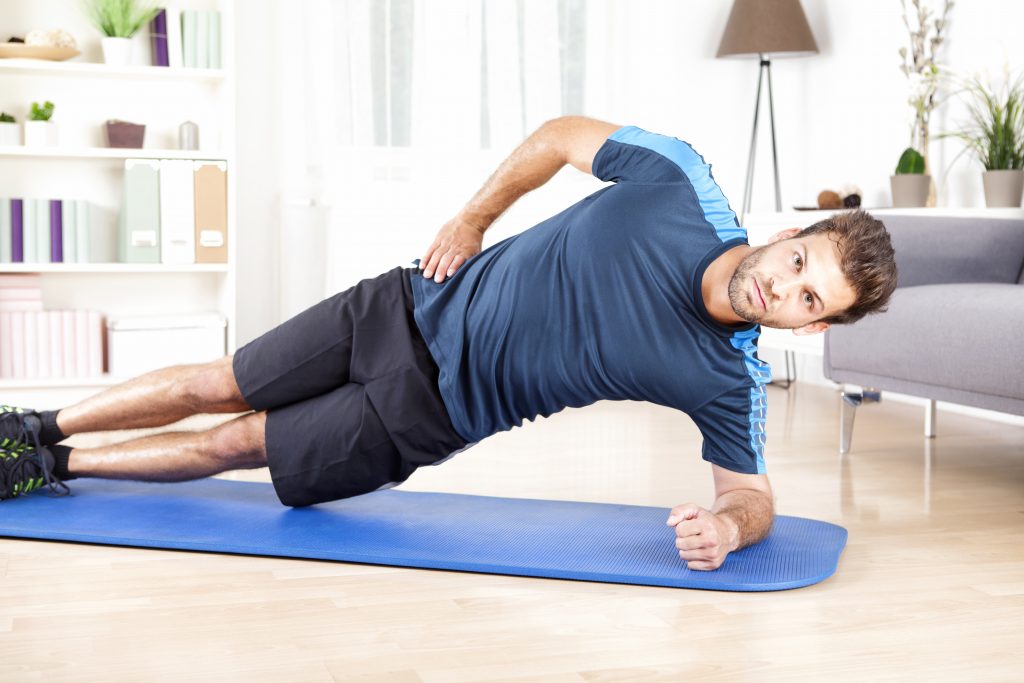
Truth be told: It’s a rare occurrence that I start working with someone and (s)he can perform it well. It’s a staple exercise with myriad benefits in both rehab and traditional strength training to target the core musculature – particularly the obliques.
Too, it’s also no coincidence, thanks to Dr. Stuart McGill, it’s considered one of the “Big 3” with regards to spinal health and working around and managing low-back pain.
When done correctly, the side plank can be a very challenging and worthwhile exercise to include in most programs.
Check out THIS article for particulars on common mistakes and how to progress the side plank.
Check out THIS article for other plank variations you should consider.
I find the side plank to be the exercise of choice for lazy trainers. It’s the sort of exercise a shitty trainer will prescribe for their client when there’s 5-10 minutes left in a session and the trainer just wants to run out the clock.
“Okay Hank, we’re going to finish with Side Planks today. Three minute holds per side. Blindfolded. While reciting the Elvish alphabet backwards. Go!”
And then, of course, Hank loses all the perceived benefits of the exercise because his technique has been compromised after 15 seconds.
“Come on Hank, 2 more minutes, keep reciting, Ampa, Anto, Hwesta…”
To be clear: I think everyone should take the time to master the side plank. It’s an important drill. It’s just that after a certain point there’s a rate of diminishing returns.
Personally, if someone can perform it perfectly for a minute per side I’d rather go a head and make the exercise more challenging than force someone to go for longer periods of time.
More to the point, can I just go a head and say it?
The Side Plank is just a boring exercise.
I’d rather spend the same amount of time scooping up my cat’s fur vomit.
To that end, here are two exercises that mirror all the benefits of the Side Plank but don’t make you want to commit seppuku when you actually do them.
1. Chaos March
Take a kettebell and wrap a band around one end. Grab onto the other end and hold it to your side as if you were holding a suitcase.
While maintaining a completely upright posture (no leaning!) march in place and try to keep the kettlebell “quiet.”
Also: In case it wasn’t obvious by lurking at my bookcase in the background: My kid loves puzzles.
Today’s guest post comes courtesy of Virginia based personal trainer, Detric Smith. In case the title doesn’t give it away, there’a a bevy of sage advice below geared toward fitness professionals on common things that can (not always) derail career advancement.
HINT: Not listed: Male pattern baldness and big biceps…;o)
This is a great read and I hope it helps any personal trainers out there reading.
Welcome to an industry where trainers with an overnight certification or with a few shirtless posts on Instagram can take clients and money away from you. Even if it’s unfair, there’s not much you can do about it except rise above the trainers who only care about one thing.
Those who lack the dedication, knowledge and true passion for personal training will likely fall by the wayside while you’ll be still putting in the work to make a good living. But some of you have the potential to be great and need a little direction in becoming a career trainer.
A career trainer must do their job with a purpose of changing lives because this allows you to stay in the game. You must be able to put aside all the distractions, long hours, and temporary setbacks.
No one would blame you for falling for one of these 8 traps because easy money is almost always enticing. However, if you want a lifelong career as a personal trainer, read on to learn how to avoid these 8 potential career pitfalls.
Trap #1: Getting Promoted Too Soon
Is it too good to be true to become a gym manager or personal training supervisor within your first year of employment? Financially, it might be the best option for you.
But are you really prepared?
Getting promoted before you’ve had a chance to learn from your mistakes and mentors may derail your career. Because if you aspire to make fitness a profitable career you need to spend years on the floor, interacting with clients and perfecting the art of coaching.
This doesn’t mean turning down a promotion if you’re doing great things. But if you do get promoted, continue to train people, and do the smallest of jobs. The best business owners understand their customers by investing their time into what matters, which are listening, coaching and problem solving.
Trap #2: Confusing IG and FB Likes With Success
No one’s arguing Instagram and Facebook are outstanding marketing tools. But they’re just tools and not a means to make a sustainable income. You don’t own or control the platforms and have no control if you’re kicked off or not.
If that happens, then what?
Even if you have enough likes to make money off IG and FB, it could be taken away from you in a heartbeat.
For career trainers, judging your success by social media likes is a huge trap. Instead, focus on turning those likes into real-life clients by getting their emails, interacting with them via DMs or your stories and trying to help solve their problem.
Trap #3: Neglecting Continuing Education
Graduation and getting a certification doesn’t mean you know everything because you’re a newbie.
This industry is constantly changing, and your market is constantly changing also. The people I trained ten years ago are different than the ones I train now. Physiology is important, but no one cares about the Krebs cycle. They only care about losing their love handles.
You know, in case you’re ever short on dinner conversation
Don’t know what’s left to learn?
Study business management, psychology, finance, the art of coaching… anything.
Hell, dive into the history of welding if you want to. Learning new things keeps you excited, challenges your brain, and helps you become a more creative and compassionate coach.
Trap #4: Unrealistic Income Expectations
Remember, you want to be a career trainer, not a part-time trainer. No one gets an undergrad or certification and instantly becomes a “trainer to the stars”, pulling in millions a year. It took Ben Bruno many years of training under Mike Boyle before he trained the likes of Justin Timberlake and Chelsea Handler.
You’re going to invest lots of time, effort, and probably your own money into your business for a long time before you’re turning any real profit. You’ll likely be working 12+ hour days, with a lot of hours early in the morning and late in the evening.
And you may need a second job to make ends meet.
If you’re not prepared for this, you have been warned. However, if you love what you do and embrace the grind, you will be rewarded. You’ll be able to work for yourself and create your own hours. Plus, you will be making real money but only if you prove your worth first.
Trap # 5: Targeting The “Wrong” Market
Some newbie trainers want to train athletes and people who look like them. 20-somethings who are already in relatively good shape and have tons of options, and quite frankly don’t really need you. The reality is you need to be training everyone who walks in the door until you figure out who you like to train.
These are typically general population clients between the ages of 30-70 who have the time and disposable income money to pay for your services. Make yourself different by being better than the other trainers who ignore them.
Then educate these clients about how you can make a huge difference in their lives.
Trap #6: Sacrificing the Truth For Quick Cash
Sure, you might get someone in for one or two sessions through a flashy ad making promises you cannot keep. But is this long-term strategy for success or a great way to shoot yourself in the foot?
Making a sale is about finding a problem you can solve and then solving it.
Understand and listen to the story they’re telling themselves because it’s possible they aren’t fully aware of their own problems.
Dig deep, create a connection, and try to find their why.
Once you‘ve connected with them, answer their objections, and show them you’re invested in them. When you get this right, the money won’t be a factor, and they’ll stay with you long-term.
Take the time to intern, get a good mentor and gather as much experience as you can.
Know when you don’t know, and don’t be a fraud. Honestly, telling someone “I don’t know, but I’ll find out for you or connect you to someone who does” puts you in a position of trust.
People make buying decisions, especially with their health, based on trust. Even if you lose a client today, you’ll gain five down the road by earning trust while expanding your expertise in the meantime.
After gaining invaluable experience, study business, and build your product. This is your career, after all, not some side gig. Learn from the best about how to grow your personal training business.
Trap #8: Following The Crowd
Everyone is doing it, so I should too.
Didn’t your mom tackle this issue with the “if your friends jumped off a bridge…” question?
I know you think that’s where the money is but it’s a trap. The money might be there short-term, but the long-term is a different matter. Unless you originated something, studied it for decades, and you’re a top name on a topic, you won’t stand out from the crowd.
Instead, go in the opposite direction. Do what no one else is doing because I’ll guarantee you there’s a market somewhere that’s being ignored. Maybe it’s the over-50 crowd who want a safe, effective, team-oriented group training session where they get personal attention. And when you find them, go all in.
Wrapping Up
I’ve been a trainer for 20 years and I’ve seen excitement and trends come and go. You do not want to be a one trick pony in this industry if you’re interested in a long-term career. Invest time in yourself, your career, and in the right clientele, and you might just crush it.
About the Author
Detric Smith, CSCS, ACSM EP-C, PN-1 is the owner of Results Performance Training in Williamsburg, Virginia. He has over two decades of experience as a personal trainer and sports performance coach.
He develops personal trainers through his site DetricSmith.com, and serves as a mentor through various fitness organizations.
I’ve worked with myriad of clients ranging from professional athletes to young athletes to people just looking to increase their general levels of badassery.
I’ve enjoyed the bulk of people I have worked and interacted with over the years. The vast majority I’d label as splendid and lovely individuals whom I’d name my second born after.6
Except for these five…
5 Things I Learned From My Most Difficult Personal Training Clients
1. Mrs. Vague
2. Mr. Late
3. Mrs. Bulk-a-Phobic
4. Mr. Complainer
5. Dr. Clueless
Who are they? What are they? How did I deal with them? Did I “fire” them? Send them to time out? What gives?
Find out in my latest article for the Personal Trainer Development Center – HERE.