CategoriesExercise Technique

Passive vs. Active Foot For Squatting Performance

There’s a lot to think about and that can (potentially) go wrong when you have a barbell on your back.

Photo Credit: Elitefts.com (Julia Ladewski)

Is it better to high-bar squat or low-bar squat?

Big air!

Are my lats engaged? Where are my elbows positioned?

Head position?

On the descent is it hips back or knees forward? (Hint: it’s both).

Are my knees out? Too far out? Or are they caving in?

What about out of the hole: am I maintaining tension, is my core braced, am I leaning too far forward?

Am I getting my hips through at the top?

Shit, did I forget to turn my stove off before I left my apartment?

Goddammit, I totally forgot to pack my protein shake. I’m totally going to lose all my gainz after this workout.

Last episode of The Walking Dead was amazeballs.

Did I get deep enough on that set?

Basically, Squatting Can Be a Mindf*** of Epic Proportions.

What works for one person, may be a disaster for someone else….and there really is no such thing as one right way to squat. Different people are different. Anthropometry, leverages, training goals, and injury history will have an effect on how one person squats compared to the next.

That said: you should pay close(r) attention to detail when squatting. Far too often I see people approach the bar with a nonchalant attitude with nonchalant technique, and not surprisingly they have nonchalant numbers to show for it.

If gym goers put as much effort into improving their squat technique as they did perfecting their “selfie” taking in the locker room or trolling fitness message boards to argue macros we’d probably have many more stronger, leaner, and happier people.

And less douchebags.

However, even for those who consider themselves more of a connoisseur there’s one component to squatting that’s often overlooked or dismissed altogether. And I’d argue it’s one of the most important.

Tripod Stance.

…….or recognizing the difference between a passive foot and active foot.

This is something I “stole” from Chad Wesley Smith of Juggernaut Training a few weekends ago while attending his powerlifting workshop here in Boston.

I’ve always known about tripod stance, and have always incorporated it into how I coach squats with my athletes and clients. However, I never heard the idea described in the same fashion as how Chad described it. And that’s what I wanted to share today.

Passive vs. Active Foot

A Few Things to Consider

1. I’d recommend taking your shoes off to really get a “feel” for what’s described in the video. There’s really no other way to get a firmer grasp of the concept and to get the tactile/proprioceptive feedback than to take those cement blocks you call shoes off.

And yes, this means you too psycho minimalist, I-read-Born-to-Run-and-wear-my-Vibrams-everywhere-I-go-and-make-sure-to-tell-everyone-about-it guy.

2. I look, like, way more intelligent when I wear my glasses.

3. Don’t misinterpret my mentioning of “knees out” when cueing the squat. Telling someone to push their knees out is one thing (and correct), but it’s another thing altogether to tell them to push out so far that they end up on the outer edges of their feet.

4. Practice barefoot with bodyweight only. From there you can put your shoes on and try to get the same pressure points, and then add the barbell.

5. As noted in the video, with an ACTIVE foot you’ll probably notice you won’t be able to squat as deep, and that’s okay. You won’t go to hell. I promise.

6. It isn’t enough to just get the pressure points. Really focus on “corkscrewing” your feet into the ground (and gaining external torque in the hips to improve stability)….this is the final step in gaining the active foot.6

7. It’s amazing how many people who swear they have flat feet and have been told their entire life that orthotics are the only answer who are still able to get an arch and maintain an “active foot” with some practice.

Give it a try today. It will feel weird. It will effect how much weight you can use (at the start). But I promise with a little practice it will make a profound difference in the long run.

CategoriesNutrition

Losing Fat and Building Muscle With a Simple Lifestyle Diet

Note from TG: Today’s guest post comes courtesy of Ohio based personal trainer, Collin Messer. Collin wrote an interesting guest post a few weeks ago HERE, and afterwards proposed a post on how to help people develop a simple lifestyle diet. I like simple. Simple works. Enjoy.

As the saying goes, the best diet is the one that you stick to. Some people have the capacity to stick to intense or complex diets and they get great results. But that’s not me. I prefer a nice lifestyle kind of diet that I can just tweak here and there to burn some fat or grow some muscle.

Usually my clients resonate with this too after they’ve wrecked their metabolism doing all kinds of crazy diets and detoxes. This led me to take the most simple approach I could. I start with a general foundation, then make small adjustments as I go depending on the client.

This is how you do it…

The Foundation

First I start with a simple foundation that all my clients can adhere too pretty well. There are five rules that I have found to be fairly painless for most people to follow.

  1. Eat well 90% of the time and don’t worry about the other 10%.
  2. Eat 2-3 meals per day.
  3. The majority of your diet should be lean meats and vegetables with occasional intake of fruits and carb sources like white rice, quinoa, or oats.
  4. Avoid processed foods, food products, and sugar as best as possible.
  5. Try to only drink water, tea, or coffee.

Usually when I give new clients these foundational principles they drop a few pounds of water weight and lose some of the bloating they didn’t even realize was there. I’ll have people build good habits and focus only on these rules for 1-2 weeks before doing anything else.

One thing to notice here is that I didn’t give any recommendation on calorie intake. I have found that by cleaning up the food choices people tend to eat in normal amounts and their body adjusts to a healthier lifestyle.


Building Upon The Foundation

After I establish a solid foundation with the client then I’ll start to build upon it and tweak things depending on the person’s goals, habits, and lifestyle. There are a lot of things you could do from here but I have a few adjustments I routinely make.

Note that I only add one or two adjustments at a time and it always depends on the client. Not every option is good for everyone, use your own judgement and you’ll do just fine.

Intermittent Fasting For Fat Loss

If the client is focusing on fat loss then I like to work in some intermittent fasting. I really like the 16/8 model found at LeanGains.com. It’s essentially a 16 hour fast followed by an 8 hour eating window. The easiest way to do this is to just skip breakfast and have your first meal at a your regular lunch time. So you would have a normal lunch, a normal dinner, and a meal or snack in between as necessary.

At this point I still don’t tell clients to try and eat less. For most people, the “diet” part is the fast in the morning. If you try to lower calories and skip breakfast then you’re probably going to be drastically undereating and clinging to that body fat for dear life.

Note From TG: for more information on Intermittent Fasting, I’d highly recommend checking out THIS resource by the peeps over at Precision Nutrition. Easily one of the best resources I’ve ever come across on the topic. It doesn’t make your head hurt with big words and it’s free. So there’s that.

Carb Back Loading For Fat Loss

Some people just don’t like skipping breakfast. It gives them a reason to get out of bed and not hate the early morning life. And that’s just fine because I can work with that. My go to solution here is back loading the carbs to later in the day.

By shifting the carbs later in the day you body will stay more sensitive to insulin for a longer period of time (one of the goals of intermittent fasting). Depending on the person and their lifestyle then I’ll have them eat their first carbs at lunch, post workout, or dinner. So, they’re eating breakfast but still taking advantage of the low levels of insulin that the.

My go to breakfast option that won’t spike insulin is a few eggs with a fatty meat like bacon or sausage. Top this off with some black coffee and you’ll be good to go.

IF or Carb Back Loading For Muscle Gain

While these strategies are great for fat loss you can definitely use them for muscle gain. I’m currently using the 16/8 IF strategy to build muscle myself. The main difference is to make sure you’re eating above maintenance on the calories. So if you can’t fit in all of you calories in 2-3 meals in an 8 hour window then this isn’t the method for you.

The reason why I skip breakfast even though I’m building muscle is because I feel it helps me stay leaner while still building muscle. More muscle with less fat is always a good goal. Plus it fits my lifestyle well as I feel very clear headed and focused in the morning, so I get a lot of writing and programming done.

Refeed Meals

With the foundation I laid out, it would be easy to find yourself eating a pretty low carb diet (less than 100g carbs per day). Though that’s not exactly the point of the foundation, it usually benefits people to reduce their carb intake a bit.

After the initial 1-2 week adjustment period, if the person seems to be continually eating lower amounts of carbs then I usually advise to up their carb intake at dinner. A sweet potato or some extra rice will work well here. If they have hit a fat loss plateau then we’ll usually break through it again.

This works well for some people, but not everyone. They either think they’re upping their carbs when they really aren’t, or they just still need more. This is where the gift of a refeed meal comes in. For one dinner, I want them to significantly ramp up carbs and whatever sugary dessert they want.

The refeed is going to really help kickstart more fat loss and provide more energy. Plus it’s always a great mental break for them to enjoy their favorite dessert again.

Be careful with these though. The refeed doesn’t mean you can go on a weekend binge fest while watching the entire Lord of The Rings trilogy in one sitting. Usually just having a big bowl of ice cream at dinner is going to work well.

Putting It All Together

There you have it folks, this is the template for building a successful lifestyle diet. You start with the foundation and then adjust it as you go to maintain steady progress towards your goal. Once you reach your goal, its as simple as adjusting your calorie intake to maintenance level and you’re good to go.

Sometimes the most simple things are the most effective.

About the Author

Collin Messer is a Personal Trainer at MesserFit Strength and Conditioning in Lebanon, OH. He primarily works with younger athletes and weekend warriors. When he’s not crushing deadlifts or back bends he’s writing at CollinMesser.com about all things life and fitness.

CategoriesExercise Technique Program Design Strength Training

The 7 Habits of Highly Effective Deadlifters – Part 2

In case you missed it, last week I shared a few thoughts on deadlifting. You can check out part one HERE.

In it, rather than regurgitate the same ol’ obvious things most people who write about deadlifts regurgitate (don’t round your back!, good deadlifters don’t “jerk” the bar off the ground, 2+2 = 4, water is wet, Kate Upton is hot, my cat is the cutest cat in the world) I opted to highlight a few things I feel most lifters overlook or aren’t aware of in the first place.

Things like:

– how the lats play a key role in pulling big weight off the floor.

– how to engage the lats more optimally.

– how paying closer attention to your setup may result in better performance.

– and what it really means to pull the slack out of the bar. I promise, despite the nefarious connotation, the explanation is completely PG rated.

– But seriously, my cat is off the charts cute.

Pretty much the best writing partner a person could ask for.

A photo posted by Tony Gentilcore (@tonygentilcore) on

As promised I wanted to continue my stream of thought and hit on a few more “habits” of highly effective deadlifters.

4. Think of 315 as 135.

Chad Wesley Smith of Juggernaut Strength hammered this point home a few weekends ago during a workshop he put on here in Boston at CrossFit Southie.

To paraphrase: You can’t be intimidated by the weight. You need to approach the bar on every set and show it who’s boss. Every time.

Like this monster.

https://www.youtube.com/watch?v=q4jO21-a2W0


Setting a little expectation management, though, if you’re training in a commercial gym and acting like this before a set of 225, you’re an a-hole. Lets calm down a little bit and put down the ammonia packets mmmm kay?

Many trainees will attack a lighter load and then turn into Bambi once the barbell hits a certain weight or threshold. Lighter loads will generally go up faster than heavier loads…..duh, I get it. However, this point does speak to something larger, and something that’s a bit more psychological in nature.

If you approach the barbell with a defeatist attitude – oh shit, oh shit, oh shit – before you even attempt the lift, how will you ever expect to improve, much less lift appreciable loads?

If you watch good (effective) deadlifters you’ll notice that every set looks the same. Regardless of whether there’s 135 lbs on the bar, 315, or 600 lbs, everything from the set up to the execution of the lift is exactly the same.

Which is why, flipping the coin, we could also make the argument that 135 lbs should be treated like 315. Getting good at deadlifting requires attention to detail and treating every set the same. Even the lights ones.

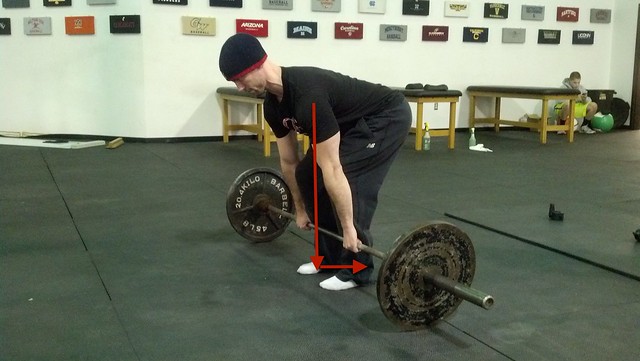
5. Don’t Just Think “Up.” Think “Back.”

The deadlift is nothing more than bending over and picking up a barbell off the ground, right?

Well, yes….but it’s a bit more complicated than that.

Many will view the deadlift as a pure up and down movement. Meaning, the barbell itself will move in a path that’s literally straight up and down.

Ehhhhhhhhhhhh, wrong.

23.7% wrong, at any rate (<—- trust me it’s science).

The deadlift is actually much more of a horizontal movement than people give it credit for. To quote my good friend, Dean Somerset:

“Deadlift drive comes from the hips when you start in flexion and move into extension. In other words, deadlift drive comes through hip drive. Driving your hips forward, coupled with vertical shins and a stable core, causes the torso to stand up vertically, pulling the weight with it.”

When people get into the mindset that deadlifitng is more of vertical movement they’ll often resort to initiating and finishing the movement with their lower back rather than their hips. Which, as you can guess, leads to some wonky habits of the rounded back nature (which we’d like to avoid as much as possible).

A cue I like to use to help initiate more of a horizontal vector is to tell people to think about “driving their sternum to the back wall.”

When they initiate the pull, they shouldn’t think up but rather……..BACK!

It sounds weird, but I like to describe this phenomenon by telling people that if they do it right – and think about pulling their sternum back – that they’d fall backwards if they decided to let go of the bar.

6. Deadlifts Don’t ALWAYS Need to be Max Effort, I’m Going to Shit My Spleen, Heavy.

Yes, you’ll need to train with max effort loads in order to improve your deadlift. To quote Ronnie Coleman, you’ll need to “lift some heavy ass weight.”

That’s pretty much a given.

But you DO NOT need to do it all the freakin time.

This is another point that Chad Wesley Smith touched on a few weeks ago. To paraphrase him (again): “I could care less about gym PRs. I want to PR when it counts.”

Understandably, most of the people reading this post aren’t competitive powerlifters like Chad, so how he trains and prepares (and peaks for a meet) is going to be drastically different from most of us.

But the message still resonates and reigns true for most trainees. You don’t need to train balls to the wall 100% of the time.

This is a tough pill to swallow for many people, especially in the shadow of CrossFit where training all out, to the point of exhaustion is not only encouraged but accepted as normal.


Don’t get me wrong: I LOVE when people train hard, and I think CrossFit has done some good in terms of getting more people excited to not run a treadmill.

However it’s also set a dangerous precedent in brainwashing people into thinking that a workout or training session is pointless if you don’t set a PR or come close to passing out.

NOTE: this doesn’t apply to every box or every Crossfit coach. So relax guy who’s inevitably going to shoot me an email saying I’m nothing but a CrossFit hater.

1. I actually have written a fair amount praising CrossFit. Like HERE

2. I also workout at a CrossFit 1-2x per week – albeit during “off” hours when I have the place to myself along with the other coaches.

3. Shut up.

More often than you think, training with SUB-maximal weight (60-85%) is going to be the best approach for most people, most of the time. Not only does it allow for ample opportunity to focus on and work on technique, but it also allows people to train the deadlift more often.

The best way to get better at deadlifitng is to deadlift. A lot.

If you’re someone who constantly trains with max-effort loads this is going to be hard to do because 1) you’re going to beat up your joints 2) you’ll fry your CNS and 3) this requires more recovery time.

Not every training session requires you to hate life. This is especially true when it comes to improving your deadlift. QUALITY reps are the key. Oh, this is weird…..it just so happens I have a deadlift specialization program that follows this mantra to a “t.”

You should check it out.

Pick Things Up

7. Pull & Push

The deadlift is a pulling dominant movement. But it also involves a fair amount of pushing.

Yep you heard me right, pushing.

Think of it like this: in order to pull an ungodly amount of weight off the floor (or for those less interested in ungodly amounts, a boatload or shit-ton) you need to generate a lot of force into the ground and push yourself away.

I’ve heard this best described as “trying to leave your heel print into the ground.”

It’s a subtle cue, but it works wonders and it’s something that effective deadlifters keep in the back of their mind all the time.

And there you have it. While not an exhaustive list of habits, I do feel the one’s highlighted in both parts of this article will help many of you reading dominate your deadlifts moving forward.

Got any of your own habits to share? Chime in below.

CategoriesStuff to Read While You're Pretending to Work

Stuff to Read While You’re Pretending to Work: 2/13/15

Gentle reminder fellas: Valentine’s Day is tomorrow.

But I’m sure I didn’t have to say anything because as every guy reading who has a girlfriend, fiancee, wife, or is within a tw0-mile radius of anyone who’s a raging case of estrogen is fully aware…..50 Shades of Grey opens in theaters this weekend.

It’s pretty much going to be THE Valentine’s weekend movie of all time, and will serve as every female’s payback for being dragged to movies like Taken (1 through 3), The Fast & Furious (1 through 117), and any movie starring Jason Statham.

No lie, here’s the conversation Lisa and I had yesterday.

Lisa: Guess what comes out this weekend?

Me: Sooo, you and Jess (one of Lisa’s BFFs) are going to go see 50 this weekend, huh?

Lisa: Yep.

Me: Oh, good. Have fun. I’ll go down to Coolidge Corner and…….

Lisa: And you’re coming with us.

Me: No I’m not.

Lisa: Yes, yes you are.

Me: Uh, no I’m not!

Lisa (don’t eff with me, look of death stare): do you know how many movies I’ve sat though with you? You’re going!

Me: [Pretty much my reaction below]


Have fun fellas. I’ll be right there with you. Washing my eyes out with broken glass.

Here’s this week’s list of stuff to read.

Complete Speed Training – Lee Taft

Today’s your last chance to take advantage of the sale price of Complete Speed Training by renowned speed coach, Lee Taft.

After midnight tonight (Friday, 2/13) the price jumps (<— or should I say, bound? Lame agility joke)…..by quite a bit.

Coach Taft is someone who has a lot of respect in the industry and he doesn’t release a ton of new material too often. When he does, though, it’s stellar.

This is easily one of the best resources I’ve come across that discusses everything from warm-ups to progressions with linear and lateral speed drills, strength training, and everything in between that will help you and your athletes dominate on the field.

Stop Doing Box Jumps Like a Jackass – Eric Bach

There’s a right way to do box jumps, and the jackass way. This article highlights the former.

Lessons From Chad Wesley Smith – Prashanti Ganesh

I had the chance to head to CrossFit Southie (located in South Boston) last weekend for a one-day powerlifting workshop put on by Juggernaut Training Systems co-founder, Chad Wesley Smith.

The man is a beast. Not only because he owns the 8th highest (raw) meet total in history, but because he’s also a very knowledgable coach who takes a more pragmatic approach than you would think.

This was an excellent write-up on some of the things he covered during the day.

CategoriesExercise Technique Program Design Strength Training

The 7 Habits of Highly Effective Deadlifters – Part 1

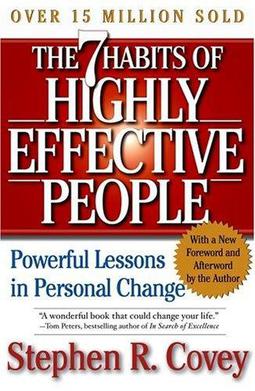
When I was a junior in college one of my professors had us read The 7 Habits of Highly Effective People by Stephen Covey.

Yeah, I didn’t read it.

But who actually reads in college anyways? I was too busy playing baseball, lifting weights, watching Party of Five, and not hanging out with girls because, well, I was watching Party of Five.

I mean, all I had to do was look at the title and I knew it was going to put me to sleep within five minutes of turning the cover. And besides, was this book going to add 5MPH to my fastball and get me drafted? Pffffft, I think not!

Fast forward five years.

Surprise! Nothing I read added 5MPH to my fastball. Professional baseball didn’t pan out and I was a year or two into my career as a personal trainer. I finally listened to my professor and read the book. And it was game changer.

I won’t bore you with the details – it’s a quick read – but The 7 Habits of Highly Effective People speaks to things like how to be more proactive, why it’s important to think about the future so that you can more concretely figure out what to make a reality, the value of the “win-win” mentality, seeking to understand shit before you open your mouth (<— that’s my own interpretation), and what it means to “sharpen the saw” (I.e., seek out activities like exercise, yoga, meditation, etc. to expedite mental focus), among a handful of others.

Needless to say it’s a book I recommend to a lot of people, and something who’s theme I’m going to rip off today.

The 7 Habits of Highly Effective Deadlifters

Being a massive human being helps (^^^^^^^^^), so I’ll just skip that one and try to focus on some less obvious points.

NOTE: What follows is more of a commentary on deadlift technique with the goal to lift a lot of weight. It’s not going to cater to CrossFit and more of the tap-n-go, bounce off the floor, (high) hinge deadlift.

NOTE II: Please don’t take this as a knock against CrossFit. It isn’t. I get that the tap-n-go approach is more relevant to the demands of a CrossFit class or competition, where high(er) reps are performed. I also recognize that there are some strong people who do CrossFit.

But if you’re a CrossFitter and you’re that easily butt-hurt over me poo-pooing a tap-n-go deadlift, I’ll ask you this: why is the exercise called a DEADlift?

NOTE III: Nothing I mention below is concrete and will apply to every lifter in every situation. While I feel much of what I have to say with resonate with a lot of people, I’m not that much of an egotistical asshat to think that it will apply to 100% of the lifting population. So take that for what it’s worth.

Anyways……..

1. Your Lats Are the Key (Point #1)

In order to move big weights (safely, and long-term) you need two things to happen: you need to place a premium on tension and alignment.

If either of the above are lacking you’re not going to be able to develop as much force.

To the former point (tension), the lats are kind of a big deal.

The latissismus dorsi (or “lats” in bro-talk) are a massive muscle, which, on top of playing a role in humeral extension, internal rotation, and adduction (blah, blah, blah), also has significant play in breathing patterns and more germane to this conversation spinal stability.

In short: get the lats to engage and garner TENSION during the setup of a deadlift, the more stable you’re going to be, and the less likely you’ll look like this:

To do this I like to use any one of the following cues:

1. Squeeze an orange in your armpits

2. Protect your armpits.

3. Phew…your armpits stink.

4. Put your shoulder blades in your back pocket.

All are fantastic external cues to help people get the lats to fire to provide more tension and thus, stability. Despite this, some people may still look at you as if you’re speaking Elvish when you tell then to “turn on” their lats.

Sometimes it’s beneficial to give them more tactile feedback or cues.

Band Lat Activation with Hip Hinge

Or what I like to call “TRICEPS”


Lat Activation (via Mike Robertson)


2. Your Lats Are the Key (Point #2)

Pigging back on the point above, your lats are what “connects” you to the bar. Yes, your hands are grabbing the bar, but it’s where your armpits (where the lats insert) are located – in relation to bar placement – that plays a huge role in deadlifting badassery.

I’m a fairly decent deadlifter. I’ve pulled 3x bodyweight….570 lbs at a bodyweight of 190. I’m no Andy Bolton, but not many people are.

For years I’ve set up with my shins as close to the bar as possible, and while it led to some success it also led to some pesky back issues.

Why?

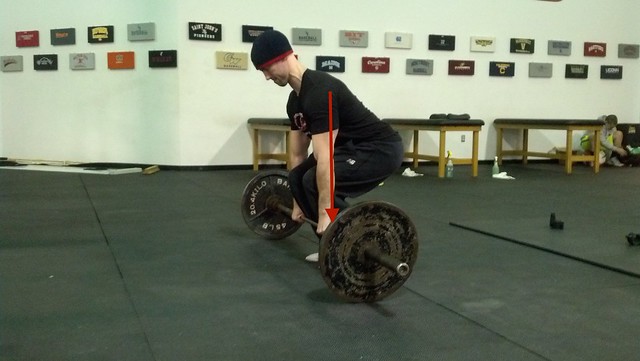
When setting up as close as possible to the bar, think about what’s happening.

1. My shins are more vertical.

2. And because my shins are more vertical, my armpits are in front of the bar, creating an awkward line of pull I have to overcome.

This not only puts me in a mechanical disadvantage, but over time is going to make my lower back flip me the middle finger. And it has, many times.

In the past few months I’ve had to overhaul my setup so I’m a little further away from the bar in that my shins can translate forward a bit, which then allows me to get my armpits directly over the bar, which in turn puts me in a more mechanical ADvantage (which helps me garner more tension), which in turn makes my lower back happy.

FYI: the picture below doesn’t show that right before I pull, I’ll push my hips back a smidge

And no, I’m not squatting the deadlift…….;o)

3. Pulling Slack Out of the Bar

Running with the tension theme, another habit of highly effective deadlifters is learning how to take the slack out of the bar.

It’s important to leverage yourself against the weight when you’re setting up. Another way to think about it is to act as if you’re “pulling” yourself (against the bar) into proper position.

This is what it means to get the slack out of the bar or what I like to say instead “bending the bar before you pull it.”

NOTE: I was in the middle of filming a video of this last night when my camera puttered out. Damn you Droid!

Luckily CSP coach, Greg Robins, filmed a video not too long ago on this very concept:

That’s it for today. I’ll be posting part II of this article sometime soon. But in the meantime I want you to recognize the key theme of all the points listed above:

That the setup is very, very, VERY important.

Like almost as important as Bilbo giving Frodo Baggins the blade Sting when leaving Rivendell on his way to Mordor.

95% of the time any mistake or snafu in technique with the deadlift can be attributed to how someone sets up in the first place. Far too often trainees fail to put much thought into it and just haphazardly bend over and pick up the bar. And far too often people end up getting hurt and/or never making any progress.

Place more precedence on getting tension and watch your deadlift take off.

CategoriesCorrective Exercise Rehab/Prehab

Prioritize Your Mobility

Today I have an excellent guest post by Boston based strength coach, Matthew Ibrahim. I love pointing people in the direction of coaches in the industry who are on the up and up, and Matthew definitely falls into that camp.

He’s someone who I feel provides a ton of great content and has a lot of great things to say. Today he discusses mobility, what it is (what it isn’t), and some new drills I think you’ll enjoy.

Craig: “Hey bro, I can’t wrap my right hand all the way around my back and grab my left arm.”

David: “Really? Everyone can do that. You definitely need some shoulder mobility to fix that.”

The word ‘need’ is quite subjective here.

Does Craig really need mobility in his right shoulder? Is that particular range of motion and pattern important enough to warrant this need? How much mobility is truly enough?

Think about these few questions. Let them marinade for a bit. We’ll jump back to them soon, but first let’s talk about the why, the where and the when.

WHY MOBILITY IS IMPORTANT

Everyone needs mobility, to a certain extent and in certain areas more than others.

It’s just a common thing to see in clients/athletes/patients: a lack of mobility in a joint.

Regardless of the reason, more often than not, that particular individual will benefit a great deal by incorporating more mobility drills in order to increase the overall range of motion for that joint to have access to. We see this both in the strength and conditioning world and in the physical therapy world.

Perfect example: if you can’t perform lunges properly due to hips that just don’t seem to function correctly, then a quick fix may be to perform a few hip mobility drills to open these areas up.

Most recently, I’ve had the opportunity to work with a big group of NFL Combine Prep college football players from Division I programs at Athletic Evolution in Woburn, MA.

One incredibly glaring thing I noticed right from the start: all of their hips were jacked up, so much so that each of their gait patterns were altered due to this imbalance, which was ultimately affecting their performance.

I knew this problem needed to be fixed, especially if they had high hopes of making some noise in the next couple months during their Pro Day.

Luckily, I was given the task of creating and implementing a mobility program, specifically designed with their needs in mind.

In this case, mobility in their hips has been most important since it has helped a great deal in restoring their gait pattern, improving their posture, and most notably, optimizing their overall performance in the weight room and on the field.

Mobility is crucial to certain joints in your body that are either limited or don’t have full access to certain ranges. It’s important for you to find the areas of most need and to constantly address them through daily maintenance.

Note From TG: it IS important to note (and I know Matthew would agree) that sometimes lack of mobility at a certain joint is due to a stability/alignment issue.  We shouldn’t set our default to always thinking it’s a mobility issue.

WHERE AND WHEN TO APPLY MOBILITY

I see too many individuals performing mobility drills without actually having a legitimate reason. They just feel that they need to do it. It’s almost as if they truly believe that their entire body “needs” mobility.

Stop. Please, STOP!

Before you go any further, put the foam roller, the lacrosse ball and the stretching strap down for two minutes.

I’ll use the shoulders as an example. Here’s what you need to know:

  • Should you perform an excessive amount of mobility drills if your shoulders already have plenty of range without any limitations? No.
  • Should you perform a couple short mobility drills for your shoulders if they’re especially tight/naggy due to a recent workout, but typically have very few limitations? Yes, go for it, but keep it light.
  • Should you perform a handful of mobility drills for your shoulders if they’re especially tight/naggy due to a recent workout, but are usually limited in several areas? Yes, definitely: address what needs to be addressed.

My point: have a legitimate reason for performing mobility drills with a thoughtful goal in mind. Don’t just do it to do it; have a purpose.

Case in point: apply mobility where it is needed most at the time of most need.

Simple enough? Yes, but that’s the point!

For example: it wouldn’t make much sense for me to focus the mobility program solely on shoulder/thoracic spine drills for the aforementioned college football players. They wouldn’t benefit much since they aren’t really lacking in those areas.

Always make sure there is a reason as to why you are doing what you are doing when it comes to mobility.

Referring back to the introduction

Is it truly that important for Craig to wrap his right hand all the way around his back and grab his left arm?

Think about what we just went over.

With those items in mind, I’m not so sure it is that important. Plus, we haven’t even discussed anything about his overhead shoulder range of motion or shoulder external rotation range of motion.

These are the angles you need to start viewing mobility from. Be conscious of how much is enough, and also how much is needed in order to perform the exercise task (i.e., overhead shoulder press) and the daily task (i.e., grabbing a snack from the top cabinet).

CHOOSE AREAS OF PRIORITY

You’re not always going to need mobility everywhere in your body.

Note From TG: Read THIS (<— it will melt your face)

It’s important to be able pinpoint what areas may need the most attention.

I’ve created three short mobility sequences below, where the body has been divided up into three separate compartments: lower, middle and upper. Select the compartment that you need to focus on the most.

MY GO-TO MOBILITY SEQUENCES

1.) Lower Compartment

If you’re someone who has a tough time loosening up the areas of the calves, ankle and feet, then give this mobility drill series a try for 2-3 rounds:


  • Lacrosse Ball Rolling
  • Lacrosse Ball Pin and Extend/Flex
  • Tibial External/Internal Rotation Shifting
  • 1-Leg Ankle Rocking

2.) Middle Compartment

Do you find it challenging to get limber in the hips, glutes and posterior chain areas? Try out this sequence for 2-3 rounds:


  • Quadruped Rocking
  • Inchworm
  • Hip Series: Spiderman, External Hip Rotators, Lateral Lunge w/Toes Up

3.) Upper Compartment

Tight shoulders? Naggy thoracic spine? Give this series of mobility drills a shot for 2-3 rounds:


  • Overhead Floor Slides
  • Scap Push-Up
  • Lateral Crawl
  • Linear Crawl
  • Quadruped Thoracic Spine: 4-Way Reach w/1-Leg Abducted

Always remember: address what needs to be addressed, and always keep it simple.

Now, go get limber!

About the Author

Matthew Ibrahim is a Strength and Conditioning Coach and Physical Therapy Rehabilitation Aide with an evidence-based approach to human movement, biomechanics and injury-prevention, and is knowledgeable on how each area impacts performance in sports and life. He delivers training methods that are aimed at bridging the gap between rehabilitation and performance through proper movement education and basic human maintenance. Feel free to read more at www.mobility101blog.com and follow ‘Mobility 101’ on Facebook and Twitter.

CategoriesProduct Review Program Design speed training youth sports training

The D’Angelo of Strength and Conditioning?

I’m not bashful when it comes to admitting my weaknesses as a coach. I did it before when I wrote a post not long ago explaining why I don’t include the Olympic lifts into my programs, and I’ll do it again today.

Ready?

Speed and explosive training is not my strong suit.

This is not to imply I don’t include any speed/explosive/movement/agility training with my athletes and clients. I absolutely do! What good is it to have strong athletes who can’t express that strength quickly and/or who move like the Tin Man?

But I’ll be the first to admit that speed training isn’t my strong point as a coach. Kind of like Aquaman being a cool superhero….;o) He can get s*** done, buuuuuuut, you know, he’s Aquaman

Part of the reason is due to my philosophy as a coach. I can’t begin to tell you how many parents walk into Cressey Sports Performance on a weekly basis and wax poetic on how their 13 year old child – who plays on five different AAU baseball teams throughout the year – needs to work on their foot speed and getting faster.

I typically nod my head, play the part of the understanding coach, and quench the parent’s thirst for that “x factor” that’s going to make their kid the next Clayton Kershaw or Mike Trout.

“We’re absolutely going to try to make your kid faster,” I’ll say, “by making him (or her) stronger.”

Silence.

Crickets chirping.

This….is….getting….awwwwwwkward.

I won’t belabor the point here, but needless to say I’ll go into a short spiel explaining that doing a bunch of cute ladder and agility drills won’t make their kid faster because their kid can barely put any force into the ground as it is.

I’ve used the analogy before, but it would be akin to me putting a sweet paint job on a Ford Focus with some spoilers and sick rims, and making look fast….but unless I do something to increase the horse power of the engine it’s pretty much all a giant waste of time.

Lets place a premium on correct movement, building a base of strength and progress from there, mmmm kay?

The other reason speed training isn’t my strong suit is because CSP coach, Greg Robins, has done an amazing job within the last year at revamping our approach to it. He’s more or less taken the reigns on writing all of our off-season “movement days” which incorporates any number of skipping drills, heidens, box jumps, foot work drills, arm/leg action drills, build-ups, and change of direction.

You can get a taste for what that entails HERE.

You still won’t find any of this nonsense, though:

All that said, can I work with a young or intermediate athlete on general sprint mechanics or helping them improve their explosive power? Yes. Can I help an athlete train for the 100M dash in the Olympics? Um, no.

It’s still no excuse on my end to take a back seat and not try to improve myself on the topic.

Lee Taft is one of the most respected speed coaches in the industry. He’s worked with countless numbers of elite athletes and is easily one of the coaches I, along with many other coaches I know, go to when “we” need to up our game with regards to getting athletes faster.

He’s also a coach who’s the strength and conditioning equivalent of the enigmatic R&B singer D’Angelo.

I love D’Angelo. His first album, Brown Sugar, is still one of my favorite albums of all-time. His second album, Voodoo, released five years after his first, again, became an instant classic.

Within that time, he rarely ever gave interviews or released any new material. And then, poof….he seemingly disappeared, making a few cameo appearances here and there on various soundtracks and guest tracks.

15 years later, he just released his latest album, and again….it’s legit. Basically, when D’Angelo releases something you know it’s going to be amazing.

The same can be said for Lee Taft.

See what I just did there? I made a comparison between D’Angelo and Lee Taft. Dammit I’m good.

Now, I don’t mean to insinuate that Lee’s emulated D’Angelo and played the role of reluctant recluse. He’s a prominent player on the Perform Better tour and has always been in the trenches, coaching.

He just doesn’t release a lot of new products (his last was ten years ago).

But when he does……it’s unreal.

Complete Speed Training

Lee’s just released his latest product, Complete Speed Training, his first in a looooong time, and after reviewing it I can say it’s pretty damn awesome.

It gives you a step-by-step breakdown – from the warm-up to the drills themselves – on how to make your athletes (and clients) faster and more agile.

And there’s nothing that’s going to make your eyes bleed.

If you’re a coach who works with athletes or a personal trainer who’s looking to add safe and appropriate progressions to your client’s training repertoire, I’d HIGHLY encourage you to check this out.

It’s on sale through this Friday at midnight, and I can guarantee you don’t want to miss this amazing opportunity to learn from one of the best.

CategoriesStuff to Read While You're Pretending to Work

Stuff to Read While You’re Pretending to Work: 2/6/15

Another week, another foot of snow here in New England. I grew up in Central NY, and have lived in the northeast my entire life so I know what a lot of snow is and I’m not of those people who complains about it.

It’s like people who live in Florida complaining about the humidity or Tom Brady complaining about having the greatest life, ever.

But good grief….they’re saying we may get another foot this weekend.

Which makes me all the more pumped for my trip to Australia in less than a month. As a quick reminder I’ll be heading “down under” in early March to put on not one, but TWO workshops. a 2-Day event in Ballina, NSW the weekend of March 7th-8th, in addition to a 1-Day event in Sydney on Saturday, March 14th.

Details including locations, cost, the over/under I’ll even touch the ocean with my big toe1, and sign-up information can be found HERE.

I also wanted to remind people that registration is still open for the 2nd Annual SUNY Cortland Strength & Conditioning Symposium (March 28th). I’ll be hitting up my alma mater (and doing my best General Zod impersonation…..KNEEL BEFORE ME!) along with Nick Tumminello, Mark Fisher, John Gaglione, and Joy Victoria for what will undoubtedly be a day full of mind melting.

Details can be found HERE.

How to Win an Argument With a Vegan – Kris Gunnars

Pew, pew, pew. Shots fired. Shots fired!

I’ll make the same statement as the author: I have nothing against vegans or vegetarians. If someone chooses not to eat meat for environmental, health, or ethical reasons…far be it from me to pass judgement.

Although I do find it comical that there are many vegan or vegetarian food options that mimic the foods they’re so adamantly against. Tofurkey burger anyone?

Looks like a hamburger and tastes like turkey. Hmmmmmm.

Anyways, what my main beef (<— LOL, awesome pun) is with some pundits is their claim that all animal protein is unhealthy, which is absurd. This article explains why.

Power to the SHE – Christa Vancini Doran

I am all about messages that help and encourage women to challenge themselves (namely in the gym). I hate pretty much every message the mainstream media attempts to throw in women’s faces – lean and long, tone, thigh gap, lose inches in days, weights make you big and bulky, blah blah blah blah –  all in the name of selling a product or sex appeal.

I understand sex sells – I’m not a moron – but how it’s delivered in the realm of health and fitness is lame IMO.

I’m a huge fan of Christa and the culture she’s built at her facility. Ladies, THIS is the type of person you should follow and learn from; not some overly hyped, narcissistic, selfie-taking nimrod who’s only claim to fame is having the world’s most exaggerated case of anterior pelvic tilt.

Squats: Fold-Ability and Proportion – Tom Purvis

I felt this was a fantastic, quick video on squat mechanics and how taking into consideration each person’s anthropometry and leverages will dictate what their squat will look like. Definitely worth five minutes of your time.

CategoriesMotivational personal training

A Tale of Two Clients

It was the best of times, it was the worst of times…..

Even for those who aren’t avid readers, the words above are fairly recognizable. At some point in everyone’s life they’ve (probably) heard the phrase absent of whether or not they know the origin:

Charles Dickens’s A Tale of Two Cities.

Yeah, I haven’t read it either.

But the book reference serves as a nice introduction to today’s post as click bait. Because, you know, everyone goes bat-shit crazy over Dickens quotes.

I was asked two questions recently (from two different people) that I felt would be best served answering here as I know a lot of personal trainers and coaches read this site.

Question #1:

I’m curious what’s the longest amount of time you had the same non-athlete client and I’d love to see more articles on what makes a good lifting trainee/student!

Question #2:

Not sure if you have touched on this in a previous blog post but would love to hear your thoughts on how you go about motivating your general fitness clients vs. your baseball players. I imagine they come in with different experiences, expectations, etc. and I imagine they both pose unique challenges in getting them to engage and buy into the process.

Two different questions, albeit not altogether too dissimilar.

Before co-founding Cressey Sports Performance in 2007 I worked as a personal trainer in both the corporate setting and commercial setting….for five years. That’s five years of early mornings, late nights, working on weekends, working on Holidays, and working with every permutation of human being you can possibly think of save for a one-legged pirate and an Astronaut.

Repeating the borrowed prose from above, my life literally was “the best of times, and the worst of times.”

It was the best of times because I was doing something I loved. Right out of the gate I was making a living wearing sweatpants to work and hanging out in a gym helping people get stronger, lose fat, address an injury, and making people of the opposite sex want to hang out with them.

That didn’t suck.

Too, it was a point in my life where I was a sponge for knowledge ( I still am). Upon graduating from school I thought I knew what I was doing – I graduated Magna Cum Laude, I played four years of college baseball, I had been lifting weights since I was 13, I had six-pack, I got this! But once my first client was handed to me I experienced a hefty reality check.

I didn’t really know as much as I thought I did.

Luckily my first client survived, I didn’t set the gym on fire or anything, things were going to be okay.

It was that time where I found sites like T-Nation.com and other reputable publications that helped me peel back the onion and understand that what I learned in school wasn’t exactly how things are in the real world. I made it a point to read, and read a lot. And I got better.

It was the worst of times because life as a personal trainer isn’t shall we say……all that glamorous.

As mentioned above you work when others don’t, there’s a bit of “politics” involved – pressure to hit quotas and numbers at the expense of quality programming and coaching, and you learn quickly that life as a trainer is just as much about becoming a good “people person” as it is a coach.

Put another way: some (and I’d say most) clients are amazing, wonderful people; while others are life sucking, Debbie Downer/Johnny Raincloud, soul crushers that would give Godzilla a run for this money.

Given all that, however, I wouldn’t change anything from my past as a fitness professional. The one piece of advice I give all incoming personal trainers – especially to the entitled ones who think they’re going to train professional athletes their first day on the job2 – is that you should work in a commercial gym setting.

For 1-2 years.

You need to grind it out, work shitty hours, and learn to work with as wide of a variety of clientele as possible. You do this, and I GUARANTEE you’ll get better and learn to appreciate which niche – if any – you’d like to pursue to further your career.

In my 13 years as a personal trainer and coach I’ve had the opportunity and honor to work with so many different people. Everything from young athletes to professional athletes to CEOs, doctors, fat loss clients, powerlifters, post rehab, and anything you can think of in between. Still waiting for that Astronaut, though.

I’ve had clients who have worked with me for 5+ years – both in person and in a distance based format. Most often when I’ve been working with someone that long they’re someone I’d train for free. I’d be lying if I said you never build a rapport past the trainer-client dichotomy with some people. You absolutely do.

I’ve had clients become really good friends, and I even have one who’s going to be an attendant in my wedding this May.

I wouldn’t say this is normal or happens all the time.

But given that circumstance is more of an outlier scenario, here are some quick bullet point traits I find make for a good client(s).

1. They pay. You have bills, right? It sounds tacky and trite, I know, but if you have a client who pays, pays on time, and is willing to do it for months, and if you’re lucky, years on end….that’s grounds for a solid start.

2. They respect you as a professional. Admittedly, there are a number of examples across the country of inept personal trainers and coaches who give the industry a bad reputation. All you have to do is peruse YouTube for 30 minutes and a small portion of your soul dies.

So part of me understands why the industry as a whole is looked down upon by many people.

But nothing grinds my gears more than when someone hires me for whatever reason – fat loss, performance, dealing with an injury – and then proceed to question/bitch/whine every…single….thing I ask them to do.

When this happens I do this:

Me: “Say Al, what is it that you do for a living?

Al: “Well, Tony, as it happens, I’m an Astronaut.”

Me: “What the what. Finally! Can we be BFFs?

Al: “Only if we can practice karate in the garage.”

Me: “Obviously.”

“Also, you know, Al, I wouldn’t have the faintest idea what the ideal ambient torsional velocity should be when ascertaining the longitudinal axis of a rocket during space docking.”

Al: “I would think not.”

Me: “Soooooo, shut up and do your freakin deadlifts.”

The point is: I’m willing to bet they wouldn’t question an accountant about their taxes or their lawyer about their lawyering. While being inquisitive is one thing (and should be expected), they shouldn’t constantly question your expertise with regards to differentiating flexion intolerant back pain from extension intolerant back pain.

Mind you, you should have a rationale and be able to explain everything written in a program. Conversely it’s not too much to ask that your client trust you. That is what they’re paying you for, right?

3. They show up on time. They schedule on time. They wear deodorant.

4. They do the work. Both in AND outside of the gym. I often give my clients homework. This may be something like asking them to keep a 3-day food diary, or maybe doing an extra active-recovery circuit on one of their “off” days from working with me. Are they compliant? The ideal one’s make an effort to be.

I’m sure I can easily keep going, and maybe I will at some point down the road. I’d encourage you to look up some of Alwyn Cosgrove’s stuff on the topic. He’s written several things on how to build an ideal client roster and how to fire clients if need be.

Meet Eddie

Eddie is a professional athlete (baseball). He works his ass off. I’d make a case that he’s one of the hardest working athletes I’ve ever coached.

Lets be honest: any professional athlete who chooses to spend his off-season in Massachusetts – we’re currently under 2+ feet of snow with more on the way – probably doesn’t need much motivation to train.

The thing about Eddie is sometimes he’s TOO motivated.

As much as it is for us coaches – as a team – to write effective, efficient, and safe programming, a large portion of our job is also to pull the reigns or pump the breaks when needed.

It’s not uncommon for me to tell Eddie to chill out and that it’s okay if he didn’t break his PR for the 16th consecutive week.

While Eddie is also an outlier, we’re very lucky to have so many hard-working and dedicated athletes (and not just baseball players) walk through our doors at Cressey Sports Performance.

Motivation, generally, isn’t too much of an issue when them. They’ll either put in the work or get released. Their choice.

Meet Robin

Robin is not an athlete. In fact, she’s a working professional who started training with us three months ago. She came to us with a vague background in strength training, but was also dealing with a few nagging injuries.

One of the advantages I have is that most people who seek out my services KNOW what they’re getting into. They read my stuff, they read Eric’s (Cressey) stuff, they read Greg Robins, Tony BonevechioMiguel Aragoncillo, and the rest the CSP’s staff material.

People know they’re not going to be doing Zumba. Not that there’s anything wrong with that.

So, in a way, most of the people I work with at CSP don’t need a whole lot of motivation to train. The brand sort of sells itself. What many of them do need – and especially in the case of Robin – is someone to help them gain their confidence back.

Some have been so “broken” for so long, and have worked with any number of other trainers, that it’s sometimes difficult to buy into what it is I have to say.

Showing them success is paramount.

They’re motivation is literally, training.

What can I do as their coach to get them to train pain free, or to do things that they thought they couldn’t do? It isn’t my objective to have everyone conventional deadlift on day one. Some people aren’t ready for that because it’s too aggressive or above their ability level. But I can have them perform some light glute bridges or some pull-throughs to get them to feel what turning on their glutes feels like in addition to grooving a hip hinge.

And then I can progress them from there.

If a female client can’t do a push-up, I’m NOT going to have her do “girl push-ups.” That’s lame and provides an initial connotation I’d prefer to avoid. Instead, she’s going to do push-ups – elevated on pins.

I’m going to show her success so that she gains some confidence. THAT’s oftentimes all the motivation anyone ever needs, and how I approach things with the bulk of my general fitness clients.

Prove to them that they CAN do “stuff.”  Once that happens it’s pretty much a domino effect in terms of progress and compliance with their programs. It’s not a sexy answer, but it works.


CategoriesExercise Technique Strength Training

Bench Press Tip: Let the Bar “Settle”

I’ve been working my way back from a pesky back injury for the past few months, and while I’ve made some awesome progress as of late (back to full squatting 315 for reps, and just started incorporating some heavy(ish) pulling into the mix), the guy who writes my programs – Greg Robins – has been making me bench press like no one’s business.

This isn’t to imply that “bench pressing like no one’s business” means I’ve been putting up some impressive numbers. To that I say:

“hahahahahahahahamsadasggwe**#1mwhupsas11hahahahhaa”

1. I’ve never been shy to say how much I hate bench press pressing.

2. And the reason for that is because I’ve never been good at it.

3. I hate bench pressing.

Giving myself some credit – my best performance on the bench press (raw, at a bodyweight of 200) is 315 lbs. Albeit it never would have seen a white light in any powerlifting federation, unless the name of it was the NBOTB (National Butt Off the Bench) Federation.

A 315 lb bench press for a raw lifter at 200 lbs isn’t too shabby, but it’s certainly nothing to brag about. However, truth be told the bench press is a lift I’ve never placed a high priority on. And it shows.

So as it happens, “bench pressing like no one’s business” means I’ve been benching a lot lately, which has been both good and bad. Good in the sense that I’m starting to see my numbers creep up to non-abysmal territory again. Bad in that I still hate bench pressing. But like a bro, I need to persevere!

Which brings me to the topic of today’s post. A common mistake I see a lot of people make when benching is rushing into the press itself and NOT allowing the bar to settle after a hand-off. Watch this video to understand more of what I mean.

Let the Bar “Settle” Before You Press

Yes, all the same rules apply to the set up: Shoulders together and down, chest up, slight arch, drive feet into the ground, don’t destroy the back of your pants.

NOTE: Read HERE why getting a hand-off is so crucial.

But learning to settle the bar is something that’s universally glossed over by a lot of trainees.

Hope that cue helps.