CategoriesExercises You Should Be Doing

Exercises You Should Be Doing: HBT Overhead Press

What the WHAT!?! I know what some of you may be thinking:

“Did Tony just recommend an overhead exercise?”

For all intents and purposes, I’m 100% against overhead pressing right? What the hell has happened? Has the world flipped on itself?

This is analogous to Donald Trump showcasing an ounce of humility, or Kanye West not being an asstard, or, I don’t know, the Jedi and Sith hugging it out.

There’s part truth to the statement above. I’ve said it before, and it bears repeating here:

“People need to earn the right to overhead press.”

Most (not all) people have the movement quality of a rusty crowbar. I’m not even sure that’s makes a ton of sense, but I’m rolling with it nonetheless.

Okay wait, people move like shit. That’s better.

Due to a litany of reasons – poor t-spine mobility, poor lumbo-pelvic-hip control (weak core), overly kyphotic posture (computer guy) or excessive extension (most athletes and meatheads), both of which affect our ability to upwardly rotate our scapulae, global warming – many of us have lost the capacity to move our arms over our heads (pressing or otherwise) without serious compensation patterns and increased risk of injury.

I’ve written on the topic in the past – HERE – and I’d be remiss not to mention that, because I’ve worked with overhead athletes almost extensively for the past eight years, I play the conservative card a bit more that other coaches with regards to total frequency I allow my athletes/clients overhead press.

It comes down to risk-reward.

I’m not against overhead pressing. I understand and respect it’s a fantastic way to build total body strength – particularly upper body strength. And, if we’re going to hop onto the “functional training” caravan I’d much rather see people get brutally strong with overhead pressing compared to bench pressing.1

That said it’s rare when someone walks in on day #1 and passes THIS screen which helps me ascertain whether or not overhead pressing is a good fit.

Even if it’s not, I can still include a variety overhead pressing variations that are more “shoulder friendly.”

Like:

1-Arm Landmine Press

Bottoms-Up KB Side Plank

And Even the Turkish Get-Up (<– links to article on MensHealth.com)

But lets say all systems are a go for overhead pressing. There isn’t a lengthy history of shoulder issues and the person standing in front of me demonstrates ample movement quality with limited restriction(s).

Lets overhead press our faces off.

HBT Overhead Press


Who Did I Steal It From: Dr. Joel Seedman from THIS article printed on T-Nation not too long ago.

What Does It Do: HBT = Hanging Band Training.

It’s exactly what is sounds like. You take some bands, hang some stuff off them, and do stuff. Because, science.

While at first glance it comes across as a bit gimmicky, HBT training does have a fair amount of efficacy. As Dr. Seedman explains in the article linked to above, the oscillatory characteristics of this brand of training provides a unique training stimulus that challenges stabilization, increases core demand, helps “excite” the CNS, and also has a bit of carryover to muscle gain due to the increase in time under tension.

Key Coaching Cues: Don’t be a hero. You won’t need a lot of weight with this exercise to make it challenging. In the video above I looped two 1″ resistance bands and hung a 12 kg kettlebell from each side. That was plenty.

The idea here is to keep the bar quiet.

You want to go slow. If you go too fast, the KBs start flying all over the place and you’ll inevitably collapse to the floor like a game of Jenga.

Take a deep breath in before you un-rack the bar and then exhale all your air until you feel your ribcage depress. Owning that position take another deep breath in and focus on getting 360 degrees of expansion.

Un-rack bar.

Maintain abdominal brace, squeeze glutes, and press – under control – keeping the bar quiet. Don’t be surprised if you end up using a tempo akin to 2-3s up and 2-3s down.

I actually like the idea of being forced to use less weight on the bar as it forces the trainee to focus on technique. But the increased time under tension will more than make up for it.

You don’t have to limit yourself to one band per side, but I also feel it’s a bit over-kill to use more. You also don’t have to use KBs. Plates work fine too.2

I consider this more of an accessory movement, so high(er) reps is the way to go. Think: 8-10.

Give it a try today and let me know what you think.

Categoriespodcast

I’m, Like, So Popular. Making the Podcast Rounds.

It’s Columbus Day here in the States. It’s a national holiday. Which means Lisa has the day off. Which means I’m going to get sucked into a day of husbandly domestication hell.

[cue Jaws theme music here]

Yep, all the guys reading know what I’m alluding to: Target.

On the bright side I’m supposedly receiving a huge shipment of equipment today…namely, my power rack from Rogue Fitness.

Holla!

So it all evens out in the end.

Lisa and I are actually up early this AM and about to hit up the gym, and then we’re off to the races. I PROMISE I’ll be writing some more content later this week. Scouts honor.

In the meantime, as of late, I’ve been invited onto a bunch of podcasts and I wanted to share another one with you today.

—> Appearance on the Fit Info Club Podcast with Guy Bortz <—

I had a blast recording this one. Guy and I discussed everything from strength training to movies, programming to my affinity for eating cereal.

If you’re stuck at work today, put on a pair of headphones and enjoy. And if you’re not at work, maybe you can still find some time to listen.

I’ll be back tomorrow with some new content.

Off to Target3

CategoriesOff Topic

Movie Review: Sicario

Three words: Sicario is sick.


And I don’t mean sick as in bad. I mean sick as in “holy shit balls this movie is fucking amazing.”

For those who need a minor brush up on their Spanish, the word ‘sicario’ can be translated to mean “hit man,” which I knew because 1) I remember all of like four words from taking Spanish in high school (biblioteca, dos, pollo, sicario. Oh, and Feliz Navidad), and 2) my wife and I just finished binge watching the first season of Narcos on Netflix.

Highly recommend it by the way.

Sicario begins by introducing us to Emily Blunt’s character, Kate, an FBI agent who’s tough as nails and as by the book as they come (as we learn later, and proves to be to her detriment).

I have slight issue with Emily Blunt being characterized as “tough as nails” because she’s all of 110 lbs (and has a cute British access in real life). But she pretty much is in this movie, plus she kicked some ass in Edge of Tomorrow so whatever, I’ll roll with it. It’s Hollywood.

She’s involved in a pretty intense raid/drug bust in the opening sequence which results in a rather disturbing and grotesque revelation that I won’t divulge here. Needless to say: it speaks to a higher, more nefarious plot point.

A plot point that results in her be “recruited” by what can only be described as an equally nefarious secret government task force – hello Josh Brolin and the almost always excellent Benicio del Toro – hell bent on not really telling what she’s being recruited for.

Just shut up and learn,” she’s repeatedly told.

And so the plot unfolds.

In one of the most intense, dark, and beautifully shot (huge props to cinematographer, Roger Deakins) films I’ve seen in recent memory

I love dark movies.

While I understand that many people use the movies as a way to escape the doom and gloom that surrounds us – Ebola, war, terrorism, Justin Bieber – and look forward to the same story line where the guy gets the girl in the end, Lassie makes it home, or to be immersed in a cornucopia of CGI eye candy where The Rock arm wrestles a T-Rex4, I for one appreciate when a movie is less butterfly kisses and rainbows (and CGI) and more of a punch in the throat that reminds us “yeah, this is real life, some shit out there is fucked up sometimes.”

I have to give a tip of the hat to director Denis Villeneuve (Prisoners, Enemy) who’s quickly climbing the ladder as one of “new” great directors, and someone who doesn’t flinch when it comes to telling a dark story…much in the same vein as David Fincher.

Everything from the storyline itself to the ominous score to the really, really cool scenes involving a gun battle at the U.S./Mexican border and night vision goggles in a tunnel (WARNING: if you’re claustrophobic you may want to skip this part) is brilliantly handled.

And least we forget the acting performances themselves. Blunt and Brolin are fine in their roles, but it’s del Toro who shines.

Every scene he’s in makes you crave for more. There’s one scene involving him and a family eating together at dinner that more or less serves as the crescendo of the film. Sooooooo good.

Look for a Best Supporting Actor nod, and don’t be surprised if he wins for the second time (his first being Traffic).

Sicario, so far, is my favorite movie this year. Go see it.

CategoriesStuff to Read While You're Pretending to Work

Stuff To Read While You’re Pretending To Work: 10/9/15

Before we dive into this week’s stuff to read I’d like to first send a HUGE internet fist bump to the people at Rogue Fitness.

I ordered a bunch of equipment from them this past Tuesday – including a power rack and a handful of accessory items – and I received noticed yesterday that everything will be arriving in Boston TODAY (Friday).

That is an amazing turn around.

What’s more, I had a representative reach out to me immediately because he noticed a discrepancy in my original order after reviewing it. One of the accessory items wasn’t going to be the right “fit” for the power rack and he quickly informed me of the correct version and refunded me the difference.

Now that’s efficient customer service.

I’m half expecting them to come over and make me breakfast in bed too.

I also had a special delivery from the UPS guy yesterday; a new trap bar for the studio. As you can see from the video below, everyone in the Gentilcore household loves it. Even Dagny:


I know, I know. It’s pretty shameless (and borderline creepy cat lady status) that I posted a video of my cat on the internet. I get it.

BUT SHE’S A BEAUTIFUL, BEAUTIFUL PRINCESS.

Oh, and one last thing.

  • There are still a handful of spots available for mine and Dean Somerset’s Complete Shoulder & Hip Workshop at Rebell Strength & Conditioning in Chicago next weekend (Oct. 17-18th). Click HERE for more information.
  • We’ll also be in Los Angeles, at CrossFit 714 (in Anaheim), the weekend of November 14-15th. Click HERE for more information.

CEU’s are available for both events. And hugs.

3 Crucial Lessons From Lifting Without a Belt – Tony Bonvechio

I wrote a post a few years ago on the efficacy of weight belts and why (and when) it’s a good idea to use one. Tony B sheds some light on why using one can often be a crutch and speaks to how not using one can improve performance.

How to Deadlift: Layne Norton’s Complete Guide – Layne Norton (via BodyBuilding.com)


Did someone say deadlifts?

SQUIRREL!!!!!!!!5

Elite Athletic Development 2.0 – Mike Robertson & Joe Kenn

Listen: these are two of the best strength coaches out there giving you the inside scoop on how they approach assessment, periodization, conditioning, coaching progressions/regressions, and everything in between.

If you’re looking to get better as a coach or personal trainer (or just looking for quality information cause you’re a fitness nerd) this shouldn’t be a hard sell.

Invest in yourself. And you might as well do it while you can still save yourself 100 bones. SALE ends tonight (Friday) at midnight.

DO IT!

CategoriesInterview podcast

Appearance On the Coach Glass Podcast

First I’d like to thank EVERYONE for all the emails, texts, and messages sent my way offering kudos, congratulatory words of encouragement, and good vibes in lieu of yesterday’s official announcement of me leaving Cressey Sports Performance.

Remember that scene towards the end of the movie in Jerry Maguire when Tom Cruise walks into the middle of a support group in a room full of divorced women, looks at his wife (Renee Zelleweger), and says “you, complete, me.”

And then they hug it out, everyone in the room starts making out (<– that was actually the alternative ending), and they live happily ever after.

Remember that?

Well, that’s how I felt yesterday from the tsunami of messages I received. It was touching to know that so many people are happy for me and willing to be supportive.

What I found interesting, comical, and borderline annoying was how a handful of people couldn’t fathom that this decision was devoid of any animosity or hard feelings between myself and CSP.

WHY are you leaving Tony? Is it because of some idealogical difference between you and the staff?  A change of methodologies you don’t agree with? Wait, never mind, Eric stole a tablespoon of your peanut butter again didn’t he? That motherfucker! I don’t blame you for leaving. Good riddance I say.”

As if to imply that every departure and separating of ways between two parties must result in some sort of blood bath, confrontation, or choreographed Jets vs. Sharks knife fight dance.

Sorry to disappoint, but it’s not like that.

We’re adults. And we came to a mutual decision and agreement to part ways, respectively.

The plan now is to set up shop at the new studio space I’m sub-leasing in Boston (Brookline) and continue to make people into beasts.

I’ll soon have a direct link here on the site for those curious about more information. But for now you can just shoot me an email and I can place you on the “Yes Tony, I’m interested in training with you and being made into a beast” list once I’m organized and up and running. Which shouldn’t be too long.

I was on the Coach Glass Podcast

I was introduced to Jason Glass via a mutual friend of ours, Dana Santas (whom I collaborated with on THIS article featured on CNN.com regarding body image and encouraging women to strength train), and was immediately impressed with not only his knowledge (he’s a highly qualified strength coach who works with many elite golfers in addition to being a lead presenter for the Titleist Performance Institute) but his sense of humor as well.

As someone who tries not to take himself too seriously, it was refreshing to sit down with Jason for an hour to talk some training shop and have a few laughs as well.

You can listen to the episode HERE (which links to iTunes).

Or you can click HERE for the direct link.

Either way, your is day is about to get infinitely better. Enjoy.

CategoriesMotivational

The Next Chapter: Reflecting On 8 Years at Cressey Sports Performance

FYI: this post is approximately 91% about me. Okay, 92%. Good news for those of you who’s favorite topic is Tony Gentilcore!

And good news for me, because I love writing about me.

In case you haven’t heard the news or have been out of the loop for the past week, I am no longer coaching at Cressey Sports Performance.

Contrary to typical fitness industry shenanigans when a co-founder and figure-head decides to part ways with a facility and institution he helped establish and build, the news comes with zero percent hard feelings, animosity, or any semblance of ill will.

In fact it comes with a degree of excitement.

Truth be told: it’s a decision – while not easy to make – has been slowly marinating for a few months (if not several months) on my end.

I reached a proverbial “tipping point” not too long ago when an opportunity arose that I couldn’t really pass up. No, I didn’t come to realization I was a boy wizard. No, I wasn’t asked to be the strength coach for team Victoria Secret. And no, I wasn’t hand selected by director Zack Snyder to play the next Superman.

Legitimate guesses on your end though.

No, an opportunity came up in Boston that will allow me (and my wife) to plan a head for our future while at the same time allotting me a degree of autonomy I couldn’t pass up.

I’ll tell you the details, but you have to keep reading. A little written prose foreplay first.

When It All Started

Some of you reading know the back story of Cressey Sports Performance. For those that don’t it literally started with a phone call.

Things fell through where Eric was working as a coach (as an independent contractor) and he called Pete Dupuis and left a voice mail saying:

“Dude, it’s time. Want to open up a gym?”

It was a well timed and fortuitous call because Pete was, in fact, out playing a round of golf waiting to hear back on another job offer.

If Eric had waited 30 minutes, CSP would have been out of a co-founder and one of the best fitness business minds in the industry.

Yep, that guy. 

But just so you know that Pete doesn’t make a habit of living a “sun’s out guns out” lifestyle at the office all time, here he is all cleaned up and professional looking:

Pete once wore sweatpants to a roundtable event at his alma mater, Babson College, geared towards business students who were given the opportunity to pepper local, successful, entrepreneurs with questions.  Straight up boss. And he can kick Chuck Norris’s ass.

Eric and I were roommates at the time, and he didn’t even finish the sentence “hey dude, I’m starting a gym do you want to……” before I was tearing off my commercial gym shirt Hulk Hogan style and giving my two weeks notice.

And off we went. The three of us. To start a gym.

Two 25 year olds and a balding 30 year old, all of whom had zero business experience what-s0-ever. The odds of everything panning out where on par with the odds of Godzilla losing a fight to a building made out of wet spaghetti.

7 out of 10 new small businesses last at least 2 years, half at least 5 years.

We ended up finding space to rent inside an indoor batting cage facility in Hudson, MA. We set up shop in the corner with nothing more than a barbell, a few plates, a sled, and one of those forearm gripper thingamajigs that had a weight plate attached to a rope.

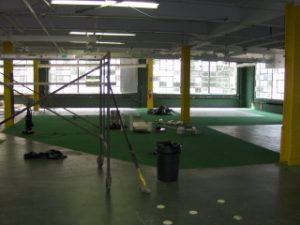
And this was what the first iteration of CSP looked like:

You can see the limited gym equipment piled in the middle, but we still managed to train people.

We eventually put up our own walls and office space and stuff – 2200 square ft in all – but our roots were minimal to say the least.

[Best piece of advice to ANYONE interested in starting their own facility: START SMALL!]

We already had a decent sized client roster of local high-school baseball players that Eric had been working with at his previous location, and I had a handful of clients follow me from my previous location as well.

And things ballooned from there.

We started getting some local college players and general fitness enthusiasts (thanks in part to mine and Eric’s growing web presence), and that parlayed into a few local New England based professional baseball players starting to make their way in.

Including Tim Collins.

Little did we know at the time that the quiet, scrawny, 135 lb left-hander from Worcester, MA who wasn’t recruited by any Division I,II, or III college, but was eventually spotted by JP Ricciardi (then the General Manager of the Toronto Blue Jays) at a summer baseball game and signed to a professional contract, would grow into a bonafide Big League pitcher with the Kansas City Royals (not to mention an unofficial – but really official – CSP staff member).

I’m not going to wax poetic on every prospect or nook and cranny of growth we’ve ever accomplished in our history. But lets just say: we’re the shit holy cow I’m proud of what we’ve been able to accomplish.

Never in a million years would I have guessed as a teenager growing up in Central NY that I’d have the opportunity to work with hundreds of professional baseball players as a strength coach. Or that I’d get paid to do what I do on a daily basis, and wear sweat pants doing it.

What started as a 2200 square ft. facility which required a tetanus shot to even use the bathrooms (<– only a slight exaggeration) grew enough to warrant three expansions and a renowned reputation as one of the premier strength and conditioning facilities in the world.

Words can’t even begin to describe how grateful and proud I am to have been associated with not only the initial beginnings of CSP, but to have witnessed it’s growth and help foster it’s unique culture as well.


NOTE: sick bicep pose at 0:33. Just sayin….

  • We’ve worked with thousands of clients and athletes from all over the U.S and world. Name a sport we’ve (probably) worked with an athlete who plays it. Name an injury we’ve (probably) worked with an individual who’s succumbed to it.
  • We’ve had the opportunity to see 100s of interns and coaches walk through our doors – many of which have gone on to successful careers in their own right.
  • I’ve made Eric’s ears bleed innumerable times with all the amount of EDM (Electrical Dance Music) I’ve played.

It’s been an amazing ride with an abyss of PRs and laughs.

Did you know wearing CSP gear increases general level of badassery and sexiness by 717%?

Or that we don’t just test deadlift 1RMs?

https://www.youtube.com/watch?v=7cXoNPTbe8s

And that during off-hours these sort of shenanigans take place?

Or that, contrary to popular belief, we don’t just train baseball players?

And, finally, that I can crush a finisher while listening to John Mayer?


All Kidding Aside

I’ve been incredibly fortunate to call Cressey Sports Performance my fitness “home” for the past eight years. I’d be remiss not to give credit where it’s due and concede that much of the success in my career has been because of CSP (and by extension, Eric).

Little do people know that Eric and I met on the internet. No lie.

And we didn’t meet at a time when that was just what people did either.

This was pre-Facebook. Pre-Tinder. Pre-text messaging. It was basically Creepy McCreepypants territory to say you met someone online; much less someone you’d inform your family that you’re going to quit your job in NY and move to CT to work and live with.

“Hey family, I’m moving to Connecticut to work with some dude named Eric. Oh, and we met on the internet. He’s totally not an ax-murderer, Mom. Promise!”

I think it’s safe to say that things turned out more than okay.

Eric’s been a major influence on me the past decade – both professionally and personally6– and I’m forever indebted to him for helping to “catapult” my career.

As it happened, it was through him why I pursued writing in the first place. Eric served as my first editor in fact.

It was via Eric that I was able to leave my comfort zone. I never would have left NY if it weren’t for him.

I mean, who knows where I’d be today?

Still a personal trainer at Bally Total Fitness in Syracuse, NY? Maybe a strength coach for a local high school near my home town? Most likely a professional grizzly bear arm wrestler.

Point is: it’s hard to fathom not being where I am today without having crossed paths with Eric.

I could make the case I never would have met my wife, Lisa.

All Of This To Say

I’m nervous to be leaving Cressey Sports Performance. Without sounding overly dramatic, a part of me feels naked and vulnerable to say I won’t be there on a day-t0-day basis anymore.

I know I’ve worked hard and performed the bulk of grunt work to build my own brand and make a name for myself in the industry, but it’s hard to picture myself not coaching with the #CSPFamily insignia hovering over my shoulder.

I’m nervous. Nervous as balls. Whatever that means.

It may sound silly, but a portion of me feels I’m losing a sense of prestige in stepping away.

But it’s that sense or nervousness and uncharted waters that will help propel me to continue to work hard and succeed in turning the page in my life.

I’ll miss a lot of things.

What I’ll miss most, though, is being around the other coaches. I am not kidding when I say I’ve been incredibly lucky to coach alongside some of the best coaches out there: Chris Howard, Greg Robins, Andrew Zomberg, George Kalantzis, Tony Bonvechio, Matt Blake, and Miguel Aragoncillo[/efn_note]Chingeda. Sorry, inside joke[/efn_note] (in addition to the un-sung hero of CSP, office manager, Stacie Leary).

All of them have kept me sharp as a coach and I was/am always amazed at how passionate, in-tune, and willing they were/are to always strive to get better.

TO ALL OF YOU (as well as past coaches/staff: Brian St. Pierre, George Abele, Michelle Elwell, Brittany Morgan): Here’s hoping I can continue to live up to the high standard of professionalism, integrity, and expectations you all have helped me mold and strive to attain.

I know I will. But thank you nonetheless.

Too, THANK YOU to the endless array of athletes and clients (some of which have become close friends) whom I’ve had the privilege to work with over the last several years.

It’s been a more than rewarding ride for me and I wish you all well.

So, What Now?

  • Cry? Did that.
  • Binge watch a new television show? Yep, Narcos.
  • Hang out with my cat, Dagny? Come on…of course.

What about starting my own “gig” in Boston?

Hell to the yes!

I’ve spent the better part of the past few days purchasing and collecting equipment – plates, barbells, matting, power rack, life size replica of He-Man, you know the important stuff – to outfit a small studio space in Brookline about a mile and half from my apartment7

For now I’ll be sub-leasing space at an already existing studio and blocking off times to train people in a semi-private format (groups of 2-4). I’m still in the throes of figuring out my schedule, but for now here’s what I envision happening:

Techno, techno, techno, AND MORE TECHNO.8

No shirt Saturdays. Kidding.9[

And lots of deadlifts.

My goal is to start this shindig towards the middle-end of October, and of course I have an open client roster.

Soooooooo, [cue bashful pose kicking dirt with feet] call or email me if interested? Please. I’ll be your BFF.

In all seriousness, if you’re interested in hearing more about what I’ll be offering shoot me an email and I’ll be happy to fill you in on the deets.

And on that note

Thank you, thank you, thank you, and thank you. I have more great memories than I could have ever possibly asked for.

The only way to appropriately summarize what I have to say is to defer to Boyz II Men.

Thanks again Cressey Sports Performance. I will miss you.


Categoriescoaching Interview

A Candid Conversation With Mike Robertson

Whenever I get the chance to listen to other coaches speak or to watch them in action, I’m always locked in. I sit with bated breath and intense concentration as I listen to him or her’s train of thought on everything…

…in addition to listening to how they cue certain exercises and coach up their clients and athletes.

Mike Robertson is one of those coaches. He’s high on my “bring a notebook, bring a pen, shut the eff up, and listen” list.

I remember reading his articles on T-Nation back in the day and thinking to myself “I’m totally picking up what he’s putting down. Samsies!”

And when I finally met him in person, when he came to Connecticut for a weekend to stay with Eric and I as he and Eric were planning Magnificent Mobility (watching it now they both look like they’re 16), I just knew he was someone I’d stay in contact with for years to come.

And I have.

Mike and I have been good friends for over a decade now, and he’s still someone I learn from and respect a ton. Plus, he has impeccable taste in old school hip-hop music.

Mike teamed up with one of the most ginormous human beings in the world, strength coach Joe Kenn, to film the Elite Athletic Development 2.o seminar.

It’s amazing.

But more to the point: it’s a 12 DVD set where Mike and Joe talk about program design, periodization, exercise technique, and how to develop your own training philosophy (and what they actually means).

It’s a sound investment for any personal trainer or coach to add to their continuing education arsenal. And, it’s on SALE this week at $100 off the regular price.

Mike was kind enough to take some time to talk some shop and answer some questions. Enjoy!

TG: Joe Kenn is a massive human being. Is his gravitational pull more powerful than the moon?

MR: You know back in the days when he was powerlifting, they called him “Big House” for a reason.

But ever since I’ve known him, he’s been pretty damn lean and pushes himself in the gym. And with his injury history it’s impressive to see him do what he does on a day-to-day basis. Respect.

TG: Elite Athletic Development 2.0 is going to entice a lot of athletes due to the title. But after watching the videos I know full well that the bulk of the information applies to your every day gym rat/meathead/goddess too. 

 Can you elaborate on why “training like an athlete” will help the average gym goer?

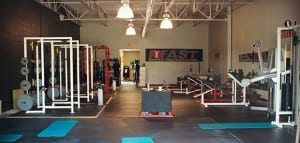
MR: Great question, and this is really at the core of my overall philosophy. In fact, I tell everyone who trains at IFAST that when they step in our gym, they are going to be the best athlete they possibly can.
I think most people get too focused on the singular quality of “strength” – and trust me, I get it.

I competed in powerlifting for many years, and in a lot of ways, still think of myself as a powerlifter.

But I also think you can make training infinitely more fun, and your body much healthier, when you focus on all the qualities of athletic development.

An athlete has to be fast, powerful, strong, conditioned and mobile. If he/she lacks any of these qualities, then their performance will suffer.

If you train all of this in the gym, you’re going to be pretty darn awesome in real life, so it just makes sense to me.

TG: I couldn’t agree more. It amazes me how many adults have lost the ability to do something as simple as skipping.

Your R7 System is pretty fucking brilliant. One thing I feel is hindering many fitness professionals is PRI (breathing drills). I know you and the rest of the coaching staff at IFAST are in the same boat as us at CSP. We both find a lot of efficacy in it, we both use it, but we also know that people need to freakin train!

Breathing drills, in simplest terms, helps “reset” the body. Can you briefly explain this?

MR: Yeah I’m not shy about the fact that I love PRI, but like anything, if you want to learn more about it go the source.

Too often, people learn about a system via the zealot who bastardizes the system, and then assume that everyone who uses the system “does it that way.”

Not true. But I digress…

To make this incredibly simple, too many of us struggle to exhale, and thus live in a position of “system extension.” To see what I mean, try this:

Take the deepest breath in you possibly can. If you’re like 99.9% of the awesome people out there who strength train, then chances are you extended your back to a degree to get the air in.

So this system extension isn’t an awful thing when you’re trying to fun fast, jump high, or lift heavy things, but it’s also associated with the sympathetic response (fight-or-flight).

When you’re training, this isn’t bad – but so many of us struggle to get out of this and we’re locked in sympathetic mode all the time!

I could go really deep into this, but the inability to breathe (and more specifically, exhale) never allows us to shift the parasympathetic dominate (i.e. rest and digest – RECOVER).

Breathing, and the ability to not only exhale, but to inhale from an exhaled position, can help reset our body. For training purposes, it can open up mobility in the hips and shoulders by improving core stability and position.

But the even bigger benefit is the fact that by doing this at the end of a session (or before bed), you can really shut your system off and kickstart the recovery process.

I think that’s the biggest benefit of all this – we love to talk training, but proper breathing starts the discussion with regards to proper recovery.

TG: YES! Thank you. If I could hug you right now I totally would.

Deadlifts. You know I have to pick your brain on this. With any movement I tend to take more of a “less is more” approach when coaching it. I know you feel the same way. Can you give us your top 3 coaching cues/tips for the deadlift?

How about the squat?

MR: Absolutely man. I’m actually trying to streamline all this so people are getting a similar message across movements.

So these three would work for both the squat and deadlift.

1 – “Exhale, inhale, brace.”

The exhale sets proper position, the inhale allows you to breathe 3D (into front, side and back of your core, and then the brace seals the deal.

2 – “Feel the whole foot,” or simply, “whole foot”

I think this is a big one, and it cures damn near everything.

If someone gets too far forward, it gets them back towards their heels.

If they get on their heels, it gets them back on their forefoot.

And if they have a tendency to supinate or pronate, it cleans up frontal/transverse plane issues.

Note from TG: give THIS post a read on Active vs. Passive Foot (or “whole foot” as MR alludes to).

3 – Push

This one is simple – if I cue someone to “push” then we get balanced (and well-timed) movements at the hip and knee.

What you see all too often is that the hips shoot up, and puts the back in an awful position to finish the lift.

By cuing someone to push, it improves timing and fixes a lot of stuff.

TG: Conditioning. It’s a double edged sword. Where do you feel most athletes (and average gym goes) go wrong with it?

MR: I think there are two main camps out there:

1 – The people that do none, ever, and

2 – The people that only go balls out, all the time.

The people that do none are doing themselves a disservice – it’s negatively impacting their recovery, health, and ultimately, their quality of life.

But people that go balls out all the time aren’t much better. They’re essentially driving themselves into sympathetic overload, and then wondering why they can’t recover, why they aren’t making progress, or why they’re always injured.

I think there’s definitely something to be said about the middle of the road here. Not everyone needs to be as conditioned as a soccer player, and I’m not saying you need to go out and train like an endurance athlete, either.

But a little bit of true aerobic development can go a long way.

TG: Speaking of aerobic development, like yourself I’ve become more and more aware that I was a tool bag for dissing steady state aerobic work for so long in my early years as a coach.

Can you explain to my readers why implementing more of it will help them in the weight room?

MR: Great question, and yes, I absolutely made this mistake early-on in my career.

We talked about sympathetic overdrive above – and high intensity (anaerobic development) is tied to sympathetic dominance.

On the other hand, if we want/need the able to access our parasympathetic nervous system, then we can use low-level aerobic development to help stimulate that process.

Now here’s the cool thing – that aerobic development will help us in several ways:

  1. We’ll be able to do more (and recover from) more training volume,
  2. We’ll recover faster in between sets,
  3. We’ll recover faster in between training days,
  4. The improved parasympathetic drive will allow us to truly shut our system off, which will improve systemic recovery.

It may sound counterintuitive, but I feel as though improved aerobic development can do a lot for us both in and out of the gym. That’s why I’m such a huge proponent of it these days.

TG: Legit answer, thank you. 

Do your low intensity aerobic work everyone!

Finally, movies: Favorite ones you’ve seen lately? 

MR: Moment of truth here – I’m jealous of your ability to see new movies every week. I was a huge movie buff as a kid, but family, work, and life just seem to get in the way!

These are a bit random, but here are some of my recent faves:

Ex Machina – Defiinitely a cool plot, and I love sci-fi so I thought it was cool.

Jiro Dreams of Sushi – Joe Kenn told me about this one. It’s a documentary but it shows what it takes to be truly excellent at your work.

And just to show how totally out of the loop I am, I have DVR’d V is for Vendetta – just looking for time to watch it!

Elite Athletic Development 2.0

Two of the best strength coaches in the biz sharing with you what’s helped make them successful and how they go about making people into BEASTS in the weight room (and on the field).

It’s quite impressive to listen to Mike and Joe talk. And all for the price of what it would cost to go to a nice steak dinner for two.

Seems like a no brainer to me.

CategoriesStuff to Read While You're Pretending to Work

Stuff To Read While You’re Pretending To Work: 10/2/15

I’ve been a little lackadaisical with updating the blog this week, which I apologize for. I’ve only put up three posts instead of my usual 4-5.

Such a slacker.

Not to be all cryptic or anything, but I do have some big news to report that I’ll be sharing in more detail sometime next week.

Hint: Tony’s Techno Tuesday10 will be in full effect.

GRAB YOUR GLOWSTICKS AND BODYPAINT AND LETS GO SQUAT!!!!!!

Before I get into this week’s list of stuff to read – and on a completely unrelated note – how excited is everyone to go see The Marian this weekend?


Ever since I read the book a year ago and then heard the news that both Ridley Scott (Alien, Blade Runner, Gladiator, Black Hawk Down) and Matt motherfuckin Damon were attached to direct and star, I’ve had to do all I can to not allow my brain to spontaneously combust via a seismic nerdgasm.

It’s been getting rave reviews – 92% “fresh” on RottenTomatoes.com – and well, Matt Damon can do no wrong.

Another movie I’m really excited to see that opens in wide-release this weekend is Sicario. Starring Emily Blunt, Josh Brolin, and Benicio del Toro – and directed by Denis Villeneuve (Prisoners) – it looks pretty spectacular and eerily similar (at least stylistically) to the movie Traffic. This too has been getting a ton of positive buzz and reviews.

Also

As a quick reminder, Dean Somerset and I will be putting on our Complete Shoulder & Hip Workshop two more times in 2015.


CHICAGO (October 17-18th) at Rebell Strength & Conditioning.

LOS ANGELES (November 14-15th) at CrossFit 714 in Anaheim.

CEU’s will be available for both workshops.

The 5 People Every Lifter Needs To Avoid (Plus 5 People You Need in Your Life) – Dani Shugart

The popular saying goes that everyone is the average of the five people they hang out with this most. This is true.

It’s also true that if the five people you hang out with the most are the type of people other people would want to shove into a live volcano, you probably shouldn’t be hanging out with them.

Review of Complete Shoulder & Hip Workshop (What I Learned From Dean and Tony) – Stevan Freeborn

This was an excellent review from an attendee from last weekend’s event in St. Louis. I’m not linking to it as a way to gloat.

Okay, maybe a little.

Stevan covers A LOT of material in this post, and does a stellar job articulating many “take aways” that everyone can use at the gym today.

Are GMOs Bad For Your Health? – Helen Kollias (via Precision Nutrition)

GMOs are evil.

They’re nothing but inedible Frankenfood.

Or are they? Enlightening and FAIR conversation in this article.

CategoriesMotivational psychology

Find Your Flow With Metacognition

My wife, Lisa, is taking the reigns today. She’s teaming with Artemis Scantalides for the I Am Not Afraid To Lift workshop at Iron Body Studios this November, and will speak to more of the psychological barriers that exist which often stagnate people’s progress in the gym.

We’re often our own worst enemy, and our inner dialogue can play tricky – sometimes harmful – games with our mind(s).

Lisa’s a psychologist (pretty much the best one in the world)11, leads an active lifestyle (she lifts heavy things and teaches several spin classes a week. So, you could say she’s a doctor who actually lifts), and sees a ton of value in combining both the power of the mind and the power of the barbell and using them in a synergistic manner.

In today’s post she discusses the concept of Metacognition, which sounds like an X-Men character but it’s not. It’s still cool though. You should totes read about it below.

Enjoy,.

Find Your “Flow” With Metacognition

Think about your thinking. Right at this moment.

What’s running through your mind right now? In that last minute? In the last hour? Sure, you’re reading these sentences, and maybe thinking about them, but you’re probably also thinking about one, or two, or seven other things, right now.

Before you continue reading, take a minute to observe your thoughts. If that’s too long, shoot for 30 seconds – you can set a timer. Don’t change them, just notice. Eyes open or closed, being still or moving… listen to your inner monologue…

What did you notice? Positive thoughts? Negative thoughts? Worries? Day dreams? Shoulds? To-Do’s? Hopes? Judgments?

Your thoughts are layered.

Your thoughts are constant.

Your thoughts influence your feelings and shape your behavior.

The exciting part is, you can control your very own thoughts and use them to improve every aspect of your life: work, relationships, and your training. You can learn what thoughts are helpful, and which aren’t, and then you can use them, shape them, change and augment them, to enhance your performance and your passion for your goals.

Thinking about thinking, or metacognition, is one of the nifty skills that set us humans apart from the rest of the animal kingdom. Not only can we be aware of our thoughts and reflect on them, but we can consciously change them.

When your thoughts are connected to the present moment, your emotions and behaviors will be as well. When your thoughts align with your goals, you are at your best; in your Zone! In other words, 100% percent of your thoughts are focused on your training. What do you do, or what can you do, to get yourself 100% present and focused on your workout?

Mihaly Csikszentmihalyi, one of my favorite psychologists, studied being in the zone, or what he calls “Flow” (1990). I’ve heard athletes and clients call it their “vibe”, or “space”, but whatever you call it, that’s the place you want to be when you train. Being in flow means that your mindset contains only constructive thoughts about the present moment. It means you and your thoughts are fully engaged in a goal-directed activity. Csikszentmihalyi explains:

“The optimal state of inner experience is one in which there is order in consciousness. This happens when psychic energy – or attention – is invested in realistic goals, and when skills match the opportunities for action. The pursuit of a goal brings order in awareness because a person must concentrate attention on the task at hand and momentarily forget everything else… By stretching skills, by reaching toward higher challenges, a person becomes an increasingly extraordinary individual” (p. 6).

When you train, what is the content of your thoughts?

One way I ask clients about this is by asking them to visualize their own mental pie chart.

If you can imagine a pie chart that represents all the various thoughts and appraisals you have during your training sessions, what are the slices inside the pie? How much space does each slice take up?

Are your thoughts unified and present, or are they splintered and disconnected from your workout?

Are you squatting while wondering about your email?

Swinging a kettlebell and taking an inventory of what’s in the fridge to whip up for dinner later on?

Thinking of some moron who never texted you back, or that tricky situation with your boss, and feeling angry or badly about yourself while trying to bench press?

Being one place in your mind and another with your body can impair performance and suck all the fun out of your training. When you are in the present moment, and your thoughts, feelings, and actions are lined up, fired up, and rolling along in your zone, you love it! It helps you, it changes you. It creates an opportunity for you to become better than you are.

The benefits to being in the zone, or flow, are both physical and psychological.

Your performance is maximized when you are present and focused on your training, which means you can train harder and progress more efficiently toward your goal. In addition, being in flow while training improves well-being, enjoyment of a goal directed activity, and leads to happiness, both in and out of the gym.

So, how about thinking about your thinking, and making some changes, in the name of better workouts?

Increased happiness? Bigger lifts?

To do this, you want to:

1. Minimize unrelated and distracting thoughts during your workout (those would be about errands, emails, relationships, and on and on) and,

2. Negative thoughts about your self, or negative self talk (“What if I can’t do the pull up and people at the gym see me look ridiculous?” or “I’ll never be able to deadlift 2x body weight.”).

Instead, your mental pie chart should be comprised of:

1. Task oriented thoughts and goals (“Inhale, hinge, sit back, drive, follow through!”), and

2. Positive self talk (“I can push myself and progress my training to do a pull up… I love to deadlift and know I can keep working hard and improve my PR!”)

Your prefrontal cortex is a highly evolved, super-fast, multitasking mammajamma, that communicates with your body, your awareness, and your emotions, to push you, drive you, and propel you toward your goals.

You may not be able to control your feelings, but you can control your thoughts. Then thoughts shape feelings. And feelings shape behavior. Your behavior will then impact your thoughts, and the cycle can either be facilitative or detrimental to your performance, your goals, and your enjoyment of your pursuits.

You can improve your training by honing your mental skills.

You can progress your mental fitness, or mental toughness, by creating a mindset that is 100% focused on your goals and fully present during your workout.

I hope thinking about your thinking can help you with your very next workout!

Just begin by noticing the content of your thoughts.

Visualize your mental pie chart, and take a look at what’s inside.

Then identify useful cues and positive statements about yourself and your training to facilitate your goals. Finally, practice! The same way you practice your physical skills, being 100% present and mentally tough means that you practice positive self talk over, and over, and over again. Thank you for reading.

I Am Not Afraid to Lift Workshop

Still interested in learning more?

I’ll be joining Artemis on November 7th  at Iron Body Studios just outside of Boston to provide psychological consultation at the I Am Not Afraid To Lift workshop!

Mental skills including positive self talk and goal setting techniques will be reviewed in conjunction with physical skills. If you’re interested, hope to see you there!

Learn more and register for I Am Not Afraid To Lift below…

Early bird ends on October 11, 2015.

Learn more about the workshop HERE.

Register for the workshop HERE under the “Events” tab.

About the Author

Dr. Lisa Lewis is a licensed psychologist with a passion for wellness and fitness. She earned her doctorate in counseling psychology with a specialization in sport psychology at Boston University, and her doctoral research focused on exercise motivation. She uses a strength-based, solution-focused approach and most enjoys working with athletes and athletically-minded clients who are working toward a specific goal or achievement.

Lisa is also a certified drug and alcohol counselor, and has taught undergraduate courses as an adjunct professor at Salem University, Wheelock College, and Northeastern University in courses including exercise psychology, developmental psychology, and abnormal psychology. Lisa currently works as the assistant director of a college counseling center in Boston, MA, and she has a small private practice in the nearby town of Brookline.

As a new addition to the “I Am Not Afraid To Lift” workshop, Lisa will integrate mental skills into the physical skills training of the day. Mental skills can enhance performance, maximize motivation and prevent barriers like negative thinking, fear, and self-doubt from interfering with goals.

CategoriesMotivational rant

The Law of Repeated Exposures and How It Can Help You Master Any Topic

As most who read this site know I spent this past weekend in St. Louis with Dean Somerset teaching our Complete Shoulder & Hip Workshop12 to a group of 25 personal trainers, coaches, and PTs at Blue Ocean Fitness located just outside of the city itself, in Chesterfield (if you’re in the area, give John Farkas a call. Great coach and amazing staff). In addition, I spent the last few days eating a fair amount of dead animal flesh.

For as much as Kansas City gets all the BBQ hype (and with good reason, it’s delicious), I have to say…St. Louis ranks right up there too.

Pulled pork aside, the entire weekend was a success – no one left early or asked for their money back. And from what I could tell everyone who attended walked away with a number of ah-HA moments.

A few “big rock” examples:

1. Shoulder assessment is much more in depth than only paying attention to anterior-posterior imbalances (rounded back). It’s crucial to pay close attention to superior-inferior imbalances as well; the ability to upwardly rotate the scapulae and control, eccentrically, downward rotation.

2. If someone lacks the ability to achieve ample shoulder flexion, they probably shouldn’t be performing overhead pressing, snatches for AMRAP, or kipping pull-ups. Ever.

3. The term “shoulder stability” is kind of a misnomer. Stability suggests broad bony structures and ligamentous attachments. This has nothing to do with the scapulae. Instead, a better term – I stole from Sue Falsone – is controlled scapular mobility.

4. The “anti-flexion” movement has given rise to a host of other equally deleterious imbalances to shoulder (and spinal) health; namely those “stuck” in gross extension, and subsequently depressed/low shoulder girdles and downwardly rotated scapulae.

This is important because how you go about “treating” and programming for these individuals will often be in stark contrast to the likes of computer guy (and zombies), who are stuck in flexion. For instance, for those in a more extended posture it’s not uncommon to hammer upper trap activation to help improve scapular upward rotation.

Something most “computer guys” won’t need. They may need to improve upward rotation, but NOT by means of MORE upper trap activation.

5. Not everyone is meant – or designed (we need to appreciate and respect people’s anatomy and bony limitations) – to squat ass-to-grass. The internet disagrees and it can go fuck itself.

6. Perceived mobility restrictions could very well be lack of motor control and/or instability. Don’t assume limited ROM in any movement means you need to stretch for endless hours or “smash” a muscle with a foam roller, lacrosse ball, barbell, or for the more hardcore SMR types, a live grenade.

Aggressive soft tissue work has a time and place, but I do feel many take it too far.

7. Along those same lines, improving proximal stability with things like plank variations and rolling patterns – to help aid core firing and stability – will result in improved distal mobility.

Dean and I didn’t film our lecture(s), but I encourage you to watch the video below of Dr. Perry Nickelston discussing the soft roll.


Also here’s an older video of Dean going all Gandalf on people, showcasing the power of planks at improving hip range of motion.


And here’s a video of me stabbing a SWISS ball. Because, corrective exercise.


And now it’s all over.

As the case is every time I complete a workshop, I did what any self-proclaimed introvert would do: collapsed on my hotel bed, vegged out, and binge watched HGTV.

What can I say: Nothing says I live life dangerously more than House Hunters and Property Brothers.

It was an early wake-up call this morning, and as I type these words on my keyboard I’m sitting here in the airport waiting for my flight to Cincinnati where I’ll connect back to Boston.

I didn’t have anything concrete to write about today, but then I remembered a question one of the attendees of the workshop this past weekend asked me prior to starting on Saturday:

“How did you get so good with shoulder stuff? Where did you learn it from?”

It was a huge compliment. It made me feel good. But it also caught me a little off guard, because I don’t consider myself anything special with regards to shoulder knowledge.

If we’re discussing the ability to quote the movie GoodFellas, regurgitate random Mark McGwire baseball statistics, and list, alphabetically, the name of each character to die in Game of Thrones…then I’m the shit.

But shoulders? I guess I’m okay. I’m also my own worst critic. I know I know a thing or two.

However, I think anyone would feel inferior in this department if one of their best friends was Eric Cressey.

Then again, that’s part of the reason I’m comfortable with the topic.

That and what I wanted to briefly discuss today:

The Law of Repeated Exposure(s)

Mind you, I don’t believe this is a real thing, much less a law. Not like The Law of Thermodynamics or The Law of Gravity or The Law of Paula Patton’s hotness.

This “law” is more or less something I made up, but nonetheless pertinent to the conversation.

Simply stated: the more you immerse or “expose” yourself to any given topic or thing (<- how’s that for science), the more likely you are to have some degree of mastery in it.

As an example Dean and I were discussing the Strong First certification this past weekend with the attendees, and he mentioned to everyone that when he took the course last year he performed roughly 3000 kettlebell swings in two days.

He got really good at swings.

Likewise, how does someone get better at deadlifting, squatting, or chin-ups?

They do them. A lot.

I work with a lot of women, and one of the common themes I notice is their apprehension or reluctance at their ability to perform a strict, full-ROM chin-up.

Whether it’s via negative self-talk (“I’ll never be able to do that!”) or the fact much of the mainstream media channels them into believing they’re these delicate flowers that can’t (or worse, shouldn’t) train with appreciable weight or intensity…many (not all) have waived the white flag before having tried.

And even if they do try, it’s less a real, valiant attempt than it is a whimper. Training the chin-up once – maybe twice – per week isn’t going to cut it.

I often defer to my good friend, Artemis Scantalides, who, is not only an outstanding coach, a Strong First instructor, one of only a handful of women to complete the Iron Maiden Challenge, and a black belt in Kung-Fu, but also champions the idea of training the chin-up in some way or fashion – varying set/rep schemes, accessory movements, etc – 4-6x per week.

That’s how you get better and more proficient with it.

Taking the “law” outside of the realm of health and fitness, it’s still every bit as efficacious.

What do writers do to get better at writing? They write.

It’s every bit as much of a learned skill as acting, throwing a baseball, learning to play guitar, or finally beating Mike Tyson in Mike Tyson’s Punch Out.
I’ve written well over 1,800 blog posts on this site, and cringe at some of my early work. I still cringe and struggle with the bulk of my writing today (I have yet to meet anyone who does a fair bit of writing and believes he or she is a “good” writer). But I know I’m better than I was 2006.

Chefs get better the more they cook. Dancers get better the more they dance. Nerds get better at not getting laid the more Star Trek conventions they go to.13

It all falls under the same umbrella.

The more you do something and the more you expose yourself to the material, the more confident you are in your abilities to master it.

Coming back full circle to shoulders: I still don’t consider myself an expert. But there’s a lot to be said from all the assessments I’ve done in the past eight years, the sheer number of overhead athletes I’ve worked with, programs I’ve written, the countless articles and books I’ve read, DVDs I’ve watched, and seminars/workshops I’ve attended.

Too, I understand that having access to someone like Eric Cressey and the amazing group of coaches I’m surrounded by on a daily basis puts me at a slight advantage.

But that’s also because I’ve worked hard to put myself if in that situation. Doing so has allowed me opportunities I otherwise couldn’t have fathomed ever happening.

Like teaching at this past weekend’s workshop.

Here’s the Lesson

Regardless of what you want to get better at: Shoulder anatomy, assessment, biceps, Scrabble, posting cute cat pictures on the internet, whatever. There is no one correct way or answer. The onus is on YOU.

Ask questions and be inquisitive. That goes without saying. But also do whatever it takes to get as many repeat exposures to the material as possible.

And then don’t stop.