Greeting from Los Angeles! I landed at LAX a little less than a hour ago, and as you can see I wasted no time firing up my laptop to bang out a quick post today.
I have a few hours to kill so I might as well do something. Dean’s (Somerset) flight doesn’t arrive until later this afternoon, and since he’s my ride from the airport to our hotel this weekend I might as well try to be somewhat productive between now and then.
Not that I haven’t been productive already.
On the flight over from Boston I was able get some writing done, finished a few programs, tinkered with my presentations, and took a quick power nap. I never sleep on planes, like ever. So the fact I was able to snake 20 minutes was a bonus.
And while I’m on the topic of my flight: I’m not one to complain, but I was a bit miffed at Virgin America that they didn’t offer any free snacks on a six hour flight. I mean, what the hell!?!?!
Not even a bag of peanuts. Or a rice cake. Nothing!
And to throw some salt on the wound, I was so hungry when I got off the plane and so focused on finding something to eat, that when I did, I completely forgot I left my phone charging in the arrival terminal.
It wasn’t until I walked through the security check point and into the next terminal that I realized my boo boo.
Thankfully there was a nice TSA employee (I know, right? They do exist) at the checkpoint who was kind enough to walk back to the phone charger station thingamajiggy and snatch it up for me. I’m hoping that’s my only snafu for the entire trip. Fingers crossed.
So yeah, I’m in LA! Holla!
On my approach in I saw the Hollywood sign, and I’m trying my best not to creep people out with one-liners from my all-time LA based movie, Swingers.
“You’re so money, and you don’t even know it!”
Others on the list:Heat, Collateral, Escape From LA…;o)
Unfortunately I won’t have much of an opportunity for too much sight seeing, but all I really care about is soaking up all the vitamin D I can muster in the next two days. It’s gorgeous here!
Next stop CrossFit 714 (located in Orange) for mine and Dean’s workshop!
In this eye-opening infographic, the team at Precision Nutrition gives insight on what it REALLY takes to get to a certain level of body fat. It’s not all unicorn kisses and rainbows people.
My former editor at T-Nation, Bryan Krahn, used to cringe sometimes when I sent him an article. It seemed every other article I sent him would hover around the topic of deadlifts.
Top Tips to Improve Your Deadlift
Deadlifts For Mass Gains
Deadlifts For Athletic Gains
How Deadlifts Can Spice Up Your Sex Life & Are Actually An Underrated Kitchen Condiment!
Which is Better: Deadlifts or Oxygen?
Every now and then I’d get a note back…
“Dude, enough with the deadlift articles! If I have to read another word on the hip hinge I’m going postal!”
I’d take the subtle hint and lay low on the deadlift content for a few months. But inevitably I’d revert back to my old ways.
I feel like I should pat myself on the back. It’s been a few months since I’ve written anything specific about the deadlift on this site. That’s right on par with Food Babe going a few days without fear mongering us to death and telling us drinking Pumpkin Spice will give us a third nipple or Carrie Bradshaw going more the five minutes without talking about shoes!
Alas, I’m Talking Bout Deadlifts Today
More to the point, I want to take a few moments to talk about TENSION!!!! Getting (and maintaining) tension throughout a set is one of the keys to solid deadlift technique. It’s the key to technique for A LOT of movements, but today I’m going to focus on the deadlift.
I’ve discussed this point in the past, but it bears repeating: One of the dead giveaways that someone lacks tension during their pull is if 1) their upper back rounds1 and 2) their hips come up too early. Like this:
In both scenarios I’ll almost always attack lat activation/engagement and upper back tension.
With regards to the lats I’ll approach it in a few ways:
1. I’ll have the lifter assume their starting stance in the bottom position and then kinda poke a prod their armpits/lats and tell them to “get tight/stiff here.” That’s pretty easy. Hopefully they’re not too ticklish.
2. Once I have that, I’ll then tell them to “pretend like you’re squeezing an orange in your armpit during the entire rep and you’re trying to make orange juice.” Again this helps to fire the lats more effectively (external cues usually work a lot better than internal cues), which in turn helps transfer force more efficiently as well as provide a ton more spinal stability.
If neither of those two cues work, a simple drill I like to use is this:
Band Lat Activation w/ Hip Hinge
NOTE: with beginners with poor kinesthetic awareness, before I have them touch a barbell I’ll start them off with this drill so I can kill two bird with one stone. I’m getting to feel what it’s like to engage their lats WHILE grooving a hip hinge.
With regards to the upper back there’s a little more to things than just telling someone to “get your back tight!” Moreover, some lifters make the mistake of literally pinching their scapulae (shoulder blades) together in an effort to get “tight.”
This is wrong. And will actually work against you.
Instead I’ll tell trainees to “set their shoulders,” and to think about placing their shoulder blades in their back pocket. What this does is posteriorly tilt the scapulae (NOT retract). Retracting the shoulder blades makes your arms shorter which will make it harder to get to the bar.
Additionally, the preferred cue helps to elicit more upper back tension.
I have a home base or “go to” for just about everything. And by that I mean the thing – however ordinary, ornate, ominous, or obligatory – I’ll always default to when in a pinch or when I know I won’t be able to make up my mind and just want something familiar.
Home base television show:House Hunters InternationalFresh Prince of Bel Air re-runs.
Home base book: anything written by Kurt Vonnegut (or has lots of pictures).
Home base lazy day activity: hanging with my cat or going to the local bookstore.
Home base musical artist: Norah Jones. Whatever dude, don’t judge me! I saw that REO Speedwagon mix tape in your glove compartment.
Home base is simple. It’s what we know. It’s consistent. No matter what, it’s what we’ll always gravitate towards when left to our own devices and just want to go with the flow. It’s home.
Many of us have forgotten what our home base is when it comes to diet and nutrition.
There’s a lot of noise out there to distract us. Every week there’s a new diet book that hits the New York Times Best Seller list.
Last week it was Paleo Rules: The Ultimate Diet We Have Little Proof Existed In the First Place and Meant Different Things to Different Parts of the World Depending on What Food Was Available to Them At the Time (Yet Will 100% Cure Everything, Ever. Including How Fat You Are)2, and this week it’s the seminal hit, Gluten Is Basically Worse Than Ebola3.
Adding fuel to the fire, one week dietary fat is bad and will steal your lunch money, and the next it’s our BFF. A few years ago intermittent fasting was all the rage. Now it’s all about if-it-fits-your-macros, yo!
NOTE: for an excellent, all-encompassing (free) resource on intermittent fasting go HERE.
It’s no wonder so many people are so confused on what to eat! I overheard a conversation not too long ago between two women at Panera where one of them was having a mid-life crisis on eating an apple before bed. She had been so indoctrinated that all carbohydrates were bad, she needed to find solace from her friend to reassure her that it was okay. The fructose police weren’t coming after her.
Listen, I’m not a hater. I recognize that what works for one person, may not be an ideal fit for the next. I also recognize there’s going to be a bit of experimentation to figure out what works best for any one individual. If you want to eat nothing but grapefruits for 17 days or ingest some magical pills that have you shitting detox rainbows, have at it!
I feel the whole “detox” trend is BS, but if that’s your bag so be it.
If it works for you and it makes you happy, cool. However, I do feel it’s important to have a home base. A place you can feel “safe” and revert to when things get dicey or unclear.
Using myself as an example, I know what works for me and what makes my body feel good. I remember I did an intermittent fasting experiment two years ago for a month to see what all the buzz was about. I hated it.
I typically train between 9-11 AM and my lifts suffered because I’d get halfway through my session and think about nothing other than when I was going to eat.
I lasted 3-4 weeks and reverted back to my “normal” diet. Lots of whole eggs, beef, chicken, fruits/veggies, etc. Sounds very Paleolike, right? I guess you could say I roll with that crowd…..to a degree. Keep reading.
I also remember a stretch where Lisa and I went hardcore Paleo. We took grains, lentils, and beans out of our diet. We also omitted peanut butter – GODDAMMIT!!! – and pretty much all dairy. It was tolerable, but I noticed after awhile I was feeling a bit more lethargic and tired during the day – especially in the mornings, which shouldn’t happen after 9-10 hours of quality sleep.
It didn’t take long before I went all Wilford Brimley and said, “fuck this I’m eating my oatmeal.”
I felt better.
I know my body. I know my body handles carbs well4; I know it prefers a big breakfast every morning; I know it prefers I “taper” carbs as the day progresses; I know it likes potatoes, beans, oats, grains, and everything else people who like to sell books hate; I know it loves eating dead animal flesh; I know it can handle dairy (I’m obsessed with cheese); I know supplements aren’t going to trump real food; and I know it loves mine and Lisa’s “Date Night,” where we go out to eat every Saturday night and not only eat bread, but ask for more than one basket. And then we eat dessert.
If I’m paying $30+ for an entree you better believe I’m having some carrot cake!
I know what works for ME and what allows me to hit my goals. If I ever stray too far away from what I know works, I can always go back. That’s the beauty of having a home base in the first place! Once you know what it is, you know where to find it.
It may take you or someone you know a bit longer to define home base – it can mean different things to different people. For some, home base is 10% body-fat year round and being able to “fuel” every grueling workout. For others, home base is eating GMO, organic sawdust. And for others, home base is eating well-balanced diet (what ever that means).
The point is: a home base exists. It works for YOU. You feel great and it allows you to reach (and MAINTAIN) your goal(s).
Basically what I’m trying to say is: oatmeal is my home base.
What’s yours?
UPDATE: maybe I need to write a little sumthin, sumthin in my training home base?
I had the opportunity to make a recent cameo appearance on The Fitcast with Kevin Larrabee.
Some long-time readers may recall I used to be a co-host of the show a few years ago; and some may even recall my now infamous first ever appearance on the show.
This is Tony Gentilcoooooooooooooore.
I was such a tool.
Nevertheless it seems like eons or Klekkets5 since I was last on the show.
It’s always a pleasure to catch up with Kevin and it’s always an honor to continue to be invited back on to talk some shop. So if you’re sitting there at work with nothing to do, or you’re trudging through a brutal cardio session and need something to listen to to pass the time, check it out. We discuss new stuff we’ve implemented at CSP, my own evolution as far as training philosophy is concerned, and more.
A week from today I’ll be on my way out to sunny California. I’ve never been to California. In fact, the furthest west I’ve ever been (in the States at least) is Las Vegas, twice.
I’m making the trek to Los Angeles next weekend for mine and Dean Somerset’s Excellent High Five Workshop. I know it seems like a week doesn’t go by where I don’t say something about our workshop, so some of you will be happy to know that this is the last stop in 2014 for the Dean and Tony show.
What can I say? We’re in demand!
We’ve been through the east coast (Boston, DC), given Canada some love (Edmonton), and we’ve also gone international stepping off of North America to Europe (London), that we figured it was high-time to give the West coast peeps some action.
Don’t worry South – we may be coming to your neck of the woods in 2015! Think: Austin, TX. I’ll be so pumped if that happens!
I’m really looking forward to next weekend’s trip though. So much so that I’ve been foregoing my usual West-Coast rap boycott and playing more Dre, Pharcyde, Masta Ace, and The Alkaholiks at the facility this week.
We have an awesome two-days planned with some cameo appearances from a handful of “fitness celebrities” sprinkled in for good measure. Spots are still available if you’re interested. Go HERE for more information.
Nutrition has been and always will be the one bottleneck for most people. It’s the nature of the beast for many people to overanalyze and pontificate over the most minute things.
“Should I eat 1.1 grams of protein per body weight or 1.2 grams?”
“Carbs are bad. Apples have carbs. Hence, apples are making me fat!”
“Tomatoes are a fruit. Pizza has tomato sauce. Pizza is like eating fruit!”
Likewise, there are a million and one buzzwords that the industry uses to allure and entice people into a mindset:
“If your grandmother wouldn’t recognize the ingredients, then do eat it.”
“Only eat whole foods.”
It’s no surprise people are more confused than ever as to what they should and should not be eating. Dr. Berardi attempts to be a voice of reason with this excellent article.
I’m a Jen Sinkler fan (but really who isn’t?) I’d argue there’s no one in the industry who’s as well-rounded and open minded as she is.
Name someone else who’s not only an ex professional athlete but who has also dabbled in CrossFit, tumbling, Olympic lifting, Strongman training, kettlebells, AND Powerlifting?
I wouldn’t be half surprised if Jen said she’s going to run for President, be the first person to walk on Mars AND that she’s Wonder Woman.
As a a predominantly sports training facility it’s no secret that we place a premium on training the backside of the body at Cressey Sports Performance.
While the “mirror muscles” (chest, biceps, quads, abs) get most of the love, what separates the athletes who get cut from the Varsity team to those who earn scholarships and maybe even play professionally are the ones who, outside of having natural ability, understand that training the backside – hamstrings, glutes, erectors, lats, rhomboids, trapzipidus6, etc – is what allows them to run faster, jump higher, and be more explosive.
Not to mention increases your intelligence by 717% in addition to improving your chances of dating a Victoria Secret model by 312%. Trust me, it’s science.
Even if you’re someone who’s not remotely concerned with developing athleticism and all you care about is aesthetics and not being timid to take your cloths off with the lights on, training the non-mirror muscles can have a profound effect on how you look.
Whether we’re talking about helping to offset the deleterious effects of sitting on all day (posture) or just building a well-rounded physique, training the backside of the body is where it’s at.
To that end exercises like deadlifts, squats, RDLs, hip thrusts, glute-ham raises, pull-throughs, and KB swings get a lot of play at CSP.
Another exercise we like to use is the slideboard leg curl. As opposed to the traditional prone 0r seated (machine) leg curl, this variation trains both (main) functions of the hamstrings – knee flexion/hip extension – simultaneously.
One variation of the slideboard leg curl we’ve been playing with recently is the core engaged leg curl.
Core Engaged Slideboard Leg Curl
Who Did I Steal It From: fellow CSP coaches Greg Robins and Miguel Aragoncillo.
What Does It Do: I’ll admit it comes across as a bit gimmicky, but the band does serve a purpose. Bilateral arm (shoulder) extension forces trunk flexion, which is just another way of encouraging a little more posterior pelvic tilt.
By engaging the core, we can keep people from defaulting into too much lumbar extension during the exercise. Since we work with a lot of people who are stuck in extension, this is an exercise that fits very well with our population of athletes and clients.
You can perform this both bilaterally (two legs) or unilaterally (one-legged). As you can see (and hear) from the video, the one-legged variation is hard! I did shoot this video AFTER a training session, so cut me some slack….;o)
Both variations are superb and a great way to train the hamstrings and glutes.
Key Coaching Cues: I like to use a controlled eccentric and extend my legs to the point where my butt just baaaaarely touches the floor. Finish with the glutes at the top!
This is a somewhat self-limiting exercise, so if you’re unable to extend your legs out all the way that’s okay. You can use what ROM you do have and build from there. You also have to consider that the exercise may be too aggressive compared to your current ability level.
Shoot for sets of 8-10 reps if performing with two legs; 4-5 per leg if performing one at time.
I’m an avid reader. At any given time I’m reading 3-4 books at once. I’m always working my way through something related to my field. These are what I like to call the “hafta reads.”
Meaning, I hafta read “x book” in order to stay sharp and on top of things related to my profession (HERE are some of my favs).
Not coincidentally these are also the books which (sometimes) take me F.O.R.E.V.E.R to get through, which shouldn’t come as a surprise. Topics like humeral anterior glide syndrome or the Patheokinesiologic model of movement doesn’t make for light reading.
In addition I like to read a fair amount of non-fiction, particularly self-improvement books or books on behavioral economics. As you can surmise, I’m always the life of the party!
I have a 40 minute commute to and from work each day, so I’ll also be working my way through a book from Audible.com, assuming I’m not listening to ESPN or EW Radio.
And like any true nerd I’m always game for a good piece of fiction, particularly science-fiction.
I started reading The Martian by Andy Weir two days ago, and I cannot put it down. Without giving away too many details it’s about astronaut Mark Watney (who’s sense of humor given his circumstances is impressive) and how his crew was forced to evacuate the planet while thinking him dead.
Only he’s not!
Mark is stranded on Mars’s surface with no way to signal Earth that he’s alive. OMG I’m biting my fingers nails as I type this!
It’s sooooo good. And not for nothing, is currently being made into a movie starring Matt Damon and Jessica Chastain and directed by Ridley Scott.7
As is the case every time I read something, I try to find parallels between what’s being written and how I can apply a certain theme or idea to what I do as a coach.
If you can believe it, I found something.
The Martian is about a guy who’s stranded and alone on a desolate planet. I, along with many of my colleagues, often feel stranded and alone when it comes to going against the grain on some common fitness myths and fallacies.
Take for instance……..stretching.
Ever notice how everyone has tight hamstrings or tight hip flexors? Also ever notice how having “tight hamstrings” (and stretching them) is the answer for everything?
Low back pain? Tight hamstrings.
Your butt “winks” at the bottom of a squat? Tight hamstrings.
Chronic hamstring strains? Tight hamstrings!
Bad hair day? It’s tight hamstrings, yo!
Facetiousness aside, this isn’t to imply that there aren’t people out there who have short or stiff hamstrings (or short and stiff anything). They do! Likewise, by all means, there are millions of people who could benefit from stretching those sons-of-bitches, and could benefit from some additional stretching in general.
There’s no denying the many advantages that static stretching provides. I’m not hatin. Although, I’d be remiss if I didn’t state that how most people stretch (and for what length of time they stretch) really does nothing other than increase the tolerance to the stretch.
I.e., you’re not “lengthening” anything.
In order to increase the length of a muscle you need to either 1) lengthen bone (um, ouch!) or 2) in the case of someone who truly presents as short or stiff, increase the total number of sarcomeres in series (which takes a metric shit-ton of stretching).
Ask physical therapist Bill Hartman how long someone really needs to stretch in order to have a significant affect and/or to add sarcomeres, and he’ll tell you the starting point is 2-3, 10 minute holds per day. Working up to 20 minute holds.
That cute 30-second “stretch” you’re doing isn’t really doing anything.
However getting back to my original point, I do find the default suggestion of telling someone to “just go stretch” is a bit overused. While a great piece of advice for some people, it could be a nightmare for others and the exact reason some people remain in pain and never see much improvement(s).
And it’s with that I’d like to highlight some common stretching mistakes and misconceptions.
1. Are You “Tight” or Just Out of Whack?
You’d be surprised how often it’s the latter. Simply put: most people aren’t so much tight as they are misaligned.
It goes back to something physical therapist and strength coach, Mike Reinold, brought up in casual conversation not too long ago.
Which is more important to hammer first: stability or mobility?
Those trainers and coaches who swing on the stability side of the pendulum tend to be the overly cautious type who have their clients stand on BOSU balls.
Those on the mobility side snuggle with their copy of Supple Leopardevery night.
Neither approach is inherently wrong so much as they’re flawed (if haphazardly assumed as “correct” for every person, in every situation).
If you strengthen (stabilize) in misalignment you develop imbalances. If you stretch (mobilize) in misalignment you develop instability.
Take someone who presents with excessive anterior pelvic tilt. It’s not uncommon for said person to complain about constant “tight” hamstrings, and no matter how often they stretch them, they stay tight.
You would think that after weeks, months, or sometimes even years of non-stop “stretching” they’d see some improvement, right?
Wrong.
The reason why they feel tight all the time has nothing to do with their hamstrings, but rather pelvic positioning. Unless you address the position of the pelvis – in this case, excessive anterior pelvic tilt – you can stretch the hamstrings until Taylor Swift writes a song about not being broken up with (<– not gonna happen), and you’ll never see improvement.
Think about it this way: in this scenario the reason why the hamstrings feel tight is because they’re lengthened and firing on all cylinders. By stretching them you’re just feeding into the problem in the first place!
We could easily chalk this up to the classic Lower Cross Syndrome as popularized by Dr. Vladomir Janda and stretch what’s tight (hip flexors, erectors), and that would be a step in the right direction. Cool.
But I feel for most people that’s not going to solve the problem and raises another issue altogether (which I’ll discuss below).
For most people the bulk of their efforts should revolve around including more things which encourages posterior pelvic tilt. Things like…..
Posterior Pelvic Tilt Hip Thrust
Cueing PPT When Squatting and Deadlifting
Reverse Crunches
Deep Squat Belly Breathing w/ Lat Stretch
** Oftentimes the lats are stiff/short and pull people into more of an extension posture. This breathing drill helps to turn off the lats while also cueing PPT.
https://www.youtube.com/watch?v=SndY5ctyU8U
2. You’re Doing It Wrong
You know how I said above that performing hip flexor stretches (stretching what’s tight) may be beneficial but that it brings up another issue altogether. No? Oh, you skipped that part? Well, FML!
Let me repeat:
We could easily chalk this up to the classic Lower Cross Syndrome as popularized by Dr. Vladomir Janda and stretch what’s tight (hip flexors, erectors), and that would be a step in the right direction. Cool.
But I feel for most people that’s not going to solve the problem and raises another issue altogether (which I’ll discuss below).
Stretching the hip flexors is fine and dandy, and a good idea…..assuming you’re doing it correctly.
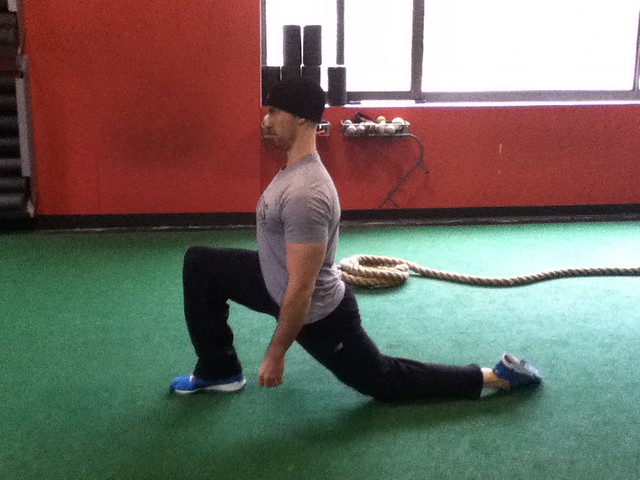
Here’s how most people stretch their hip flexor, though:
Most aren’t cognizant of pelvic positioning and just go into MORE anterior pelvic tilt and end up hanging on the ligaments of their lumbar spine. This is NOT a hip flexor stretch, and I’d argue is doing more harm than good.
Instead, I coach people to do what I like to call “doing shit right.”
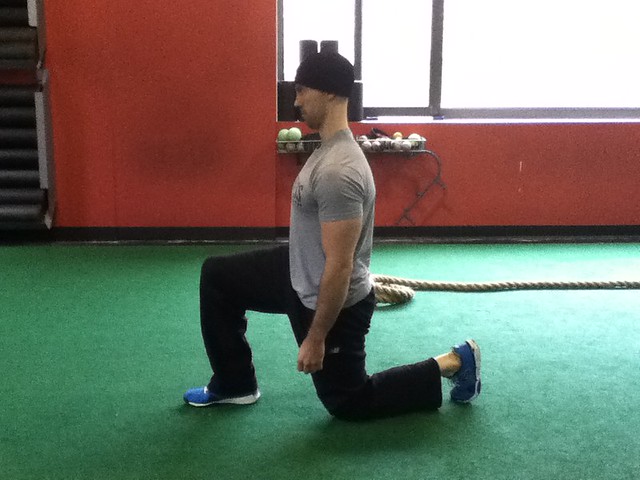
Here’s how you perform a proper hip flexor stretch:
– In the half kneeling position, think chest up.
– Dig the toes of your trailing leg into the ground (toes point into the floor).
– On that same side, squeeze the glute of the trailing leg…..HARD!!! This will posteriorly tilt the pelvis. This cue alone will DRASTICALLY increase the effectiveness of the stretch.
– From there, without cranking through the lower back, gently shift your weight forward a few ticks. It won’t take much. The idea here is to move into a “deeper” stretch through the hip joint itself and not the lumbar spine. SQUEEZE THAT GLUTE!!!!
If you’d like to up the ante, because the rectus femoris crosses two joints – the hip and knee – you can place one hand on the wall for support and reach back and grab the ankle of the trailing leg with the other hand and perform the stretch in that fashion. Honestly, though, most will feel plenty enough of a stretch without doing that.
3. Are You “Tight” or Just Unstable?
I posted this Tweet the other day:
If I had nickel for each time someone told me they had “tight” hamstrings, only to test 5/5 on the Beighton Score, I’d have a lot of nickels
This sorta mirrors my comments above – when discussing alignment – but deserves a bit more love here.
I can’t tell you how many athletes (particularly baseball players) and even general fitness clients I’ve assessed who adamantly tell me how “tight” they are (and have been told how tight they are from physical therapists) only to pass every range of motion test with flying colors and test a 5/5 (technically 9/9) on the Beighton Laxity Score.
In geek speak it’s called protective tension.
Yet, there they are……stretching, stretching, and doing more stretching.
STOP IT!!!!
These people have so much ROM and are so unstable that the body perceives it as a threat and as a results ends up putting on the emergency breaks (your body doesn’t want you to hurt yourself!).
Muscle will hold tension in the presence of implied instability of associated joints. Muscles will relax when the implied instability of the associated joint(s) is improved.
Stretching a tight muscle without improving stability will result in a muscle that remains tight.
As classic example is the person who has a poor squat pattern due to “tight hips.” They lean forward too much, their knees cave in, and they present with all sorts of compensation patterns because they’re so tight.
Of course, they’ve been doing nothing but stretching and implementing a litany of hip mobility drills to address the problem. To no avail.
Try this: have that same person hold a 5-10 lb plate with their arms extended out in front of their body and see what happens. PRESTO……..more often than not you’ll see a profound difference on not only how the squat looks, but how deep they can go.
Holding the weight out front serves as a counterbalance (easier to hip hinge back) and forces the anterior core to engage. Hence provides more stability.
And this phenomenon can be applied to other things as well. As Dean Somerset has noted on several occasions, “muscles do not have origins or insertions, merely anchors to bone.” The body is essentially one muscle connected by fascia. Anyone who disagrees can read Thomas Myers’ Anatomy Trains and get back to me on that.
Or you can watch this video by Dean and see how he’s able to increase one’s hip ROM by having them perform a few repetitions of planks (done correctly).
Note from TG: Today’s guest post comes courtesy of friend and strength coach Kelsey Reed. I’ve known Kelsey (and her husband Steve) for a few years now (they actually got engaged on my blog and came to Cressey Sports Performance for their honeymoon!)
You can check out those shenanigans HERE (<– the actual sneaky engagement post) and HERE (<– my follow-up post).
I have a ton of respect for Kelsey not only as a fantastic strength coach, but as someone I feel is a true “champion” for fostering the sentiment that women aren’t these delicate flowers who should appease themselves to the regurgitated BS that the mainstream media tosses their way.
Here she dives into fitness marketing towards women and some of the shadiness that goes down. Enjoy!
Before I dive into the meat and potatoes of the post, I want to thank Tony for allowing me to write a post for the blog (I might have done a happy dance when I began this post).
Today I will focus on the devious, misleading, and body-centric phrases that magazines, fitness products, and various other media outlets use to lure women into reading or purchasing their products. These schemes are birthed out of the intent to deliver what every woman wants: the perfect body, as dictated by their marketing.
Don’t check out yet, fellas!
I assume, since you read this blog, that you are either a fitness professional, an individual of higher enlightenment than the rest of America, or both. And we need you to help rebuke these, I think, demeaning claims and spread the good news of iron. Claims and “promises” such as:
“Lose a dress size in a week!”
“Torch those calories!”
“Flatten your belly!”
“Lengthening muscles and tone that tush!”
“Get rid of that jiggle!”
* and other such claims that are so asinine they make my cats take out their rage upon us poor humans.
Ladies and gents, we are barraged with headlines and marketing techniques designed to a) make a woman feel inadequate about her current body shape and b) continue to ingrain in her that her worth is based on her looks.
Not only do they fail to encourage, but they even discourage, the pursuit of process-oriented goals. Both a) and b) lead to repeated cycles of short bursts of motivation and hard work, followed by despair at her failures (typically because the claims above set her up for nothing but failure), and ending in a return back to her starting point.
Do this for me, Google image “women dumbbell exercises.” 99% of the images are with 5 lbs or less (and for some reason are performing bicep curls. I thought that was a guy thing?). These portrayals are ubiquitous in women’s magazines and, subliminally, tell women they can’t, or worse shouldn’t, lift heavy things.
This is what our friends, coworkers, and clients see on a daily basis.
Now, there has been a movement, “Strong is the new skinny,” which, I’ll admit, is definitely a step up.
In word, at least, it encourages women to try heavier weights and strive for strength. However, have you Googled that phrase? Do so, I’ll be right here when you get back.
What did you see?
Images of muscular (more so than usual) women who are still lean (thin) and long-legged and busty. Not that I think those attributes are wrong to possess, those models can’t help their genetic lot, and power to the women who can rock it, but those are the traits that seem to be highlighted almost exclusively.
I don’t think it’s ignoble to strive for the body of a Greek goddess, especially for women who compete in physique sports; I used to be one!
Despite the words of the message, there is still the expectation that women should look like Wonder Woman or any of the other female superheroes from old DC comics, and that simply is not a realistic goal for most women.
(I’m rather short, un-curvy, un-busty, and will never be any of those things.)
PLEASE NOTE: this is NOT me disagreeing with this new mentality that is permeating the fitness world. I DO believe that being strong is better than being skinny. After my battle with anorexia, I know better than most how damaging focusing on body image can be and whole-heartedly agree with the shift in thinking away from looks and towards performance.
The focus of our message should be to the non-physique competitors, the women who want to be strong and healthy but are still inundated with the images of busty, tiny-waisted women with a visible 6-pack.
And even though these women are more muscular than the general model to grace the cover of women magazines, there’s still the subliminal expectation that to be “healthy” or “strong” a woman’s physique must contain less than 12% body fat.
We must remind our friends, family, and clients that lifting weights alone will NOT MAKE SOMEONE LOOK LIKE THAT. More importantly: To not let the fact that they don’t discourage them or frustrate them.
We must communicate that diet and genetics play a large role in how these idealized women look; if you’re 5’1” and have the curves of a pre-pubescent boy (like me)…striving to meet these ideals will only cause frustration and disappointment.
We must live in our realities; not in the fantastical world of internet models and Photoshop.
Unfortunately, the women who most need to hear this message are not regularly exposed to resources, such as blogs like Tony’s, which encourage women to step away from the grocery store magazines. Therefore, as fitness professionals (females and males) and enlightened individuals we must do 3 things:
Reset our expectations for ourselves (ladies) and set goals that are both attainable and realistic. We’re not immune from this either and we cannot hope to inspire change in others if we have not first done so ourselves. I also challenge the guys to examine how you personally view the women you either work with or who are in your life, and see if these arbitrary standards have crept into your subconscious.
Encourage other women – be it friends or clients – to set and strive for goals that aren’t based upon an idolized “ideal” woman. Note that you can accomplish this not only through words, but also through your actions; it’s often the latter that is more effective.
Educate and continually remind those women that their goals will be accomplished through consistent hard work, patience, and embracing a process-oriented approach. The world will continually try to sell them short cuts and inflame their impatience for results. We must be the voice of unvarnished reason amidst the din.
“How do you eat an elephant? One bite at a time.” – my dad
I’m personally encouraged that there is an increasing number of women ditching the magazines in favor of a more reasonable and healthy training approach. Our job is to foster and encourage this trend.
We’re not going to change the world overnight, but we can change it one woman at a time.
Note from TG: for more on this topic you can check out my Training Jane from Joe webinar on Mike Reinold’s Rehab Webinar’s website (you get access to my webinar and HUNDREDS of others).
Kelsey Reed is head strength coach at SAPT Strength & Performance located in Fairfax, VA. Bitten by the iron bug at 16, Kelsey has been lifting ever since. Her love for picking up heavy things spurred her to pursue a degree in the Science of Exercise and Nutrition at Virginia Tech.
Now she spends her days teaching and coaching others in the iron game. In her down time, she lives life on the wild side by not following recipes when she cooks, fighting battles through characters fantasy fiction novels, and attempting to make her cats love her.
Soooo, who’s as excited as me to go see Interstellar this weekend? I bought two tickets for Lisa and I to go see it this Sunday afternoon in IMAX.
Admittedly, I’m a little biased. I’ll go see anything Christopher Nolan makes. The man can do no wrong. He could write and direct a movie about Tracy Anderson saying the alphabet backwards while curling 3 lb pink dumbbells and fighting Batman…..in space, and I’d be like “SHUT UP AND TAKE MY MONEY!!!!”
Quick Movie Fact: did you know writer/director, ChrisNo8, filmed an entire hour of this film with IMAX cameras???
As a quick reference, remember the opening sequence of The Dark Knight, when the camera panned down from the sky towards the top of the building where the bank robbers zip-lined into the next building, which was a bank, and then chaos ensued where they started shooting one another, the Joker appeared (he was one of the robbers!!!!), a bus came out of no where and plowed through the bank walls and he escaped?
Needless to say I’m super excited, and I may write up a quick review at some point this weekend like I did HERE. It all depends on whether or not I faint from excitement when the movie starts.
I like to eat meat, and I don’t really care for any program (or person) who tries to convince me that eating meat is the equivalent of shaking hands with Hitler.
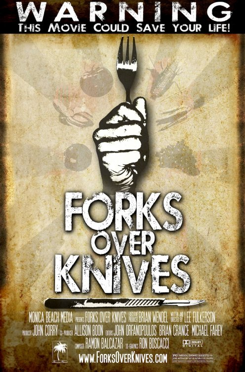
I “get” the message that documentaries like Forks Over Knives – and more recently, Fed Up – are trying to convey. The Western Diet is crap and it’s killing people. 100% agree!
But to use the approach that eating meat is the main culprit – without taking into context all the other variables in people’s diets (loads and load of processed foods, sugar, lack of fruits, vegetables, and fiber, as well as lack of exercise), not to mention the conversation that TOTAL (excess) calories matter – is shameful at best, sensationalistic BS at worst.
I felt this short rant and take on the movie by Kelsey was fantastic and brought up many valid points. Don’t believe everything you hear!!!
Also, as a reminder Examine.com’s Research Digest is on sale for 20% off through this weekend (ends on Nov. 9th). I feel it’s a fantastic resource for professional development, and even if you’re not a fitness professional is worth a look if you’re interested in staying on top of relevant nutritional topics.
Note from TG:I know some people are put off when they read something only to get to the end and find out they’re being “sold” something. I just wanted to be straight forward from the get go that what follows is an endorsement for Examine.com’s Research Digest.
I love what they do and what they stand for, and feel this is something that will help a lot of people tune out the noise and chaos propagated by the mainstream media.
I hate reading research. There I said it.
I know it seems sacrilegious for someone who makes a living doing fitness writing to say that, but it’s true. I hate it.
If I had to choose between sitting down to read an entire research study or swallowing live bees I’d seriously contemplate the latter.
This isn’t to say I don’t feel research isn’t important or that I never do it. Before people start grabbing their pitchforks and storm the castle, to be clear: I do feel it’s very important and I do read it.
It’s just that whenever I attempt to read a research study I get through two paragraphs before I start falling asleep. And if by some miracle I do make it through to the end, I rarely ever remember anything because I either 1) blacked out or 2) started making paper airplanes out of the study itself.
When I do read research, however, particularly research reviews, I always appreciate when it comes from sources that I recognize and trust.
Shit gets convoluted real quick once the mainstream media gets their dirty paws on a study. Anything that they can sensationalize and distort in order to separate themselves from the masses and to garner viewership is all they’re after.
Anyways, as much as I disdain reading research I do like to stay a head of the curve. And to that end, any chance I have to allow someone else do the “dissecting of research” for me, the better.
It’s no secret I’m a big fan of the guys (and girls) over at Examine.com. They’re my GO TO source for unbiased information on supplementation. I can’t begin to tell you how many athletes and clients I’ve referred to them.
They single-handedly solved that niche.
Now they’re goal is to make research more accessible.
And it isn’t just ONE person doing the grunt work.
– They have a panel of nerds researchers doing researchy things.
– Before anything is put to print, all their references and claims are double-checked by a group of editors hand picked for their experience and expertise in their respective fields.
– THEN there’s another round of edits and “checks and balances” done by outside industry and academic leaders to ensure a more fair and balanced representation of the information.
In addition:
1. It’s written in laymen’s terms and in a way which won’t require a Klingon-English translation.
2. It provides unparalleled professional development on a monthly basis.
3. If you don’t have the time to read ERD, you can listen to it instead. It’s also available in MP3 format.
4. And, it’s stunning to look at. The production value is top-notch. I.e., there’s pictures!!!
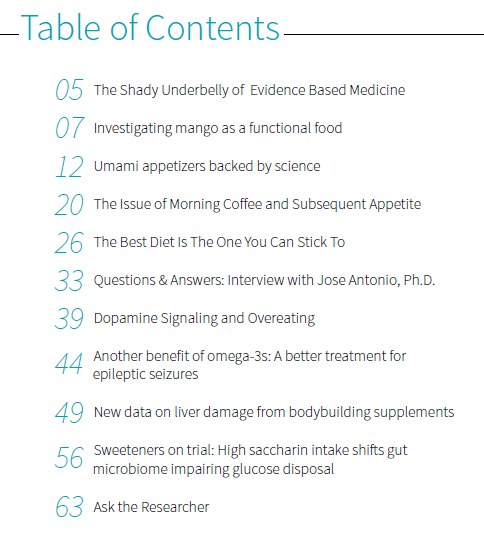
I was lucky enough to land an advance copy of Issue #1, and it’s sooooooo good I can’t even stand it. Here’s the table of contents.
Of Note: one of my favs, obesity doctor, Dr. Yoni Freedhoff, wrote this month’s editorial The Shady Underbelly of Evidence Based Medicine. And each subsequent issue will highlight other industry big wigs moving forward.
All in all it’s an excellent way to stay on top of the research, stay up-to-date with the research, and not feel intimidated by the research. All for about a $1 per day. It’s a monthly subscription.
HOWEVER, you can save 20% off the monthly price starting TODAY (Nov. 6th) through the rest of the week by going HERE.








 It’s no secret I’m a big fan of the guys (and girls) over at Examine.com. They’re my GO TO source for unbiased information on supplementation. I can’t begin to tell you how many athletes and clients I’ve referred to them.