I have a 7-month old here at home and to say that my day-to-day routine – wake up, casual breakfast, peruse the internet, take a pic of my cat, do a little writing, go lift heavy things, go coach, come home, eat dinner, watchForensic Files1, repeat – that I like(d) very much and grew accustomed to over the years has been interrupted would be an understatement.
Now my world revolves around diaper changes, eating & sleep schedules, and subconsciously rocking back and forth while standing in place (oddly, many times despite not holding a baby).
Sure I may bitch and whine about having to be more on-point and expeditious with my training – gone are the two hour bro-sessions – and also be more steadfastly aware that my ability to recover has been compromised (again, gone are the two hour bro-sessions), but it’s all good.
In the grand scheme of things I have little to complain about.
Julian is growing, happy, healthy, and already has his sights on the 2040 Olympics.2
My kid’s cute and stuff and I’d love to talk about him more, but lets get back to topic of training.
The peeps over at BodyBuilding.com knew I had become a Dad recently and asked if I’d be willing to drum up a quick-n-dirty program not necessarily directed towards new parents per se, but more so for people who are busy and don’t have copious amounts of time to get their diesel on.
I was happy to oblige and this is what I came up with.
Today’s guest post comes courtesy of good friend and Jedi strength coach, Todd Bumgardner. Many don’t know this, but Todd was one of the people who encouraged me most when I was thinking about leaving Cressey Sports Performance and going off on my own.
He’s a no-bullshitter and someone who tells it like it is. There’s a reason why 100+ fitness professionals trust him and the other coaches of The Strength Faction to help separate themselves from the masses; to get their shit together.
It’s because of articles like the one he’s sharing today.
As personal trainers, we’re like de facto members of the personal development industry. God, it feels weird to say that it’s an industry…almost spewing sacrilege. But it’s a reality. We spend a lot of time, and money, on personal development—and we really should. It’s worth it—it’s the sole reason Chris Merritt, Mike Connelly, and I run Strength Faction.
Commitment to personal, and professional, development has set all of our lives on an upward trajectory, and we want to help as many fellow fitness folks hit that same upward spiral.
I’m sure that you want the same thing for yourself and for your clients—a gradual ascension that carries everyone forward. Well, here’s some pretty goddamn obvious thinking: you can’t help your clients ascend unless you’re committed to the process. It’s a long game, and it’s worth playing. Here are a few tips we’ve found helpful for staying in the game and moving toward the goal line.
1) Realize That It’s Important
Let’s start here.
We love the X’s and O’s of our profession. We want the answer when someone asks us how many sets we should be doing for hypertrophy (there is no real answer, by the way), and we love being able to pontificate with each other on the virtues and vices of a given energy systems development strategy—when in reality ninety percent of our clients wouldn’t be affectively able to use it.
Professional development is important, so please, don’t take that as a slight.
We have to be good at what we do, and we have to get results for our people. But most of our impact, and our money, is made by being a human that’s worth being around. Granted, we all start with different raw materials—some folks have natural propensities for human connection, others have a difficult time. Some, yet, are born assholes and have to learn how to be someone worth being around. I mostly fall into the latter category.
Aw, come on: does this look like the face (or body) of an asshole?
In the context of our careers, personal development is the scaffolding that allows us to display our professional development.
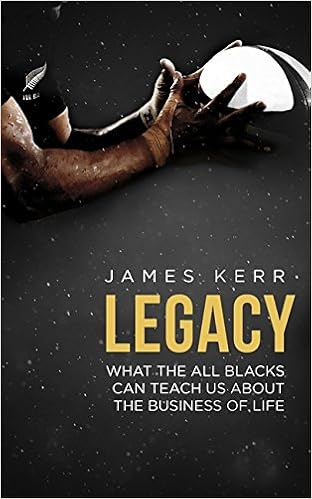
Being a growth-centered human being gives people cause to feel attracted to us—people like people headed in the right direction. It also gives us the chance to actually connect with the people that want our help. The New Zealand All Blacks live by the value that “better people make better All Blacks.” The same is true for personal trainers.
Beyond the toil of our work, personal development, in my limited understanding of life, is what we’re here to do. By the time the casket closes and the loved ones that we leave behind say their goodbyes, we should be the best possible thing that we could evolve into. I believe that’s the most important thing in the world.
2) Decide What You Value
“I really need help with time management. I’m not always sure what I should be doing, and I waste a lot of time. I feel like I never get done all of the things I should get done.”
The quotation is a conglomeration of three common statements I hear on coaching calls. Most folks feel like they need to do a better job managing their time—and they’re not wrong. But I don’t think the main problem is time management, it’s value management.
It’s tough to use time wisely if we don’t know what our aim is, what’s most important to us, where we’re trying to go.
I think we just try to be busy because it seems like everyone else is busy and that’s what we’re supposed to do. It’s the illusion of hustle perpetuated by guys that are really good at marketing on social media. They convince us that if we “grind” and follow their lead, we’ll get all the shit we want.
It’s circular, empty promise.
But it does lead us back to the starting line, the initial question: what do you want, and what do you value above all else?
Having the answer to that two-part question will give you the best insight into how you should manage your time.
Personally, I value human development for development’s sake above all else, so I don’t mind busying myself with it. But it also helps me order how I should spend my time each morning, each afternoon, and each evening.
It decides who, and what, get my time, and most importantly, my attention.
You don’t, however, have to hustle and grind if that’s not what you value—fuck the Jones’. If you value living in rural America and raising chickens, figure out how to do more of that.
If you feel aimless with your time, work through what you value you most. That will give you your aim. Then, when you have an aim to develop yourself toward, you’ll be better able to manage your time doing the little things that take you closer to that aim.
3) Just Have Good Friends (Forget About Your Goddamn Network for a Minute)
Psychological safety, unbridled truth—it’s a concept we use to guide our actions as leaders at our gym and as leaders of Strength Faction. What it means is we create a consistent, supportive environment that allows people to be themselves and feel like they are safe. Once this happens, people usually open up enough to hear the truth—from themselves and from other people. But the environment has to exist first.
That’s what a good friendship is—an environment where you feel heard and understood enough to let people tell you the truth.
And a good friend will tell you the truth, not just pat your ass and tell you that you’re special.
They’ll unconditionally show you that they love you while also holding up a mirror so you can look at yourself, recognize your faults, and do something about them. That’s the community we’ve created in Strength Faction. Our members have become friends. They look out for each other. They support each other.
And they tell each other the truth.
Here’s an example from the Summer ’17 Faction.
One member posted a poll to gather strength coach’s opinions on yoga.
At the end of the questionnaire she included a question that quite a few members thought was off-putting and unnecessary—so they told her about it.
She, then, engaged them in dialogue and explained herself.
The conversation went on, and everyone expressed their opinions, their truths, without attack. They stayed in dialogue. They were friends…even though many of them had never met other than in our private Facebook group and on our weekly ZOOM calls.
That’s what a web of friends does for your development. There’s not a lot of talk about that in our industry. Mostly the conversation centers on expanding our networks.
Don’t get me wrong, that’s important. But if you want to develop, networks need to evolve into friendships, or sometimes you have to prioritize friends over networking. Each needs to exist, but a web of friends in a community that’s moving in a good direction will do more for your life, and development, than an expansive, superficial network.
Personal Trainer, Personal Development
It’s a long game, folks. But when we commit to ourselves, and the process of personally developing over the long haul, this strange thing happens—things get better. Make some time for personal development, prioritize based on values, and make sure you have the right people around you. You’ll keep inching toward the goal line.
Enrollment for the Fall ’17 Strength Faction is currently open!
If you dig learning more, or enrolling, check out the link below.
There’s only less than two weeks left to take advantage of the Early Bird rate for Dean Somerset and I’s workshop in Orlando, at Spark Fitness, the weekend of October 21st.
I’ve never been to Orlando. I bet it’s going to be beautiful in October. Yet, there’s no way in hell I’m visiting Disney World.3
HEADS UP: We’ve also added Boston into the mix later this year. Not Burlington Boston or Beverly Boston, two cities that are lovely, albeit not (that) close to Boston.
No, this is IN Boston. In the heart of the city Boston, at AMP Fitness.
Early bird rate is in effect now and if you’re super eager to sign-up you can go HERE.
2) Strong Body-Strong Mind – Toronto
For real this time.
This was supposed to happen this past June, but Lisa and I didn’t have a passport for our little guy (then four months old) when we arrived at the airport and we had to cancel last minute.
Our bad.
We’ve re-scheduled for Saturday, September 23rd at Humber College in Toronto, Ontario. I can tell you – and I’m totally not biased when I say this (but I am) – there’s no other workshop like this in the fitness industry.
Lisa and I saw an underserved component within the industry – namely, mental skills – and we’ve combined our superpowers skill-sets to provide a 1-day curriculum that will help fitness professionals develop better skills to build competency, autonomy, and rapport with their clients, in addition to coaching skills (assessment, program design, exercise technique).
NOTE: the registration process is a little bit tricky and if you get to the point where you feel like you’re going to toss your face into the keyboard, please contact Bradley Corcoran at: [email protected]
Hope to see you there.
3) Elite Fitness & Performance Summit – Chicago
I’ll be in Chicago this September alongside some other phenomenal speakers for the Elite Fitness & Performance Summit. The cast includes:
Nick Tumminello
Mark Fisher (if I have to follow him on stage I’m going to be pissed)
Josh Henkin
Nick Berry
Molly Galbraith
Krista Scott-Dixon
Ryan Ketchum
And many, many more. It’s one of the most action-packed fitness events of the year, so be sure to reserve your seat ASAP. You can go HERE to do so.
Fun Tony factoid: Stumptuous.com (Krista’s site) was one of the first fitness blogs I ever started reading. It’s also where the seeds were planted on this whole idea of infotainment and how I got into writing myself.
She’s an amazing writer and very knowledgable coach. And she swears. She’s good people.
Social Media Shenanigans
Twitter
Learn to pick your battles & prioritize. Client lacks big toe dorsiflexion yet can’t perform a push-up. Work on the push-up, jackass.
I’m not someone who feels everyone needs to squat with a barbell on his or her’s back. I kinda lose a lot of respect for those coaches who have a knack for putting their ego and bravado a head of individual variances in anatomy, ability/skill level, injury history, not to mention goals.
Call me old-fashioned but I’d rather STFU and listen to my client/athlete’s preferences and what feels best to them (and what will breed immediate success) than to force my ideologies and way of doing things into their mix….and then expect they’re going to apply to every…single…individual I work with.
That being said I’m still very much a fan of squatting. And yes, a fair portion of my clientele do back squat.
However, a fair portion do not.
And that’s cool.
The world will continue to spin.
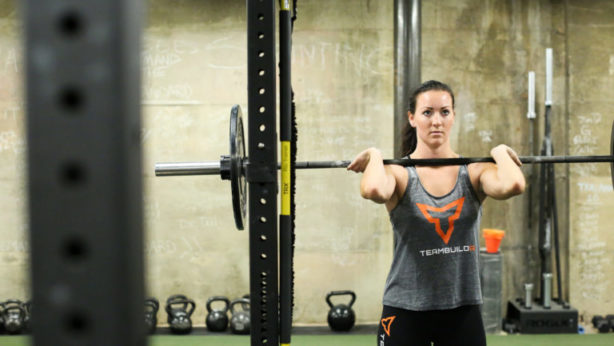
There are numerous ways I can have people squat that will take into account the premise of minimal load/maximal training effect. For long-term, consistent progress the idea is to load people juuuuust enough that they nudge the body to adapt, but also take into account it’s ability to recover.
NOTE: Just so the internet doesn’t have a conniption or shit a copy Supertraining, I want to reiterate that I do like traditional barbell squatting (back and front squat) as well as any speciality bar variation that suits your fancy – SSB squat, GCB squat Duffalo bar squat – and feel all should be considered the first “tier” if the goal is to add mass or get stronger.
That said, we don’t always have to crush people. And, to be honest, the more “joint-sparring” modalities I can incorporate or pepper in the better.
Offset Shouldering Squat
Who Did I Steal It From? – Aw, snap. I can’t recall. One of my female clients showed this variation to me off of someone’s Instagram account that she follows.
It wasn’t God. It wasn’t John Cena.
Man, I can’t remember.
Sorry whoever I “stole” this from.
What Does It Do? – This variation is a close cousin to the traditional Landmine Goblet Squat – where the barbell is held at chest height right against the sternum. What’s makes that such a nice iteration is that the bar path is somewhat (not completely) fixed which makes the movement easier to control and groove.
In addition, the Landmine Goblet Squat helps reinforce the “chest up” cue and more or less organically teaches people to sit “into” a proper squat position.
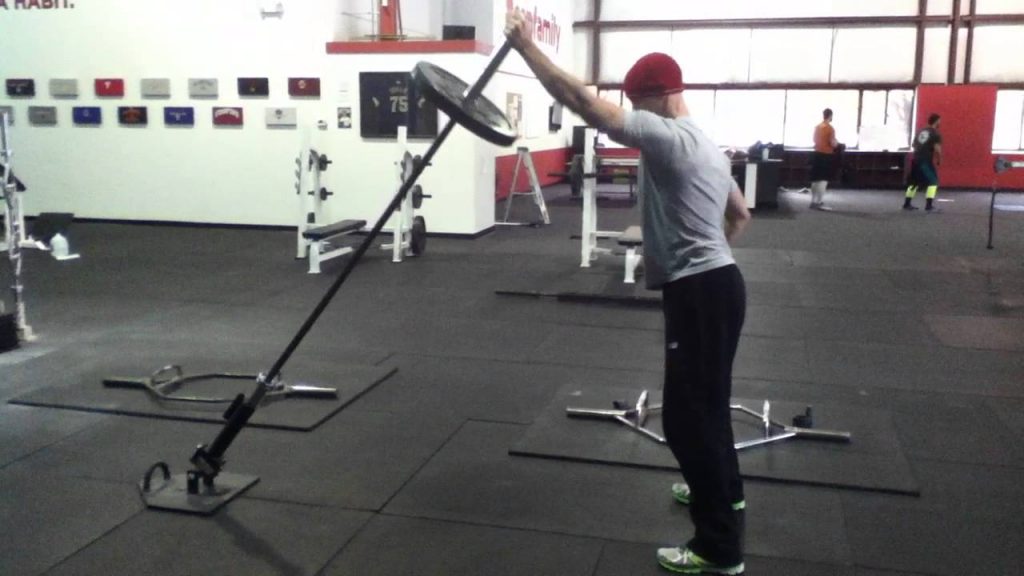
By moving the barbell to one shoulder or the other – in an offset position – we now add a significant rotary stability component to the movement.
In other words: your core stability will be like “whaaaaaaaat?”
Key Coaching Cues: You don’t have to use one, but I like to place a squat or hip thrust pad on the end of the barbell so that it can rest on the shoulder without any major discomfort. The idea is to let the barbell rest in place – don’t actively hold it there.
And then, you know, squat.
Like I said, the advantage of using the Landmine is that the bar path is pretty much set. There isn’t much thinking involved and the squat will come instinctively to most.
I’ve been having my clients perform 5-6 repetitions PER SIDE trying to emphasize being explosive with each one. I’ll also add these would probably be best served as a nice accessory squat movement to the traditional back or front squat.
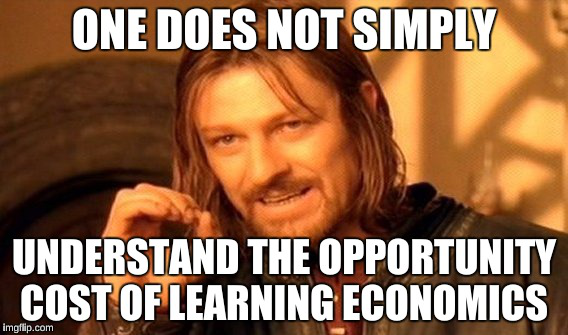
Today’s guest post from regular contributor, Justin Kompf, discusses a phenomenon everyone deals with on a daily basis: opportunity costs.
For example, the opportunity cost of me posting pictures of my cat in different outfits everyday is that I don’t get invited to public gatherings all too often.4
In the health & fitness realm we battle opportunity costs all the time. It drives why we may hit up the pizza buffet rather than make an omelet, or why we’d choose to go exercise over going out drinking with our friends. Opportunity costs very much play a role in our ability to make healthy decisions and differ person to person.
I hope today’s post helps shed some light on a very important and relevant topic.
In college, I had a roommate who would tag along with me to the grocery store. He had this habit of always performing the mental arithmetic to determine how much chicken he could get for the price of any one item.
“Hmm this bacon is $6.00 but I could get 2.5 pounds of chicken for the same price.”
“Well, I like steak but I could get double the amount of chicken for this.”
What my friend didn’t know was that he was demonstrating, nearly perfectly, an economic principle called opportunity cost. The text-book term for opportunity cost is “the unrealized flow of utility from the alternatives a choice displaces” (Frederick, Novemsky, Wang, Dhar, & Nowlis, 2009).
To a money saving 21-year-old, opportunity cost begs the question; is 2 pounds of chicken plus an extra four dollars more valuable than eating steak?
Opportunity-cost dictates that anytime we make a decision between several choices we give up the benefits of the alternative choices.
People do not implicitly think about opportunity-cost when making purchasing decisions (Frederick et al., 2009) and I would argue that they fail to as well with health decisions. Further, most people limit themselves in their decision-making process to usually one of two choices (do this or that, pick this or that).
Identifying the opportunity cost of healthy decisions in a similar way to economic decisions may prove beneficial. In order to do this, one would simply replace a dollar amount with a caloric amount or replace lost time amounts that could be used on activities other than exercise (i.e. family time vs gym time).
Opportunity Cost Application to Health Decisions
It would be useful to identify opportunity cost to help resolve ambivalence in the healthy decision making process. Competing demands often do exist between a person’s desires to be physically active and to be sedentary (Smith & Biddle, 1999).
Similarly, anyone that has attempted to lose weight likely understands the competing demands between the desire to be lean and the desire to eat tempting food.
Taking part in one of these pursuits inherently means foregoing the other (i.e. you cannot be sedentary and exercising at the same time) and therefore not realizing the benefits that each activity provides.
Opportunity-Cost Scenario 1
Take for example, one scenario where an individual has strong beliefs that if they exercise their fitness can improve; thus, reducing the risk for cardiac disease. They also hold a competing belief that if they exercise time will be taken away from their family (Godin, 1993).
Perceived cost: lost health benefits vs lost time with family.
Perceived opportunity: improved health vs more time with family.
Opportunity-Cost Scenario 2
In another example, if a person has the option between a fast food dinner and a home cooked meal they must decide between the hedonic pleasure and convenience of the fast food meal and the health benefits of eating the home cooked meal.
Perceived cost: high calorie foods can lead to weight gain vs loss of pleasure and time.
Perceived opportunity: improved health vs pleasure and more time.
Reframing Choices and Resolving Ambivalence
In scenario 1 it is perceived that time can only be spent exercising OR with family. Pursing one choice will remove the benefits of the other.
Many people examine the decision-making process as the choice between one of two options (Heath & Heath). However, this is rarely ever the instance in any decision.
In the case of the potential exerciser, the opportunity-cost may seem relatively salient (this is likely different in food choice as most people do not naturally consider opportunity cost, Frederick et al., 2009) yet they remain indecisive.
The individual in this situation is likely feeling ambivalent about the decision process. They want to exercise, but at the same time they don’t want to exercise because of the cost.
This person may be falling into a decision-making mistake called the ‘limited search trap’. In scenario one the best solution would be to help this person ‘widen’ their options (Nutt, 2004).
Rather than limit the decision-making process to two options this person should think of other ways they could be active without losing out on family time. Some of these options might include:
Option 1: Exercise with the family by recruiting family members to go for walks after dinner to discuss the day.
Option 2: Exercise for 30 minutes during a lunch break. This time would not be spent with the family anyways so this time is not being taken away from the family.
Option 3: Evaluate how other time is spent. Perhaps this person spends an hour of time before they go to bed watching TV. They can cut their TV time down to 30 minutes and replace the other 30 minutes with 20 minutes of cycling, walking or running and the remaining 10 to shower.
In scenario 2 an individual is faced with the decision of eating a fast food meal or a home cooked dinner. This would be an appropriate scenario to help increase the salience of opportunity-cost to aid the decision-making process.
This person might compare the calories (1,050 vs 550), they might judge what would taste better based on the mood they are in, or they may factor in time constraints. But they don’t see that they could (1) double the healthy meal and still have nearly the same number of calories or (2) save those extra calories for something else such a 300-calorie popcorn during the movies (still 200 calories less).
They were already willing to ‘spend’ 1,050 calories. By utilizing this opportunity-cost strategy they may be able to more readily observe what other foods or ways that they could ‘spend’ their calories on.
Conclusions
If a person is struggling with making the best possible decisions for their health and well-being they may benefit from a thorough examination of the opportunity-cost of their behavior.
In other cases, opportunity-cost may seem explicit, as in the case of the exerciser but only when trapped in limited searching.
For ambivalent individuals who seem to have clear opportunity-cost increasing the number of available options can help in the decision-making process.
About the Author
Justin is a doctoral student at the University of Massachusetts Boston where he is studying health and exercise sciences. Justin writes at www.Justinmkompf.com.
References
Godin G. Theories of reasoned action and planned behavior: usefulness for exercise promotion. Medicine & Science in Sports & Exercise 26(11), 1391-1394, 1994.
Frederick S, Novemsky N, Wang J, Dhar R, Nowlis S. Opportunity cost neglect. Journal of Consumer Research. 36(4): 553-561, 2009.
Nutt PC. Expanding the search for alternatives during strategic decision-making. Academy of Managment Executive 18(4), 13-27.
Smith AR, Biddle SJ. Attitudes and exercise adherence: Test of the theories of reasoned action and planned behavior. Journal of Sports Sciences 17: 269-281, 1999.
It’s been quite the week, huh? While I’d like to sit here and espouse a plethora of nuanced commentary on the unfortunate, and, quite frankly, sickening events of this past week here in the U.S., I feel all I can really add to the conversation is this admittedly un-nuanced soundbite:
There’s only less than three weeks left to take advantage of the Early Bird rate for Dean Somerset and I’s workshop in Orlando, at Spark Fitness, the weekend of October 21st.
I’ve never been to Orlando. I bet it’s going to be beautiful in October. Yet, there’s no way in hell I’m visiting Disney World.6
HEADS UP: We’ve also added Boston into the mix later this year. Not Burlington Boston or Beverly Boston, two cities that are lovely, albeit not (that) close to Boston.
No, this is IN Boston. In the heart of the city Boston, at AMP Fitness.
Early bird rate is in effect now and if you’re super eager to sign-up you can go HERE.
2) Elite Fitness & Performance Summit– Chicago
I’ll be in Chicago this September alongside some other phenomenal speakers for the Elite Fitness & Performance Summit. The cast includes:
Nick Tumminello
Mark Fisher (if I have to follow him on stage I’m going to be pissed)
Josh Henkin
Nick Berry
Molly Galbraith
Krista Scott-Dixon
Ryan Ketchum
And many, many more. It’s one of the most action-packed fitness events of the year, so be sure to reserve your seat ASAP. You can go HERE to do so.
3) Appearance on The Strength House Podcast
It was great to catch up with old friends Greg Robins and Tony Bonvechio. I think I am officially the smallest & weakest guest they have ever had…;o)
A common practice is giving near maximal effort on every….single….exercise. I love when people want to work that hard, but that mentality can also be as detrimental as it can be helpful.
Here’s John with a nice, rational piece explaining why “precision” and doing exercises correctly is vital for short and long-term success.
I think I like Erica’s writing because much of the time it mirrors my tone and I can appreciate a good “bang my head against a wall” joke and references to dragons.
But, too, I think she makes a lot of sense and I respect the advice she gives.
People tend to over-think things and are always after what’s “best” or “optimal”
Newsflash: it all works.
Social Media Shenanigans
Twitter
Stop using assessments to show people how broken they are. Use it as an opportunity to demonstrate to them success.
For starters, I get a nice stroke to my ego. I mean, who doesn’t like talking about themselves for 30-60 minutes?
Second, and less-douchey of a reason, I consider it an honor every time someone reaches out to invite me on their show. It doesn’t matter to me if they have 10,000 listeners, a 100, or even 10…unless the show is titled Deadlifts Are Stupid or, I don’t know, The Tony Gentilcore Has a Small Penis Show I’m probably going to say yes and make an appearance.
Recently I was invited onto the Barenaked Health Podcast with Nick Horowski.
Cool factoid: Nick reached out by linking to a personalized video he made of himself walking somewhere (it looked like it was a baseball field) with his toddler strapped to his back. He had some nice things to say and mentioned how’d he’d love to have me on his show.
It was a nice touch.
How could I say no?
We discussed a lot of things: what “strength” is, why it’s okay to say “I don’t know” or to even change your mind on things, the absurd notion that deadlifts are dangerous for everyone, and I’m sure we snaked in some Star Wars references to boot.
For some people seeing the words “Turkish Get-Up” in the title of an article elicits a gag reflex or makes them want to jump into a live volcano.
Even I’ll be the first to admit it’s not the most exciting exercise to talk about.
However, that doesn’t mean it’s altogether invalid or that it doesn’t deserve our undivided attention. It’s an exercise that has carryover to many facets of fitness whether you’re a beginner or elite athlete.
Call me crazy, but I wholeheartedly believe it has a time and place in everyone’s programming.
In today’s guest post by Calgary based personal trainer, Linden Ellefson, he breaks down the movement into more manageable, bite-sized tidbits that’ll (hopefully) convince you to give it a try.
Shoulder, chest, and arm development will skyrocket due to the amount of time you spend keeping the kettlebell above your head.
It will iron out any left to right imbalances, meaning that your bench press and squat will likely improve because both are being trained equally.
Because your hip moves in multiple planes of movement, you train your hip more than up/down and forward/back like a squat or deadlift. This helps prevent injury.
Another benefit of this exercise is that since there are so many pieces to the exercise, you can work on improving each step to get better at the whole.
If you aren’t drooling with anticipation to master this exercise and be the envy of your entire gym, we can’t be friends.
You’re going to need:
Overhead Mobility: Can you put your arms overhead so that your biceps rub your ears without your lower back compensating?
Hip Hinge: Can you move your hips independently of your lower back? If so, then feel free to give this a shot!
Obligatory “If You’re Hurt, Then Read This” Warning: If you are currently going through an injury, then you need to see a physical therapist or doctor to get out of pain first. Do that, THEN you can learn your turkish get-ups.
Lets Get to the Breaking Down Part
While this exercise may look complicated when we look at the whole, there are actually five different parts you’re going to learn about. Here’s what they are.
Drive to the elbow
Press to the hand
Bridge the hips
Sweep the foot underneath
Half kneeling position
Stand Up
If you watch this video, you’ll know how technical this movement is.
This is best learned by having someone coach you through it. If you have access to a competent coach, be sure to learn this from them.
Note From TG: You can find competent coaches by perusing both the StrongFirst & RKC (Dragondoor.com) websites.
If you like learning by reading, read along!
A Couple Keys to Keep in Mind.
There is a concept known as active and passive shoulder. When you have an active shoulder when someone pulls on your hand, your whole body would come with it. When you have a passive shoulder, it means that your shoulder moves independently of your body. We’re looking to keep your shoulder active the entire time.
You’ll naturally press into the hand that’s holding the kettlebell, but I also want you to press into the ground with your bottom hand like you’re a wide receiver trying to stiff arm the safety as you run to the endzone for a touchdown. This will allow you to keep the shoulder in a safe position, not increasing your risk of shoulder pain.
Ready to learn? Let’s start then.
Drive to the Elbow
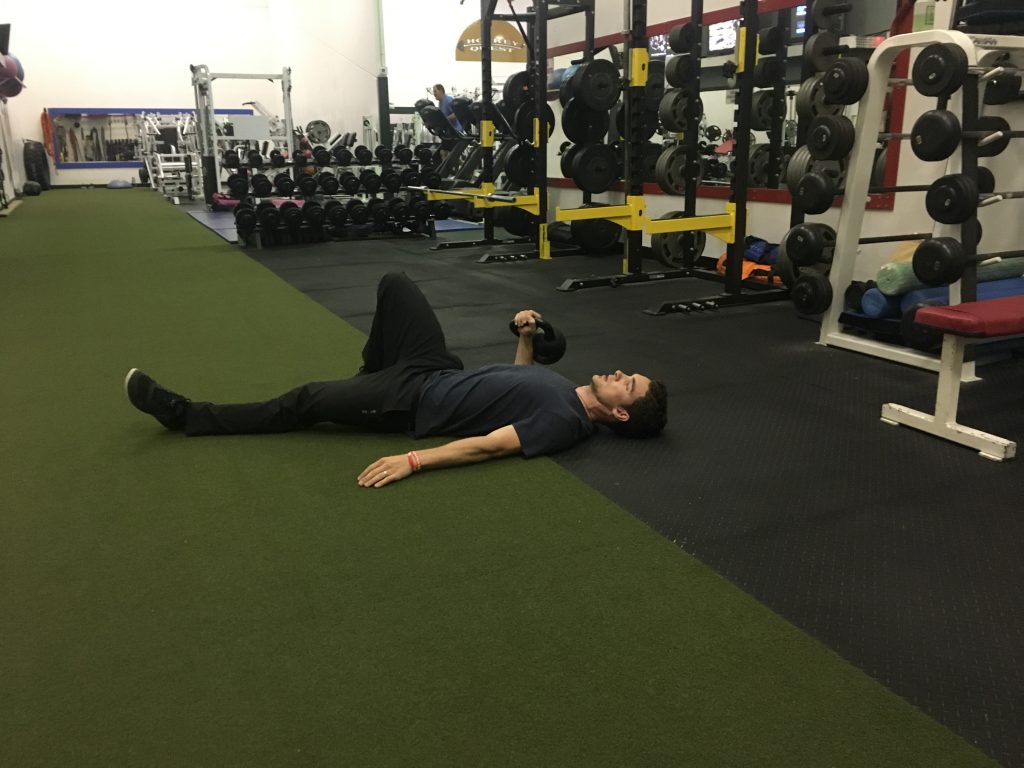
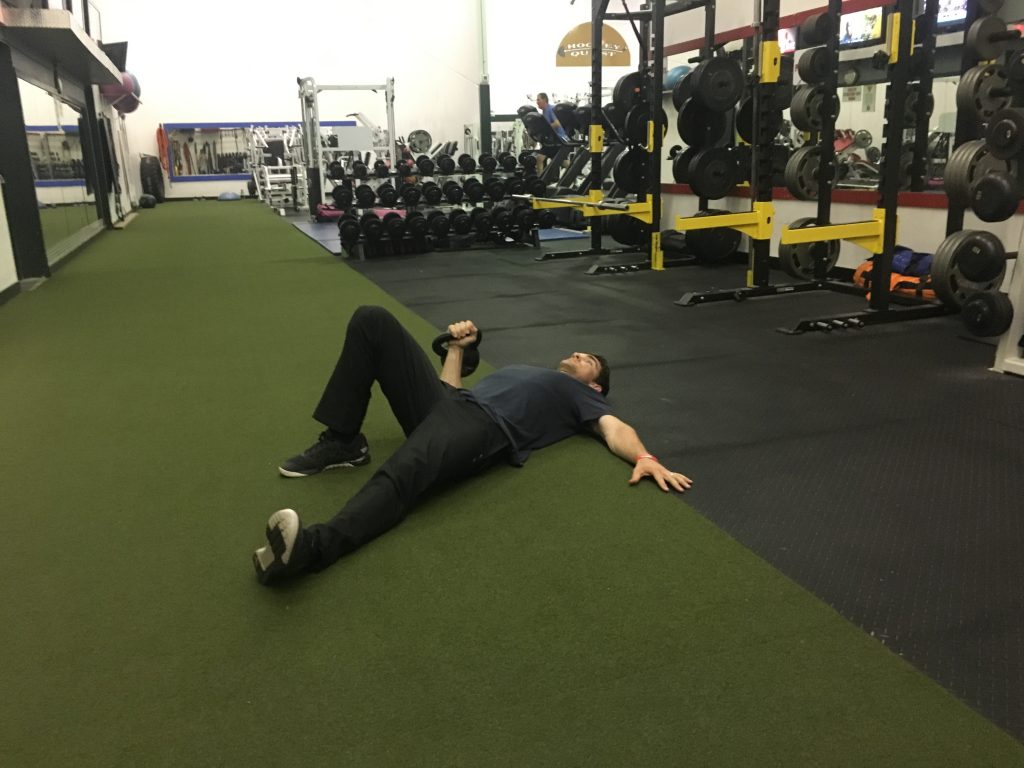
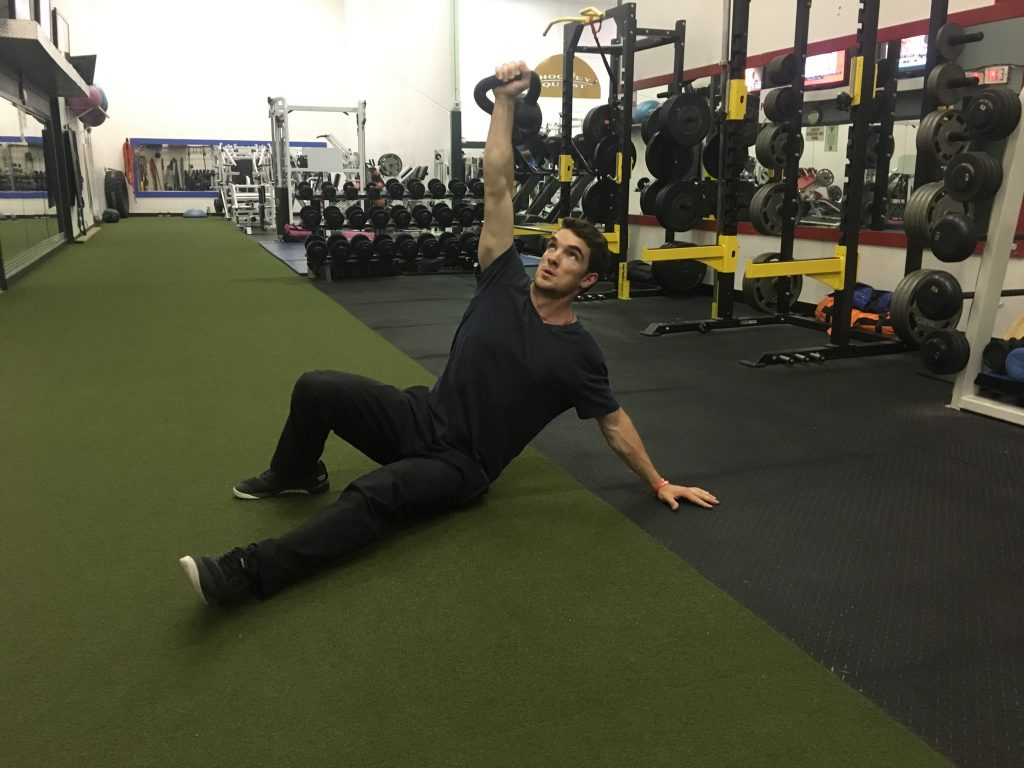
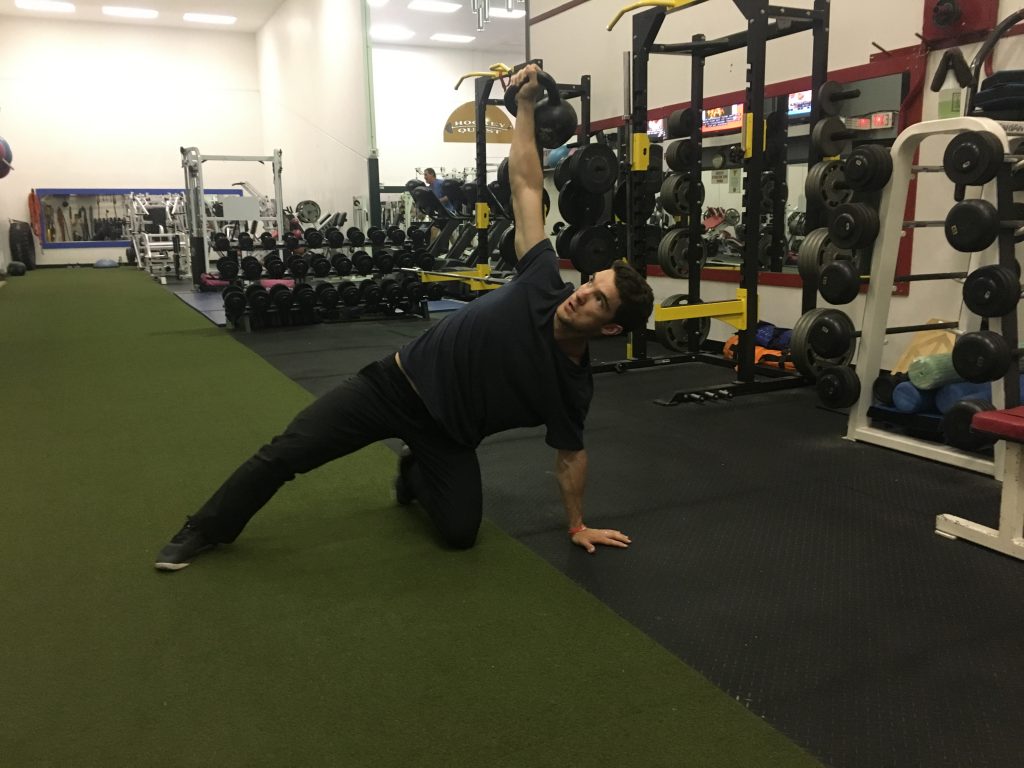
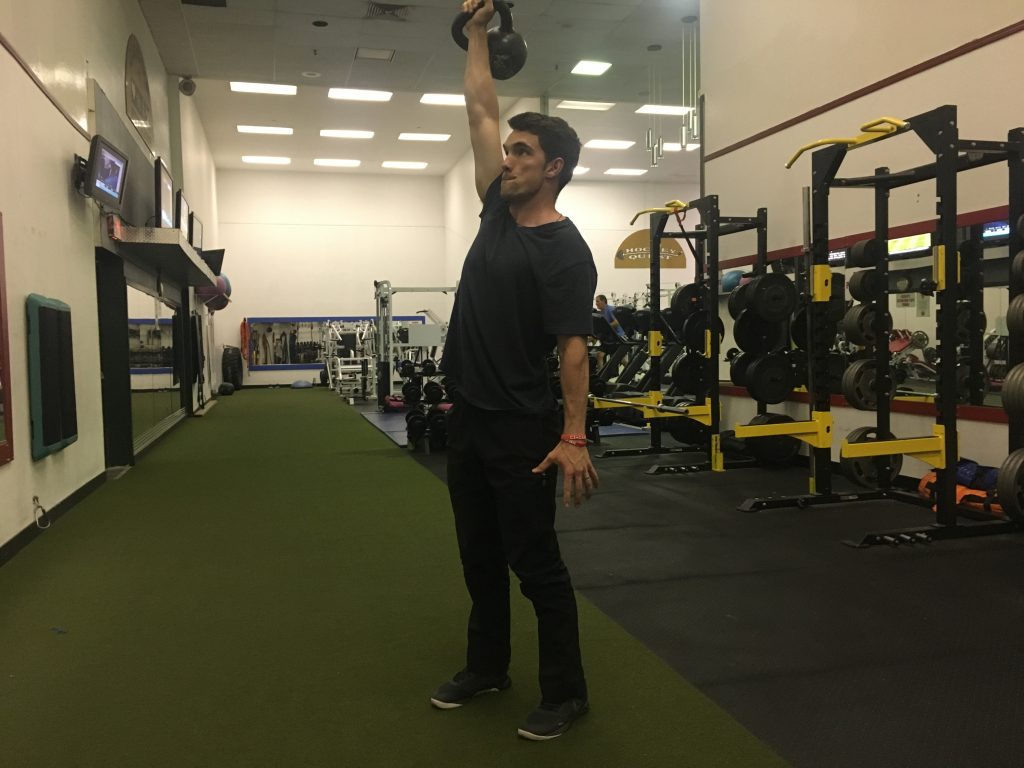
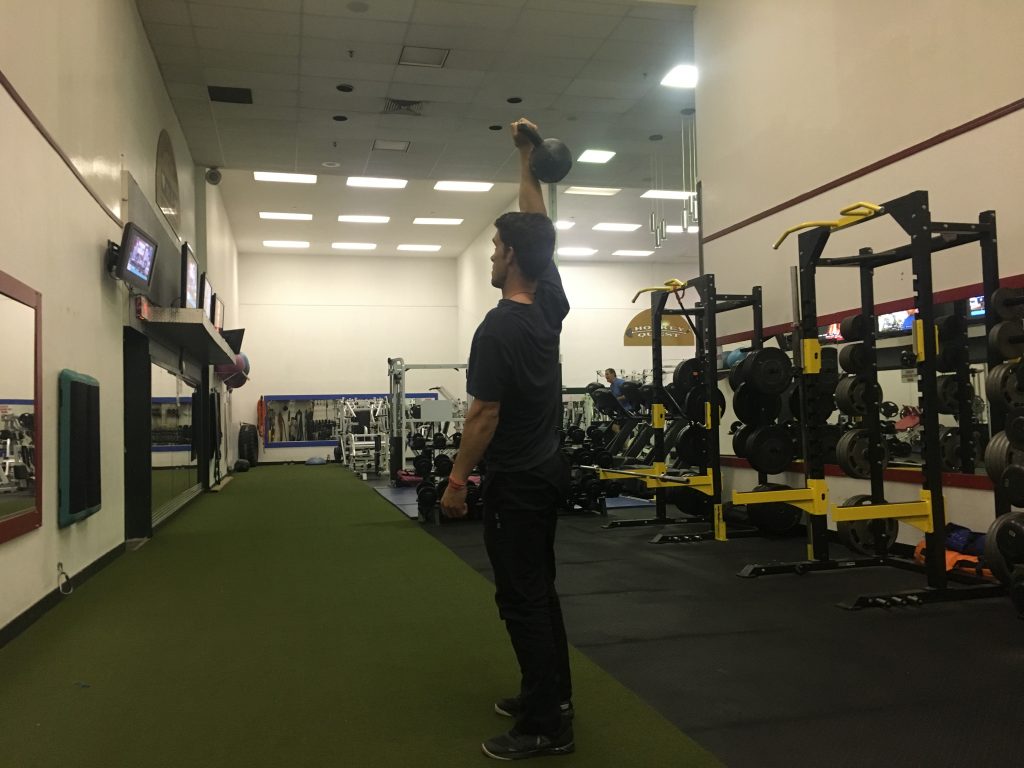
Assume you’re using your right hand. Start with the kettlebell directly above your elbow at a 90 degree angle. Your right knee is at a 90 degree angle with your foot on the ground. You will look like the following:
From here, drive the kettlebell across your body as if you’re going to punch someone. Push with your right leg as well.
As you drive the kettlebell in the air across your body make sure you push through your elbow into the ground. When you do this, your shoulder is less likely to get injured.
Part 1 done! At this position, you should feel your back turned on, your shoulders nice and warm, and core turned on too. Finish position below:
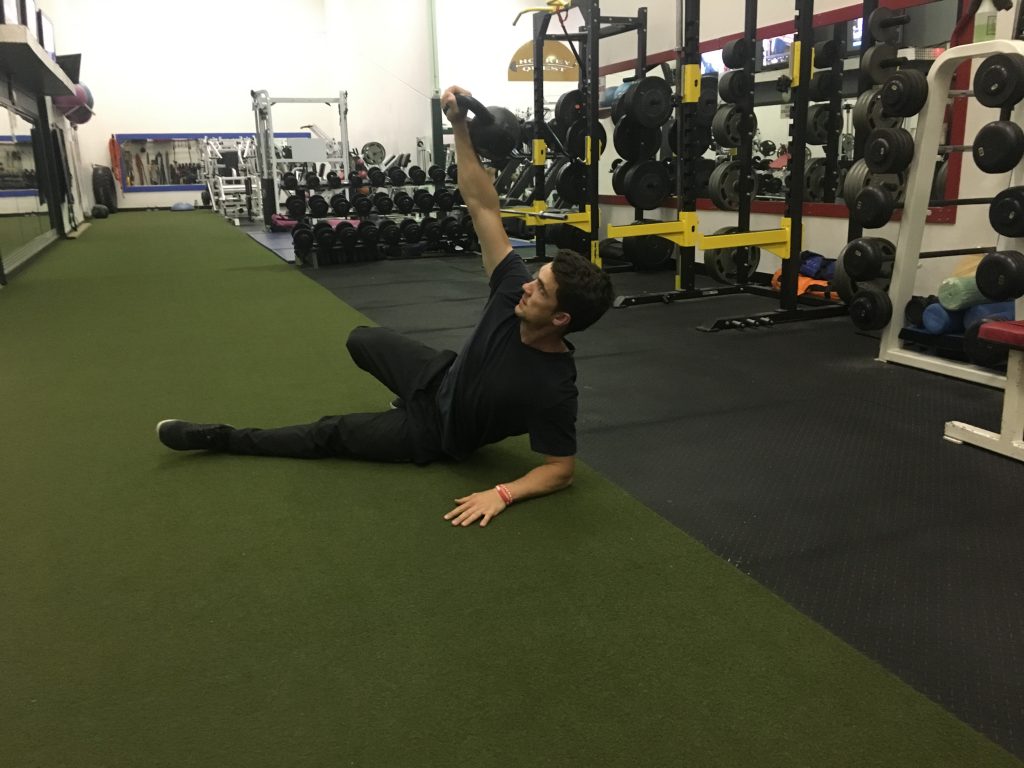
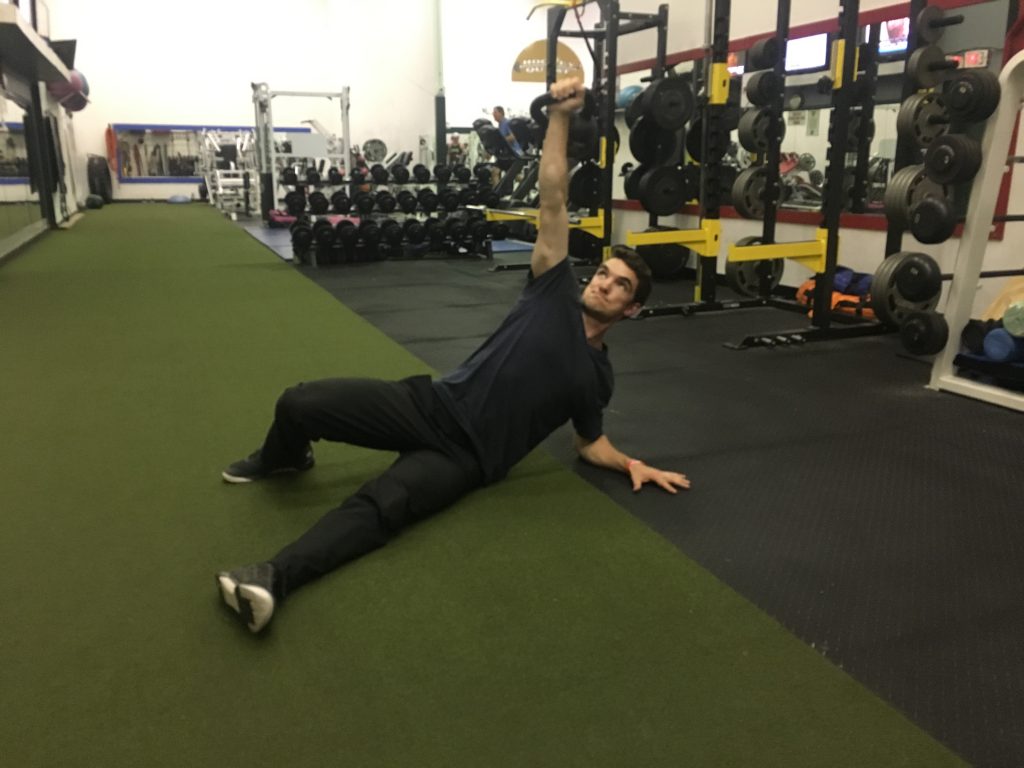
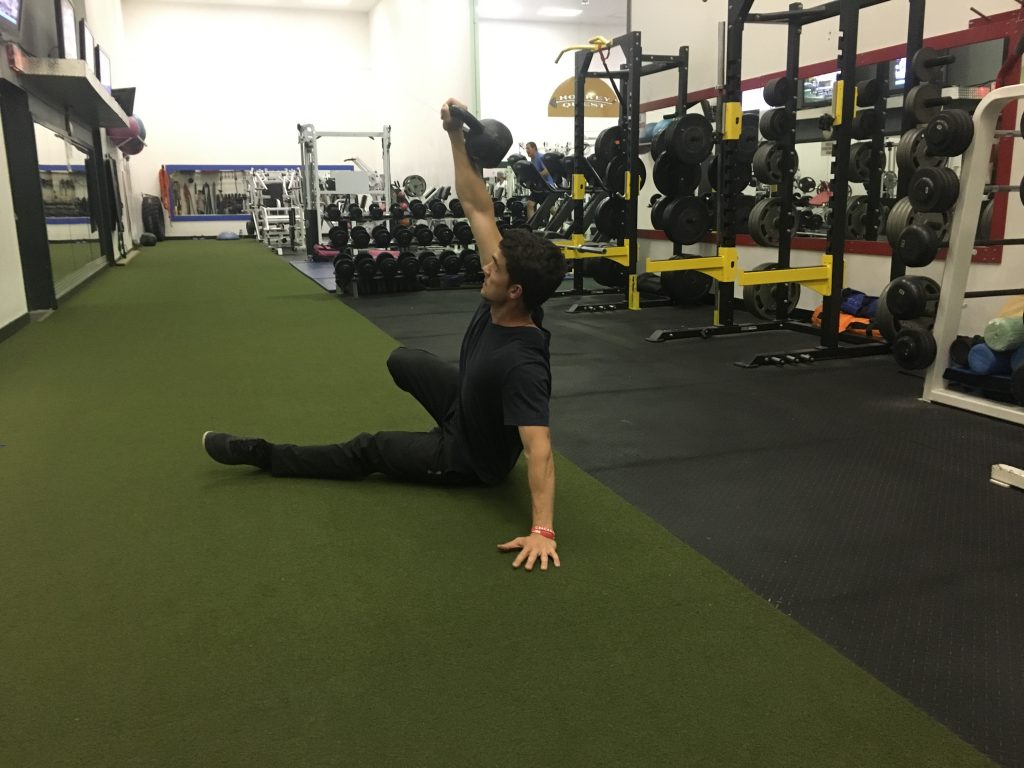
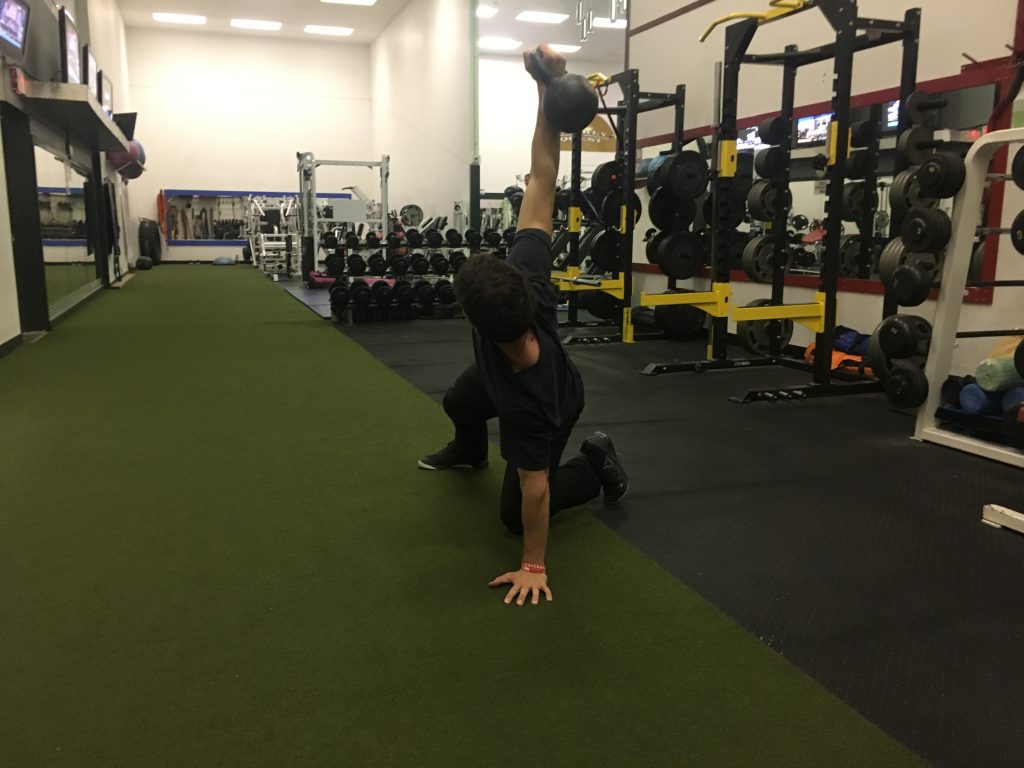
Press to Hand
With your right hand in the air, extend your left elbow and squeeze your tricep as you press up onto your hand, just like a tricep extension. When you finish you will look like the following:
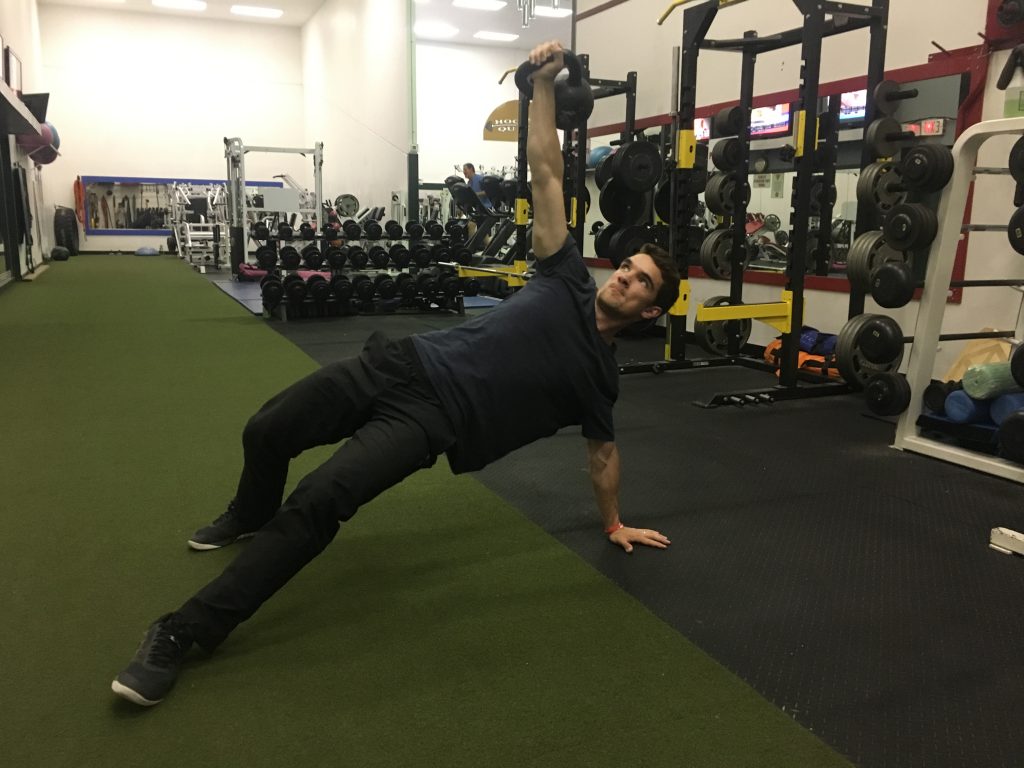
Hip Bridge
This step can cause the most problems with trainees. Make sure your both the bell hand and the hand on the ground are stable. When here, drive your hips up in the air by aggressively squeezing your glutes.
Like a deadlift.
Or other fun activities 😉
The higher you can get your hips, the easier the next step will be.
This is the finish position:
Note From TG:As an alternative, and I hope Linden doesn’t mind me poking my opinion into the mix, I’m not married to trainees always performing the high bridge option. Both Gray Cook and Dr. Mark Cheng (the latter likely should get more credit) note that this is a “speed bump” or fork in the road to the get-up.
Meaning we have some options.
There’s the high-bridge option which is delectable option for those with optimal hip mobility and hip flexor length.
And then there’s the non high-bridge option where one more or less sweeps the leg – Johnny Lawrence style – and transitions to the half kneeling position from sitting.
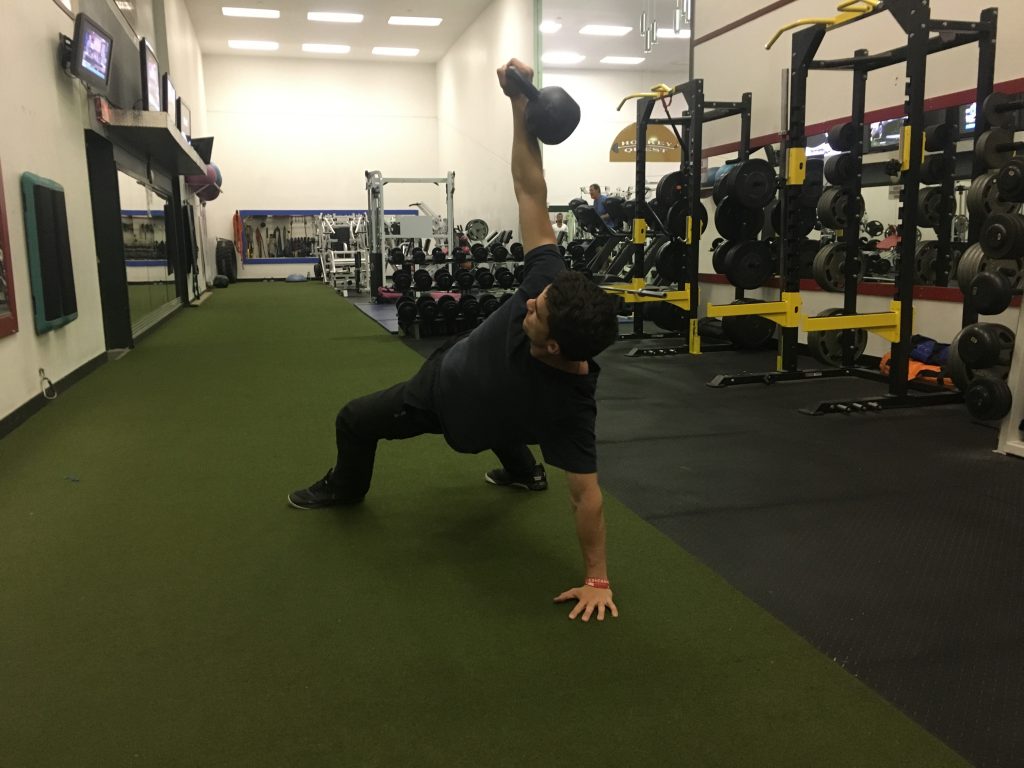
Sweep the Leg
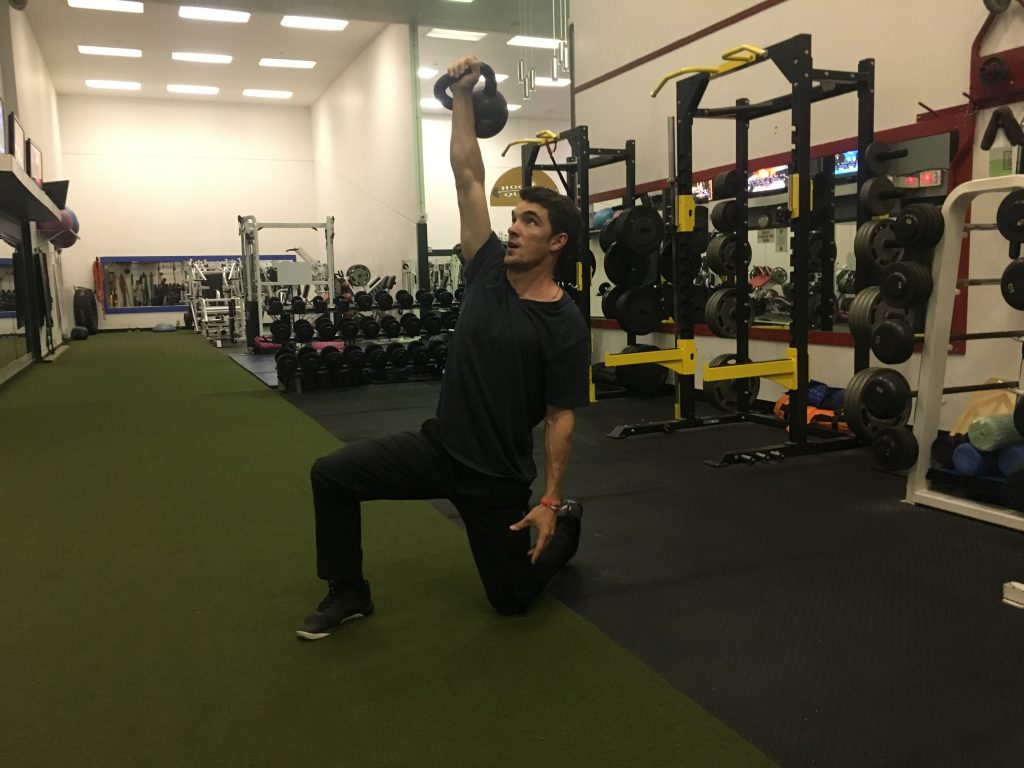
From here, you’re going to take your LEFT leg, and sweep it underneath your right leg and place your left knee directly underneath your hip. Your right arm will still be in the air, and your left hand directly below your right. You will look like the following picture:
Half Kneeling Position
This isn’t a movement, but the position you end in. You DON’T use your back to get to a kneeling position with the bell above your head. Instead, you’re going to brace your core, squeeze your butt and push your hips underneath your upper body as you press the weight up.
Your butt is fully engaged here as you keep the weight up. Keep your core tight as the tendency here will be to use your lower back to keep the shoulder stable.
The picture of the position is below.
Note From TG:Hey, it’s me again. This is yet another speed bump to the Get-Up. The most popular option to transition to the half-kneeling position is the “windshield wiper” the back leg and position into half-kneeling.
This is fine.
However, it can oftentimes feel wonky to a lot of trainees.
Another option I like is this:
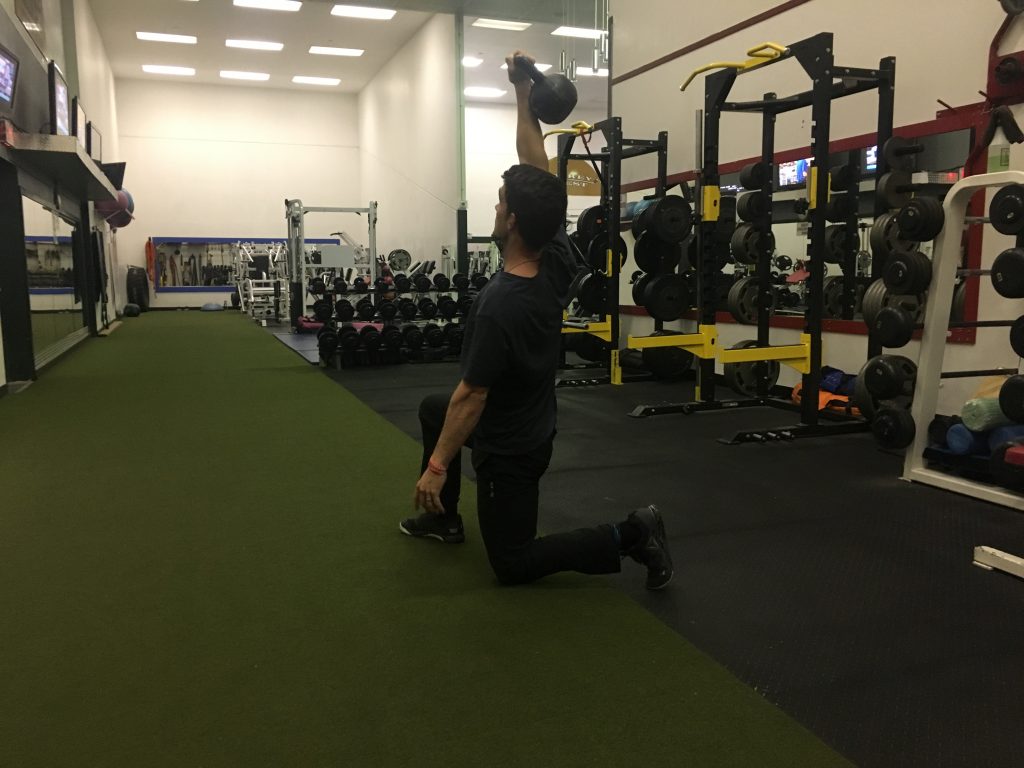
Stand Up
This is essentially where we stand up from a lunge. With the weight over our head, we’ll stand up using the entirety of our legs. Stand up from there.
Finished position below:
With that, we’re going to reverse this whole process to lie back down.
If you understood all that and put it into practice, then you might have successfully completed your first turkish get-up.
OR you might have picked up a couple cues to clean up your relatively hideous one.
Where Should You Put It In Your Workout?
Without understanding how to put it into your workouts, it does you no good. There are three places where I would suggest using them.
As a Warm-Up. Since this uses every muscle, depending on your workout for the day, you can emphasize different steps to get specific muscle groups prepped.
Doing upper body? Spend 3 Seconds in each position until you Sweep the Leg. Got a killer deadlift workout coming? Spend 3 Seconds in each step from the hip bridge on.
Use it as part of your strength programming. This can work as your second or third exercise in an upper body day or your full body workouts. Due to the length of this exercise, if you’re looking to get stronger, I would suggest sets of 3-5 reps with a heavy bell. Start with 35lb as a man, and 15-25lb as a woman.
Use it for conditioning. With a lighter bell than you would use for your strength work, set a timer for 10-15 minutes and see how many good quality Get-ups you can do in the time frame. Alternate your hands every rep or after every second rep. Challenge yourself to be better next time.
If you want a good challenge, one of my new favourite conditioning combos is to use turkish get-ups and overhead walking lunges together. Check out the video below to see how to perform it.
If you follow this step by step guide, along with download the accompanying video, you’re going to master this exercise in no time. Use this exercise, abuse it, and thank the fitness fairy godmother for this one when you get a chance.
About the Author
Linden Ellefson,
Bkin, CPT
Linden is a Calgary, Alberta personal trainer and online coach. He loves good coffee, his Boston Terrier Taco, and a great workout. Most of all, he loves making his clients the strong, pain free, athletic beasts they were meant to be.
To find out more from Linden connect with him at www.lindenellefson.com Facebook (he’s the only Linden Ellefson), or onInstagram.
I get it: boring isn’t sexy. And it sure as shit doesn’t help sell DVDs or keep people’s attention at 3 o’clock in the morning watching the latest infomercial on how performing 47 different bodyweight calisthenics while juggling two machetes – you know, to keep the body guessing – is the key to your ultimate body.
BONUS: If you order within 30 minutes you’ll also receive a month’s supply of grass-fed acai berries soaked in the belly-button sweat of a Centaur.
Because, why the fuck not? And, science.
People have been sold on the idea of incessant novelty and variety being the determining factor in getting results at the gym.
I disagree.
“The greatest gap in most people’s training isn’t lack of novelty, but rather lack of mastery.”
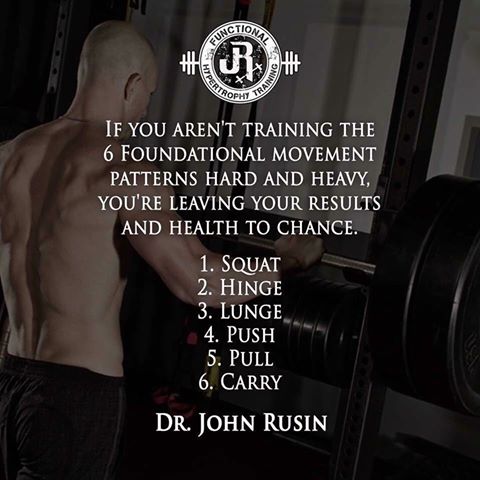
It’s telling, then, that many of the most popular training programs around and top coaches in the industry often predicate their roots and training around these basic movements: squat, hinge, push, pull, lunge, carry.8 That’s it.
That’s about as un-sexy as it gets.
However, what’s often lost in the age of exercise ADD is that those six categories alone can be broken down into hundreds of iterations when you factor in variances in grip used, stance used, sets/reps, load, tempo, speed of movement, not to mention barbell vs. dumbbell vs. kettlebell vs. bulldozer (depending on how ginormous of a human you are).
There’s more than enough variety to keep even the most strident exercise enthusiast satiated for a fitness lifetime.
To that end, I can see why some people aren’t as enamored with the Landmine Press as others.
Upon first glance it’s the vanilla ice-cream or NASCAR of the strength and conditioning world.
“Oh, you mean, like, you just press the barbell up and down like that? At an angle? Repeatedly?
It’s nerds like me who can see the bigger picture and can appreciate how valuable of an exercise/drill the Landmine Press is.
I’ve waxed poetic enough in the past on the importance of overhead mobility and people’s lack of ability to do so in a safe and efficient manner.
You can check THIS article out; or THIS one; or THIS one; or not.
I’m cool either way.
In the end, it’s a fantastic, joint-friendly way to perform “fake” overhead pressing for those who lack the requisite range of motion to do so.
Pressing up and down, at an angle, indeed, while seemingly boring, helps keep people out of their “danger zone”…yet still glean an effective training effect that helps build strong shoulders, core, and general levels of badassery.
And as much of a champion of monotony as I am, I can appreciate that, after a certain amount of time, it’s often prudent to up the ante and provide more excitement and, GASP, variety to the movement.
Here Are Some of My Favorite Progressions/Regressions/Lateralizations (Whatever Word Piques Your Interest Most) of the Landmine Press
1) A Quick Primer on Set-Up and Execution
In general, much how I program my warm-ups, I prefer to progress my landmine variations from the ground to standing. When you adopt a tall kneeling or half-kneeling stance you take joints out of the equation (ankles, knees, hips, lumbar spine) and provide less of a window for people to default to aberrant movement patterns that can cause injury or exacerbate any painful symptoms they may have.
2) Tall Kneeling 1-Arm Landmine Press
I should note there are a handful of tenets with regards to technique across the board:
Abs and glutes engaged. Both will nudge people into a little more posterior pelvic tilt and less likely to crank through their lumbar spine.
If you are performing these 1-arm at a time I like to cue people to make a fist with their free hand to encourage more full-body tension.
The shoulder of the working arm should not “dip” or round forward on the lowering phase.
Keep the chin tucked.
When appropriate, there should be a slight “reach” (or shrug) at the top to more fully engage the upper traps (which play a role in scapular upward rotation).
Also when appropriate, play some Wu-Tang.
3) Half Kneeling 1-Arm Landmine Press
This is probably my favorite variation regardless. I like this one because we’re hitting a lot of problematic areas at once: shoulder health (upward rotation), rotary stability, hip flexor length, and glute activation (on kneeling side).
I prefer to coach people to dorsiflex the toes of the back foot (dig them into the ground), but in the end it comes down to whatever feels better for the person.
4) Half Kneeling Sideways Landmine Press
This is one I stole from my buddy Dean Somerset.
Here we’re training more in the frontal plane, which is important…cause we should get people out of the sagittal plane once they master it.
NOTE: you could also combine this one into a 1-arm clean-to-press hybrid movement if you wanted.
Honeybadger don’t give a shit.
5) Plain Ol’ Boring Standing 1-Arm Landmine Press
You can toss in a few curveballs here. You can adopt a staggered stance (one foot in front of the other), which makes things more challenging due to a narrower base of support.
You can also add bands into the mix.
6) Band Resisted Landmine Press
I like adding bands because it provides an added challenge to the anterior core musculature, in addition to forcing the lifter to control the eccentric portion of the lift more.
We can also make the case it “saves” the shoulders even more in that the band automatically decelerates the movement at the top.
Also, on a side note: When the hell are Jon Snow and Daenerys going to hook up on Game of Thrones?
7) Side to Side Landmine Press
This is a great option for when you want to be a little more aggressive with loading.
8) 2/1 Technique Landmine Press
The 2/1 technique is a concept I picked up from Christian Thibaudeau years ago, and something I’ve used in my own programming and that of my clients ever since.
We all know that we can handle more weight on the yielding (eccentric) portion of any lift compared to the overcoming (concentric).
The 2/1 technique takes this into account.
The idea is simple: Press up with both arms (preferably, in an explosive manner) and lower with one under control.
9) Deep Squat 1-Arm Landmine Press (<– Only For Those Who Want to Hate Life)
I hate this one so much. And by hate, I mean love.9
I wasn’t sure where to place this one, so I guess I broke my “from the ground up” rule here.
Whatever, it’s my blog, I can do whatever I want.
Like, yell out “I’m Batman!” or post a picture of a unicorn shitting rainbows and cupcakes.
This one is a doozy and requires someone exhibits sufficient t-spine extension to perform well. Even though it’s a ground-based variation I’d be reticent to place have beginners perform this one.
That’s It, Folks
I hope you learned a few new variations in today’s post. If you have some of your own you’d like to share please feel free to post them in the comments section here or on Facebook.
BONUS Option
Because nine sucks, here’s a 10th variation.
Viking Landmine Press
If you have the Viking attachment (which you can purchase HERE) you can add another nice variation, which includes a neutral grip option.
As you’re reading this I’m likely 35,000 feet in the air making my way back from Florida to Boston. What’s also likely is Lisa and I trying not to destroy the back of our pants juggling a 6-month old lap to lap in an effort to keep him at bay and not terrorize the rest of the passengers.
Knowing today was going to be a wash in terms of productivity I planned a head and prepped this week’s list of stuff to read a day early.
There’s only less than three weeks left to take advantage of the Early Bird rate for Dean Somerset and I’s workshop in Orlando, at Spark Fitness, the weekend of October 21st.
I’ve never been to Orlando. I bet it’s going to be beautiful in October. Yet, there’s no way in hell I’m visiting Disney World.11
HEADS UP: We’ve also added Boston into the mix later this year. Not Burlington Boston or Beverly Boston, two cities that are lovely, albeit not (that) close to Boston.
No, this is IN Boston. In the heart of the city Boston, at AMP Fitness.
Early bird rate is in effect now and if you’re super eager to sign-up you can go HERE.
I trust the people over at Precision Nutrition implicitly. If there’s ever a topic on nutrition I’m curious about or if a client has questions I almost always defer to them.
Today’s nutrition climate is sooooooo confusing and dichotomous. Who’s right? Who’s wrong? It’s sometimes hard to ascertain if something is BS or legit.
Well, PN (or, more specifically, the legend himself, John Berardi) just released this awesome, FREE, multi-day mini-course covering nutrition “hot topics” like whether grains are good/bad for you, the good and bad detoxes, whether you should be worried about GMOs, the facts about post-workout nutrition, nutrient timing, calorie counting, and, like, do unicorn tears really increase protein synthesis by 119%?