CategoriesAssessment coaching personal training Program Design Strength Training youth/sports training

Addressing the Stone Cold Facts of Training Athletes

Remember that show diary on MTV? You know, the one that aired back in the early to mid-2000s?

The documentary style show centered mostly on musicians and celebrities and followed them through their daily lives.

Each episode started with said celebrity looking into the camera and saying…..

“You think you know, but you have no idea.”

And then for the next 60 minutes we got a true taste of the celebrity lifestyle, given an opportunity to witness their trials and tribulations with the paparazzi, hectic travel schedules, demands on their time, and what it’s like to demand a bowl full of green only M&Ms in their dressing room (and actually get it), not to mention the inside scoop on what it’s really like to be able to bang anyone you want.

Stupid celebrities. They suck….;o)1

Sometimes I feel like strength coaches should have their own version of the show diary, because when it comes to training athletes I feel like many people out there “think they know….

“…..but they have no idea.”

Oh snap, see what I just did there?

While I don’t think it’s rocket science, I’d be lying if I said there isn’t a lot of attention to detail when it comes to training athletes – or any person for that matter – and getting them ready for a competitive season. Everyone is different, with different backgrounds, ability level, injury history, strengths, weaknesses, goals, anthropometry, as well as considerations with regards to the unique demands of each sport and position(s) played.

By contrast, there are numerous parallels in training despite athletic endeavors or whether or not someone is an athlete to begin with.

We can take the Dan John mantra of:

Push, pull, hinge, squat, lunge, carry

Do those things, do them well, and do them often….and you’ll be better off than most. It’s complicated in its simplicity.

Much like Dan I prefer to train everyone I work with as if they’re an athlete. There’s something magical that happens when I can get Joe from accounting or Dolores from HR to deadlift 2x bodyweight or to start tossing around some medicine balls. Even better if it’s done while listening to Wu-Tang Clan.

They wake up!

They’re less of a health/fitness zombie, haphazardly meandering and “bumping” into exercises. Once they start to train with intent and purpose – and move – it’s game time.

That said, lets be honest: when it does come to training athletes there are many other factors to consider; many more than an article like this can cover. However, I do want to discuss a few philosophical “stamps” that some coaches deem indelible or permanent when it comes to training athletes, when in fact they’re anything but.

1) Strong At All Costs

There’s a part of me that cringes to admit this, but it needs to be said: strength isn’t always the answer.

Don’t get me wrong, I still believe strength is the foundation for every other athletic quality we’d want to improve.

If you want to run faster (<— yes, this matters for endurance athletes too), jump higher, throw things harder or further, or make other people destroy the back of their pants, it’s never a bad thing to be stronger.

When working with athletes, though, there’s a spectrum. If you’re working with a college freshman who’s never followed a structured program and is trying to improve their performance to get more playing time, you can bet I’ll take a more aggressive approach with his or her’s training and place a premium on strength.

When working with a professional athlete – who’s already performing at a high level, and is worth millions of dollars – is it really going to make that much of a difference taking their deadlift from 450 lbs to 500 lbs?

Moreover, we’ve all seen those snazzy YouTube and Instagram videos of people jumping onto 60″ boxes:


It may get you some additional followers and IG “street cred”…but man, the risk-reward is pretty steep if you ask me. I’m not willing to risk my career (and that of my athletes) for some stupid gym trick.

Besides, if I wanted to I’d up the ante and have them do it while juggling three chainsaws. BOOM! Viral video.

To that end, I like Mike Robertson’s quote which sums my thoughts up the best:

“I think athletes need to be using the weight room as a tool to improve efficiency and athleticism, not simply push as much weight as possible – MR”

2) You Don’t Have to OLY Lift

Some coaches live and die by the OLY lifts, and I can’t blame them…..they work. But as with anything, they’re a tool and a means to an end. They’re not the end-all-be-all-panacea-of-athletic-and-world-domination.

I don’t feel any coach should receive demerit points – or be kicked out of Gryffindor – because he or she chooses not to implement them into their programming.

Lets be real: If you know you have an athlete for a few years, and have the time to hone technique and progress them accordingly, the OLY lifts are a good fit. It’s another thing, too, if you’re competent.

I for one am never guaranteed four years with an athlete, nor am I remotely close to feeling competent enough to teaching the OLY lifts. And that’s okay….

I can still have them perform other things that’ll get the job done:

Jumps:

https://www.youtube.com/watch?v=QUbClRjpLGk


https://www.youtube.com/watch?v=kn5v85ekXFs


NOTE: both videos above courtesy of Adam Feit.

Starts/Acceleration

5 yd Starts

https://www.youtube.com/watch?v=TklqD8uN_Ds


5 yd Jog to 10 yd Acceleration

https://www.youtube.com/watch?v=HM-BPJKTslg


Change of Direction

Up 2, Back 1 Drill

https://www.youtube.com/watch?v=YSFDp1QSA2w


That One Time I Looked Athletic

Medicine Balls Drills

Scoop Toss


OH Stomp


Kettlebell Swings


Punching Ramsay Bolton in the Mouth

No video available.2

3) Single Leg Work Matters

This is probably the part where some people roll their eyes or maybe scroll past, but hear me out.

I think it’s silly when I see coaches on Facebook argue over bilateral vs. unilateral movements and try to win everyone over as to which is best.

They’re both fantastic and warrant attention.

Where I find the most value in single leg training:

  • Serves as a nice way to reduce axial loading on the spine when necessary.
  • It can be argued all sports are performed – in one way or another – on one leg, so from a specificity standpoint it makes sense to include it.
  • Helps to address any woeful imbalance or weakness between one leg and the other.
  • Places a premium on hip stability and core/pelvic control.

All that said, I do find many people are too aggressive with their single leg training. It’s one thing to push the limits with your more traditional strength exercises like squats and deadlifts, but when I see athletes upping the ante on their single leg work to the point where knees start caving in and backs start rounding that’s when I lose it.

I’m all about quality movement with any exercise, but more so with single leg training. I’d rather err on the side of conservative and make sure the athlete is owning the movement and not letting their ego get in the way.
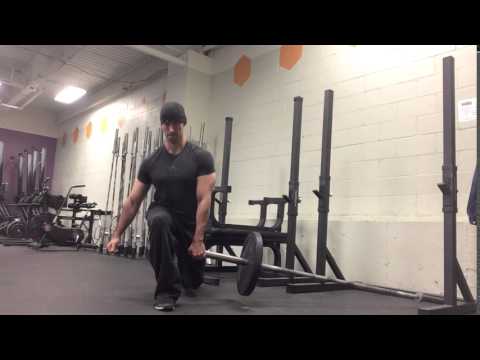
Like that one time I posted this video and Ben Bruno shot back a text showing me a video of Kate Upton using more weight than me. Thanks Ben! Jerk….;o)

Unfortunately, some coaches are so set in their ways that they’ll never cross the picket lines. They’re either team bilateral or team unilateral.

How about some middle ground with B-Stance variations?


4) Recognize Positions Matter

I’m not referring to Quarterback or Right Fielder here. But rather, joint positions and how that can play into performance in the weight room and on the field.

If you work with athletes you work with extension.

As I noted in THIS post, anterior pelvic tilt is normal. However, when it’s excessive it can have a few ramifications, particularly as it relates to this discussion.

Without going into too much of the particulars, people “stuck” in extension will exhibit a significant rib flair and what’s called a poor Zone of Apposition.

Basically the pelvis is pointing one way and the diaphragm is pointing another way, resulting in a poor position; an unstable position.

Anyone familiar with the Postural Restoration Institute and many of their principles/methods will note the massive role they’ve played in getting the industry to recognize the importance of breathing.

Not the breathing that’s involved with oxygen exchange – evolution has made sure we’re all rock stars on that front.

Instead, PRI emphasis the importance of the reach and EXHALE; or positional breathing.

It’s that exhale (with reach) that helps put us into a more advantageous position to not only encourage or “nudge” better engagement of the diaphragm, but also better alignment….which can lead to better stability and better ability to “display” strength.

NOTE: this is why I’m not a huge fan of telling someone to arch hard on their squats.


When joints aren’t stacked or in ideal positions, it can lead to compensation patterns and energy leaks which can compromise performance.

5) You Need to Control Slow Before You Can Control Fast

It’s simple.

Learn More With Elite Athletic Development 3.o

Mike Robertson and Joe Kenn released their latest resource, Elite Athletic Development 3.0 this week.

I can’t begin to describe how much information they cover, but if you’re someone who trains athletes then this is a no-brainer.

Many of the concepts I discuss above are covered, in addition to twelve more hours worth of content over the course of ten DVDs

Point Blank: You’ll learn from two of the best in the biz.

The seminar is on SALE this week at $100 off the regular price, and it ends this Friday (7/22), so act quickly.

Go HERE for more details.
Categoriescoaching Exercise Technique Strength Training

Big Rock Cues That Work For Pretty Much Everyone

As I’ve gotten older I’ve learned to be more succinct in many facets of my life.

– When I was 25 I’d consider it a travesty if I didn’t spend at least two hours in the gym. Now? A few “top sets” of my main movement, followed by an accessory movement to compliment that movement, and 45 minutes later I’m good.

– I’ve learned to trim my prose over the years, too. One of the best pieces of advice I ever learned on the topic came from my good friend (and my former editor at T-Nation.com), Bryan Krahn.

“Write your first draft, and then cut 20% of it, no matter what. Get rid of the fillers, fluff, and extraneous jargon3 that doesn’t do anything to support your message.”

– When I first met my wife and was wooing her I was all about impressing her with my collection of vintage Teenage Mutant Ninja Turtles t-shirts culinary skills. I remember a time or two4 attempting to drum up a four-course meal without burning down my apartment.

Now? “Babe, how about some tacos?”

The same can be said about my coaching career.

In a presentation I did last weekend at Iron Village Strength & Conditioning in Beverly, MA titled The Art of Coaching I discussed how, early in my career, I made the mistake of trying too hard to win-over my clients with big words like reciprocal inhibition, proprioceptive neuromuscular facilitation, post activation potentiation, and plethora (<— because, you know, that word is a boss).

Moreover, I made another huge mistake: Peppering my clients with too many coaching cues.

A set of squats would sound like this:

“Okay, squeeze the bar.”

“Push your knees out.”

“Don’t forget to spread the floor with your feet.”

“Big air!”

“Chest up.”

“Drive out of the hole.”

“Finish with your hips.”

“Stay tight, stay tight, I said STAY TIGHT!”

It was a juxtaposition on how not to coach clients. More often than not, they would end up feeling overwhelmed, frustrated, and thiiiiiiis close to wanting to drop kick me in the kidneys.

So today I’d like to share some succinct, BIG ROCK cues I feel work for pretty much everyone. At the expense of sounding like a fitness cliche, less coaching is more.

The Deadlift: Place Shoulder Blades in Your Back Pocket/Squeeze the Orange in the Armpit

Anything we can do to ensure (and maintain) upper back tightness throughout a set is going to be money. I could wax poetic and quote Dr. Stuart McGill here and all the work he’s done over the past 10-15 years to demonstrate how counteracting sheer force is kind of important for spinal stability and reducing the likelihood of back injury.

Instead, go read Ultimate Back Fitness and Performance.

“Place shoulder blades in your back pocket” or “squeeze the orange in your armpit” do an amazing job at engaging the lats, which are a big player in spinal stability.


The Squat: Sit Down, Not Back

Like many young, impressionable coaches at the time, back in 2002-2005 I read many, many articles written by Dave Tate and the crew over at Westside Barbell.

And why wouldn’t I? If you were (and still are) remotely interested in getting yourself or your clients strong, you’d be hard pressed to find better information. More to the point, if you were/are a powerlifter or training powerlifters those were the guys to read.

There’s no question there’s validity in using the cue “sit back” when coaching the squat. We can break down the biomechanics and draw lever arms…but at the end of the day, if the goal is to lift as much weight as humanly possible it makes sense to target the hips and posterior chain more by sitting back.

However, as the years passed and as I coached the squat more, I started to see a trend where people’s lower backs started flipping them the middle finger. They didn’t feel good.

This is when I started putting two and two together and understanding that the cues that work very well for powerlifters – specifically, geared powerlifters, where squat suits help with providing more stability – don’t necessarily jive well with un-geared lifters.

The cue “sit back” (and subsequently: arch!) places a lot of people in a compromising position where they fall into excessive anterior pelvic tilt, which can promote a more unstable position…to the point where they’re relying more on their “passive restraints” (ligaments) and bone(s) to stabilize their spine and not their “active restraints” (muscles).

“Sit Down, Not Back” (bracing abs, moving through the hips (not initiating with lower back), and pushing knees forward/out) works very well here. The squat is equal parts knees coming forward and hips going back

You know, a squat.

NOTE: Yes, there is still a forward lean in the torso. Relax. Deep breaths, internet.

Individual differences need to be taken into consideration, of course, in terms of injury history5 mobility restrictions, anthropometry, stance width, depth, etc, but I’d encourage you to give this cue a try and see if it feels better.

The Bench Press: Wrapping the Barbell

The bench press is a much more nuanced lift than some people give it credit for. As far as technique is concerned, I find it’s a black hole for many lifters – myself included.

There are many things to consider here.

For starters: is it Monday?

Secondly, cues like “meet the bar with the chest,” “shoulder blades together and down” and “put force into the ground with your feet” (leg drive) all have merit.

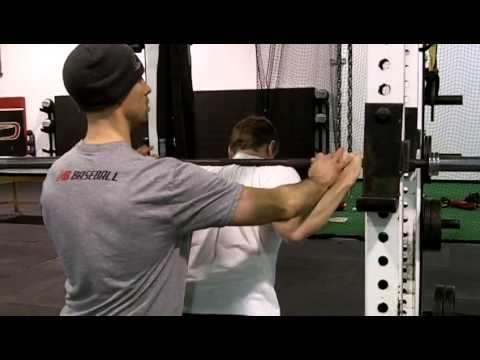
However, one cue that has resonated with me (and that of my clients) is the idea of wrapping the barbell. It’s a great way of ensuring lat activation/upper back stiffness without having to cue someone to “turn your lats on” when they have no idea what the fuck that even means.

Cressey Sports Performance coach, Miguel Aragoncillo, explains it better than I:


These Cues Don’t Mean I’m Right6

My objective here was not to insinuate these are the best cues for everyone. Only “pretty much everyone.” (<— It’s a fact. A true, fact).

Rather, the idea was to demonstrate various cues that have worked for me and my athletes/clients throughout my time as a coach. They may not be a good fit for you and your clients, and that’s cool. I’d be honored if you’d consider them nonetheless.

If not, “I HATE YOU. YOU’RE RUINING MY LIFE!!!”

[Slams door]

CategoriesAssessment coaching Corrective Exercise Exercise Technique

A Common Mistake People Make With Thoracic Extension

Thoracic (mid-back) extension is kind of a big deal.

Without turning this into an anatomy lesson, t-spine extension is important for a variety of reasons. In no particular order:

  • It’s what the mid-back (T1-T12) is designed to do.  However, due to the long hours many of us tend to accumulate at work and at home in excessive flexion (hunched over, rounded upper back), we lose the ability to get into and maintain extension.
  • In short: “good” posture can become compromised.
  • T-spine extension allows us to get into proper positions to lift things – it’s crucial for overhead activities (or elevating the arms overhead in general), deadlifting, squatting, and helping to offset “sheer forces” on the spine.
  • Lack of t-spine extension means you can never be Batman.7
  • Our scapulae (shoulder blades) are more or mess at the mercy of thorax position. For those who present with a more kyphotic/computer guy posture, the “resting” position of our scapulae can be affected (abducted, anteriorly tilted) which can (not always) lead to shoulder ouchies in addition to scapular dyskinesis.

There are numerous ways to address lack of thoracic extension, the most common being foam rolling the mid-back followed by corrective modalities such as:

Bench T-Spine Mobilizations


Rocked Back Extension-Rotations


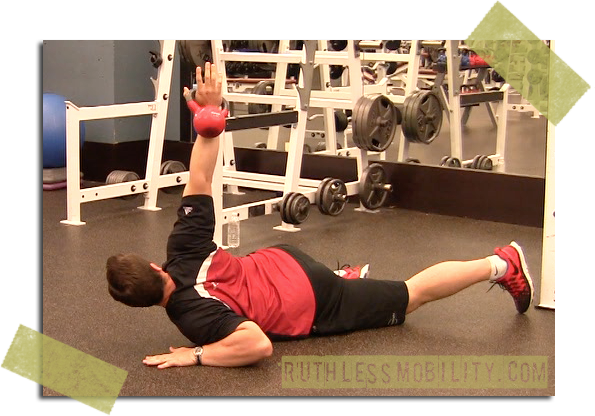
Side Lying Windmill


We’d then follow all of that with strength-based exercises – cued well – to help “cement” things. Front squats, for example, would be a great fit here. The anterior placement of the barbell forces the upper back musculature to counteract the forward pull to keep the torso upright; in effect nudging trainees into more t-spine extension.

Another popular approach is to use the foam roller in a different way and pepper in some additional t-spine extension patterning.

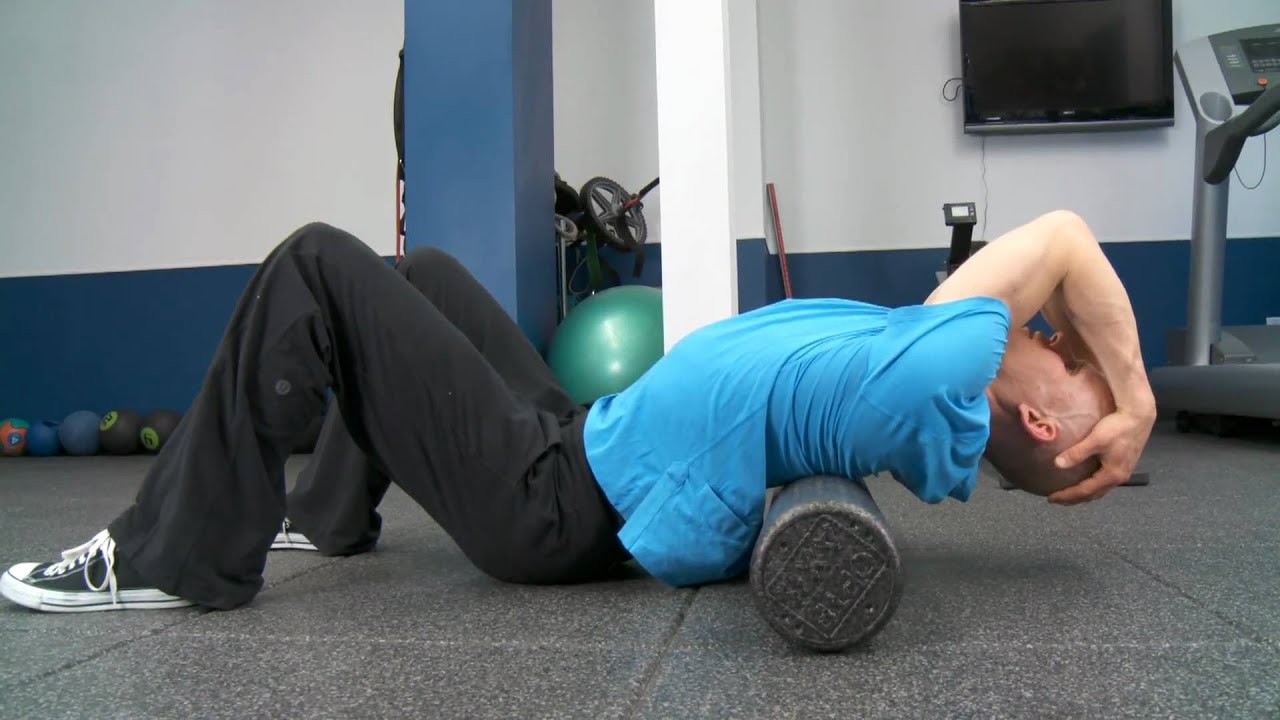
You all know the drill: take a foam roller, lie on it, and lean back, waaaaaaay back.

Like this:

While intentions are good in this scenario and there is some mid-back extension happening, it arrives at the expense of movement coming from elsewhere…the lumbar spine (often times with the hips coming off the ground) in conjunction with a massive rib flair.

Thoracic movement is much more subtle than people think. I fear this is one of those cases where many people – fitness industry pros included – have grown infatuated with the notion more ROM (Range of Motion) is better ROM.

Not the case.

What T-Spine Extension on Foam Roller Really Looks Like

Categoriescoaching personal training

Why Not Every Client Needs Perfect Form

Today’s post comes courtesy of Jonathan Hamilton-Potter, and it covers a topic I feel is an important one for many new and up-coming fitness professionals to consider. Heck, industry veterans too.

And that is…being too strict with exercise technique.

Enjoy.

Why Not Every Client Needs Perfect Form

My eyes narrowed in disgust as I scanned the gym, trying to take in what was going on.

  • There was fellow personal trainer James, whose client Kelly was performing upright rows with no scapula retraction.
  • I spied Denise, training two girls to bench press, but completely neglecting the fact that using a lower-back arch and utilizing leg drive would have made them far more efficient and given better leverages.
  •  And worst of all – Kevin, who had one of his guys squatting, but cutting reps short of parallel.

They were gym crimes of the highest order. As a personal trainer, I should have been furious.

But I was okay with it, and here’s why –

1) Not Everyone Can Perform Exercises 100% Correctly

This is basic biomechanics.

If you have a client who can’t squat to depth because they’ve experienced knee or back issues in the past, then having them squat slightly higher than what’s usually considered acceptable in order to prevent pain isn’t such a bad idea.

With slightly less depth the muscle will still be getting worked (albeit not as well as if full range was carried out, but worked all the same) and if this allows Dave, the 63-year old former fireman who’s had three knee surgeries to be able to do a greater selection of exercises then I don’t think it’s such a bad thing.

Photo Credit: EliteFTS

You can obviously try to fix the issues though flexibility work, mobility and stretching but it’s also ok to move away from a particular exercise or modify it if the client cannot perform the movement at any range of motion without pain.

It doesn’t matter what Internet ‘experts’ say – not every client needs to train like they’re going into a powerlifting meet.

If someone can’t do an exercise in a particular way, then don’t force it upon them.

2) If You Try to be a ‘Form Perfectionist’ Then Your Clients Won’t Progress.

If I was personally spending hours and hours and huge amounts of my clients hard earned cash (which they most likely gave me for physical results such as fat loss or muscle gain) and spent the whole time working on postural correction, making sure there was absolutely no momentum used in any exercise, breathing was perfect and every single lifting ‘cue’ was nailed then I would have zero results to show and one pissed off client.

It’s ok to allow for a little form breakdown when it comes to an exercise, as long as a client is still moving safely though a movement.

You can correct a client’s posture over time if needed, but let’s not forget what clients come to us for – to be happy.

They’ll get more happiness from seeing results in terms of fat loss and body composition changes, than from you barking orders at them and stopping a set every single time they don’t quite get the movement perfect.

Obviously this is a trade-off.

In an ideal world, you might see a client seven days a week, and spend one hour on postural correction and mobility and then another hour actually training, but this is the real world.

Clients have a limited amount of time, so get them working hard when they see you, and advise they visit a sports massage therapist, a chiropractor or physical therapist to iron out any postural issues, as well as giving them some home mobility drills to do.

3) Perfect Form Doesn’t Allow For Maximum Intensity.

When it comes to any form of strength training a certain amount of effort, intensity and overload is required to coax your body to want to get stronger and better.

As training experience develops it becomes harder and harder to progress without regimented periods of high intensity. This should be carried out through the use of heavy weights or sets taken close to muscular failure coupled with muscular overload.

Maintaining ‘perfect form’ throughout every rep and set of every exercise will result in an extreme lack of the muscular overload needed for the client to progress, get stronger and improve the way they look.

Once again: clients want results and without them feeling and looking better then they’ll eventually leave.

4) Constantly Drilling Form Can Confuse a New Client and Make Them Feel Like They’re Always Doing Something Wrong.

Imagine you were doing something completely new to you – perhaps learning the guitar, or trying to speak a foreign language.


How would you feel if your tutor gave you 25 different instructions and made you stop every time something lapsed slightly?

Probably pretty down and demotivated.

That’s how a client can potentially feel.

They’re already doing something new and scary by joining the gym and working out (possibly for the first time ever) so give them small, manageable, bite-size chunks of information and don’t pick up on every error all at once.

Certain cues do need to be in place initially in order to prevent injuring your client.

A mistake I see a lot of trainers make is that they throw numerous teaching points at a new client in a single session, often resulting in the person looking mentally exhausted and disheartened.

Look at teaching a client the basic cues first such as keeping a neutral lumbar spine, monitoring breathing and so on, then every week or two once the basics have been developed (along with confidence) you can then look at adding one or two more teaching point to the mix and repeat.

Gradually adding teaching points this way allows clients to feel they’re accomplishing something each session and doesn’t leave them overwhelmed.

Take Home Points 

  • As long as a client isn’t risking injury then let them do the exercise.
  • Let clients lift sufficient load with enough intensity to cause progression.
  • 90% of your clients pay you for aesthetic improvements and fat loss, not to correct their form for a whole hour.
  • Don’t throw 100 teaching points at a new client and overwhelm them, add a new cue in every couple of weeks until each are mastered.
  • You don’t NEED to do any one exercise with a client.

About the Author

Jonathon Potter is a personal trainer, bodybuilder and is the owner of JHP fitness online coaching company.

You can check out his website HERE, and his Facebook Page HERE.

CategoriesAssessment coaching Corrective Exercise mobility

3 Unconventional Ways to Move Better

Counting today’s post, four out of my last five entries have had a number included in the title. That’s never happened before.

Wanna know what else I’ve never done?

  • Gotten a speeding ticket.
  • Tried calamari.
  • Deadlifted 2000 lbs.
  • Cried to the movie Notting Hill.8

Nevertheless, in conjunction with Dean Somerset putting his Ruthless Mobility resource I sale TODAY (through July 4th) I wanted to share a few thoughts on the topic (mobility/movement/general badassery) that maybe some of you reading would find useful or interesting or mildly captivating.

Captivating like this picture of a kangaroo punching someone in the face:

1. Anterior Pelvic Tilt Doesn’t Always Have to be Fixed, Nor Is It Bad. Everything Will Be Okay. Seriously.

New Client: “I’m so excited to work with you. I was told by my previous trainer I had anterior pelvic tilt.”

Me: “Okay, explain.”

New Client: “Well, I went in for my assessment and he told me I had anterior pelvic tilt and that it needed to be addressed and that he’d write me a program to fix it.”

Me: “I see. How long did you do the program for? And, was it fixed?”

New Client: “I worked with him for eight months, and I don’t know if it was fixed. All I know is that we did a metric shit-ton of stretching, corrective exercise, and very little strength training.”

Me: “Well, that’s unfortunate. Excuse me while I go toss my face into a brick wall.”

Okay, the brick wall comment didn’t really happen…but everything else stated above was said verbatim as I sat down with a new client recently.

Without going into the particulars I went on to state that roughly 7 billion other people in the world “suffer” from anterior pelvic tilt, and that it’s truly reached pandemic levels of clusterfuckedness.

In short: I explained that, aside from scenarios where excessive anterior pelvic tilt may be causing pain or movement dysfunction, having it was not a disease or a scenario which always required intervention.

In fact, APT is considered anatomically neutral. I.e., Your lumbar spine has a natural lordotic curve.

To quote Bret Contreras:

“Is APT abnormal?

No, it’s not. According to a published study by Herrington 2011, 85% of males and 75% of females presented with an anterior pelvic tilt, 6% of males and 7% of females with a posterior pelvic tilt, and 9% of males and 18% of females presented as neutral. Anterior pelvic tilt is also the most common postural adaptation in athletes according to Kritz and Cronin 2008, and it seems to naturally occur with athletes that do a lot of sprinting. Therefore, it’s actually normal for healthy individuals to possess APT, and the average angle of anterior pelvic tilt ranges from 6-18° depending on the study and methods used to determine the angle, with around 12° appearing as the norm (ex:Youdas et al. 1996, Youdas et al. 2000, Christie et al. 1995, Day et al. 1984).”

As I recall, there’s no definitive test or “screen” which can correlate “x-degrees” of APT and one’s vulnerability to pain and dysfunction.

Some people have APT and walk around in considerable pain, while others have APT (even excessive APT) and have no issues what-so-ever.

However, those coaches with an acute eye for assessment and movement can often use a plethora of screens and tests to ascertain whether or not APT may be something that’s needs to be addressed.

To reiterate, APT is not always wrong (or bad)…but it can be problematic once we start allowing ill-prepared people to load the pattern and not only that…begin to add repetitions and/or speed.

Often, it’s the LACK of ability (or our proclivity to refrain from) posteriorly tilting the pelvis when bad things start to happen.9

As Tony B mentions above: There’s a big difference between cueing someone to arch like crazy (and thus encouraging excessive APT, resulting in poor positioning and increased instability) and cueing someone to posteriorly tilt the pelvis to nudge them into a more neutral spinal position.


NOTE: As Mike Robertson notes in THIS article, there is no such thing as a bad cue. However, there does exist poor cues when they’re not applicable to the individual or are used haphazardly (because you heard someone else use it).

2. Thoracic Spine Endurance is Often Overlooked

A huge shout-out to Mike Reinold for hammering this point home in a recent Inner Circle I watched on How to Improve Thoracic Extension.

Mike noted that in order to improve t-spine extension it is important to work on mobility (Windmills, Bench T-Spine Mobilizations, Quadruped Extension-Rotations, etc), however we can’t dismiss the importance of ENDURANCE in order to maintain it.


Mike also noted that with regards to posture, “sitting upright is fictitious.” The amount of hours many of us spend in a flexed position far out-weigh the number or hours we’re upright. As such, keeping an upright posture is freakin exhausting.

My words, not his.

Building spinal endurance (not strength) is key here.

Don’t get me wrong: strength is (and always will be) important. A healthy dose of horizontal rowing (DB rows, seated rows, chest supported rows, Seal rows) is never a bad thing.

However, when we’re talking about our “posture muscles” – the muscles that need to be on all day in order to keep us upright – endurance is the name of the game.

3. Lack of ROM Isn’t Always Because You Need to Stretch More

The second someone is told that they lack range of motion (ROM) in any part of their body, they’re immediately shown 37 different stretches and ways to “smash” their tissue.

Many end up cranking this joint and yanking that joint till their blue in the face.

One of the more common examples I like to use here is lack of shoulder flexion (or ability to elevate the arms above one’s head).

Many people are unable to do so without some form of compensation via forward head posture, rib flair, and/or excessive lumbar extension. Picture on the left.

The fix can be any number of things: addressing lat length, fighting a zombie, poor anterior core control, poor tissue quality in the pecs/pec minor, you name it.

And none of those approaches would be wrong. Fighting zombies is awesome.

However, stretching tends to be the “go to” modality for many fitness professionals, and frankly it isn’t always the answer.

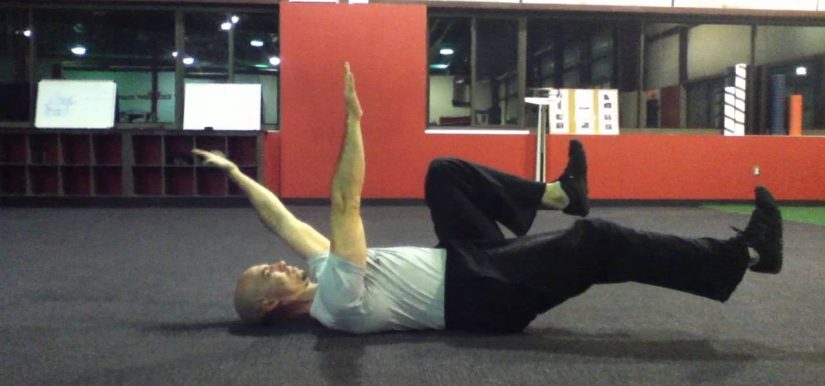
Oftentimes, taking the time to teach people to get 3D expansion of the rib cage with their breath (front, side, and into the back) and then learning to fully exhale (to get rib cage down and promote better engagement of anterior core) will help to “open up” the thorax.

I can’t tell you how many times I’ve tested someone’s shoulder flexion and saw an immediate 10-20 degree improvement after having them perform ten good breaths.

I call it my Gandalf moment.

Except, you know, I’m not a wizard.

Did Someone Say Gandalf?

For more insights on the topic and wizard-like shenanigans I’d recommend checking out Dean’s Ruthless Mobility.

You get FIVE hours of content (digital or DVD) from one of the smartest coaches I know on assessment, corrective exercise, and how to get people moving better.

What’s more, CEUs are available AND it’s on SALE at close to 50% off the regular price.

Go HERE and thank me later.

Categoriescoaching fitness business Motivational

The 5 Most Important Things I Learned From My Internship

Today’s guest post comes courtesy of former CSP intern (and now staff member in the Jupiter, FL location), Ashley Crosby.

I really liked this, as it served as a stark reminder that internships can provide more than just monetary value10 Particular to fitness industry internships it’s also a reminder that the “true” value is in learning the intricacies behind working with people, and not just getting good at breaking down deadlift technique and regurgitating Prilepin’s chart.

Enjoy!

5 Most Important Things I Learned From My Internship

When I did my internship at CSP-FL in the spring of 2015, I was mostly concerned with nailing down the technical aspects of coaching. How do you write the best program? How do you spot compensation patterns? What are the best exercises and progressions for each individual at each point of their season? Why choose one exercise over another? What’s better?

See, I was finishing up grad school, and though I was lucky enough to have some experience in the field, I was still mentally stuck in finding the one correct answer. I wanted cut and dry answers, steps to follow, and I wanted to be the most proficient in each and every exercise.

I studied relentlessly–not just the database and in-services we have access to prior to our internship to prepare us, but for my exams as well. I read every article I could get my hands on. I spent a lot of time with my head in books. (To be fair, I still do.)

I recently asked our new class of interns what they were most interested in learning about, and saw similar topics: nutrition supplementation for sport, arm care and managing injuries after surgery and rehab, set/rep schemes, developing throwing programs, density training–the technical aspects of what we do day in and day out.

But here’s the thing: the most important lessons I learned as a coach were not technical in nature.

Comfort in the technical aspects comes with time and practice, from reading both the science and articles from other coaches on how they apply techniques, and from making mistakes and trying new things.

Being on the other end of the internship process now as a staff member and watching the newest class of interns go through their internship experience, I feel these are five of the most important things I’ve learned (by doing and seeing):

1. Learn everybody’s name, and a few facts about them.

Greet them by name every day.

As Dale Carnegie said in How to Win Friends and Influence People (a book I highly suggest every coach out there read), there is great power in a person’s name. Use it often.

2. Learn how to ask questions and genuinely, actively listen to them.

Start every session by asking athletes how they feel, how their weekend was, how their game was, or some other question to see how they’re feeling. It gives you a good idea of their level of fatigue or their mood, and gives you a chance to set (or re-set) the tone for the day.

NOTE from TG: I listened to a recent interview on The Fitcast with Mike Boyle and he mentioned a program that he and the staff at MBSC are experimenting with called CoachMePlus.

The idea is to have better access to the metrics that affect athletes on a daily basis and to better prepare coaches to augment training and programming variables accordingly. Seems interesting.

3. It doesn’t matter what kind of day you are having; leave your troubles at the door.

As a coach, you are an emotional rock and set the tone for the facility and for the session. Don’t let your bad day become your athlete’s bad day.

4. Whether it’s busy or dead, don’t lose your focus.

When it’s slow, it’s easy to mentally check out and want to hang out with the other coaches or interns. It’s great to be friends with your fellow interns–in fact I genuinely hope you are, because they’re part of your new professional network.

However, when people are in the gym, your focus should be on them. Use it as an opportunity to get to know your athlete better, to spend a little more time working on a movement they struggle with, and as a chance for you to become better as a coach.


5. Seek out the quiet ones and the young ones.

These are often the hardest to work with—not the pro guys who are very talented athletes and cue up quickly, but the ones who are still figuring out how their bodies are supposed to move or are too shy to ask for help.

Not only do they need the most help technically, they need to feel a part of the gym culture that you’re creating as a coach.

While I learned a lot of the technical aspect during my internship (and continue to every day through articles and books and interactions with my coworkers), they’re all just in the background of what I do all day, which is interact with people, and build a relationship and trust with them.

As Teddy Roosevelt said and Eric often quotes, people won’t care how much you know until they know how much you care.

Author’s Bio

Ashley Crosby recently finished her MS at Bridgewater State before coming to Cressey Sports Performance, first as an intern and then as a coach. A CSCS and Pn1 certified coach, she runs the strength camps in the CSP-FL location. Before she went back to school for her masters, she was the social media director for the Cape Cod Baseball League. When she’s not coaching or lifting, she’s usually watching baseball.

Categoriescoaching Exercise Technique

Turkish Get-Up Tip: Vertical Knee

The Turkish Get-Up.

Some people love them.

I mean, really love them.

https://www.youtube.com/watch?v=M_98w0cwqFQ


And others are indifferent maybe even skeptical.

I know some strength coaches who view them as a valued asset to their programs, providing insight on their athlete’s movement quality as well as highlighting any “weak links” that may exist.

And I know some strength coaches who could make a list of other things more valuable or worth their time:

  • Deadlifts
  • Squats
  • Arguing with a vegan
  • Running a 5K
  • A basket of dicks

I, for one, do find value in them.  Of course, whether or not I transplant them into someone’s program depends on several factors; namely, their goal(s).

Sorry, but if someone’s goal is hypertrophy I can think of roughly 412 other exercises more prudent to get the job done than the Turkish get-up.

I’m not saying it’s a waste of time to include them in a program designed to get someone jacked – maybe include them as part of an extended warm-up to get the joints primed for larger, compound movements, or, say, if someone has the movement quality of a pregnant pig (they’re a nice addition to GPP days) – however, I’d raise an eyebrow (or two) to any coach who places heavy precedence on including them in such a program.

That said, I find the get-up to be one of those universal movements I use with my athletes and general fitness clients alike. For athletes it’s a great way to control fatigue and reduce axial loading. Not to mention we’re accomplishing a lot with regards to scapular stability, hip mobility, glute activation, as well as working on primitive patterns such as rolling, half kneeling, to standing.

I pepper them into programs for general fitness clients because, well, it’s good for them (and I like to LOL when they call me an a-hole for making them do it).

There are a lot of moving parts to the get-up. Not surprisingly, this makes the learning curve a bit tricky for some with regards to honing technique

Much like how I prefer to layer the KB Swing, I think it’s wise to also break down the get-up to more bite-size portions.

Today I’d like share a tip I learned from StrongFirst Team Leader, Artemis Scantalides, on a subtle “technique trap” many seem to fall prey to.

Maintaining a vertical knee (which helps to keep the glute engaged during the initial roll to press).

Vertical Knee

Categoriescoaching Motivational psychology

Disfluency and Why It Can Help You Reach Your Fitness Goals

In the Spring of ’96 I made my first collegiate start as a pitcher. I was playing for Onondaga Community College out of Syracuse, NY, and we were down in Florida for our annual Spring Training trip.

Can you find me?

Not only was it the first time I saw green grass in several months (winters in Central NY are long and brutal), but it was my first trip to Florida, which meant it was also my first time seeing palm trees.11

We arrived in West Palm Beach to play West Palm Beach Community College. On the bus ride from our hotel to the field I was fidgeting, listening to my Discman – remember those? – probably Wu-Tang Clan or Tribe Called Quest, and trying everything I could to take my mind off of destroying the back of my pants.

It was my first collegiate game, my first start, so of course I was nervous.

And if that wasn’t enough, I heard inklings from some of the players and coaches that 8 of the 9 players in the line-up for WPBCC were drafted out of high-school in the previous year’s MLB draft.

Okay, now I was really nervous.

I took a few deep breaths, said a few words of encouragement to myself12, and proceeded to do my normal pre-game ritual of stretches, long-toss, and warm-up.

And then it was game time.

1st Batter: ground ball out.

“Whatever, this is easy.”

2nd Batter: strike out.

“MLB prospect my ass.”

3rd Batter: walk

“Okay, you can’t win them all.”

4th Batter: 0-2 count, I threw a hanging curveball, and I think the ball is due to pass Neptune’s orbit any day now.


If my memory serves me, I lasted four innings, and we ended up losing that game 12-4. Or 72-4. I don’t remember all the details.

Whatever the score ended up being it stands to reason I didn’t do well.

That said, it was a learning experience:

1) Don’t throw hanging curveballs on an 0-2 count to arguably the team’s best hitter.

2) Even though I was nervous heading into that game, I’d be lying if I said I wasn’t a tad bit smug. I mean, I was an All-League selection in high-school, twice! I got this.

Um, no.

My first college game served as a wake-up call for me, and provided the slap in the face I needed to respect that anything can be a lesson you can learn from. And it’s how you observe, reflect, digest, and use those lessons moving forward that will make all the difference in the world. It’s how you prevent history from repeating itself.

While I didn’t realize it at the time I was using a form of DISFLUENCY to my advantage.

In his book Smarter, Faster, Better, Charles Duhigg, discusses this phenomenon:

“The people who are the most successful at learning – those who are able to digest the data surrounding them, who absorb insights embedded in their experiences and take advantage of information flowing past – are the ones who know how to use disfluency to their advantage. They transform what life throws at them, rather than just taking it as it comes. They know the best lessons are those that force us to do something and to manipulate something.”

In other words: people who are actively “disfluent” take data and transform it into experiments whenever they can.

Taking an example from the book, Duhigg references a study performed in 2014 at UCLA which examined the relationship between learning and disfluency by looking at the difference between students who took notes with their laptop and those students who took notes the old fashioned way.

By putting pen or pencil to paper.

As Duhigg states:

“Recording a speaker’s comments via longhand is both harder and less efficient than typing on a keyboard. Fingers cramp. Writing is slower than typing, and so you can’t record as many words.”

In not so many words, students who use laptops put forth less effort and can “collect” twice as many notes as their pen holding counterparts.13

“Writing is more disfluent than typing, because it requires more labor and captures fewer verbatim phrases.”

Common sense would make us assume that the students who took notes with their laptops – and thus, collected twice as many words – would score better on tests and be able to recite more of what the lecturer said.

Of course, you would be 100% incorrect in assuming this.

Don’t worry, if it’s any consolation, when I first heard Eminem I thought to myself “no way this guy lasts.”

There was also a time I thought Mariah Carey and I were soul mates.

Shows how much I know.

What the researches found was that, time and time again, those students who wrote their notes down out-performed laptop users on test scores of the lecturer’s content.

What Does This Have To Do With Your Health and Fitness Goals?

When we bump uglies with new information, and want to learn from it, we should force ourselves to do something with the data.

NOTE: it’s not physically possible to “bump uglies” with information. It’s just a metaphor. Don’t be weird. Unless, you know, you’re part of The Matrix or something and you actually can do it.

If so, we need to hang out.

To quote Duhigg one more time:

“It’s not enough for your bathroom scale to send you daily updates to an app on your phone. If you want to lose weight, force yourself to plot those measurements on graph paper and you’ll be more likely to choose a salad over a hamburger for lunch.”

Likewise, those people who take the time to track their training sessions – recording exercises done, sets, reps, and total weight lifted – tend to stay more consistent and make better progress than those who don’t

Too, when it comes to honing technique on any given exercise, reading other coach’s insights and perspectives on it is great. You may learn a new cue or subtle tweak that resonates.

However, I’d argue it’s those people who take a more laborous approach, take the time to record their lifts with a camera, and analyze their lifts that end up hitting their goals quicker and with more efficiency and precision.

Disfluency. Use it.

Categoriescoaching Conditioning speed training

When Going Backwards Is a Good Thing: The Up Two, Back One Drill

Today’s guest post comes courtesy of one of my most favorite people in the world, Jen Sinkler. She, along with strength & conditioning coaches Angie Brambley-Moyer and Tim Moyer are releasing their new strength, speed, & agility training product Lightning & Thunder.

I’ve just started playing with the program myself (my wife and I went to BU on Sunday to move around a a bit, photo evidence HERE), and I gotta say…I really, really like it.

It’s elegant in its simplicity, and will compliment pretty much anyone’s training whether they’re an athlete or not.

Check out Jen’s gleaning example below…

When Going Backwards Is a Good Thing

When it comes to training for speed and agility — a worthy endeavor whether you’re an athlete or not, in terms of power and movement efficiency — you may think about zig-zagging from side to side explosively and working on your go-forward locomotion, but just as important is the ability to quickly transition from forward to backward and vice versa.

“Forward-to-backward movement is what athletes do poorly at first. It’s the most likely skill to be untrained and un-coached,” says Angie Brambley-Moyer, MS, MSCC, assistant director of strength and conditioning for Princeton University.

This is a critical error.

In many sports, the ability to switch from offense to defense and back again is paramount, adds Angie’s husband, Tim Moyer, MS, CPT, head volleyball coach of Philadelphia University and longtime strength and conditioning coach.

“Agility is the ability to perform a series of explosive power movements in opposing directions in rapid succession, and unless you’re training these key movement patterns by focusing on movement quality over speed at first, breaking down skills into smaller parts, and getting feedback (from a coach, a video, or motor recognition) from rep to rep, your mechanics will remain slow and sloppy,” Moyer says.

“Form equals function. The better your form the better you will function.” That means patterning proper mechanics from the get-go.

“From an injury prevention standpoint, you are only going to be as fast as you can stop and change direction,” says Brambley-Moyer. “In many sports, you have to change direction every three to five steps, and the ‘Up Two Back One’ drill closely mimics that. It’s important to master these short direction changes before increasing the distance (which increases intensity).”

This is one of Brambley-Moyer’s favorite drills for working on forward-to-backward-to-forward agility. Incorporate it at the very beginning of any conditioning work you do, performing three total sets and using a 1:3 work-to-rest ratio. Start slowly and focus on really nailing the mechanics of footwork and body position, picking up speed only as your form improves.

Moyer refers to one of the special forces’ mottos, saying, “Remember: Slow is smooth, and smooth is fast.”

Up Two, Back One: Forward Sprint to Backpedal Instructions:

The Up Two, Back One drill is performed like it sounds: You will first run forward to the second cone, come to a stop, backpedal one cone and then repeat by running up two more cones before backpedaling again. You will sprint and backpedal a total of three times before transitioning to your last sprint and coasting to a stop.

For the set up, place five cones three yards apart in line with one another. Completing the drill as outlined above counts as one set. To ensure you’re performing each set with the proper intensity and technique, take three times the rest as it takes you to run the drill, in a 1:3 work-to-rest ratio.

Coaching Points:

To start, use a staggered stance (with one foot slightly in front of the other) as your starting position for the drill. Direct your head and shoulders toward your target by leaning forward, and then take off into a sprint.

Decelerating at each cone starts by lowering your center of gravity toward your base of support (your feet). You will also increase the length of your ground contact time by taking a number of smaller, choppier steps until you come to a complete stop next to each cone.

This drill’s focus is accelerating quickly, decelerating quickly, and then transitioning into the backpedal before moving forward into another sprint. To ensure you’re staying low and using proper acceleration and deceleration mechanics, touch the ground at each cone when performing this drill.

Ideally, you will touch the ground with the opposite hand as the foot that’s in front. Meaning, if your left foot is the front foot at the transition point (sprint to backpedal or backpedal to sprint), your right hand should touch the ground.

After your last backpedal, focus on proper arm- and leg-drive mechanics through the final cone and coast to a stop.

Lightning & Thunder will help you become a force of nature.

I’ve said it before and I’ll say it again…you don’t have to be an athlete in order to train like one.

Athleticism is one of those things where the saying “if you don’t use it, you lose it” becomes inevitable. As adults we often become more enamored with adult-like things. Things like balancing checkbooks, going to bed early, and binge watching Netflix.

Too, in the context of training, as adults we sometimes (not always) tend to “pump the brakes,” and training goes from this:

To this:

And the most athletic thing many people do on a day-to-day basis is chase down the 66 Bus after work.

That being said: athleticism is important yet it is something that intimidates a lot of people; especially for those who participate in more fantasy sports than actual sports.

However, you don’t need any fancy equipment or complicated periodization schemes in order to train athleticism.

Lightning & Thunder is a brand new strength, speed, and agility program written by Tim Moyer, MS, CPT, and Angie Brambley-Moyer, MS, MSCC, with Jen Sinkler, personal trainer, fitness writer, and former U.S. national team rugby player.


Moyer, Brambley-Moyer, and Sinkler have teamed up to get you stronger, faster, and more agile. You don’t have to have any experience playing sports, and you don’t have to play any in the future, either, if you don’t have the inclination. You only need to be interested in training like an athlete, in moving like one and looking like one.

Make no mistake, though: this program is perfect for athletes too.

In it, you’ll get:

  • A comprehensive training manual that lays the groundwork for this philosophy of training for both the strength and the speed and agility (SAQ) programs.
  • Both beginner and intermediate 12-week SAQ programs.
  • Both beginner and intermediate 12-week strength programs, with an explanation and calendar on how to combine the strength work with the speed work.
  • A complete exercise glossary with written coaching cues and images for every single strength and SAQ movement. This detailed description of 180 moves is a resource in and of itself!
  • A streamable video library of more than 25 speed and agility demonstration videos. In the videos, Tim and Angie coach the athlete through the fundamentals of their SAQ patterns and drills, allowing them to know what they need work on whether they are watching from home or watching it as they hit the gym.

Here’s the best part. To celebrate its release, Lightning & Thunder is on sale for HALF OFF now through midnight Friday, June 3rd. For more information click HERE.

About Jen Sinkler

Jen Sinkler is a longtime fitness writer and personal trainer who talks about all things strength related at her website, UnapologeticallyStrong.com. The former editorial director of fitness for Experience Life magazine, she writes regularly for a variety of national health magazines. She’s a certified RKC 2 kettlebell instructor, and a powerlifting coach through USA Powerlifting. She also holds coaching certs through Ground Force Method, Progressive Calisthenics, Onnit Academy, and DVRT (Ultimate Sandbag).

A lifelong competitive athlete, Jen played rugby for 13 years, many of those on the U.S. women’s national 7s and 15s teams. She co-owns The Movement Minneapolis with her husband, David Dellanave.

CategoriesAssessment coaching Motivational personal training

3 Questions to Assess Your Clients’ Willingness to Change

You may have heard I’m traveling in Europe.14

Today’s guest post comes courtesy of Canadian health and fitness professional, Dave Smith. He shares some excellent advice on how we can better assess our clients’ willingness to change.

Have you ever had a client who was extremely eager to jump into the health and fitness lifestyle?

They’ve bought their new fancy running shoes, pedometer, sweat pants, and they’re ready to go.

You sense this eagerness, and to help them, you construct an intensive diet and training plan that will help them achieve their goals.

1 week passes – everything is going well.

2 weeks pass – they’ve missed a training session.

3 weeks pass – they’ve missed 3 training sessions and only followed the diet plan for 2 days of the week.

4 weeks pass – they’ve given up. Dieting and training just “isn’t for them.”

We’ve all had these types of clients in the past, and it can be very misleading – one day they’re inspired and motivated to be healthy, the next day they’ve given up and are back to their old ways.

It’s important that when you’re working with new clients, you assess the stage that they’re at regarding to how willing they are to make changes.

You have to see past the initial excitement that they may have, and make a proper assessment of their level of dedication to changing.

The 5 Stages Of Behavior Change

The Transtheoretical Model is a handy little tool that you can use to assess your clients willingness to change – in this case, a change in their training and eating habits.

These 5 stages are:

  • Pre-Contemplation: The person is not planning on taking action at all
  • Contemplation: The person is aware that their behaviour is problematic, and is beginning to educate themselves on the changes necessary
  • Preparation: The person is preparing and is ready to take action in the near future
  • Action: The person is making changes to their behavior
  • Maintenance: The person has now made those changes a habit and is a part of who they are

Using these 5 stages, we are able to assess our clients and their willingness to change.

The Reason Why The Stages Of Change Are So Important

Understanding the stages of change is crucial for being able to properly assess a new client’s ability to build new habits.

For example, let’s look at a new client that we’re working with named Jimmy.

Jimmy’s a cool guy. He’s 32 years old – wife and two kids, works a standard office job.

Jimmy wants to make some real gains. He wants to put on some muscle.

So Jimmy comes to you looking for a training and diet plan that will help him with his goal. He seems extremely eager, energetic and ready to go all out with the new plan that you’ve written up for him.

But you’ve seen this too many times.

Too many times clients have come to you with the energy of a kid in a candy store, only to have that energy drained after a mere three weeks.

Not only have they upset themselves, but it can also can give the impressions that the service you’re providing is sub-par.

The reason why it’s important to recognize the 5 stages of behaviour change is because it allows you to see past the initial excitement and assess your client’s willingness to change in a long-term perspective.

So now when Jimmy comes to you ready and wired, it’s your job to ground his excitement and assess where he’s really at.

Not only will it prevent him from being upset in the future if he decides to drop off at the three week mark, but it also prevents the chance that your reputation is tainted.

3 Questions For Assessing Your Clients

To do this assessment, here are three questions you can ask Jimmy that will bring down the initial wavering excitement levels and decide if he REALLY is ready for change.

1. Have you tried anything previously to make progress towards your goals?

If Jimmy tells me he’s tried everything from calisthenics to Olympic lifting, there’s a good chance that he’s probably in the preparation stage. He’s searching for answers but hasn’t figured out an appropriate action plan.

This is shown by Jimmy’s inability to pick a path and stick with it. This might also tell you that Jimmy is looking for a “magic pill” to solve his problems. Maybe he’s looking for the quick fix rather than sticking with one plan.

2. What, specifically, has stopped you in the past from reaching your goals?

This is where you get to see if Jimmy comes up with an external excuse or not.

If Jimmy tells you he hasn’t had enough time because of work, or because his wife and kids have kept him too busy – you can recognize that he’s probably in either the Contemplation or Preparation stage.

While he sees value in adding more muscle to his frame, his priorities lie elsewhere.

Throwing him into an intensive program is doomed to fail (at this point).

Jimmy needs to be introduced to change more slowly.

3. Using a scale of 1 to 10 (1 being “there’s no way” and 10 being “definitely will do”), would you be able to exercise for _minutes for _days this coming week?

This is the ultimate test of Jimmy’s willingness to change.

In this case, Jimmy says that he’s probably at a 6 when it comes to exercising 45 minutes, 4 times per week: He’s got a lot of commitments next week, but he’s ready to “try his best.”

Is a 6 rating really that convincing?

Do you really want to give a client a task that has at least a 40% chance of failure? (I say “at least” because most clients overestimate their ability to take on change in the beginning!)

Identifying a Willing, Ready, and Able Client

Question #1 gets the ball rolling. It lets you see how new or experienced your client is with training and nutrition, and also his level of interest in these two areas.

Question #2 throws a curve ball to the client. He is perhaps thinking you’re just asking a basic question, but really you’re screening the client to see his attitude and willingness to change.

If your client blames the reason of not reaching their goals on external factors – deflecting the reason to things such as not enough time, too busy with work, the wife not cooking healthier meals or the kids bringing home junk food – then this is a sign of someone who’s in one of the earlier stages of change.

Again, the notion of wanting change is there, but perhaps not at the expense of other enjoyable things in life.

However, if they take responsibility for their actions or lack of, then that’s a good sign of someone who could possibly be ready to get started.

Question #3 is the true test of a client’s willingness to change. “Action speaks louder than words”, and we’re about to find out how loud their actions really are.

Any number they give you shows their level of commitment to following a training and nutrition plan.

  • Any number between 1 and 3 is a sign that they’re probably not ready for much of a change.
  • A number between 4 and 6 is an okay, mediocre response. A small change may be possible.
  • A number between 7 and 10 is a good sign that they’re ready to go. Let’s take them into Action.

Changing Your Plan For Different Behavioral Stages

You can’t give a client an intensive, thorough training and nutrition plan when they’re not ready to change, so it’s important to identify which stage your client is at and adjust their needs from there.

Remember, the majority of them are going to say “they’re ready for everything right now” when their excitement levels are high, but it’s your job to assess how willing they truly are.

Clients that are in the Precontemplation stage need help finding their “why.” Help them see why it’s important to work out and eat healthy. You can relate it to having more self-confidence, living longer so they will be able to spend more time with their family etc.

Once you find their why, keep tapping on that pressure point.

Clients that are in the Contemplation stage will benefit by showing what they can achieve as well as the sacrifices they’re going to have to make to achieve it. Also a basic level of the how to achieve their goals will help them.


Clients that are in the Preparation stage will benefit from organizing a custom plan for them. Sorting out times that they’re able to exercise, recipes that are healthy and they also like etc. Anything that is customized for them and moves them towards taking action.

When the client has reached the Action stage, they’re now to start working on the fitness plan that you’ve customized for them. Remember to not jump the gun and start with extreme exercise sessions to begin with. Gauge where your clients fitness levels are at and work your way up from there in small steps.

Once your client is in the Maintenance stage, you’re now able to just keep the ball rolling and help them so they don’t fall back to their old ways. Spice things up every now and then with different exercises, challenges; perhaps increasing their training frequency or adding some extra healthy snacks.

Remember, you’re the professional. You’re the leader. It’s up to you to properly assess a new client and then deliver a program that has the highest likelihood of success.

About the Author

Dave Smith is a professional fitness and weight-loss coach who was chosen as “Canada’s Top Fitness Professional” in 2013. He shares awesome health and weight-loss tips through his blog and podcast that you can find at makeyourbodywork.com.